SpaDeX mission, 100th launch, collaboration with NASA, discovery of exoplanet and more: India’s major accomplishments in space research and exploration in 2025
2025 is nearing its conclusion and we will enter the new year in a few days. The current year has been marked by many success stories for India. The country has made substantial progress in various sectors, including economy, infrastructure, defence and digitisation, among others. Likewise, India has excelled in the field of science, space and technology. The Indian Space Research Organisation (ISRO) has established itself as a powerhouse, achieving significant accomplishments in 2025, just as it has done consistently over the years, bringing pride not only to its fellow citizens but to the entire scientific community around the world. On 17th December (Wednesday), the Department of Space (DoS) presented a comprehensive overview of the key milestones reached by the nation in 2025, which have added more feathers to the golden cap of its glorious feats in this domain. SpaDeX Mission demonstrated docking, undocking, power transfer technology and circumnavigation experiment On 30th December of last year, PSLV-C60 successfully sent the SPADEX (Space Docking Experiment) satellites into a targeted 474-kilometre circular orbit. On 16th January, the two spacecraft successfully docked in orbit. Spadex Satellites (Source: PIB) The country’s crucial indigenous technologies for its Space Vision 2047 were showcased by this pivotal mission. It comprised of sensors, control algorithms, docking and undocking, power transfer between satellites, circumnavigation alongside exclusive mission planning and operations, all of which were tested in orbit. Docking mechanism (Source: PIB) The SPADEX platform and spaceship docked once more on 20th April following ground simulations and in-space evaluations based on the initial docking, undocking and circumnavigation. The next day, the spacecraft transitioned to joint control mode and power transfer between them was successfully tested. CROPS breakthrough in biological research in space Compact Research Module for Orbital Plant Studies, also known as CROPS is an unmanned experimental module that aids ISRO to cultivate and care for plants in space. The goal of the first mission, CROPS-1, was to demonstrate plant growth and seed germination in orbit up to the two-leaf stage. CROPS image from orbit on 30th December 2024 (Source: PIB) During the PSLV-C60 mission, CROPS-1 travelled as a payload on the POEM-4 platform to evaluate plant survivability and seed germination for five to seven days. After ground tests on a variety of seeds, cowpea (Vigna unguiculata) was chosen owing to its rapid germination time. The CROPS-1 payload was activated after the POEM platform descended to a 350 kilometre orbit post the main satellite’s launch and separation. The temperature was properly regulated between 20 and 30 degrees Celsius and all systems performed as intended. Ground controllers added water to the soil by opening an electronic valve approximately ninety minutes later. CROPS image from orbit on 6th January 2025 (Source: PIB) Seed germination was detected by elevated carbon dioxide levels in data from later orbits. Seeds started to emerge from their encased tissue strips on the fourth day. The sprouts had two leaves on the fifth day, meeting the mission objectives. National conference on the release of Aditya L1 data and evaluation of payload performance The first set of scientific data from India’s groundbreaking solar observatory, Aditya-L1, was made available to scientists worldwide on 6th January at ISRO Headquarters in Bengaluru. Aditya-L1 entered its halo orbit around the first Lagrange point (L1) of the Sun-Earth system one year ago on this date. Forty scientists, academics and students from fifteen Indian institutions and research facilities attended the national gathering. National Meet on Aditya L1 Data Release (Source: PIB) All seven of the mission’s on-site and remote-sensing investigations were included in the preliminary datasets. The performance of the spacecraft’s instruments was reviewed after the event. On 14th February, a second set of data was made available by ISRO. Together with direct observations of particles and magnetic fields at L1, these datasets offered substantial understanding into the Sun’s surface (photosphere), lower atmosphere (chromosphere) and outer atmosphere (corona). Third Launch Pad approved by Modi government The Third Launch Pad (TLP) at ISRO’s Satish Dhawan Space Centre in Andhra Pradesh’s Sriharikota had been approved by the central government. The project aims to build the launch infrastructure for ISRO’s Next Generation Launch Vehicles there as well as serve as a backup launchpad for the Second Launch Pad. Moreover, this is going to boost the launch capacity for upcoming human spaceflight missions from India. ISRO’s 100th launch from India’s spaceport The 17th GSLV rocket mission from the Sriharikota spaceport on 29th January witnessed ISRO’s 100th launch. The NVS-02 navigation satellite

2025 is nearing its conclusion and we will enter the new year in a few days. The current year has been marked by many success stories for India. The country has made substantial progress in various sectors, including economy, infrastructure, defence and digitisation, among others. Likewise, India has excelled in the field of science, space and technology. The Indian Space Research Organisation (ISRO) has established itself as a powerhouse, achieving significant accomplishments in 2025, just as it has done consistently over the years, bringing pride not only to its fellow citizens but to the entire scientific community around the world.
On 17th December (Wednesday), the Department of Space (DoS) presented a comprehensive overview of the key milestones reached by the nation in 2025, which have added more feathers to the golden cap of its glorious feats in this domain.
SpaDeX Mission demonstrated docking, undocking, power transfer technology and circumnavigation experiment
On 30th December of last year, PSLV-C60 successfully sent the SPADEX (Space Docking Experiment) satellites into a targeted 474-kilometre circular orbit. On 16th January, the two spacecraft successfully docked in orbit.

The country’s crucial indigenous technologies for its Space Vision 2047 were showcased by this pivotal mission. It comprised of sensors, control algorithms, docking and undocking, power transfer between satellites, circumnavigation alongside exclusive mission planning and operations, all of which were tested in orbit.

The SPADEX platform and spaceship docked once more on 20th April following ground simulations and in-space evaluations based on the initial docking, undocking and circumnavigation. The next day, the spacecraft transitioned to joint control mode and power transfer between them was successfully tested.
CROPS breakthrough in biological research in space
Compact Research Module for Orbital Plant Studies, also known as CROPS is an unmanned experimental module that aids ISRO to cultivate and care for plants in space. The goal of the first mission, CROPS-1, was to demonstrate plant growth and seed germination in orbit up to the two-leaf stage.

During the PSLV-C60 mission, CROPS-1 travelled as a payload on the POEM-4 platform to evaluate plant survivability and seed germination for five to seven days. After ground tests on a variety of seeds, cowpea (Vigna unguiculata) was chosen owing to its rapid germination time.
The CROPS-1 payload was activated after the POEM platform descended to a 350 kilometre orbit post the main satellite’s launch and separation. The temperature was properly regulated between 20 and 30 degrees Celsius and all systems performed as intended. Ground controllers added water to the soil by opening an electronic valve approximately ninety minutes later.

Seed germination was detected by elevated carbon dioxide levels in data from later orbits. Seeds started to emerge from their encased tissue strips on the fourth day. The sprouts had two leaves on the fifth day, meeting the mission objectives.
National conference on the release of Aditya L1 data and evaluation of payload performance
The first set of scientific data from India’s groundbreaking solar observatory, Aditya-L1, was made available to scientists worldwide on 6th January at ISRO Headquarters in Bengaluru. Aditya-L1 entered its halo orbit around the first Lagrange point (L1) of the Sun-Earth system one year ago on this date. Forty scientists, academics and students from fifteen Indian institutions and research facilities attended the national gathering.

All seven of the mission’s on-site and remote-sensing investigations were included in the preliminary datasets. The performance of the spacecraft’s instruments was reviewed after the event. On 14th February, a second set of data was made available by ISRO. Together with direct observations of particles and magnetic fields at L1, these datasets offered substantial understanding into the Sun’s surface (photosphere), lower atmosphere (chromosphere) and outer atmosphere (corona).
Third Launch Pad approved by Modi government
The Third Launch Pad (TLP) at ISRO’s Satish Dhawan Space Centre in Andhra Pradesh’s Sriharikota had been approved by the central government. The project aims to build the launch infrastructure for ISRO’s Next Generation Launch Vehicles there as well as serve as a backup launchpad for the Second Launch Pad. Moreover, this is going to boost the launch capacity for upcoming human spaceflight missions from India.
ISRO’s 100th launch from India’s spaceport
The 17th GSLV rocket mission from the Sriharikota spaceport on 29th January witnessed ISRO’s 100th launch. The NVS-02 navigation satellite went into the intended Geosynchronous Transfer Orbit by the mission. The orbit was attained with great accuracy and every stage of the rocket operated flawlessly.

However, the valves for supplying oxidiser to the thrusters did not open, making it impossible to raise the orbit and transport the satellite to its ultimate position. The satellite has since settled in an elliptical orbit and its systems are in good condition.
PSLV Orbital Experimental Module completed 1000 orbits
The PSLV Orbital Experimental Module (POEM-4), the fourth stage of the PSLV, carried 24 payloads: 10 from non-governmental organisations and 14 from ISRO. Every payload effectively completed the intended experiments in orbit. On 4th March, POEM-4 completed 1,000 orbits.

Space robotics experiments, bacterial growth and seed germination in microgravity, green propulsion, laser activation of thrusters, amateur radio signals, and sophisticated sensors were all tried out.
An AI (Artificial Intelligence) model was uploaded and executed by a space startup as part of an in-orbit AI lab. POEM-4 surpassed the previous three POEM flights to hold the record for the most payloads of any mission to date and yet again displayed its worth as an affordable, adaptable platform for an array of experiments.
First 32-bit microprocessors made in India for space applications
The Semiconductor Laboratory (SCL) in Chandigarh hosted an event in New Delhi on 5th March, where S. Krishnan, Secretary of MeitY, presented the first batches of two 32-bit microprocessors for space use, VIKRAM3201 and KALPANA3201, to Dr. V. Narayanan, Secretary of DOS and Chairman of ISRO.
ISRO’s Vikram Sarabhai Space Centre collaborated with SCL to design and manufacture these microprocessors.

The IEEE 1754 Instruction Set Architecture serves as the foundation for the 32-bit SPARC V8 RISC CPU KALPANA3201. It has been tested using actual flying software and supports both custom simulators and development environments in addition to open-source software tools.
Centre of Excellence at IIT Madras
On 17th March, the “Centre of Excellence (CoE) for Research in Fluid and Thermal Sciences” was opened at the Indian Institute of Technology (IIT)-Madras by the Chairman of ISRO and the Secretary of DoS. The institution is called the S Ramakrishnan Institution of Excellence in commemoration of the prominent space scientist and former director of ISRO’s LPSC and VSSC. He graduated from the institution as well.
On 11th November 2024, ISRO and IIT Madras signed a Memorandum of Understanding (MoU) to create the facility. It would be used to address thermal and fluid-related issues pertaining to the design, analysis and testing of different fluid-thermal components of ISRO’s launch vehicles and spacecraft.
Firing life test of Stationary Plasma Thruster (SPT) for 1000 hours
ISRO successfully finished the 1000-hour life test of the 300mN Stationary Plasma Thruster, which is designed to be integrated into satellite electric propulsion systems, on 27th March. Future ISRO satellites are expected to replace their chemical propulsion systems with electric propulsion systems. It is set to open the door for communication satellites that only rely on electric propulsion mechanisms for station maintenance and orbit acceleration.
This initiative would lead to major mass savings, which would allow the transponder capacity of communication satellites to be raised. These thrusters are propelled by xenon. An essential performance metric for a space propulsion system is the Specific Impulse of the Electric Propulsion System, which is at least six times greater than that of the Conventional Propulsion System.
The erosion of electrode liners was routinely seen during the life test, which was conducted at a full power level of 5.4 kilowatts in a room that mimics the vacuum conditions of space.
ISRO takes charge of “International Charter Space and Major Disasters” for 6 months
India assumed the six-month lead role in the “International Charter Space and Major Disasters” through ISRO. The development which happened in April illustrated strong leadership in space-based catastrophe management. Major international space organisations and 22 foreign delegates attended the 53rd meeting of the Charter, which was held in Hyderabad from 14th to 17th April, at ISRO’s National Remote Sensing Centre (NRSC).

India is not only a signatory but also a founder member of the Charter, which celebrated its 25th anniversary this year. It is a framework for collaboration between 17 organisations that exchange Earth observation data and practical goods for use in catastrophe management across the globe.
NRSC/ISRO had to employ space tools to spearhead the Charter’s worldwide emergency responses during the next six months. This include managing activation requests, promptly disseminating products, directing strategy and assisting with outreach, training and capacity-building initiatives.
ISRO satellites predict the yield of wheat
According to a study conducted by ISRO utilising remote sensing satellites, as of 31st March, the combined wheat production from India’s eight major wheat-growing states would be 122.724 million tonnes. NRSC/ISRO created a semi-automated and scalable system called Agricultural (Comprehensive Remote Sensing Observation on Agricultural Progress). It allows for the live tracking of sowing and harvesting throughout India in the Rabi season.
This method used Optical and Synthetic Aperture Radar (SAR) remote sensing datasets from EOS-04 (RISAT-1A), EOS-06 (Oceansat-3) and Resourcesat-2A for the Rabi season, 2024–2025. It methodically assessed the progress of wheat-sown stretches and the general crop condition across the country’s regions.

The satellite data disclosed that 330.8 lakh hectares of wheat had been sown by 31st March, near to the figures, 324.38 lakh hectares, produced by the Ministry of Agriculture and Farmers Welfare as of 4th February. A process-based crop growth simulation model with a 5-kilometre by 5-kilometre spatial resolution incorporates satellite-derived characteristics, involving crop area, sowing date information and in-season crop condition, to conduct an experimental evaluation of wheat output at the national level.
NE-SPARKS: Program for Northeast students
The North East Students Programme for Awareness, Reach, and Knowledge on Space (NE-SPARKS) is a ground-breaking program designed to stimulate students from India’s North Eastern Region (NER) with an interest in space science and technology. Through trips to ISRO Centres in Bengaluru, this program aspires to address geographical and informational barriers by offering students a comprehensive knowledge of India’s breakthroughs in space research and exploration.

From April to December, the program would be conducted in eight batches at least one month apart. Approximately 700 students in seven batches have so far had the chance of experiencing state-of-the-art technology and engage with renowned scientists and engineers via a meticulously organised guided tour. Students are able to envision a career in STEM (science, technology, engineering, and mathematics) after learning about ISRO’s mission to explore the unknown.

Students had the opportunity to visit the Satellite Control Centre (SCC), Mission Operations Complex (MOX), and the Indian Deep Space Network (IDSN) at Byalalu, gaining first-hand insight into satellite operations and deep space communications. They also visited UR Rao Satellite Centre (URSC), exploring spacecraft integration facilities and the URSC exhibition area. They had also visited the Jawaharlal Nehru Planetarium with a fascinating lecture and planetarium show on Gaganyaan.
GLEX 2025 comes to India: Developing global routes in space exploration
An important turning point in international cooperation was reached during the Global Space Exploration Conference (GLEX) 2025, which took place in New Delhi from 7th to 9th May. ISRO and the International Astronautical Federation’s (IAF) Astronautical Society of India (ASI) co-hosted the program.

Leaders, astronauts and scientists from more than 35 nations attended the prestigious conference with the theme “Reaching New Worlds: A Space Exploration Renaissance,” underlining India’s fundamental role in global space diplomacy and innovation. GLEX 2025 presented international progress in space exploration with over 240 interactive presentations spread throughout 10 technical sessions and 15 subject sections.
PSLV-C61/EOS-09 Mission
The PSLV-C61 mission, ISRO’s 101st launch effort, planned to deploy the 1,696-kilogram EOS-09 Earth Observation Satellite into a 505-kilometre Sun-Synchronous Polar Orbit. It improved India’s all-weather radar imagery for agriculture, disaster management and surveillance. PSLV-C61 was the Polar Satellite Launch Vehicle’s 63rd mission and the 27th to execute the PSLV-XL variant.

Launch was attempted on 18th May, and PSLV-C61 performance was standard until the second stage. The mission could not be concluded because of an observation made in the third stage.
Third hot test of Semi-Cryogenic Engine Power Head Test Article completed successfully
ISRO started a series of performance evaluation examinations for the Power Head Test Article (PHTA) of the Semicryogenic combustion engine in March 2025, which includes all engine systems except the thrust chamber. The purpose was to check the design of the propellant feed system, which comprises a pre-burner, start system, control components, low-pressure and high-pressure turbo-pumps.
The Power Head Test Article (PHTA) underwent a third hot test on 28th May at the ISRO Propulsion Complex (IPRC) in Mahendragiri. The goal was to confirm the engine’s ignition and start-up sequence and identify the optimal sequence for the integrated engine.

The engine successfully ignited and ran at 60% of its rated power output during the test, exhibiting steady and regulated performance. Two hot tests have already been conducted on the PHTA. The first test, which took place on 28th March, showed that the bootstrap and ignition processes ran smoothly for about 2.5 seconds.
In the second hot test, conducted on 24th April, a 3.5-second hot-firing was used to test the start-up procedure and exhibit the start transient build-up. The third test was carried out on 17th December and lasted for three seconds in order to further refine and complete the start-up routine.
The present liquid core stage (L110) of the LVM3 launch vehicle shall be replaced with the Semi-Cryogenic Propulsion Stage (SC120), which is powered by the 2000 kN (kilonewton)-class SE2000 engine, with the intention to expand its payload capability.
ISRO Academia Connect Workshop at Bhopal’s MANIT
On 22nd May, ISRO hosted a one-day Academia Connect workshop at Maulana Azad National Institute of Technology (MANIT), Bhopal, for the central parts of the country, such as Madhya Pradesh, Uttar Pradesh and Chhattisgarh. Dr. K. K. Shukla, Director of MANIT Bhopal and M. Ganesh Pillai, Scientific Secretary of ISRO, also attended when Dr V. Narayanan inaugurated the workshop.

Senior scientists from ISRO and DoS Centres delivered presentations on an assortment of prospective space science and technology research areas where ISRO and academia might work together. More than 200 academics and researchers from 70 engineering colleges and universities from the three states joined the event.
First Indian to ISS: Shubhanshu Shukla’s Axiom-04 Mission
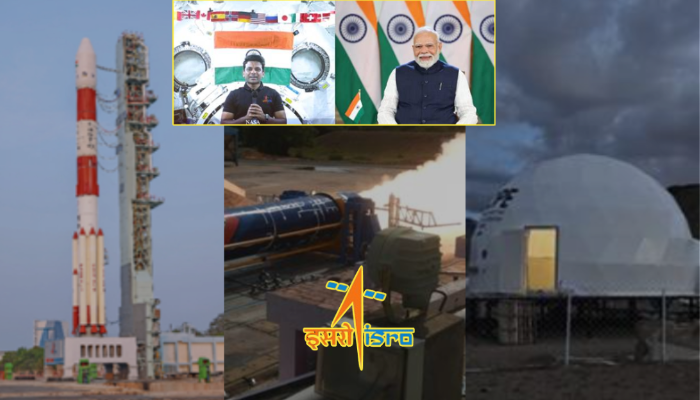
Shubhanshu Shukla, an ISRO astronaut, successfully completed the Axiom-04 mission and returned to Earth. This was a momentous occasion for the space agency and India. He spent 18 days aboard the International Space Station (ISS). The European Space Agency (ESA), National Aeronautics and Space Administration (NASA), Axiom Space and other international organisations collaborated to perform the mission on a SpaceX Dragon spacecraft on 25th June.

Shukla did an outstanding job of adjusting to the microgravity environment during his time on the International Space Station. He remained in excellent health during the journey despite the psychological and physical demands of spaceflight. He documented life and work in orbit with multiple images and videos.
He accomplished a series of seven microgravity experiments created by Indian scientific institutes under the supervision of the Human Space Flight Centre (HSFC). With the goal of improving knowledge of human spaceflight and microgravity science, these trials investigated muscle regeneration, algal development, crop viability, microbial survivability, cognitive performance in space and cyanobacteria behaviour.

Strong public outreach was part of the objective to inform India’s citizens and young people about its space achievements, outlining patriotism and inspiring the following generation. Shukla also spoke with Prime Minister Narendra Modi via live video conversation from the International Space Station on 28th June.
The latter conveyed the happiness of the country at seeing the Indian flag in orbit and commended his part in the country’s space journey. Millions of Indians watched the event, which turned into an important turning point for India’s space alliances.

Shukla also engaged with schoolchildren in Trivandrum and Lucknow on 3rd July. He answered multiple questions about life on the International Space Station and how to become an astronaut.
ISRO-STC Confluence 2025 at IIT Kharagpur
On 1st and 2nd July, the Indian Space Research Organisation and IIT-Kharagpur hosted the second ISRO-STC (Space Technology Cell) Confluence. Dr. V Narayanan inaugurated the event and issued the ISRO-STC Confluence Proceedings in the presence of ISRO’s Scientific Secretary and Director of IIT-Kharagpur.

It is an extensive compilation of certain research projects from the nine Space Technology Cells (STCs) that ISRO established in the nation’s top universities. These initiatives have proved considerable technological value and have directly impacted numerous ISRO missions in areas including as spacecraft systems, propulsion, sensors, materials and AI applications.
Department of Space hosts Chintan Shivir for Space Vision 2047 and beyond
The Department of Space (DoS) arranged a three-day workshop, “Chintan Shivir 2025,” from 16th to 18th July, in accordance with the directive of PM Modi. The aim was to push the strategies, action plans, milestones and more, for achieving the goals laid out in Space Vision 2047 alongside evolving space vision beyond that year. The theme, “Implementing Space Vision 2047 and Looking Beyond,” was in line with that objective.

Experts from ISRO, NewSpace India Limited (NSIL), Indian National Space Promotion and Authorisation Centre (IN-SPACe), DoS and other independent DoS institutes came together for the workshop and sketch out a comprehensive roadmap for DoS. Eleven key domains, space transportation, space infrastructure, space applications, human space exploration, supporting Indian space industries and space business were the focus of the deliberations.
NISAR Mission: Historic growth in Indo-US space partnership
On 30th July, ISRO’s GSLV-F16 launched NASA-ISRO Synthetic Aperture Radar (NISAR), the first joint satellite of ISRO and NASA, from Satish Dhawan Space Centre (SDSC SHAR) in Sriharikota. Weighing 2392 kilograms, NISAR is a special earth observation satellite that was the first to use a dual frequency Synthetic Aperture Radar (NASA’s L-band and ISRO’s S-band) to study the planet.
NASA’s 12 metre unfurlable mesh reflector antenna was fitted onto ISRO’s modified I-3K satellite bus or the INSAT 3000. For the first time, NISAR deployed SweepSAR (Swept Synthetic Aperture Radar) technology to observe Earth with a 242-kilometre swath and high spatial resolution.

The launch was the culmination of over a decade of close technical partnership between ISRO and NASA/JPL (Jet Propulsion Laboratory) technical teams.
The satellite allows for a multitude of uses by scanning the entire planet and providing all-weather, day and night data at 12-day intervals. Even minute alterations in the Earth’s surface, consisting of vegetation dynamics, ice sheet movement and ground deformation, can be detected by NISAR.

Sea ice classification, ship detection, coastline monitoring, storm characterisation, changes in soil moisture, surface water resource mapping and monitoring, as well as disaster response are its additional applications.
ISRO’s Space Analogue Mission in Ladakh
The goal of the Indian Human Spaceflight Programme, a national initiative headed by ISRO, is to increase human presence across the solar system by accomplishing an Indian Crewed Lunar Landing by 2040 and commencing with human spaceflight flights to Low Earth Orbit (LEO).
This necessitates conducting systematic studies to collect the essential Indian subject data for tackling the many physiological, psychological and operational issues associated with human space flight missions. Hence, ground-based analogue missions in environments that mimic some characteristics of a normal human space mission offer a chance to comprehend the hazards to human performance and health.
This project is headed by ISRO’s Human Space Flight Centre (HSFC) for the organisation’s future human space missions. The HSFC team led the Ladakh Human Analogue Mission (LHAM) in November 2024. It worked on the recently completed ten-day Isolation Study “Anugami” with ISRO’s Gaganyatri in July. The Himalayan Outpost for Planetary Exploration (HOPE) analogue mission setup in Tso Kar Valley of Ladakh was officially opened on 31st July by Dr. V Narayanan, in line with this effort.

HOPE is a specially constructed 8-meter-diameter habitat module for crew housing and a 5-meter-diameter utility module for operations and support systems, both of which are coupled for smooth operation. The Tso Kar Valley was chosen especially for this analogue expedition because of its extraordinary environmental similarities to early Mars, including saline permafrost, intense UV flux, low air pressure and extreme cold.
An industrial partner arranged the 10-day analogue mission featuring the selected experiments from collaborating national institutions, including the Institute for Aerospace Medicine in Bangalore, Indian Institute of Space Science and Technology (IIST) and Rajiv Gandhi Centre for Biotechnology (RGCB) in Trivandrum, IIT Hyderabad and IIT Bombay.
These researchers investigated the epigenetic, genomic, physiological and psychological reactions of two analogue mission crew members. They also evaluated health-monitoring protocols, improved planetary surface operations, and refined sample collection and microbiological analysis methodologies.
The extensive data acquired would serve as the foundation for the creation of protocols and infrastructure for future Indian Human Exploration Missions. It would also offer critical insights into technology performance, crew procedures and environmental adaptation.
Successful static test of KALAM 1200
On 8th August, SDSC SHAR of ISRO successfully completed the first static test of the KALAM 1200 Motor, the first stage of the Vikram-1 Launch Vehicle of M/s Skyroot Aerospace Private Limited (SAPL). This is an important moment in the setup and implementation of the systems for the Vikram 1 Launch Vehicle.

The motor has a propellant mass of 30t and is a monolithic composite motor measuring 11 metres in length and 1.7 metres in diameter. This longest monolithic motor is made at the Solid Propellant Plant in Sriharikota in response to design feedback. The design for the Test Stand, which is utilised for the motor’s static test, was also supplied by the ISRO team.
This is consistent with the Government of India’s Space Policy 2023 program, which seeks to present private sector participants with the technical infrastructure and managerial direction needed to support the expansion of the space economy. As anticipated, the test bed and related systems are operating normally.
Bharat Mandapam organises National Meet and National Space Day
ISRO held the National Meet (NM) 2.0 at the Bharat Mandapam in New Delhi on 22nd August, which coincided with the Second National Space Day celebrations. “Leveraging Space Technology and Applications for Viksit Bharat 2047,” served as the theme and provided an essential forum for bringing together many stakeholders, including ministries, state governments, businesses, startups, academia and space enthusiasts.

The unveiling of an exhibition that represented ideas from startups, academic institutions and business followed the NM 2.0, which emphasised the role of space in national growth.

“Aryabhatta to Gaganyaan: Ancient Wisdom to Infinite Possibilities” was the subject of the magnificent and proud celebration of the second National Space Day 2025 at Bharat Mandapam in New Delhi on 23rd August.
Foundation stone for Launch Pad at SSLV Launch Complex
The SSLV Launch Complex is under construction as a specialised launch facility in Kulasekarapattinam, Tuticorin or Thoothukudi district in Tamil Nadu, to accommodate the nation’s escalating launch requirements, mainly for SSLV launches and Non-Governmental Enterprises (NGEs). The foundation stone was placed by PM Modi on 28th February 2024 from Tuticorin. Afterward, 32 of the 33 main facilities are being built. Dr. V. Narayanan did the groundbreaking ceremony for the Launch Pad at the SSLV Launch Complex (SLC) on 27th August.

SLC has launch pad and rail track systems, range systems, checkout systems, telemetry and tele-command systems, safety and firefighting facilities, stage preparation and vehicle integration buildings and basic civic amenities.

The Mobile Launch Structure (MLS), bogies, platforms, doors, Jet Deflection Duct, and vibration isolation systems are among the major systems that have been internally created. Large-scale systems like telemetry, telecommand and radars are being developed in the nation and put into service through industry cooperation.
MPTTF and ITPF facility openings at LPSC/ISRO
On 3rd September Liquid Propulsion Systems Centre (LPSC)/ISRO opened the Integrated Titanium Alloy Propellant Tank Production Facility (ITPF) and Monopropellant Thruster Test Facility (MPTTF) at Tumakuru, Karnataka. The purpose of MPTTF is to qualify, accept, and assess the performance of monopropellant hydrazine thrusters, which are crucial for maintaining orbit and controlling attitude in satellites, spacecraft and launch vehicles.
ITPF is a cutting-edge facility that specialises in producing lightweight titanium alloy propellant tanks, including propellant management devices for microgravity operations, for spacecraft and PSLV’s PS4 stage. The facility offers advanced techniques such as electron beam welding, precision machining, non-destructive testing, and cleanroom assembly to cater to the greater need for ISRO missions.
Small Satellite Launch Vehicle (SSLV) Technology Transfer Agreement
On 10th September, NewSpace India Limited, ISRO, IN-SPACe and Hindustan Aeronautics Limited (HAL) inked a technology transfer agreement to transfer the Small Satellite Launch Vehicle (SSLV) technology at Bengaluru’s ISRO Headquarters.
Satellites up to 500 kilograms in weight can be launched into Lower Earth Orbit (LEO) using the SSLV, a three-stage all-solid vehicle. ISRO created SSLV as a fast turnaround, on-demand launch vehicle that can be produced industrially and is intended to serve the worldwide market for small satellite launch vehicles. For inclined launches, it can be launched from Sriharikota or from the upcoming new launch site at Kulasekarapattinam for polar launches.

The Modi government’s recommended space-sector reforms have made it possible for the SSLV Technology Transfer Agreement. It is anticipated that the successful commercialisation of SSLV would contribute to the Indian space ecosystem and satisfy the need for small satellite launch services both domestically and internationally.
India presents space accomplishments at Sydney’s IAC 2025
India’s contribution to international space pursuits was emphasised at the 76th International Astronautical Congress (IAC 2025), which was held in Sydney from 29th September to 3rd October. The India Space Pavilion, created by ISRO and IN-SPACe, showcased 60 years of the nation’s space journey, from groundbreaking missions like Chandrayaan and Aditya L1 to ambitious future initiatives like Gaganyaan and the projected Bharatiya Antariksh Station.

These displays reflected India’s ongoing quest for space technology innovation and excellence. 18 Indian space enterprises and showed off their products and accomplishments as part of the Indian Space Pavilion. As part of IAC-2025, 5 Indian startups and space businesses set up standalone promotional pavilions.
CMS-03 communication satellite successfully launched by LVM3 launch vehicle
On 2nd November, the CMS-03 communication satellite was successfully launched by the LVM3 launch vehicle in its fifth operational flight (LVM3-M5). A broad oceanic region, including the Indian mainland, is covered by the multi-band communication satellite. It weighs around 4400 kilogram and is the heaviest communication satellite to ever take off from Indian land into Geosynchronous Transfer Orbit (GTO).
C25 Cryogenic Stage demonstration restart in LVM3-M5 Mission
Powered by the CE-20 engine, the LVM3-M5 mission accomplished the first-ever in-space restart of its locally sourced C25 cryogenic upper stage. Future LVM3 missions are going to be able to deploy satellites into different orbits in a single mission because of to this vital feature which enhances mission flexibility. The primary satellite, CMS-03 was successfully launched into its assigned orbit prior to the restart.
PRL/ISRO finds a new exoplanet
A new exoplanet, TOI-6038A b, a dense sub-Saturn with a mass of 78.5 Earth masses and a radius of 6.41 Earth radii in a broad binary system, hab been found by researchers at the Physical Research Laboratory (PRL), Ahmedabad. The planet revolves around a brilliant and metal-rich F-type star in a circle every 5.83 days.
The TOI-6038A b offers a rare opportunity to research planetary creation and evolution. It is not present in our solar system and is located in the Sub-Saturn category between Neptune-like and gas giant exoplanets.

This is the second finding of an exoplanet. The cutting-edge PARAS-2 spectrograph, mounted on a 2.5-meter telescope at PRL’s Mount Abu Observatory in Gurushikhar made the discovery. Moreover, it is the fifth exoplanet to be identified by the joint use of the PARAS-1 and PARAS-2 spectrographs. The PARAS-2 spectrograph, the highest-resolution stabilised radial velocity (RV) spectrograph in Asia, points to India’s expanding proficiency in cutting-edge astronomical instrumentation.
Memorandum of Understanding for space medicine collaboration
The Framework Memorandum of Understanding on Cooperation in Space Medicine was signed by the Indian Space Research Organisation (ISRO), Department of Space (DoS) and Sree Chitra Tirunal Institute for Medical Sciences & Technology (SCTIMST), Department of Science & Technology (DST). This represents a landmark event in the development of space medicine and its uses in the nation.
The Indian Human Space Program, Gaganyaan, is a national initiative of ISRO that provides a special opportunity in the areas of human health research, microgravity research, space medicine and space biology to many national agencies, academia and business. The national human space program would gain from cooperation in the specialised field of space medicine as a result of this framework Memorandum of Understanding between ISRO and SCTIMST.

Human physiological studies, behavioural health studies, biomedical support systems, radiation biology and medicine, countermeasures for enhancing human health and performance in space environments, telemedicine and communication protocols and crew medical kits for space missions would reap the rewards of these innovations and breakthroughs. The opportunities for research and experimentation would be made possible by the project, particularly in the area of space medicine.
Conclusion
The growth of the Indian space program, which has successfully positioned India’s flag on the southern side of the moon and aims to send humans to Earth’s natural satellite, is indeed a heartwarming story of dedication and commitment. The diverse achievements in multiple areas, including wheat production and space biological experiment, further illustrated the profound and evolving technological competence and ability of India and its space agency.
ISRO has come a very long way from its days of carrying rockets on bicycles. This year has also seen multiple significant achievements along with several crucial firsts and with the current momentum, the next year is likely to be even more eventful for India and its ambitious space ventures.