Bareilly violence accused Rihan’s bail rejected: Read what Allahabad HC said on the Sar Tan Se Juda slogan by Islamists and its threat to sovereignty of India
On 17th December (Wednesday) the Allahabad High Court pronounced a landmark judgement regarding the slogan “gustakh-e-nabi ki ek saja, sar tan se juda, sar tan se juda (the only punishment for insult to prophet is beheading),” during the bail hearing of Bareilly violence accused named Rihan. The case pertains to the violence amid “I love Muhammad” row. Justice Arun Kumar Singh Deshwal stated that the slogan undermines India’s sovereignty, integrity and legal authority. The plea for bail was also rejected. OpIndia has a copy of the order. Rihan had been booked under sections 109(1), 109(2), 118(2), 121(1), 189(5), 191(2), 191(3), 195(1), 196(1), 196(2), 223, 310(2), 324(5), 324(6), 61(2), 62 BNS, 7 Criminal Law Amendment Act and Section 3/4 Prevention of Damage of Public Property Act. The applicant’s lawyer alleged that he “has been falsely implicated and he was arrested from his home, but the police falsely claimed his arrest from the spot.” He added, “Rihan has no criminal history and there is no incriminating material against him. Therefore, he is entitled to be released on bail during the investigation/trial.” However, the prosecution led by Additional Advocate General for the State of Uttar Pradesh, Anoop Trivedi fiercely objected to the prayer and maintained that the actions of Rihan and the other co-accused were against the state, the unity and integrity of India and religious communities. It was argued that the use of the slogans “gustakh-e-nabi ki ek saja sar tan se juda, sar tan se juda” demonstrated their disdain for the Indian legal system, since insult to any God or prominent figures of any religion is criminalised in Bharatiya Nyaya Sanhita (BNS) through appropriate punishment. “There is no such punishment for beheading a person who disrespects the God or Nabi of any religion,” the prosecution added. As a result, such a conduct carries penalties not only under section 152 of the BNS, but also under other sections of the BNS. The prosecution mentioned that the individuals involved, including the applicant, threatened India’s sovereignty and integrity by shouting the aforementioned slogans and destroying public and private property. Allahabad High Court’s decision The high court noted that the role of Maulana Taukir Raza, Nadeem Khan and the 500 people who assembled in Biharipur area and raised slogans against the state alongside the controversial “gustakh-e-nabi ki ek saja, sar tan se juda, sar tan se juda” was “not in dispute.” It also acknowledged that violence was carried out due to the inflammatory remarks of Maulana Taukir Raza. According to BNS 299 and 196, blasphemy and disparaging any faith or God are crimes. Additionally, section 302 of the BNS stipulates that anyone who intentionally uses a word to offend someone’s religious feelings would be punished. Sections 298, 299 and 302 BNS are the pertinent sections of Chapter XVI of the BNS, which contains violations pertaining to religion. The court specifically emphasised the particular provisions and the penalties imposed on the convicts of such actions. It observed, “From the perusal of the above section, it is clear that BNS has taken care of all such situations where any person disrespects any religion or its God, Prophet, Guru or attempts to promote enmity between the religious groups by chanting any slogan or visible representation, then appropriate punishment has also been provided.” The court held that using the slogan is tantamount to subverting India’s integrity and sovereignty as well as the country’s legal system, which is founded on serious constitutional goals and democratic ideals. The genocidal slogan is a challenge to Constitution and legal system “The Constitution of India provides freedom of speech and expression as well as other liberties to all Indian citizens irrespective of their caste, creed or religion. Therefore, if a person, instead of respecting the law framed under the Indian constitution, attempts to challenge the law or promotes or incites people to commit an offence in the garb of providing punishment, though the same is not provided in the criminal law then that should be dealt with strictly,” the order read. The court outlined that Article 19 of the Indian Constitution guarantees the freedom of speech and expression as well as the right to assemble. However, Article 19(2) of the Indian Constitution places restrictions on these rights. Thus, any slogan that calls for murder in contrast to the proper punishment stipulated by the BNS or other criminal laws is not only contrary to the constitutional intent but also contests the legitimacy of the Indian legal system and is punishable under section 152 BNS. The judge highlighted slogans from various faiths, such as “Jai Shree Ram,” “Har Har Mahadev,” “Jo bole so nihaal, Sat Sri Akal,” and even “Nara-e-Takbir Allahu Akbar,” to show that these calls to devotion or proclamation uttered by an individual or a
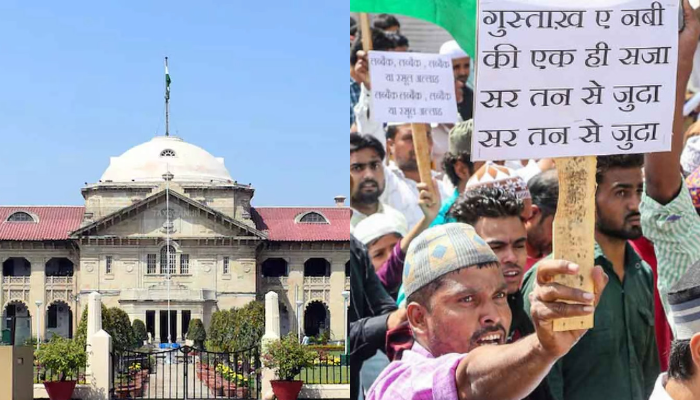

On 17th December (Wednesday) the Allahabad High Court pronounced a landmark judgement regarding the slogan “gustakh-e-nabi ki ek saja, sar tan se juda, sar tan se juda (the only punishment for insult to prophet is beheading),” during the bail hearing of Bareilly violence accused named Rihan. The case pertains to the violence amid “I love Muhammad” row.
Justice Arun Kumar Singh Deshwal stated that the slogan undermines India’s sovereignty, integrity and legal authority. The plea for bail was also rejected. OpIndia has a copy of the order.
Rihan had been booked under sections 109(1), 109(2), 118(2), 121(1), 189(5), 191(2), 191(3), 195(1), 196(1), 196(2), 223, 310(2), 324(5), 324(6), 61(2), 62 BNS, 7 Criminal Law Amendment Act and Section 3/4 Prevention of Damage of Public Property Act.
The applicant’s lawyer alleged that he “has been falsely implicated and he was arrested from his home, but the police falsely claimed his arrest from the spot.” He added, “Rihan has no criminal history and there is no incriminating material against him. Therefore, he is entitled to be released on bail during the investigation/trial.”
However, the prosecution led by Additional Advocate General for the State of Uttar Pradesh, Anoop Trivedi fiercely objected to the prayer and maintained that the actions of Rihan and the other co-accused were against the state, the unity and integrity of India and religious communities.

It was argued that the use of the slogans “gustakh-e-nabi ki ek saja sar tan se juda, sar tan se juda” demonstrated their disdain for the Indian legal system, since insult to any God or prominent figures of any religion is criminalised in Bharatiya Nyaya Sanhita (BNS) through appropriate punishment. “There is no such punishment for beheading a person who disrespects the God or Nabi of any religion,” the prosecution added.
As a result, such a conduct carries penalties not only under section 152 of the BNS, but also under other sections of the BNS. The prosecution mentioned that the individuals involved, including the applicant, threatened India’s sovereignty and integrity by shouting the aforementioned slogans and destroying public and private property.
Allahabad High Court’s decision
The high court noted that the role of Maulana Taukir Raza, Nadeem Khan and the 500 people who assembled in Biharipur area and raised slogans against the state alongside the controversial “gustakh-e-nabi ki ek saja, sar tan se juda, sar tan se juda” was “not in dispute.” It also acknowledged that violence was carried out due to the inflammatory remarks of Maulana Taukir Raza.
According to BNS 299 and 196, blasphemy and disparaging any faith or God are crimes. Additionally, section 302 of the BNS stipulates that anyone who intentionally uses a word to offend someone’s religious feelings would be punished. Sections 298, 299 and 302 BNS are the pertinent sections of Chapter XVI of the BNS, which contains violations pertaining to religion.

The court specifically emphasised the particular provisions and the penalties imposed on the convicts of such actions. It observed, “From the perusal of the above section, it is clear that BNS has taken care of all such situations where any person disrespects any religion or its God, Prophet, Guru or attempts to promote enmity between the religious groups by chanting any slogan or visible representation, then appropriate punishment has also been provided.”
The court held that using the slogan is tantamount to subverting India’s integrity and sovereignty as well as the country’s legal system, which is founded on serious constitutional goals and democratic ideals.
The genocidal slogan is a challenge to Constitution and legal system
“The Constitution of India provides freedom of speech and expression as well as other liberties to all Indian citizens irrespective of their caste, creed or religion. Therefore, if a person, instead of respecting the law framed under the Indian constitution, attempts to challenge the law or promotes or incites people to commit an offence in the garb of providing punishment, though the same is not provided in the criminal law then that should be dealt with strictly,” the order read.

The court outlined that Article 19 of the Indian Constitution guarantees the freedom of speech and expression as well as the right to assemble. However, Article 19(2) of the Indian Constitution places restrictions on these rights. Thus, any slogan that calls for murder in contrast to the proper punishment stipulated by the BNS or other criminal laws is not only contrary to the constitutional intent but also contests the legitimacy of the Indian legal system and is punishable under section 152 BNS.
The judge highlighted slogans from various faiths, such as “Jai Shree Ram,” “Har Har Mahadev,” “Jo bole so nihaal, Sat Sri Akal,” and even “Nara-e-Takbir Allahu Akbar,” to show that these calls to devotion or proclamation uttered by an individual or a group of people are not illegal unless they are employed vilely to intimidate adherent of a different religion.

He stated that the phrase “gustakh-e-nabi ki ek saja sar tan se juda, sar tan se juda” does not appear in the Quran or any other Muslim holy scripture, but is often used by the community who is unaware of its true meaning and consequences.
Origin of “gustakh-e-nabi ki ek saja”
The Allahabad High Court pointed out that the blasphemy law was established by the British in 1927 in response to the communal strife between Hindus and Muslims. It conveyed how the blasphemy laws in Pakistan were turned harsher after the partition and recounted the accusations against Christian woman Asia Bibi, which received international attention.
The court mentioned that the Governor of Punjab, late Salman Taseer’s support to her sparked unrest in the nation and led to the emergence of the notorious slogan. Taseer was killed by his bodyguard while extremists took to the streets under the guidance of Islamist Tehreek-e-Labbaik Pakistan‘s (TLP) late supremo Khadim Hussain Rizvi.

The order revealed that the Pakistani hardliner Rizvi was the one to use the slogan for the first time “and thereafter this slogan also spread to other countries including India and has been widely misused by certain Muslims just to intimidate the people of other religions and also to challenge the authority of the state.” The court reiterated that the slogan widely heard in the streets of India “is nothing but used to challenge the authority of law and sovereignty of India and also to incite people for armed rebellion.”
The court referenced the life of Prophet Muhammad to illustrate instances of kindness that the prophet reportedly showed towards his neighbours and repeated that it was evident that the slogan “gustakh-e-nabi ki ek saja, sar tan se juda, sar tan se juda” raised by an individual or by a crowd questions the authority of the law as well as the sovereignty and integrity of India because it encourages armed rebellion. Hence, this act would be penalised under section 152 BNS.
Judge rejects the bail application
The court confirmed that “it is not in dispute that such a disputed or objectionable slogan was used by the crowd of thousands of people assembled at the instigation of Maulana Taukir Raza.” It also affirmed the criminal conduct of Maulana Taukir Raza and the Islamist throng despite the police’s objections along with the violence directed at cops which prompted the arrests of several perpetrators including Rihan.
The judge emphasised, “There is sufficient material in the case diary showing that the applicant was part of an unlawful assembly which not only raised objectionable slogans challenging the authority of the Indian legal system but also caused injuries to police personnel and damaged public as well as private property, which is nothing but an offence against the state and he was arrested from the spot. Therefore, this court does not find any ground to release the applicant on bail.”
He further concluded, “Accordingly, the bail application of the applicant is rejected.”
Background of the case
The prosecution informed that on 26th May, a formal complaint was lodged charging that Maulana Taukir Raza Khan, President of the Ittefaq Minnat Council, had called on the Muslim community to gather at Islamia Inter College in order to protest the state’s atrocities and alleged false charges against Muslim youth. On 25th September, police were informed that Raza and Nadeem Khan, one of the INC’s leaders, had encouraged members of the Muslim community to gather on Islamia Inter College grounds following the conclusion of namaz on 26th September.
Police asked the crowd not to proceed. Furthermore, section 163 Bharatiya Nagarik Suraksha Sanhita (BNSS), which forbids any gathering of more than five people was also implemented in the district. Afterward, the first informant, who was stationed close to Nadeem Khan’s home in Biharipur, discovered that he had encouraged people to gather and head for Islamia Inter College. A mob emerged from Nadeem Khan’s home as well.

He also exited the place to provoke people elsewhere. It was then discovered that 500 people gathered in Biharipur and began shouting slogans against the government and “gustakh-e-nabi ki ek saja sar tan se juda, sar tan se juda.” Police attempted to stop them, but they started snatching their canes and ripping off their uniforms.
When the cops objected, the mob hurled petrol bombs, fired shots and threw stones which injured many personnel and damaged several police personnel along with private vehicles. Seven people, including Rihan, were immediately taken into custody. The names of other people, consisting of the primary suspects, Maulana Taukir Raza and Nadeem Khan, emerged based on their accounts.
An FIR (First Information Report) was filed against 25 named and 1700 unknown individuals in line with the statements of these detainees and the identification of other co-accused. Police then captured other named suspects and identified anonymous persons according to evidence gathered from the held individuals, independent witnesses and CCTV footage.
The real-life effects of the radical slogan
Multiple occurrences, such as the shocking beheading of Kanhaiya Lal and the murder of Kamlesh Tiwari, whose throat was slit by two Islamist fanatics, highlight the fact that “gustakh-e-nabi ki ek saja, sar tan se juda, sar tan se juda” constitutes a real threat to the lives of non-Muslims, especially Hindus. Multiple Hindu leaders, including former Bharatiya Janata Party leader Nupur Sharma and Yati Narsighanand Saraswati of the Dasna Devi Temple, have faced similar threats over accusations of showing ‘disrespect’ towards the Prophet of Islam.
Essentially, a target is placed on the back of anyone regarded as a blasphemer, regardless of the truth. This slogan not only stir up violence directly but, as the order rightly indicated, is a serious threat to India’s Constitution and legal system. It also exemplifies how Muslims in Pakistan target their shrinking minorities, particularly Hindus, while similar actions are being attempted in India by Muslim fundamentalists.