Ethanol Factory row in Rajasthan’s Hanumangarh: Farmers’ mahapanchayat triggers new political and environmental tensions
Massive protests were witnessed in the Hanumangarh district of the Rajasthan state on Wednesday, 17th December, where a large gathering of farmers was witnessed during the mahapanchayat that has been organised against the biggest ethanol production facility in Asia. The protest that took place at the Junction Dhan Mandi has caused quite a stir in the region, where the farmers have raised vocal slogans such as “Factory band karo,Kisan Bachao.” #Hanumangarh इथेनॉल फैक्ट्री के विरोध से जुड़ा मामला, धान मंडी परिसर में किसानों की महापंचायत@HmghPolice @DmHanumangarh @Pradeepsuthar01 #LatestNews #RajasthanNews #RajasthanWithZee pic.twitter.com/YduAPzfXs5— ZEE Rajasthan (@zeerajasthan_) December 17, 2025 Although the meeting was relatively peaceful, there was a sense of tension present. The government, in anticipation of violence, continued with strict measures on the fourth day running, including the ban on the internet, imposition of Section 144, and a strong police presence in the district. At the root of this protest is the deep-seated fear of the farmers about this ethanol unit damaging their land and depleting their water resources and the future of the coming generations. At the same time, questions are being raised over whether the agitation is purely a local farmers’ issue or if political interests and external groups are fuelling the unrest, especially with the visible presence of farmer unions from neighbouring Punjab. Ethanol plant at the centre of the storm Tibbi, a part of the Hanumangarh area, has been renowned for its fertile land and an agriculture-based economy. The farmers of this area have been utilising the groundwater resources and canals for irrigation purposes and have been facing challenges associated with electricity shortages and decreasing levels of water. The issue started getting raised in the year 2023 when the then Congress party of the state chose a proposed ethanol plant project of the Punjab-based firm Dune Ethanol Private Limited for funding to the tune of ₹450 crores. The proposed plant was expected to manufacture ethanol using rice husks. This was supposed to create jobs, offer the farmer a fair price for farm waste, as well as conserve the environment through the promotion of ethanol as a cleaner fuel alternative to petrol. However, farmers did not believe these assurances. As per their claims, Hanumangarh is already experiencing drought-like conditions, as water levels in groundwaters have gone below 100 feet. They feel that this unit is also going to utilise water to the extent of 50 to 60 lakh liters every day. Besides water, pollution is another big issue here. According to farmers, harmful gases like methanol and carbon dioxide are also produced by emissions from the factory, which can cause respiratory and cancer-related problems. Even as environmental clearance has been given by the Pollution Control Board, natives argue that the EIA study has been done on paper, without taking into account realities on the ground. How the protests turned violent earlier this month This unrest has not broken out in a single day. On 10th December, a mahapanchayat was held at Tibbi, where farmers marched towards the plant site in anger. This time, the situation got heated with machines vandalised, vehicles set on fire. The police unleashed a lathi charge on the protesters, resulting in at least 16 farmers being injured, while 40 protesters were arrested. This incident has led to tension among the farm community. Following this, there were negotiations between the government and farm union representatives on 12th December. A deal was struck regarding the formation of a committee to look into their grievances, and, subsequently, a pause in the construction activities at the spot. However, farm unions, particularly the Samyukt Kisan Morcha, labelled this attempt as an “eyewash” and said that only a complete withdrawal of their project would assuage their anger. However, this unsettled anger ultimately resulted in the huge mahapanchayat on Wednesday, 17th December. Mahapanchayat Day: Calm on the surface, tension beneath The mahapanchayat started around 12 pm on Wednesday, 17th December at Junction Dhan Mandi. From early morning, long lines of tractors could be seen entering the town, though authorities imposed restrictions on tractor movement to maintain order. Security was tight. Internet services remained suspended, drones hovered over the area, Section 144 was in force, and senior officials, including District Collector Khushal Yadav, were present on the ground. Despite the heavy security presence, farmers maintained discipline, and no violent incidents were reported. Addressing the crowd, former MLA Balwan Poonia of the Communist Party accused the government of signing an MoU with the company without consulting farmers. “We will not step back until the MoU is cancelled,” he declared. Farmer leaders from Punjab also took the stage, warn
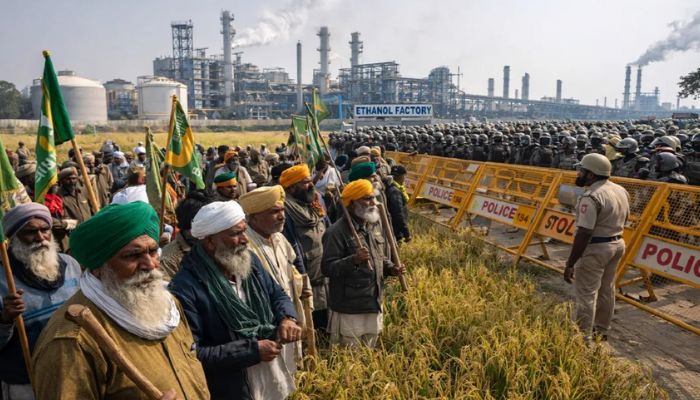

Massive protests were witnessed in the Hanumangarh district of the Rajasthan state on Wednesday, 17th December, where a large gathering of farmers was witnessed during the mahapanchayat that has been organised against the biggest ethanol production facility in Asia. The protest that took place at the Junction Dhan Mandi has caused quite a stir in the region, where the farmers have raised vocal slogans such as “Factory band karo,Kisan Bachao.”
#Hanumangarh इथेनॉल फैक्ट्री के विरोध से जुड़ा मामला, धान मंडी परिसर में किसानों की महापंचायत@HmghPolice @DmHanumangarh @Pradeepsuthar01 #LatestNews #RajasthanNews #RajasthanWithZee pic.twitter.com/YduAPzfXs5
— ZEE Rajasthan (@zeerajasthan_) December 17, 2025
Although the meeting was relatively peaceful, there was a sense of tension present. The government, in anticipation of violence, continued with strict measures on the fourth day running, including the ban on the internet, imposition of Section 144, and a strong police presence in the district.
At the root of this protest is the deep-seated fear of the farmers about this ethanol unit damaging their land and depleting their water resources and the future of the coming generations. At the same time, questions are being raised over whether the agitation is purely a local farmers’ issue or if political interests and external groups are fuelling the unrest, especially with the visible presence of farmer unions from neighbouring Punjab.
Ethanol plant at the centre of the storm
Tibbi, a part of the Hanumangarh area, has been renowned for its fertile land and an agriculture-based economy. The farmers of this area have been utilising the groundwater resources and canals for irrigation purposes and have been facing challenges associated with electricity shortages and decreasing levels of water. The issue started getting raised in the year 2023 when the then Congress party of the state chose a proposed ethanol plant project of the Punjab-based firm Dune Ethanol Private Limited for funding to the tune of ₹450 crores.
The proposed plant was expected to manufacture ethanol using rice husks. This was supposed to create jobs, offer the farmer a fair price for farm waste, as well as conserve the environment through the promotion of ethanol as a cleaner fuel alternative to petrol.
However, farmers did not believe these assurances. As per their claims, Hanumangarh is already experiencing drought-like conditions, as water levels in groundwaters have gone below 100 feet. They feel that this unit is also going to utilise water to the extent of 50 to 60 lakh liters every day.
Besides water, pollution is another big issue here. According to farmers, harmful gases like methanol and carbon dioxide are also produced by emissions from the factory, which can cause respiratory and cancer-related problems. Even as environmental clearance has been given by the Pollution Control Board, natives argue that the EIA study has been done on paper, without taking into account realities on the ground.
How the protests turned violent earlier this month
This unrest has not broken out in a single day. On 10th December, a mahapanchayat was held at Tibbi, where farmers marched towards the plant site in anger. This time, the situation got heated with machines vandalised, vehicles set on fire. The police unleashed a lathi charge on the protesters, resulting in at least 16 farmers being injured, while 40 protesters were arrested. This incident has led to tension among the farm community.
Following this, there were negotiations between the government and farm union representatives on 12th December. A deal was struck regarding the formation of a committee to look into their grievances, and, subsequently, a pause in the construction activities at the spot. However, farm unions, particularly the Samyukt Kisan Morcha, labelled this attempt as an “eyewash” and said that only a complete withdrawal of their project would assuage their anger.
However, this unsettled anger ultimately resulted in the huge mahapanchayat on Wednesday, 17th December.
Mahapanchayat Day: Calm on the surface, tension beneath
The mahapanchayat started around 12 pm on Wednesday, 17th December at Junction Dhan Mandi. From early morning, long lines of tractors could be seen entering the town, though authorities imposed restrictions on tractor movement to maintain order.
Security was tight. Internet services remained suspended, drones hovered over the area, Section 144 was in force, and senior officials, including District Collector Khushal Yadav, were present on the ground. Despite the heavy security presence, farmers maintained discipline, and no violent incidents were reported.
Addressing the crowd, former MLA Balwan Poonia of the Communist Party accused the government of signing an MoU with the company without consulting farmers. “We will not step back until the MoU is cancelled,” he declared.
Farmer leaders from Punjab also took the stage, warning that if the factory is allowed to operate, protests would spread beyond Rajasthan. “This is not just Rajasthan’s issue, it is a national’ issue,” one Punjab-based leader said, drawing parallels with the 2020–21 farmers’ agitation.
However, some local farmers expressed discomfort with the growing involvement of outsiders, saying they only wanted to protect their land and livelihoods, not turn the issue into a national political movement.
Farmers place three clear demands before the administration
During the mahapanchayat, officials held discussions with farmer representatives. The protesters placed three key demands before the administration: immediate cancellation of the MoU signed with the ethanol company, withdrawal of all cases filed against farmers during the protests, and the formation of a genuinely impartial investigation committee.
The administration assured farmers that their demands would be conveyed to the state government. Farmers, however, gave a clear deadline of 20 days and announced another mahapanchayat on 7th January in Sangaria if their demands remain unmet.
“We will continue our protest peacefully, but we will not surrender,” said a farmer. “The government must understand that farmers are not weak.”
Political blame game comes to the fore
Politics has become deeply intertwined with the movement. Critics point out that it was the Congress government that approved the ethanol project in 2023, yet now Congress leaders are among the loudest voices opposing it. Congress MLA from Sangaria, Abhimanyu Poonia, accused the BJP-led state government of favouring corporates over farmers. “Lathi charges and arrests show the government’s true face,” he said at a press conference.
Interestingly, FIRs related to the 10th December violence also name Congress MPs and MLAs. Balwan Poonia dismissed the allegations, calling the violence a “government conspiracy” to defame the movement. The BJP, on the other hand, accuses the Congress of hypocrisy and instigating unrest for political mileage.
Punjab’s role raised eyebrows, old memories return
The involvement of farmer groups from Punjab has added another layer of complexity. Leaders from the Bharatiya Kisan Union and the Samyukt Kisan Morcha arrived in large numbers, reviving slogans and rhetoric from the 2020-21 farmers’ protest.
“If farmers lose in Rajasthan, Punjab will also rise,” warned a Punjab-based leader. Others spoke of cross-border solidarity among farmers. However, many locals remain sceptical. “These people look like professional protesters,” said an elderly farmer. “They come, ignite the fire, and leave. We are the ones who suffer.”
Administration sets up committee, situation temporarily calms
In response to mounting pressure, the administration formed a five-member committee led by the divisional commissioner, with the district collector and subject experts as members. The committee will examine issues related to groundwater depletion, pollution, and water availability. Construction work at the factory site will remain halted until the committee submits its report.
Still, farmer leaders remain cautious. “A committee is fine, but unless the MoU is cancelled, we will not stop,” said one leader, adding that preparations for the 7th January mahapanchayat are already underway.