Osman Hadi was killed by fellow Bangladeshis, yet India was relentlessly demonised: How anti-Hindu hysteria fuels Islamist mobilisation like nothing else
Bangladesh has escalated its efforts to address the murder of anti-India Islamist Sharif Osman bin Hadi. Faisal Karim Masud has been identified as the primary accused, and a nationwide look-out notice has been issued for him and other attackers. A travel ban has also been put in place as violent protests persist to take hold around the nation, particularly targeting the marginalised Hindu community. On 21st December (Sunday), a Dhaka court prohibited Masud from departing the nation. The authorities believe that he continues to live in Bangladesh, although he moves around often to avoid being apprehended. Several investigation teams have been sent out, and surveillance has increased to monitor his whereabouts. Another accused, Mohammad Alamgir Sheilkh, was riding the motorbike as Masud fired the bullets at close range. Earlier reports claimed that with the aid of a human trafficking network, the two allegedly fled via a secluded border path in Haluaghat of the Mymensingh district and into Meghalaya. However, the authorities confirmed that the claims lacked considerable substantiation. According to Additional Inspector General of Police Khandaker Rafiqul Islam, there was no established proof that Masud left Bangladesh. He outlined, “We have not received any reliable information indicating that he has crossed the border.” The senior official even warned that suspects frequently disseminate false information. Meanwhile, police and border forces detained four people who are purportedly implicated in the accused’s escape. Who is Faisal Karim Masud 32-year-old Sharif Osman Hadi, the spokesperson for Inqilab Moncho, was shot on 12th December by masked assailants and died in Singapore on 18th December after he was taken there for medical treatment. Afterwards, Faisal Karim Masud emerged as the main accused in the case. The investigations unveiled that he was a former leader of the Chhatra League. It is the student branch of the now-banned Bangladesh Awami League, which is the political party of the former prime minister Sheikh Hasina. A journalist from Bangladesh claimed, “Faisal Masud joined Hadi’s campaign with the intention of killing him,” while talking to the Telegraph. He added, “Law enforcement agencies have detained several people, including Faisal’s parents, wife, and girlfriend, but have so far failed to arrest the accused.” According to reports, he had actively participated in the election campaign together with Alamgir. The authorities mentioned that Masud already informed his girlfriend that something would “shake entire Bangladesh.” He had conveyed, “Something will happen tomorrow that the whole country will tremble,” to her the night before the incident. Masud was on the ground in July with leaders and activists of the Awami League and its affiliated groups to quell last year’s agitation, according to a Prothom Alo article. The inquiries have disclosed that he had earlier been imprisoned in relation to an armed robbery at a school in Dhaka that resulted in the theft of 1.7 million taka and the recovery of a foreign-made pistol. He was later freed, which has further enraged the protesters at present. Masud listed himself as the proprietor of three businesses,s including Apple Soft IT, YCU Technology and Enlist Work on his LinkedIn profile. He earned a bachelor’s degree in computer science from a private university in Dhaka in 2013, based on the profile, which further stated that he eventually graduated from another private university with an MBA. Blame India to conceal country’s deteriorating situation and galvanise Islamists Bangladesh has been in a state of turmoil since last year, initially due to student protests and subsequently for the removal of Sheikh Hasina, when the situation soon transformed into anti-Hindu violence. Now, there are protests regarding the death of Sharif Osman Hadi. Notably, the unjust vilification of India has been a recurring theme in this unrest alongside the brutal targeting of the Hindu community. From the interim Yunus government to the jihadists wandering the streets and intimidating the oppressed minorities, they have devised a common foe to point fingers at for their own shortcomings and to blame for their failures. Hadi was slain by a fellow Bangladeshi in the country, and the extremists opted to attack India. It would be genuinely amusing if it were not so perilous for the vulnerable Hindu population, who are the first victims of this anti-India narrative and are susceptible targets for the highly radicalised community. The frothing mobs have undoubtedly seen a window of opportunity to attack India,dia which is demonstrated by the spike in their derogatory remarks after Hadi’s demise. Leaders and members of the extremist Jamaat-e-Islami and the student-led National Citizen Party (NCP) were among the throngs of people who raised anti-India slogans. There have been direct attacks against Indian diplomats and embassies.
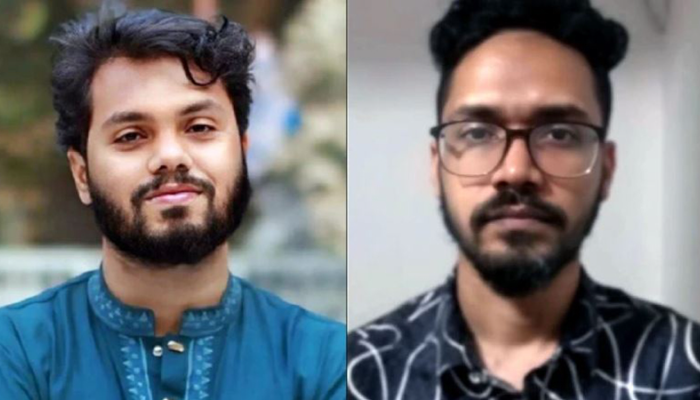

Bangladesh has escalated its efforts to address the murder of anti-India Islamist Sharif Osman bin Hadi. Faisal Karim Masud has been identified as the primary accused, and a nationwide look-out notice has been issued for him and other attackers. A travel ban has also been put in place as violent protests persist to take hold around the nation, particularly targeting the marginalised Hindu community.
On 21st December (Sunday), a Dhaka court prohibited Masud from departing the nation. The authorities believe that he continues to live in Bangladesh, although he moves around often to avoid being apprehended. Several investigation teams have been sent out, and surveillance has increased to monitor his whereabouts.
Another accused, Mohammad Alamgir Sheilkh, was riding the motorbike as Masud fired the bullets at close range. Earlier reports claimed that with the aid of a human trafficking network, the two allegedly fled via a secluded border path in Haluaghat of the Mymensingh district and into Meghalaya. However, the authorities confirmed that the claims lacked considerable substantiation.
According to Additional Inspector General of Police Khandaker Rafiqul Islam, there was no established proof that Masud left Bangladesh. He outlined, “We have not received any reliable information indicating that he has crossed the border.” The senior official even warned that suspects frequently disseminate false information. Meanwhile, police and border forces detained four people who are purportedly implicated in the accused’s escape.
Who is Faisal Karim Masud
32-year-old Sharif Osman Hadi, the spokesperson for Inqilab Moncho, was shot on 12th December by masked assailants and died in Singapore on 18th December after he was taken there for medical treatment. Afterwards, Faisal Karim Masud emerged as the main accused in the case. The investigations unveiled that he was a former leader of the Chhatra League. It is the student branch of the now-banned Bangladesh Awami League, which is the political party of the former prime minister Sheikh Hasina.
A journalist from Bangladesh claimed, “Faisal Masud joined Hadi’s campaign with the intention of killing him,” while talking to the Telegraph. He added, “Law enforcement agencies have detained several people, including Faisal’s parents, wife, and girlfriend, but have so far failed to arrest the accused.”
According to reports, he had actively participated in the election campaign together with Alamgir. The authorities mentioned that Masud already informed his girlfriend that something would “shake entire Bangladesh.” He had conveyed, “Something will happen tomorrow that the whole country will tremble,” to her the night before the incident.
Masud was on the ground in July with leaders and activists of the Awami League and its affiliated groups to quell last year’s agitation, according to a Prothom Alo article. The inquiries have disclosed that he had earlier been imprisoned in relation to an armed robbery at a school in Dhaka that resulted in the theft of 1.7 million taka and the recovery of a foreign-made pistol. He was later freed, which has further enraged the protesters at present.
Masud listed himself as the proprietor of three businesses,s including Apple Soft IT, YCU Technology and Enlist Work on his LinkedIn profile. He earned a bachelor’s degree in computer science from a private university in Dhaka in 2013, based on the profile, which further stated that he eventually graduated from another private university with an MBA.
Blame India to conceal country’s deteriorating situation and galvanise Islamists
Bangladesh has been in a state of turmoil since last year, initially due to student protests and subsequently for the removal of Sheikh Hasina, when the situation soon transformed into anti-Hindu violence. Now, there are protests regarding the death of Sharif Osman Hadi.
Notably, the unjust vilification of India has been a recurring theme in this unrest alongside the brutal targeting of the Hindu community. From the interim Yunus government to the jihadists wandering the streets and intimidating the oppressed minorities, they have devised a common foe to point fingers at for their own shortcomings and to blame for their failures.
Hadi was slain by a fellow Bangladeshi in the country, and the extremists opted to attack India. It would be genuinely amusing if it were not so perilous for the vulnerable Hindu population, who are the first victims of this anti-India narrative and are susceptible targets for the highly radicalised community.
The frothing mobs have undoubtedly seen a window of opportunity to attack India,dia which is demonstrated by the spike in their derogatory remarks after Hadi’s demise. Leaders and members of the extremist Jamaat-e-Islami and the student-led National Citizen Party (NCP) were among the throngs of people who raised anti-India slogans. There have been direct attacks against Indian diplomats and embassies.
Osman Hadi’s younger sister, Masuma Hadi, who has spearheaded the despicable rhetoric recently, alleged that the nation, along with the Awami League are attempting to sabotage the parliamentary elections. Such initiatives, she added, must be prevented from succeeding. Masuma stressed that forces which rely on violence must not be let to seize power and insisted that the election could not be obstructed under any conditions.
After asserting that authority should not be handed over to those who commit acts of violence, Masuma urged jihad against India and stated, “We should give jihadi training to everyone in every home, irrespective of gender, including children, to fight India.” She proceeded to draw an outrageous comparison with Indian freedom fighters and declared, “I did not see Khudiram Bose or Azad, but I have seen Osman Hadi. Hadi is a revolutionary leader.”
Masuma then referred to a “200-year-old” fight and threatened, “We Bangladeshis will not rest until Indian dogs are completely wiped out. This war began 200 years ago.” She highlighted that the message was the same irrespective of identity or party. According to her, Bangladesh has to be “built on justice” and announced, “We do not want to live under the subservience of any state. We want to live with our heads held high.”
"We Bangladeshis will not rest until Indian dogs are completely wiped out. This war began 200 years ago"
— Kreately.in (@KreatelyMedia) December 21, 2025
– Osman Hadi's sister pic.twitter.com/m0fOAFeuoC
Beyond the nauseating animosity towards India, the factual inaccuracies in these remarks are glaring. Such figures routinely fabricate claims to inflate the importance of an imagined struggle against a manufactured enemy. Masuma’s assertion of a two-century conflict with New Delhi is particularly absurd for a nation barely 55 years old, serving only to exaggerate history and further incite her already radicalised domestic audience.
Likewise, she conveniently overlooked the fact that Bangladesh exists solely due to India’s support and assistance. Her utterances were similar to the conspiracy theories spun by her deceased brother, who had collaborated with Deobandi madrasas and extremist groups as well as joined forces with hardliners hoping to convert Bangladesh into a caliphate.
He denounced the brutalised Hindu community and their organisations, including ISKCON, which he labelled as a “terrorist organisation,” an “Indian agent”, and wanted to outlaw it in the country. The siblings, although driven by genocidal loathing, malicious assertions and a sinister agenda, were entirely without any facts or proof to back their allegations.
Hadi’s funeral turns into a display of anti-India sentiment
Hadi’s last rites were performed on 20th December in D, haka, and the public event arranged to mourn his death became a spectacle of hostility towards India. “We will not allow the Indian-backed Awami League,eague who are subservient to Indian hegemony, anti-people and anti-state forces, their collaborators, along with the cultural fascists who produce narratives in their favour, to engage in destructive politics in Bangladesh,” pledged Mahmd-ur-Rahman, who assumed control of Inqilab Moncho after the latter’s demise.
“There is no use in showing civility because enough is enough. We have been patient for too long. Further, those who served Indian interests or the interests of other foreign forces will also not be allowed to remain safe. This is the basic condition. No one should attack us. If one body falls on our side, we will take a body from their side in return,” expressed Mahfuj Alam. He is the former information adviser in the Yunus government.
More importantly, Bangladesh’s Chief Advisor Muhammad Yunus, who was also present at the funeral, promised to uphold the deceased Islamist’s ideals and fulfil his dreams.
Disdain for India, fondness for Pakistan
A Bangladeshi was furious because India did not produce a flattering video regarding Hadi, unlike Pakistan, because he was a Muslim. The person accused India of providing shelter and protecting as well as nurturing, Hadi’s killer. “But our Pakistani brothers will make such videos about Osman Hadi, because Bangladeshi and Pakistani Muslims are brothers to each other,” the post further read.
India will never make such a video about Osman Hadi, because Hadi was a Muslim.
— Jashim (@jashim4truth) December 19, 2025
Instead, India gives shelter to Hadi’s killer, it will protect and nurture him.
But our Pakistani brothers will make such videos about Osman Hadi, because Bangladeshi and Pakistani Muslims are… pic.twitter.com/zhOaen5Zbo
The Pakistani army had sought to annihilate the Bengali population and would likely have succeeded had India not intervened. Yet expecting gratitude from Islamists is futile, as allegiance to the ummah supersedes all historical memory and national reality.
Moreover, another individual alleged that Hadi was a vocal opponent of “Indian regional dominance” and took down Sheikh Hasina’s 16-year authoritarian rule. “India serves as a safe house for Hasina and the killers of Osman Hadi,” he added.
Osman Hadi—an outspoken critic of Indian regional hegemony and a student leader of the July Revolution that dismantled Hasina’s 16-year fascist regime.#India serves as a safe house for Hasina and the killers of Osman Hadi#WeAreHadi
— K H A N (@Enthusishtiak) December 20, 2025
@MEAIndia @narendramodi @UN pic.twitter.com/TOdvHScKIo
Bangladeshi leader Hasnat Abdullah likewise boasted, “Once we win and reach Parliament, we will behead Delhi and send it back,” to a cheering crowd at a protest rally. “We will shelter separatist and anti-I,ndia forces and then we will sever the seven sisters from India. I want to make it clear to India that if you provide shelter to forces that do not respect Bangladesh’s sovereignty, potential voting rights, and human rights, Bangladesh will respond,” he had vowed.
BNP leader’s startling revelations
Nilofer Chowdhury Moni, leader of Khaleda Zia’s Bangladesh Nationalist Party, brought attention to Jamaat-e Islami’s association with Hadi’s death. “The man who fired at Hadi in an attempt to kill him, one must look at his background. Who bailed him out twice? Shishir Manir bailed him out twice. I am saying this with responsibility,” she asserted during a program.
SENSATIONAL PROOF INDIA IS BEING SCAPEGOATED.
— Rahul Shivshankar (@RShivshankar) December 22, 2025
Pak backed Jamaat-e-Islami bumped off Bangladesh's Islamist student leader Hadi. BNP leader Niloufer claims: Hadi’s killer was granted bail twice by BJI leader Shishir Monir after August 5. Alleges Jamaat link to Hadi's killer. pic.twitter.com/xBvpr0CuPP
Moni then asked, “Who got caught with 17 lakh rupees? How did this happen twice within a month? We see accused getting caught, but never see them leaving custody. Twice he was bailed out, and on both occasions it was Jamaat’s lawyers.” She added, “This boy was also part of Chhatra League and was also part of the Jamaat circle.” She refused to elaborate out of fear and concluded, “If I speak too much, I won’t be able to go home safely. We did not oust Sheikh Hasina for this.”
Emulating the tactics utilised by Pakistan
Pakistan has repeatedly resorted to anti-India rhetoric in times of crisis, whether due to floods, poor economy or terrorist attacks, because it is very easy to rally support by portraying an infidel country with a majority Hindu population as an enemy in the Islamic Republic. This was recently noticeable when the country, recognised as a breeding ground for terrorism, designated Baloch rebel groups and Tehrik-e Taliban Pakistan (TTP) as “Indian proxies” to distract from its own delinquencies.
However, the reality is that their challenges are a result of their own actions and not due to any external conspiracy or similar influences. Now, Bangladesh has similarly taken a cue from this propaganda playbook and jumped on the “blame India” bandwagon. Because nothing excites brainwashed Islamists more than appealing to their collective hostility towards ‘kafirs’, i.e. Hindus.
The country, akin to Pakistan, is on a trajectory of self-destruction and collapse as its policies and actions, along with the prioritisation of Islamism over development, are responsible for the steep decline,e but it has chosen to blame its neighbour, as this is convenient, particularly with a highly radicalised and Islamist populace that harbours hatred towards Hindus. Nonetheless, it is apparent that, like all matters, Hadi’s death is also tied to the internal political dynamics and power conflicts within the country.
His sister, however, chose to issue a call for jihad against India, fully aware of her audience and cognisant of the fact that anti-India rhetoric, coupled with extremist views, commands wide popular appeal in the country. The same political calculus underpins the sustained vitriol directed at India by other Bangladeshi politicians.
All this resentment is a product of unfounded speculation, as there is not even a trace of evidence that has been introduced to showcase India’s involvement in the affairs transpiring in Bangladesh. The propaganda predictably has clearly overshadowed the truth.
It is increasingly evident that Bangladesh, in its bid to draw closer to Pakistan, has chosen to forget the massacres and mass rapes carried out by the Pakistani military and is instead continuing down a path of jihadism, united with Islamabad by a shared contempt for India and Hindus, and by the same cynical tactics used to mobilise Islamist sentiment at home.