India’s poorest households are consuming gutkha, other tobacco products at an alarming rate, spending more and more on it: Study reveals
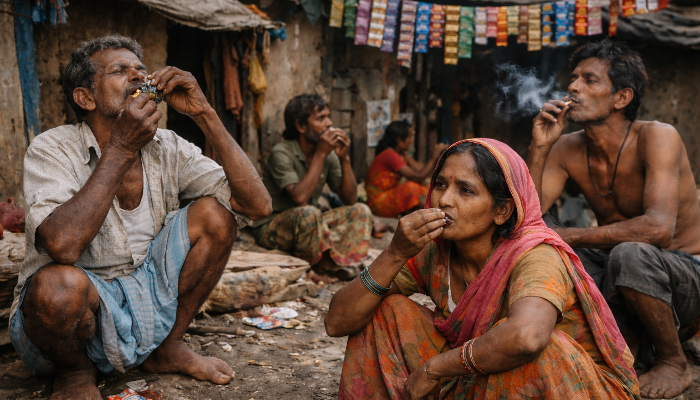
The National Statistics Office (NSO) conducted a survey on Household Consumption Expenditure from August 2023 to July 2024. A striking aspect of the study was the surge in gutkha consumption within the country, a point also emphasised by Shamika Ravi, a member of the EAC-PM (Economic Advisory Council to the Prime Minister) and her colleague Partha Protim Barman in a recent article in the Indian Express. Notably, NSO is a part of the Ministry of Statistics & Programme Implementation (MoSPI). It regularly undertakes research on household consumption expenditure to gather data on both food and non-food products. The recent analysis that was published in January underscored how the usage of Gutkha has turned into a norm across all demographics, particularly in the northern states of the country, though southern states too are showing a concerning surge in usage. Rising menace of tobacco consumption (Gutkha & Cigarettes), specially among poorer households, has major implications for both public health and public finance. @ShamikaRavi & @Partha_Protim05 explain the growing moral hazard problem across Indiahttps://t.co/kqOSed0lhI pic.twitter.com/BSpV3DDmeS— EAC-PM (@EACtoPM) January 21, 2026 Ravi and Barman outlined that the use of tobacco is growing swiftly, becoming more prevalent and deeply ingrained in the lives of lower-class households, in the article in The Indian Express. This is occurring simultaneously with the state’s expansion of subsidised healthcare leading to a glaring contrast which has significant ramifications for social policies, health results and financial sustainability. The per capita expenditure on tobacco rose dramatically between 2011-12 and 2023-2024, climbing by 58% in rural India and 77% in urban regions after accounting for inflation, the article states. Nearly 1.5% of the monthly per-capita consumer expenditure (MPCE) in rural areas and 1% in urban areas are currently attributed to tobacco. These shares might seem modest but it is concerning that the number of households using tobacco has skyrocketed. Disturbing figures from rural and urban regions Tobacco-using households in rural India surged from 9.9 crore (59.3% of all households) to 13.3 crore (68.6%). It is a remarkable 33% hike in less than a decade. Ravi and Barman noted that the figure obtained from the increase in urban India is much more astounding. The number of households utilising tobacco jumped from 2.8 crore (34.9%) to 4.7 crore (45.6%). The troubling fact is that tobacco consumption is progressively getting mainstreamed in both urban and rural regions. It is no longer limited to specific groups or populations. Leaf tobacco and gutkha is behind the spike in rural parts. The percentage of rural households that consume gutkha went up from 5.3% to 30.4%, a roughly sixfold leap conveying the survey’s most startling finding. Gutkha is presently the most valuable tobacco product accounting for 41% of all tobacco spending in these locations. On the other hand, gutkha followed the sudden rise in cigarette consumption in urban areas which are considered to be more health-conscious. 18.1% of urban households smoke cigarettes making them the most popular tobacco product there while gutkha consumption stood at 16.8% which demonstrated how far it has crept into city markets. Gutkha consumption rampant in the central belt Ravi and Barman stated that Madhya Pradesh, Uttar Pradesh, Bihar, Chhattisgarh and Rajasthan contribute significantly higher to gutkha consumption than the country’s rural average of approximately 30%. Over 6 in 10 of households (60%) in the rural territories of Madhya Pradesh consume gutkha and Uttar Pradesh already surpassed 50% mark. Problematically, urban trends have begun to resemble rural ones. Gutkha is consumed by around half of Madhya Pradesh’s urban households as the figures recorded in Uttar Pradesh, Bihar and Rajasthan are even higher than one-third. Gutkha consumption in both rural and urban regions has been shown to be greater than the national average in several Northeastern states as well, as per the article. The usage is generally lower in Southern India but the results are disturbing. The consumption of gutkha by one in four rural households in Karnataka serves as an example. The class divide Tobacco use happens to be more common in lower-class homes. More than 70% of rural households in the lowest 40% of the income distribution utilise tobacco. This percentage is higher than 85% in Bihar, Uttar Pradesh and Madhya Pradesh. Compared to the top 20% (1.2%), poorer rural households devote a higher percentage of their MPCE (1.7%) on tobacco. According to Ravi and Barman, the class disparity in urban India is considerably more pronounced. While less than 37% of households in the top 20% use tobacco, more than half of those in the bottom 40% consume it. The poor spend almost twice as much of their MPCE as the wealthy on tobacco consumption, a disturbing

The National Statistics Office (NSO) conducted a survey on Household Consumption Expenditure from August 2023 to July 2024. A striking aspect of the study was the surge in gutkha consumption within the country, a point also emphasised by Shamika Ravi, a member of the EAC-PM (Economic Advisory Council to the Prime Minister) and her colleague Partha Protim Barman in a recent article in the Indian Express.
Notably, NSO is a part of the Ministry of Statistics & Programme Implementation (MoSPI). It regularly undertakes research on household consumption expenditure to gather data on both food and non-food products. The recent analysis that was published in January underscored how the usage of Gutkha has turned into a norm across all demographics, particularly in the northern states of the country, though southern states too are showing a concerning surge in usage.
Rising menace of tobacco consumption (Gutkha & Cigarettes), specially among poorer households, has major implications for both public health and public finance. @ShamikaRavi & @Partha_Protim05 explain the growing moral hazard problem across Indiahttps://t.co/kqOSed0lhI pic.twitter.com/BSpV3DDmeS
— EAC-PM (@EACtoPM) January 21, 2026
Ravi and Barman outlined that the use of tobacco is growing swiftly, becoming more prevalent and deeply ingrained in the lives of lower-class households, in the article in The Indian Express. This is occurring simultaneously with the state’s expansion of subsidised healthcare leading to a glaring contrast which has significant ramifications for social policies, health results and financial sustainability.
The per capita expenditure on tobacco rose dramatically between 2011-12 and 2023-2024, climbing by 58% in rural India and 77% in urban regions after accounting for inflation, the article states. Nearly 1.5% of the monthly per-capita consumer expenditure (MPCE) in rural areas and 1% in urban areas are currently attributed to tobacco. These shares might seem modest but it is concerning that the number of households using tobacco has skyrocketed.
Disturbing figures from rural and urban regions
Tobacco-using households in rural India surged from 9.9 crore (59.3% of all households) to 13.3 crore (68.6%). It is a remarkable 33% hike in less than a decade.
Ravi and Barman noted that the figure obtained from the increase in urban India is much more astounding. The number of households utilising tobacco jumped from 2.8 crore (34.9%) to 4.7 crore (45.6%). The troubling fact is that tobacco consumption is progressively getting mainstreamed in both urban and rural regions. It is no longer limited to specific groups or populations.
Leaf tobacco and gutkha is behind the spike in rural parts. The percentage of rural households that consume gutkha went up from 5.3% to 30.4%, a roughly sixfold leap conveying the survey’s most startling finding. Gutkha is presently the most valuable tobacco product accounting for 41% of all tobacco spending in these locations.
On the other hand, gutkha followed the sudden rise in cigarette consumption in urban areas which are considered to be more health-conscious. 18.1% of urban households smoke cigarettes making them the most popular tobacco product there while gutkha consumption stood at 16.8% which demonstrated how far it has crept into city markets.
Gutkha consumption rampant in the central belt
Ravi and Barman stated that Madhya Pradesh, Uttar Pradesh, Bihar, Chhattisgarh and Rajasthan contribute significantly higher to gutkha consumption than the country’s rural average of approximately 30%. Over 6 in 10 of households (60%) in the rural territories of Madhya Pradesh consume gutkha and Uttar Pradesh already surpassed 50% mark. Problematically, urban trends have begun to resemble rural ones.
Gutkha is consumed by around half of Madhya Pradesh’s urban households as the figures recorded in Uttar Pradesh, Bihar and Rajasthan are even higher than one-third. Gutkha consumption in both rural and urban regions has been shown to be greater than the national average in several Northeastern states as well, as per the article. The usage is generally lower in Southern India but the results are disturbing. The consumption of gutkha by one in four rural households in Karnataka serves as an example.
The class divide
Tobacco use happens to be more common in lower-class homes. More than 70% of rural households in the lowest 40% of the income distribution utilise tobacco. This percentage is higher than 85% in Bihar, Uttar Pradesh and Madhya Pradesh. Compared to the top 20% (1.2%), poorer rural households devote a higher percentage of their MPCE (1.7%) on tobacco.
According to Ravi and Barman, the class disparity in urban India is considerably more pronounced. While less than 37% of households in the top 20% use tobacco, more than half of those in the bottom 40% consume it. The poor spend almost twice as much of their MPCE as the wealthy on tobacco consumption, a disturbing trend. The use of tobacco remains most common for the poorest and the lowest among the wealthy in both rural and urban places.
Gutkha use is widespread in rural India, reflecting an unnerving normalisation. All income classes have seen a bump in consumption, with the rate of the top 20% and bottom 40% of households exhibiting almost similar results. However, inequality is evident in urban areas as fewer than one in ten households in the top 20% consume gutkha while more than one in five households in the bottom 40% do the same.
The disastrous impact of gutkha consumption on health and finances
The rise in gutkha consumption has prominent and detrimental health consequences. The article then threw light on the estimates from the Ministry of Health and Family Welfare, which revealed that tobacco smoking causes around 13 lakh fatalities in India each year. It is one of the main risk factors for non-communicable diseases (NCDs) such as cancer, heart disease, respiratory conditions and hypertension. According to the World Health Organisation (WHO), NCDs are responsible for 63% of all deaths in the nation.
It was pointed out that the relationship between escalating tobacco use and increasing public healthcare coverage has made the current situation especially critical. Ayushman Bharat was created to protect vulnerable households from unmanageable medical costs. Around 12 crore families had received over 42 crore Ayushman cards as of October 2025. Households have already saved an estimated Rs 1.52 lakh crore in out-of-pocket medical expenses because of the program.
Government health spending shot up from 29% to 48% of overall expenditure concerning the sector while out-of-pocket expenses dropped sharply between FY (fiscal year)2015 and FY2022.
The nation bears a greater portion of the costs when tobacco use which thrives in lower-income households causes chronic illness. The long-term financial viability of publicly supported healthcare programs could be gravely compromised in the absence of remedial measures. Likewise, weak fiscal offsets exacerbate this danger. Only 2.4% of gross tax revenue came from tobacco goods in FY23.
The household finances paint the clearest image. The poorest 40% of households in rural India spend only 2.5% of their MPCE on education, compared to 4% on alcohol, tobacco and intoxicants. The article asserted that a welfare state cannot legitimately support the development of human capital while permitting addictive objects to supplant investments in health, nutrition and education.
The writers argued that an unregulated increase in tobacco usage is incompatible with the government’s commitment to social protection and universal health coverage. It is noteworthy that the HCES (Household Consumption Expenditure Survey) data have been described as a policy alarm bell as well as a statistical warning.
What is the way forward
Ravi and Barman also offered suggestions to tackle the sensitive matter and expressed that adding more tax on chewing tobacco alone won’t be enough, even though the Central Excise (Amendment) Bill 2025 calls for it. Thus, strengthening regulatory control is necessary and the actions of leading Bollywood celebrities who are employing surrogate advertising to promote pan masala and gutkha under the fig leaf of “silver-coated cardamom” should not be accepted.
The aforementioned report gathered information on approximately 405 food and non-food items that households utilise such as cereals, pulses, milk, vegetables, meat, eggs, fuel and light, education, medical along with pan, tobacco and intoxicants, among others.