Is Kerala really a Communist state? The myth of the ‘Kerala Model’ and Left govt’s misleading claims of eradicating extreme poverty
A few days ago, a bright red full-page advertisement splashed across the front pages of multiple newspapers made a bold declaration: Kerala has eradicated extreme poverty. According to the ad, it achieved what no other Indian state could. However, this narrative has not remained confined to print media. Across social media, a growing number of influencers have begun aggressively pushing the claim that Kerala is a communist state and that its “outstanding performance” is proof that communism works. High literacy rates, low poverty figures, and better health indicators are repeatedly cited as evidence that communist governance delivers superior outcomes. But behind this carefully narrated image lies a more uncomfortable question: “Is Kerala actually a communist state or is the term being loosely used to market welfare outcomes achieved within a capitalist framework?” And more importantly, “Do Kerala’s selective social indicators truly validate communism as an economic and governance model?” This article cuts through the propaganda for both printed and viral claims to examine the data, the economic reality, and the ideological claims surrounding the so-called Kerala Model. Is Kerala really a communist state? Defining communism vs reality Before accepting Kerala’s social indicators as proof of communist success, it is essential to address the fundamental question that is deliberately blurred: Is Kerala actually a communist state? Classical or traditional communism is not a vague label or a welfare slogan. It has clear defining features, including state ownership of the means of production, the abolition of private property, the elimination of free markets, and centralised economic planning. In the past, wherever this model was implemented, from the Soviet Union to Maoist China, it required strict control over industry, labour, media, and individual movement. However, Kerala does not fit this definition by any serious standard. Kerala offers complete protection for private property. Private companies dominate the economy. A market-driven environment governs the operations of hospitals, schools, banks, travel agencies, and service sectors. The state government does not govern trade, price, or production. Most importantly, Kerala operates within India’s capitalist constitutional framework. It depends heavily on central government tax transfers, national financial institutions, private-sector employment, and foreign remittances in capitalist economies. But none of this comes under the actual communist economic system. What Kerala has is a left-led government running welfare-heavy policies within a capitalist economy, not a communist state. Calling Kerala “communist” in the ideological sense is therefore misleading. It is a political branding exercise, not an economic reality. This difference matters because you cannot credit communism for the outcomes achieved without communism. Investments in public health, land reforms, and welfare spending are policy decisions rather than exclusive outcomes of communist philosophy. Democracies across the world, including non-communist ones, have achieved similar or better outcomes without dismantling markets or private enterprise. Poverty eradication: A real breakthrough or a manufactured narrative? The Left’s loudest defence is the claim that the state has “eradicated extreme poverty”, as the idea that Kerala is a communist state is already in jeopardy. This assertion has been portrayed as historic, unheard of, and distinctively communist. A closer examination of the data reveals an entirely different picture, according to the National Family Health Survey (NFHS-5), which was conducted between 2019 and 2021. Kerala’s extreme poverty rate stood at just 0.5%. In practical terms, extreme poverty in the state was already nearly eliminated before the Communist government launched its special poverty-eradication mission in 2021. This single statistic punctures the entire propaganda balloon. If poverty had already fallen to negligible levels before the much-publicised programme began, then what exactly is being celebrated now? The Communist government’s claim of lifting 64,000 families out of extreme poverty does not reflect a structural transformation; rather, it reflects rounding up an already declining figure. National data further exposes the exaggeration. A NITI Aayog report shows that between 2016 and 2021, states like Uttar Pradesh reduced poverty by nearly 13%, while Kerala’s reduction during the same period was from 0.7% to 0.5%. In relative terms, Kerala’s change is marginal, not exceptional. Other states, like Goa, have also reached near-zero levels of extreme poverty without projecting the outcome as an ideological victory or branding it as a civilisational breakthrough. The difference lies not in outcomes, but in advertising. It becomes more concerning with the allegation of data manipulation related to Kerala’s claim. The o
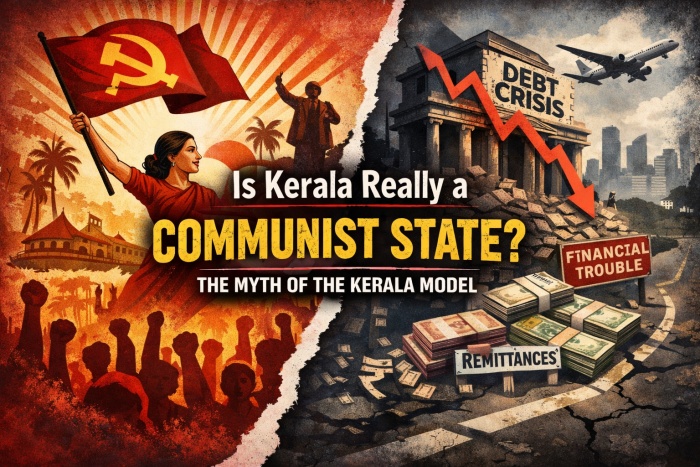

A few days ago, a bright red full-page advertisement splashed across the front pages of multiple newspapers made a bold declaration: Kerala has eradicated extreme poverty. According to the ad, it achieved what no other Indian state could. However, this narrative has not remained confined to print media. Across social media, a growing number of influencers have begun aggressively pushing the claim that Kerala is a communist state and that its “outstanding performance” is proof that communism works. High literacy rates, low poverty figures, and better health indicators are repeatedly cited as evidence that communist governance delivers superior outcomes.
But behind this carefully narrated image lies a more uncomfortable question: “Is Kerala actually a communist state or is the term being loosely used to market welfare outcomes achieved within a capitalist framework?” And more importantly, “Do Kerala’s selective social indicators truly validate communism as an economic and governance model?”

This article cuts through the propaganda for both printed and viral claims to examine the data, the economic reality, and the ideological claims surrounding the so-called Kerala Model.
Is Kerala really a communist state? Defining communism vs reality
Before accepting Kerala’s social indicators as proof of communist success, it is essential to address the fundamental question that is deliberately blurred: Is Kerala actually a communist state?
Classical or traditional communism is not a vague label or a welfare slogan. It has clear defining features, including state ownership of the means of production, the abolition of private property, the elimination of free markets, and centralised economic planning. In the past, wherever this model was implemented, from the Soviet Union to Maoist China, it required strict control over industry, labour, media, and individual movement. However, Kerala does not fit this definition by any serious standard. Kerala offers complete protection for private property. Private companies dominate the economy. A market-driven environment governs the operations of hospitals, schools, banks, travel agencies, and service sectors. The state government does not govern trade, price, or production.
Most importantly, Kerala operates within India’s capitalist constitutional framework. It depends heavily on central government tax transfers, national financial institutions, private-sector employment, and foreign remittances in capitalist economies. But none of this comes under the actual communist economic system.
What Kerala has is a left-led government running welfare-heavy policies within a capitalist economy, not a communist state. Calling Kerala “communist” in the ideological sense is therefore misleading. It is a political branding exercise, not an economic reality.
This difference matters because you cannot credit communism for the outcomes achieved without communism. Investments in public health, land reforms, and welfare spending are policy decisions rather than exclusive outcomes of communist philosophy. Democracies across the world, including non-communist ones, have achieved similar or better outcomes without dismantling markets or private enterprise.
Poverty eradication: A real breakthrough or a manufactured narrative?
The Left’s loudest defence is the claim that the state has “eradicated extreme poverty”, as the idea that Kerala is a communist state is already in jeopardy. This assertion has been portrayed as historic, unheard of, and distinctively communist. A closer examination of the data reveals an entirely different picture, according to the National Family Health Survey (NFHS-5), which was conducted between 2019 and 2021.
Kerala’s extreme poverty rate stood at just 0.5%. In practical terms, extreme poverty in the state was already nearly eliminated before the Communist government launched its special poverty-eradication mission in 2021. This single statistic punctures the entire propaganda balloon. If poverty had already fallen to negligible levels before the much-publicised programme began, then what exactly is being celebrated now? The Communist government’s claim of lifting 64,000 families out of extreme poverty does not reflect a structural transformation; rather, it reflects rounding up an already declining figure. National data further exposes the exaggeration.
A NITI Aayog report shows that between 2016 and 2021, states like Uttar Pradesh reduced poverty by nearly 13%, while Kerala’s reduction during the same period was from 0.7% to 0.5%. In relative terms, Kerala’s change is marginal, not exceptional. Other states, like Goa, have also reached near-zero levels of extreme poverty without projecting the outcome as an ideological victory or branding it as a civilisational breakthrough. The difference lies not in outcomes, but in advertising. It becomes more concerning with the allegation of data manipulation related to Kerala’s claim.
The opposition party in the state has drawn attention to differences between the newly disclosed poverty lists, which claim that there are just 6,400 Scheduled Tribe families, and the 2011 Census, which recorded almost one lakh of these people. These stark differences raise valid concerns about political convenience, exclusion, and technique. Additionally, there are claims that the ₹1.5 crore spent on publicising this purported accomplishment was taken from funds intended for housing low-income people, turning charity into a marketing ploy. The broader truth is unavoidable: poverty has been declining across India, driven by national-level economic growth, welfare schemes, and infrastructure expansion. Kerala’s latest claim does not represent a unique communist intervention, but it means a state taking credit for a trend it did not create.
The financial reality: Supreme Court rebuke and a state running on borrowed time
Although the Kerala government uses public messaging and commercials to celebrate the eradication of poverty, the state’s actual financial situation paints a considerably less optimistic picture. In March 2024, the Communist-led Kerala government approached the Supreme Court by urgently seeking permission to borrow beyond its prescribed limits. This move alone punctured the image of a self-sustaining, model state. A government confident in its economic strength does not run to the country’s highest court for emergency borrowing approval. What followed was even more revealing.
The Kerala state would not be able to cover even its regular expenses without the more than 13000 crore as financial relief provided by the central government. The irony was apparent that the very system that left leaders routinely condemned became the lifeline keeping their government afloat. The Supreme Court did not mince words. In a pointed observation, the court stated that Kerala was responsible for its own poor financial condition. This was not a political allegation but a judicial assessment based on fiscal data and borrowing patterns. At the same time, reports emerged that the state government was unable to pay salaries to its employees on time, a basic obligation that any functional administration must meet before declaring ideological victories. This episode exposed a fundamental contradiction at the heart of the Kerala Model. On one hand, it is showcased as proof of superior governance; on the other, it survives on debt, emergency relief, and judicial leniency. Welfare spending without sustainable revenue generation does not represent economic strength, it represents financial stress deferred into the future.
A model that depends on repeated borrowing and external support may sustain political narratives, but it cannot sustain itself indefinitely.
Debt explosion under Left rule: The numbers behind the ‘Kerala Model’
If a government’s economic claims are so big, they must withstand scrutiny of debt, deficits and fiscal discipline. On this count, the Kerala model fares poorly. According to the Comptroller and Auditor General (CAG) report, Kerala’s total public debt is projected to touch ₹4.5 lakh crore by the end of the 2024–25 financial year.
This figure alone places Kerala among the most heavily indebted states in the country. What makes this especially troubling is the speed at which the debt has accumulated. When the Communist government assumed power, Kerala’s debt stood at approximately ₹1.6 lakh crore. In just ten years, the figure has nearly tripled. This rapid expansion cannot be explained away as a national trend or a one-time crisis response, but it reflects structural fiscal mismanagement. It is more concerning that Kerala’s debt-to-GDP ratio is now around 34%. Economists generally consider a ratio of 25% or below to be fiscally sustainable for Indian states. Kerala has not merely crossed this threshold, but it has done so comfortably, with no credible roadmap for reversal.
If high debt is used for productive growth, it need not be automatically disastrous. However, Kerala’s borrowing has mainly been used to pay salary and pension liabilities, welfare commitments without revenue backing, and routine expenditure rather than capital creation. In other words, the state is borrowing to survive, not borrowing to grow. This is why fiscal stress keeps resurfacing in different forms, such as delayed payments, disputes over borrowing caps, and repeated appeals for central assistance. A model that relies on ever-expanding debt while advertising welfare outcomes is not an economic success; it is a postponement of accountability. The uncomfortable reality is that the celebrated Kerala Model is being sustained not by robust economic output, but by credit-fuelled consumption. And credit, unlike propaganda, eventually demands repayment.
Conclusion: Branding welfare as Communism, and failure as a ‘Model’
So, is Kerala really a communist state? The evidence says no. Kerala is not communist in structure, not communist in economics, and not communist in operation. It is a welfare-heavy state functioning entirely within India’s capitalist constitutional framework, surviving on central transfers and private enterprise. Most crucially, money is earned in capitalist economies outside the state. Calling it “communist” is less an economic description and more a political branding exercise. In reality, what is being portrayed as a “communist success story” today is a combination of strong PR, national welfare trends, and historical social reform. Even before the most recent Left government began its campaign, the decrease in extreme poverty was almost complete.
More than modern ideological administration, decades-old reforms and social movements are responsible for high literacy and health statistics. None of these results necessitated the elimination of capitalism, markets, or private property, the same foundations that communism purports to replace. At the same time, the economic costs of the so-called Kerala Model are becoming impossible to ignore. A state drowning in debt, dependent on borrowing for survival, unable to generate sufficient employment for its youth, and running on remittances sent by workers forced to leave home, cannot be held up as a sustainable governance ideal.
Exporting labour is not development. Borrowing endlessly is not prosperity. Advertising welfare is not economic strength. Instead of confronting these structural weaknesses, the Communist leadership, aided by influencers and a PR agency, chooses to manufacture a narrative that equates welfare delivery with ideological victory. The real danger of this narrative is not ideological, but practical. When propaganda replaces honest assessment, course correction becomes impossible. Kerala does not need more slogans about models and revolutions. It needs jobs, investment, fiscal discipline, and growth that allows its people to stay, not leave. Until then, the Kerala Model will remain what it increasingly looks like: a publicity-friendly story sustained by debt, remittances, and selective data, not a communist success, and certainly not a model worth replicating.