With 128 FIRs, 32 arrests: Read how the Yogi government is uprooting the codeine cough syrup drug syndicate and how accused Alok is connected to SP supremo Akhilesh Yadav
The campaign launched by the Yogi Adityanath government to uproot the illicit drug trade in Uttar Pradesh not only transcends state borders but is also proving to be a milestone in dismantling the empire of the drug mafia at the international level. While Phensedyl, a common cough syrup made from codeine, is used to treat coughs, it is being misused as a cheaper narcotic to spread addiction through illicit trafficking. In Uttar Pradesh, a racket involved in the illegal sale of this drug was exposed, which was responsible for the illicit sale of the drug not only within the country but also abroad. In 2024, the Yogi Adityanath government ordered a joint operation to investigate the matter. The Food Safety and Drug Administration (FSDA) and the state’s Special Task Force (STF) received orders to investigate the illegal storage and smuggling of codeine-based drugs and syrups. The investigation began in 2024, and a vast network was uncovered by 2025, leading to the filing of 128 FIRs, the cancellation of 280 drug licenses, the seizure of over 3.5 lakh vials, and the arrest of 32 key accused. This illegal empire, estimated to be worth over ₹425 crore, stretched from 28 districts of Uttar Pradesh to Nepal, Bangladesh, Dubai, and Pakistan. From super-stockist firms to shell companies, political connections, and even a terror funding angle have been exposed during the investigation. The suspected links of some Samajwadi Party leaders, including those close to Samajwadi Party chief and former Uttar Pradesh CM Akhilesh Yadav, with the drug trade have stirred political turmoil. Pursuant to the instructions of Chief Minister Yogi Adityanath, a joint operation by the STF, FSDA, and the Enforcement Directorate (ED) dismantled a ‘halal’ drug syndicate, which has been ruining youth and endangering national security. The SIT and ED are now conducting an investigation into the drug syndicate, which could uncover money laundering and terror funding worth thousands of crores. What is codeine and its syrup? Codeine is a derivative of opium. It is commonly used in cough syrups and can cause mind-numbing effects if taken in excessive amounts. Long-term use of codeine has the potential to cause addiction, similar to heroin or opium. In recent years, its use as a soft drug has increased. Using 10 ml of codeine in 100 ml of syrup can cause addiction. How did the first case come to light? In February 2024, a raid was conducted in the Sushant Golf City area of Lucknow. The UP Special Task Force (STF) had received information that a large quantity of Phensedyl, a codeine-based syrup, was being illegally stored there. The raid revealed fraudulent documentation, and the syrup’s supply chain raised suspicions. An FIR was registered at the Sushant Golf City police station under various sections of the Narcotic Drugs and Psychotropic Substances Act, 1985 (NDPS) and the Indian Penal Code. The action was taken based on inputs received over several months. Following this raid, all aspects of the case were investigated for more than a year. Uttar Pradesh Chief Minister Yogi Adityanath issued a direct order that no leniency should be shown in dealing with the drug syndicate. The investigative agencies of Uttar Pradesh followed the CM’s direction. Over the course of about a year, the STF and the FSDA conducted a thorough investigation, scrutinised all the details of the case to ensure that no culprits escaped their sight and the entire racket behind it was exposed. Super stockist and drug mafia nexus During the investigation of the case by the STF, it was revealed that some firms were super-stockists, licensed to stock large quantities of medicines. The investigation revealed that legitimate purchases of large quantities of codeine-containing cough syrup were first made in the name of these super-stockist companies. Thereafter, fake firms were set up to sell the cough syrup illegally. By forging records, the syrup was sold on the black market as a narcotic syrup instead of a medicine. This drug was then supplied to Nepal and Bangladesh via the nearby states of Uttar Pradesh, Bihar, Jharkhand, and Bengal. The illegal drug trade spanned 28 districts in Uttar Pradesh, including Lucknow, Lakhimpur Kheri, Bahraich, Varanasi, Jaunpur, and Saharanpur, and several other states. Several scandals, ranging from political connections to the international drug mafia, surfaced. The biggest challenge for the state government and administration was to arrest the kingpin and expose the syndicate. How was the syndicate exposed? After nearly a year of investigation, a truck was seized in Sonbhadra district of Uttar Pradesh on October 18, 2025. Inside the truck were found a large number of cartons of chips (snacks). But when these cartons were opened, a huge cache of drugs was found inside. The cartons contained bottles of cough syrup containing codeine. To the shock of the administration, the value of these drugs was

The campaign launched by the Yogi Adityanath government to uproot the illicit drug trade in Uttar Pradesh not only transcends state borders but is also proving to be a milestone in dismantling the empire of the drug mafia at the international level. While Phensedyl, a common cough syrup made from codeine, is used to treat coughs, it is being misused as a cheaper narcotic to spread addiction through illicit trafficking.
In Uttar Pradesh, a racket involved in the illegal sale of this drug was exposed, which was responsible for the illicit sale of the drug not only within the country but also abroad. In 2024, the Yogi Adityanath government ordered a joint operation to investigate the matter. The Food Safety and Drug Administration (FSDA) and the state’s Special Task Force (STF) received orders to investigate the illegal storage and smuggling of codeine-based drugs and syrups.
The investigation began in 2024, and a vast network was uncovered by 2025, leading to the filing of 128 FIRs, the cancellation of 280 drug licenses, the seizure of over 3.5 lakh vials, and the arrest of 32 key accused. This illegal empire, estimated to be worth over ₹425 crore, stretched from 28 districts of Uttar Pradesh to Nepal, Bangladesh, Dubai, and Pakistan.
From super-stockist firms to shell companies, political connections, and even a terror funding angle have been exposed during the investigation. The suspected links of some Samajwadi Party leaders, including those close to Samajwadi Party chief and former Uttar Pradesh CM Akhilesh Yadav, with the drug trade have stirred political turmoil. Pursuant to the instructions of Chief Minister Yogi Adityanath, a joint operation by the STF, FSDA, and the Enforcement Directorate (ED) dismantled a ‘halal’ drug syndicate, which has been ruining youth and endangering national security. The SIT and ED are now conducting an investigation into the drug syndicate, which could uncover money laundering and terror funding worth thousands of crores.
What is codeine and its syrup?
Codeine is a derivative of opium. It is commonly used in cough syrups and can cause mind-numbing effects if taken in excessive amounts. Long-term use of codeine has the potential to cause addiction, similar to heroin or opium. In recent years, its use as a soft drug has increased. Using 10 ml of codeine in 100 ml of syrup can cause addiction.
How did the first case come to light?
In February 2024, a raid was conducted in the Sushant Golf City area of Lucknow. The UP Special Task Force (STF) had received information that a large quantity of Phensedyl, a codeine-based syrup, was being illegally stored there. The raid revealed fraudulent documentation, and the syrup’s supply chain raised suspicions.
An FIR was registered at the Sushant Golf City police station under various sections of the Narcotic Drugs and Psychotropic Substances Act, 1985 (NDPS) and the Indian Penal Code. The action was taken based on inputs received over several months. Following this raid, all aspects of the case were investigated for more than a year.
Uttar Pradesh Chief Minister Yogi Adityanath issued a direct order that no leniency should be shown in dealing with the drug syndicate. The investigative agencies of Uttar Pradesh followed the CM’s direction. Over the course of about a year, the STF and the FSDA conducted a thorough investigation, scrutinised all the details of the case to ensure that no culprits escaped their sight and the entire racket behind it was exposed.
Super stockist and drug mafia nexus
During the investigation of the case by the STF, it was revealed that some firms were super-stockists, licensed to stock large quantities of medicines. The investigation revealed that legitimate purchases of large quantities of codeine-containing cough syrup were first made in the name of these super-stockist companies. Thereafter, fake firms were set up to sell the cough syrup illegally.
By forging records, the syrup was sold on the black market as a narcotic syrup instead of a medicine. This drug was then supplied to Nepal and Bangladesh via the nearby states of Uttar Pradesh, Bihar, Jharkhand, and Bengal. The illegal drug trade spanned 28 districts in Uttar Pradesh, including Lucknow, Lakhimpur Kheri, Bahraich, Varanasi, Jaunpur, and Saharanpur, and several other states.
Several scandals, ranging from political connections to the international drug mafia, surfaced. The biggest challenge for the state government and administration was to arrest the kingpin and expose the syndicate.
How was the syndicate exposed?
After nearly a year of investigation, a truck was seized in Sonbhadra district of Uttar Pradesh on October 18, 2025. Inside the truck were found a large number of cartons of chips (snacks). But when these cartons were opened, a huge cache of drugs was found inside. The cartons contained bottles of cough syrup containing codeine. To the shock of the administration, the value of these drugs was estimated to be around Rs 3 crore. Three smugglers from Madhya Pradesh, Hemant Pal, Brijmohan Shivhare, and Ramgopal Dhakad, were arrested.
Since February last year, the STF had been connecting links of the drug syndicate to similar smuggling operations. When this information came from Sonbhadra, the dots began to connect. Initial investigations revealed that the consignment was headed to Pakistan via Nepal. Within fifteen to twenty days, large consignments of drugs were also seized from Jharkhand and Ranchi.
A thorough investigation into the case revealed a name: Shubham Jaiswal. The agencies arrived at Shubham’s name after screening over 300 firms. Out of these firms, 133 were shortlisted as being either directly involved in the drug trade or facilitating diversion. A few months before the truck was seized in Sonbhadra, agencies had started conducting similar raids to reach the roots of the entire drug nexus.
Banaras to Dubai connection and drug syndicate
As the STF swiftly pursued the investigation, the layers of the drug syndicate began to come off. Shubham Jaiswal, originally from Varanasi, currently lives in Dubai. On November 27th, the STF arrested Amit Kumar Singh, alias Amit Tata, near Gauri Square in Lucknow’s Vibhutikhand area. During interrogation, it was revealed that he was a key link in this drug trade and operated the entire network from Dubai at Shubham Jaiswal’s behest.
The digital devices recovered from Amit Tata revealed the supply route, transaction routes, and the syndicate’s entire network map. Shubham’s father, Bhola Prasad, was also involved in his drug dealings. He was arrested at Kolkata airport while trying to flee to Thailand, fearing action by the Uttar Pradesh Special Task Force (STF).
The Chief Minister ordered the Special Task Force (STF) and the Uttar Pradesh Drugs Department to crack down on the entire network. As the investigation intensified, agencies discovered that the drug syndicate used supply chains belonging to major pharmaceutical companies, including Laborate, 3B Healthcare, and Abbott.
#WATCH | Lucknow, UP: CM Yogi Adityanath briefs media on Cough Syrup case, says, "… Action was taken following complaints of poisonous cough syrups being sold at various locations. There were also reports of illegal smuggling of syrups in Uttar Pradesh, and the case was pursued… pic.twitter.com/6SFDpnlu2f
— ANI (@ANI) December 19, 2025
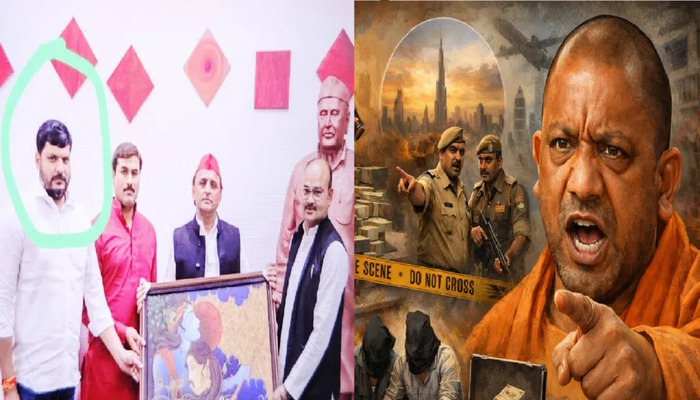
The name of Alok Kumar Singh, a dismissed Uttar Pradesh police constable, also surfaced. His 7000 sq. ft. mansion stunned the ED officials. Subsequently, a photo of SP chief Akhilesh Yadav with Alok Kumar Singh surfaced. Names of several influential politicians also emerged, although the agencies have not yet released any names. Photos and videos of these politicians with Shubham Jaiswal and Amit Tata are going viral on the internet. Furthermore, with such a vast business spanning across borders, there are suspicions that some high-profile individuals may be involved. This is the reason that CM Yogi Adityanath has ordered strict and swift action under a zero-tolerance policy of the government.
What action has been taken so far?
Following these arrests and the discovery of the syndicate’s kingpin, the investigative agencies focused on dismantling the entire network. On 8th December, Principal Secretary of the Home Department Sanjay Prasad, Director General of Police (DGP) Rajiv Kumar Krishna, and FSDA Commissioner Roshan Jacob held a joint press conference in Lucknow, detailing the actions taken so far.
It was reported that 128 FIRs have been registered so far, 280 drug licenses have been cancelled, and 3.5 lakh vials have been seized. Thirty-two people involved in this smuggling network have been arrested till now. The prominent names identified in these arrests are Vibhor Rana, Vishal Rana, Saurabh Tyagi, Bhola Prasad Jaiswal, Alok Pratap Singh, Abhishek Sharma, Akash Pathak, and Amit Singh alias Amit Tata.
During the investigation into this entire racket, the UP Special Task Force (STF) discovered that the illegal drug trade could amount to thousands of crores. A rough estimate of approximately ₹425 crore has been made. A Special Investigation Team (SIT) has been formed to thoroughly investigate every detail related to the case. On 3rd December, the ED filed an Enforcement Case Information Report (ECIR) against 67 accused. The ED conducted simultaneous searches at 25 locations, including Lucknow, Saharanpur, Varanasi, and Ghaziabad in Uttar Pradesh, and the capital cities of Jharkhand and Gujarat.
During the search, it was discovered that 700 fake firms were registered in the names of 220 individuals, which were created directly for money laundering. The ED estimated that the total amount involved could exceed thousands of crores and is therefore preparing to take action in this case under the Prevention of Money Laundering Act,2002 (PMLA).
Recently, in a press conference held in Lucknow on 8th December, UP Police DGP Rajiv Krishna stated that a total of 11 cases have been registered in the Lucknow zone, 4 cases in the Bareilly zone, 10 cases in the Gorakhpur zone, and 2 cases in the Varanasi zone. Through these cases, preparations are underway to dismantle the entire network through which the illegal drug trade was being conducted.
Halal intoxication is cough syrup, and the angle of terror funding is also coming to the fore.
There have been reports of BSF operations on the India-Bangladesh border on several occasions, including intercepting and confiscating cough syrups. During the ED investigation in the current case, it was revealed that the proceeds from the drug smuggling were used to fund terror.
Names of two smugglers, Asif and Wasim, from the Meerut district in Uttar Pradesh have also surfaced in the case. It is reported that Asif smuggled money to other Gulf countries via Bangladesh. The hawala network used to launder money is suspected of benefiting terrorists.
Furthermore, it is said that since alcohol is prohibited in Islam, the use of such cough syrups for intoxication has increased rapidly. Cough syrups are promoted as ‘halal’ intoxicants. Reports suggest that the consumption of cough syrups is higher in areas with a majority Muslim population.
Here is a list of 12 names who are the main accused in the Codeine Cough Syrup case:
Shubham Jaiswal: A resident of Varanasi, he currently lives in Dubai. He is the mastermind behind the entire racket.
Bhola Prasad Jaiswal: A resident of Varanasi, he is the father of Shubham Jaiswal. He owns Sally Traders, which has a turnover of 100 crore rupees.
Manohar Jaiswal: A member of Shubham Jaiswal’s family. He played a key role in establishing shell companies.
Vibhor Rana: A resident of Saharanpur, he is the main superstockist and supplies the syrup through GR Trading Company.
Saurabh Tyagi: A resident of Ghaziabad, he was found in possession of 1.57 lakh bottles. He was the one who provided Shubham Jaiswal’s name to the agencies.
Vishal Rana: A resident of Saharanpur, brother of Vibhor Rana, who orchestrated the network of fake billing and shell firms.
Pappan Yadav: He is a resident of Lakhimpur Kheri/Bahraich. He worked in transport and oversaw the Nepal supply route.
Shadab: A resident of Varanasi/Jaunpur. He is accused of stocking locally using a fake license.
Abhishek Sharma: A resident of Lucknow, he is accused of possessing a fake drug license. 8 million bottles were seized from his possession.
Vishal Upadhyay: A resident of Lucknow, he handled bogus billing and paperwork.
Akash Pathak: He is a resident of Varanasi and used to handle the business at the local level.
Vinod Agarwal: A resident of Lucknow/Varanasi, he is a CA by profession and used to manage the money trail through shell companies.
The drug syndicate’s connection to Samajwadi Party leaders came to light
Among the many names circulating on social media in connection with the drug syndicate, one name is Rahul Yadav. He is a close associate of Lucky Yadav, a Samajwadi Party MLA from the Malhani seat in Jaunpur district. In a viral photo, Rahul Yadav can be seen shaking hands with Akhilesh Yadav.
Photos of dismissed UP Police constable Alok Singh with Akhilesh Yadav are also circulating on social media. As per the information mentioned in 128 FIRs registered across 28 districts, many of the accused received drug licenses during Akhilesh Yadav’s tenure. The accused are said to have played a key role in spreading the illegal trade. Currently, they are working as retailers at the local level.
Samajwadi Party is upset with the action of the Yogi Adityanath government
The Samajwadi Party’s frustration is growing at the same pace with which Uttar Pradesh agencies are apprehending codeine offenders. As the entire network of major drug mafias is being dismantled with the precise planning of Uttar Pradesh agencies, which have been given free rein by the government, the Samajwadi Party’s annoyance is clearly visible.
The photo of dismissed UP Police constable Alok Singh’s meeting with SP chief Akhilesh Yadav hints at a political connection. As the investigation advances, the Samajwadi Party’s troubles are likely to increase.
Codeine has become a poison that has devastated a large population. Those who profit from its trade are considered close to the Samajwadi Party. Many more names and their connections to the Samajwadi Party are yet to be revealed. The names of those mafias who have long had good relations with Akhilesh Yadav’s father, Mulayam Singh Yadav, have also surfaced.
The Yogi government has made it clear through its sustained action over the past several months that no one linked to the drug syndicate will be spared. The ED has expanded its investigation to terror funding. The government and the administration have made clear their intention to destroy this drug trade.