What are undersea Internet cables, and why are nations racing to defend them? Explained
In the contemporary era of escalating hybrid warfare and power competition, the concealed arteries of the global internet are under a serious threat. The modern world relies on undersea fibre-optic cables that carry nearly all of the intercontinental data, financial transactions, and communications. However, these internet lifelines lying on the ocean floor now face sabotage risks as the ongoing decade is turning out to be a decade of wars and countries finding unique means to threaten adversaries with economic paralysis and absolute isolation. “Seabed is battlefield”: Australia, US and UK come together to protect undersea internet cables and energy pipelines As threats of deliberate sabotage and consequent internet blackouts loom, the United States, United Kingdom, and Australia have announced a new AUKUS initiative to deploy advanced Unmanned Underwater Vehicles or Uncrewed Undersea Vehicles (UUVs) specifically designed to safeguard seabed infrastructure, particularly internet communication cables and energy pipelines. On 30th May 2026, the UK, US, and Australia announced the initiative to protect undersea cables at a defence minister’s meeting at the Shangri-La Dialogue. The initiative will be a part of AUKUS Pillar II, which focuses on advanced capabilities in areas like AI, undersea robotics, and autonomy. The United Kingdom will contribute around £150 million to the project. As per media reports, these UUVs will feature cutting-edge payloads for safeguarding seabed infrastructure, surveillance, reconnaissance, logistics, and strike capabilities. The project will deliver results next year. Speaking about what warranted the necessity to launch the AUKUS Pillar II initiative, Australian Defence Minister Richard Marles described undersea internet cables as “the arteries of the modern world” and highlighted how there has been a “historically unprecedented” surge in cuts or attacks on undersea infrastructure in the last 18 months. Besides AUKUS, 17 nations, Singapore, Brunei, Malaysia, the Philippines, Thailand, Australia, New Zealand, Qatar, Estonia, Finland, France, Italy, Latvia, Lithuania, the Netherlands, Sweden and the United Kingdom have approved the Guiding Principles for Underwater Infrastructure Defence Exchanges (Guide) to protect vital undersea cables. Russia, which has been embroiled in a war with Ukraine since 2022, has its submarines tracked by the UK, surveying Atlantic communication cables. In recent years, at least two Chinese-flagged vessels have also been involved in disruptions of crucial undersea internet cables in the Baltic Sea. In October 2023, NewNew Polar Bear, a Hong Kong-registered, Chinese-owned container ship, dragged its anchor for more than 100 miles. This severed both the Balticconnector gas pipeline and the telecom cables connecting Finland to Estonia. A similar incident was reported in November 2024, wherein a Chinese cargo ship, Yi Peng 3, was tracked to be involved in the near-simultaneous severing of the C-Lion1 cable that connected Finland and Germany, and the C-Lion1 cable, which linked Sweden and Lithuania. In 2026, Iran, which has found reprieve in a fragile ceasefire, has threatened to damage undersea internet cables in the Strait of Hormuz. Clearly, access to undersea cables is a massive geopolitical leverage, especially for countries like Iran, which are engaged in war, as they can secure concessions from adversaries during negotiations. As undersea cables hold immense significance for global internet and communications, and are now under threat from wars, let’s understand what exactly these cables are, how they are laid undersea, and why they are vital Undersea internet cables: The arteries of the modern world Colloquially called undersea cables, submarine communications cables are fibre-optic lines laid on the seabed to carry the massive amount, nearly 95-99% intercontinental data, voice, and financial traffic. According to various reports and research, there are over 570 active undersea communications cables, while numerous others are planned. The existing undersea cables network spans over 1.5 million kilometres. It is reported that a single modern undersea cable can carry terabits per second, having way more capacity and lower latency than satellites. These undersea cables underpin global internet and cloud services, international banking and trade, e-commerce, communications, and AI/data centre demands. They are also vital as green energy interconnectors. In short, without these undersea cables, the modern technology-driven civilisation, with real-time global connectivity, would collapse in affected regions in no time. Though satellites will be the resort in case of undersea cable disruption, they cannot completely compensate because of latency, bandwidth, and coverage limits, particularly for high-volume data. How undersea cables are laid on the seabed For the deployment of undersea cables, specialised cabl
In the contemporary era of escalating hybrid warfare and power competition, the concealed arteries of the global internet are under a serious threat. The modern world relies on undersea fibre-optic cables that carry nearly all of the intercontinental data, financial transactions, and communications. However, these internet lifelines lying on the ocean floor now face sabotage risks as the ongoing decade is turning out to be a decade of wars and countries finding unique means to threaten adversaries with economic paralysis and absolute isolation.
“Seabed is battlefield”: Australia, US and UK come together to protect undersea internet cables and energy pipelines
As threats of deliberate sabotage and consequent internet blackouts loom, the United States, United Kingdom, and Australia have announced a new AUKUS initiative to deploy advanced Unmanned Underwater Vehicles or Uncrewed Undersea Vehicles (UUVs) specifically designed to safeguard seabed infrastructure, particularly internet communication cables and energy pipelines.
On 30th May 2026, the UK, US, and Australia announced the initiative to protect undersea cables at a defence minister’s meeting at the Shangri-La Dialogue. The initiative will be a part of AUKUS Pillar II, which focuses on advanced capabilities in areas like AI, undersea robotics, and autonomy. The United Kingdom will contribute around £150 million to the project. As per media reports, these UUVs will feature cutting-edge payloads for safeguarding seabed infrastructure, surveillance, reconnaissance, logistics, and strike capabilities. The project will deliver results next year.
Speaking about what warranted the necessity to launch the AUKUS Pillar II initiative, Australian Defence Minister Richard Marles described undersea internet cables as “the arteries of the modern world” and highlighted how there has been a “historically unprecedented” surge in cuts or attacks on undersea infrastructure in the last 18 months.
Besides AUKUS, 17 nations, Singapore, Brunei, Malaysia, the Philippines, Thailand, Australia, New Zealand, Qatar, Estonia, Finland, France, Italy, Latvia, Lithuania, the Netherlands, Sweden and the United Kingdom have approved the Guiding Principles for Underwater Infrastructure Defence Exchanges (Guide) to protect vital undersea cables.
Russia, which has been embroiled in a war with Ukraine since 2022, has its submarines tracked by the UK, surveying Atlantic communication cables. In recent years, at least two Chinese-flagged vessels have also been involved in disruptions of crucial undersea internet cables in the Baltic Sea.
In October 2023, NewNew Polar Bear, a Hong Kong-registered, Chinese-owned container ship, dragged its anchor for more than 100 miles. This severed both the Balticconnector gas pipeline and the telecom cables connecting Finland to Estonia.
A similar incident was reported in November 2024, wherein a Chinese cargo ship, Yi Peng 3, was tracked to be involved in the near-simultaneous severing of the C-Lion1 cable that connected Finland and Germany, and the C-Lion1 cable, which linked Sweden and Lithuania. In 2026, Iran, which has found reprieve in a fragile ceasefire, has threatened to damage undersea internet cables in the Strait of Hormuz.
Clearly, access to undersea cables is a massive geopolitical leverage, especially for countries like Iran, which are engaged in war, as they can secure concessions from adversaries during negotiations.
As undersea cables hold immense significance for global internet and communications, and are now under threat from wars, let’s understand what exactly these cables are, how they are laid undersea, and why they are vital
Undersea internet cables: The arteries of the modern world
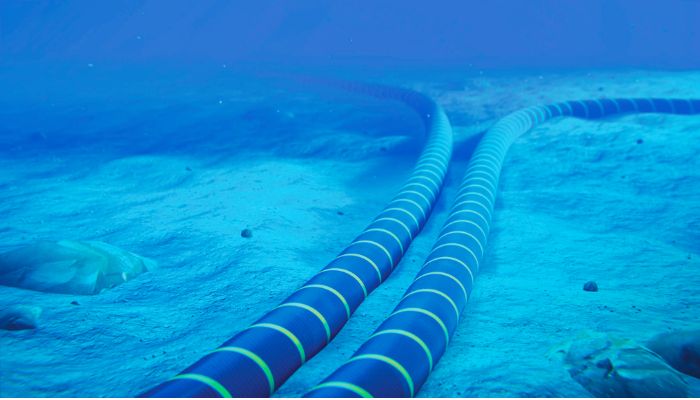
Colloquially called undersea cables, submarine communications cables are fibre-optic lines laid on the seabed to carry the massive amount, nearly 95-99% intercontinental data, voice, and financial traffic. According to various reports and research, there are over 570 active undersea communications cables, while numerous others are planned. The existing undersea cables network spans over 1.5 million kilometres. It is reported that a single modern undersea cable can carry terabits per second, having way more capacity and lower latency than satellites.
These undersea cables underpin global internet and cloud services, international banking and trade, e-commerce, communications, and AI/data centre demands. They are also vital as green energy interconnectors.
In short, without these undersea cables, the modern technology-driven civilisation, with real-time global connectivity, would collapse in affected regions in no time. Though satellites will be the resort in case of undersea cable disruption, they cannot completely compensate because of latency, bandwidth, and coverage limits, particularly for high-volume data.
How undersea cables are laid on the seabed
For the deployment of undersea cables, specialised cable-laying ships, with huge spools holding hundreds of kilometres of cable, are used. The cables are not randomly laid. Such projects undergo proper planning, with routes avoiding fault zones, fishing or anchoring areas, hazards, etc., using detailed seabed maps.
The undersea cables are armoured and buried using ploughs or through remotely-operated vehicles (ROVs). Ploughs are used to create a trench, lay the cable, and then sediment covers it. Since burial is impractical, cables are laid directly on the seabed or the benthic zone.
The cable-laying process begins from the onshore landing stations. The ship used for cable-laying deploys cable gradually while moving. Sometimes, thrusters are used for precision.
Notably, repairing cable disruption is a complex, weather-dependent, expensive and time-consuming task. The repair process often involves grappling the ends, splicing on a ship, and re-laying the cable.
More than 80% of the over 1.3 million kilometres of active submarine fibre optic cables are located in inaccessible deep sea below 1500 m depth, making the repair job even more difficult.
What happens if undersea internet cables are cut
If an undersea cable is cut, fibre strands are severed, disrupting data flow in that segment. Such disruptions cause increased latency, congestion, and slowdowns. Internet blackouts would occur. There would be economic disruptions, affecting finance, business, payments, and services.
Multiple studies show that most of the incidents of damage to undersea cables originate from unintended human activity at sea, such as fishing (38%) and drag anchoring (25%), followed by environmental hazards (14%) like seaquakes or underwater currents.
A 2022 research paper titled “The digital divide in state vulnerability to submarine communications cable failure” studied the impact of undersea cable disruption in affected regions. It cited a case from 2015, wherein the only available submarine cable on the archipelago of the Northern Marianas ruptured. Caused by underwater currents, the rupture disconnected the island from broadband traffic for several days, inflicting significant negatives on the island’s economy and connectivity.
“Cascading effects caused internet, telephone communication, and air traffic to collapse, along with disruptions in the health, tourism, and education sectors. The U.S. overseas territory with 50,000 inhabitants suffered damage amounting to 21 million USD. Small island developing states (SIDS) hardly offer any possibility to operate a cable economically due to their characteristics, such as their remote location, small number of citizens, and below-average GDP, resulting in lower internet usage,” the research paper reads.
One of the first major incidents of undersea cable disruption was reported in 2008, when multiple cables were damaged near the Persian Gulf, particularly in Alexandria, Egypt, and elsewhere. The damage affected millions of lives in West Asia, India, Pakistan, Egypt, etc. There were reports of massive slowdowns and outages, with Egypt losing 80% capacity.
Similar disruptions and aftermaths were reported in the 2022 Tonga incident, wherein the Hunga Tonga-Hunga Ha’apai volcanic eruption caused tsunamis, currents, and debris that severed Tonga’s only international undersea cable. Tonga, a small island nation east of Australia, lost broadband connectivity for weeks, with international repairs taking over five weeks, and domestic repairs taking even longer.
In more recent years, damage to undersea cables has been reported in the Red Sea between 2024 and 2025. Linked to conflict and shipping, damage to undersea cables like AAE-1, EIG, SEACOM, and SMW4 affected traffic between Asia, Europe, the Middle East, and Africa. Although rerouting helped mitigate blanket blackouts, latency issues and disruptions were reported across many countries.
A 2026 National Oceanography Centre (NOC) research found that over 75% faults on island cables happen within 300 kilometres of coastlines. This happens due to both human activity and natural hazards.
While accidental damages caused by human activity or natural disasters remain the major causes of undersea cable disruptions, due to wars, deliberate attacks are moving from being a rarity to a serious threat, jeopardising global connectivity. Besides choosing dialogue over war to resolve disputes, routes diversification, investment in repair fleets, boosting satellite backups, and adhering to international norms are crucial measures to protect global connectivity, since the stakes here are existential.