US senators propose 100% tariffs on Russian oil buyers in new sanctions bill: The hypocritical and capricious American policy
For years, the US has been exporting its inflation to other countries through its monetary policy and dollar-dominance mechanism; however, the country also has a consuetude for exporting blame to others for its own blunders. In a fresh such bid, US senators have introduced a revised bipartisan Russia sanctions bill proposing a 100% tariff on major buyers of Russian oil, including India and China. Russia sanctions bill: From 500% to 100%, US senators push for weaponising tariffs as geopolitical tool On 14th July 2026, a group of US senators introduced an updated version of the earlier proposals, particularly the 2025 Sanctioning Russia Act. Senators Jeanne Shaheen, Richard Blumenthal, and Roger Wicker, among others, held a press conference in Washington to announce the proposal and expressed confidence that the bill has the required senatorial backing and will be passed by August 2026. Breaking: US Senators – backed by Trump – propose hitting India and others with upto 100% tariffs for buying Russian oil BUT their new bill will exempt European allies for purchasing Russian natural gas pic.twitter.com/Swbar8klnV— Shashank Mattoo (@MattooShashank) July 15, 2026 The revised version is widely referred to as the Lindsey Graham Russia Accountability Act, in honour of the late Republican Senator Lindsey Graham who championed the original Sanctioning Russia Act. The Graham-introduced Sanctioning Russia Act of 2025 proposed that “the [US] President must increase the rate of duty on all goods and services imported into the United States from countries that knowingly engage in the exchange of Russian-origin uranium and petroleum products to at least 500% relative to the value of such goods and services.” The original proposed Russia Sanctioning Act of 2025. The Sanctioning Russia Act received lacklustre backing from the Trump administration and failed to advance to a vote due to its extreme provisions. The revised bill, however, narrows tariff provisions against buyers of Russian oil, and proposes authorising the US president to impose tariffs up to 100% on exports from the five largest Russian oil buyers, namely, China, India, Slovakia, Hungary, and Azerbaijan. Reports say that these countries have been described as “targeted” and “narrowly limited”, and not a blanket policy to several other countries in earlier drafts. The updated bill proposes full blocking sanctions on large parts of Russia’s financial, defence and energy sectors, oligarchs and businesspersons. It also includes provisions targeting Russian President Vladimir Putin personally. Furthermore, the bill proposes measures against the shadow fleet of Russian tankers used to evade existing sanctions. The bill includes visa bans, asset freezes, and sanctions on Russian officials, banks, and energy firms. The bill also imposes sanctions on Russia’s shadow fleet of tankers that do not depend on Western maritime services, on Russian financial institutions, including the Central Bank of the Russian Federation, and on Russia’s largest state-owned energy projects, including Yamal LNG and Arctic LNG 1, 2 and 3. The revised bill is America’s fresh attempt at disrupting Moscow’s war economy by penalising nations that help sustain it through oil and gas purchases, while providing the US President with tools to enforce these measures if Russia does not engage favourably in peace talks. The bill’s most interesting provision, however, is the natural gas exception. The Lindsey Graham Russia Accountability Act largely exempted countries importing less than 15% of their total Russian natural gas and actively reducing purchases. This provision is essentially a shrewd carve-out designed to shield most European allies of the US. If the bill gets passed and signed into law, it will hand the US administration new leverage to pressure India, China, and other Russian oil purchasers economically. Though not set 100% automatically, given the Trump administration’s desperate and fickle policy decision-making approach, in case the bill is passed, the US government would want to set maximum possible tariffs to ‘discourage’ Russian energy purchases. Somehow, the Indian mainstream media is portraying the reduction of proposed ‘punishment’ tariffs from 500% to 100% as a “relief”. However, 100%,500%, 1000% or just 10%, the US imposing any tariffs on Indian exports as a ‘penalty’ for buying Russian oil goes beyond the question of burden or relief; it is mindless and steeped in hypocrisy. The original 500% figure was never realistic and so extreme that even many US lawmakers saw it as unworkable. By reducing the proposed tariffs from 500% to 100%, the new bill only made the threat more credible, targeted, and to some extent, workable. By narrowing down specifically to tow five buyers, particularly India and China, the US senators have created a targeted and implementable weapon to hand the Trump administration leverage to arm-twist t
For years, the US has been exporting its inflation to other countries through its monetary policy and dollar-dominance mechanism; however, the country also has a consuetude for exporting blame to others for its own blunders. In a fresh such bid, US senators have introduced a revised bipartisan Russia sanctions bill proposing a 100% tariff on major buyers of Russian oil, including India and China.
Russia sanctions bill: From 500% to 100%, US senators push for weaponising tariffs as geopolitical tool
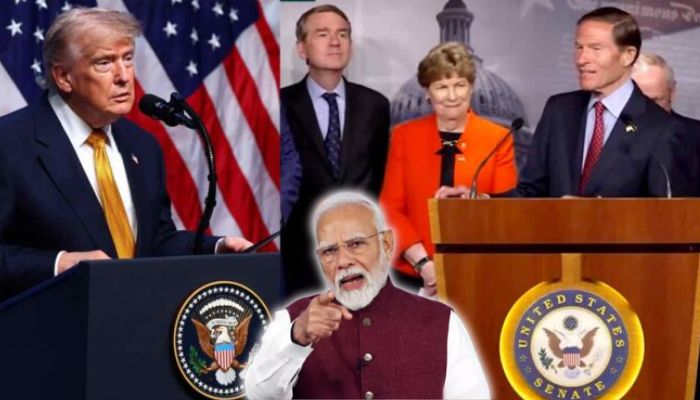
On 14th July 2026, a group of US senators introduced an updated version of the earlier proposals, particularly the 2025 Sanctioning Russia Act. Senators Jeanne Shaheen, Richard Blumenthal, and Roger Wicker, among others, held a press conference in Washington to announce the proposal and expressed confidence that the bill has the required senatorial backing and will be passed by August 2026.
Breaking: US Senators – backed by Trump – propose hitting India and others with upto 100% tariffs for buying Russian oil BUT their new bill will exempt European allies for purchasing Russian natural gas pic.twitter.com/Swbar8klnV— Shashank Mattoo (@MattooShashank) July 15, 2026
The revised version is widely referred to as the Lindsey Graham Russia Accountability Act, in honour of the late Republican Senator Lindsey Graham who championed the original Sanctioning Russia Act.
The Graham-introduced Sanctioning Russia Act of 2025 proposed that “the [US] President must increase the rate of duty on all goods and services imported into the United States from countries that knowingly engage in the exchange of Russian-origin uranium and petroleum products to at least 500% relative to the value of such goods and services.”
The original proposed Russia Sanctioning Act of 2025.
The Sanctioning Russia Act received lacklustre backing from the Trump administration and failed to advance to a vote due to its extreme provisions.
The revised bill, however, narrows tariff provisions against buyers of Russian oil, and proposes authorising the US president to impose tariffs up to 100% on exports from the five largest Russian oil buyers, namely, China, India, Slovakia, Hungary, and Azerbaijan.
Reports say that these countries have been described as “targeted” and “narrowly limited”, and not a blanket policy to several other countries in earlier drafts.
The updated bill proposes full blocking sanctions on large parts of Russia’s financial, defence and energy sectors, oligarchs and businesspersons. It also includes provisions targeting Russian President Vladimir Putin personally.
Furthermore, the bill proposes measures against the shadow fleet of Russian tankers used to evade existing sanctions. The bill includes visa bans, asset freezes, and sanctions on Russian officials, banks, and energy firms. The bill also imposes sanctions on Russia’s shadow fleet of tankers that do not depend on Western maritime services, on Russian financial institutions, including the Central Bank of the Russian Federation, and on Russia’s largest state-owned energy projects, including Yamal LNG and Arctic LNG 1, 2 and 3.
The revised bill is America’s fresh attempt at disrupting Moscow’s war economy by penalising nations that help sustain it through oil and gas purchases, while providing the US President with tools to enforce these measures if Russia does not engage favourably in peace talks.
The bill’s most interesting provision, however, is the natural gas exception. The Lindsey Graham Russia Accountability Act largely exempted countries importing less than 15% of their total Russian natural gas and actively reducing purchases.
This provision is essentially a shrewd carve-out designed to shield most European allies of the US.
If the bill gets passed and signed into law, it will hand the US administration new leverage to pressure India, China, and other Russian oil purchasers economically. Though not set 100% automatically, given the Trump administration’s desperate and fickle policy decision-making approach, in case the bill is passed, the US government would want to set maximum possible tariffs to ‘discourage’ Russian energy purchases.
Somehow, the Indian mainstream media is portraying the reduction of proposed ‘punishment’ tariffs from 500% to 100% as a “relief”. However, 100%,500%, 1000% or just 10%, the US imposing any tariffs on Indian exports as a ‘penalty’ for buying Russian oil goes beyond the question of burden or relief; it is mindless and steeped in hypocrisy.
The original 500% figure was never realistic and so extreme that even many US lawmakers saw it as unworkable. By reducing the proposed tariffs from 500% to 100%, the new bill only made the threat more credible, targeted, and to some extent, workable.
By narrowing down specifically to tow five buyers, particularly India and China, the US senators have created a targeted and implementable weapon to hand the Trump administration leverage to arm-twist targeted countries.
The bill enjoys substantial support, with over 80 Senate co-sponsors, and is expected to advance quickly towards a vote.
It is notable, however, that the new Russian sanctions bill, if passed, would authorise the US President to impose up to 100% tariffs on the five countries, and not make them mandatory or come into effect automatically. This law would grant the President legal room to impose tariffs or grant waivers or exemptions.
This would be more feasible given the US Supreme Court previously struck down Trump’s sweeping global tariffs, ruling that he exceeded his authority by invoking a 1977 emergency powers law to impose duties on imports from nearly every trading partner worldwide.
Even if the Trump administration does not impose a full 100% tariff, the law, if passed, would create a permanent legal authority to threaten and influence negotiating terms while dealing with the targeted countries. India and the US are engaged in extensive talks for a bilateral trade deal; imposition of a 100% tariff on Indian exports to the US would put pressure on India to demonstrate a meaningful reduction in Russian oil purchases to secure an exemption.
However, given the Indian government stands its ground firmly when it comes to strategic autonomy and freedom to buy energy from whichever source, a fresh impasse could emerge in the much-anticipated trade deal.
As long as India remains in the crosshairs of this abject blame game-driven tariff threat, there is no sign of relief.
From requesting India to buy Russian oil to ‘punishing’ it for the same: American hypocrisy knows no bounds
It is a fact that India’s purchase of discounted Russian energy increased dramatically after the war broke out in Ukraine in 2022. Though not essentially due to American threats or pressure, India has in recent years diversified its energy sources, and so has Europe, which was heavily dependent on Russian energy earlier.
However, the US senators specifically exempted natural gas from the bill, knowing that despite reductions, the European Union remains the largest buyer of Russian Liquefied Natural Gas (LNG). It is a clear case of selective targeting.
After failing to secure India’s endorsement for his imaginary role in stopping the India-Pakistan conflict in May last year, Donald Trump directed his frustration over failing to secure a ceasefire between Russia and Ukraine towards India. Grappling with criticism and embarrassment for failing to end the Russia-Ukraine war despite promises of ending the war within 24 hours of assuming office as US President, Trump first imposed ‘reciprocal’ tariffs and doubled tariffs on India to 50%. The 25% addition was a punitive tariff for buying Russian oil.
Trump unleashed his officials, including Peter Navarro, Scott Bessent, and Havard Lutnick, to launch rhetorical attacks on India and Indian refiners and portray New Delhi as the financier of Russia’s war against Ukraine.
This mindless vilification and tariff tirade came even as the same US, though under the Biden administration, requested and even praised India for buying Russian oil as it helped moderate global energy prices by keeping supplies flowing into international markets, including the EU.
Then-US Ambassador to India Eric Garcetti had publicly acknowledged that the US wanted India to buy Russian oil at the G7-introduced capped price. “They bought Russian oil because we wanted somebody to buy Russian oil at a price cap… That was not a violation… It was actually the design of the policy because… we didn’t want the oil prices going up,” he said.
Clearly, when the US needed India to play the anchor role and keep the oil flowing globally, Indian Russian oil purchases were good and necessary. However, when the US failed to secure even a ceasefire, let alone permanent cessation of hostilities between Russia and Ukraine, Washington conveniently labelled India as the “financier” of the Russian war against Ukraine.
In the interim, the US itself continued to import fertilisers, uranium, palladium, and base metals, among other products from Russia, saying that these products are critical for American industries and hard to replace. OpIndia has reported earlier how the same US that accused India of profiteering from the Russia-Ukraine war is itself the biggest beneficiary of the prolonged war.
The US essentially projected its own failure to effectively counter Russia’s alternate tactics to dodge sanctions via shadow fleet, deeper discounts, etc, on India.
However, as India-US trade deal talks advanced, things began to ease between the two countries and by February 2026, the US lowered its effective tariff rates on most Indian goods to 18% and removed the 25% Russian-oil penalty, issued Reliance a general license to buy Venezuelan crude directly, and also announced a sanctions ‘waiver’ for Russian oil purchases. The Modi government, however, made it clear that New Delhi will continue buying Russian oil regardless of whether America allows India to do so or not.
This American policy shift, however, was not driven by any epiphany but by changed global circumstances. As the US and Israel attacked Iran, the West Asian nation blockaded the Strait of Hormuz, the global energy chokehold. As energy prices soured, and the US faced domestic and global criticism for starting a war without chalking out a plan to navigate an inevitable energy crisis, Washington turned to the same ‘financier of the Russian war machine’, India.
The new Russia sanctions bill targeting India, and other major buyers of Russian oil, if passed, would risk straining India-US ties, already marred by a trust deficit. With the 100% tariffs proposal, the US policymakers are once again attempting to export the blame for its failure to negotiate an end to the Russia-Ukraine war on India and China.
Since the senators have explicitly stated that they reached an agreement with the Trump administration to move the legalisation forward, the US President will likely sign the bill if it reaches his desk, if Congress passes it. Undoubtedly, Trump would be delighted to use tariffs as a geopolitical weapon against Russia and buyers of Russian energy.