Meet the ‘Dolphin Hunter’: Read how the Indian Navy’s Anjadip will guard the country’s shallow waters and improve coastal security
The Indian Navy’s Anti-Submarine Warfare (ASW) capabilities are soon going to receive a significant push after the commissioning of “Anjadip,” the third member of the Arnala-class eight-vessel ASW Shallow Water Craft (SWC) series. Admiral Dinesh K. Tripathi, Chief of the Naval Staff, is scheduled to preside over the event on 27th February(Friday) when the warship will officially join the Eastern Naval Command at Chennai Port. The Navy has planned to put the second next-generation destroyer into service with the goal of finding enemy submarines in shallow waters. The state-of-the-art marvel was created especially to handle the difficulties of the littoral warfare environment, which includes the shallow and coastal waters that are critical to the security of the country. The ship is intended to operate as a “Dolphin Hunter,” whose primary mission is to locate, track and destroy enemy submarines in coastal regions. INDIAN NAVY TO COMMISSION ANJADIPThe Indian Navy is set to enhance its Anti-Submarine Warfare (ASW) capabilities with the commissioning of Anjadip, the third vessel of the eight-ship Anti-Submarine Warfare Shallow Water Craft (ASW-SWC) project. The warship will be formally… pic.twitter.com/XskjKT60I2— PIB India (@PIB_India) February 23, 2026 “The ship is a reincarnation of the erstwhile INS (Indian Naval Ship) Anjadip, a Petya class Corvette decommissioned in 2003. The ship derives its name from Anjadip Island located off the coast of Karwar, Karnataka, underscoring India’s commitment to safeguarding its expansive maritime domain,” the Navy outlined. It further highlighted, “The Shankh symbolises divine energy, purity and the sound of creation. Anjadip’s operational prowess – encompassing its Anti-Submarine Capabilities is powerfully encapsulated by its motto – Seek the enemy, and be ever victorious.” The ship, which was delivered to the Indian Navy on 22nd December in Chennai, has been designed and built locally by Garden Reach Shipbuilders and Engineers (GRSE), Kolkata. #Anjadip – ‘Dolphin Hunters’ Unveiling the crest of Anjadip, the third ship of the eight ASW-SWC built by @OfficialGRSE.The Shankh symbolises divine energy, purity, and the sound of creation.Anjadip’s operational prowess – encompassing its Anti-SubmarineCapabilities is… pic.twitter.com/FuATfzsQRI— SpokespersonNavy (@indiannavy) February 23, 2026 “The ASW SWC ships have been designed and constructed as per the Classification Rules of Indian Register of Shipping (IRS) under a Public-Private-Partnership (PPP) of GRSE with M/s L&T (Larsen & Toubro) Shipyard, Kattupalli, thus demonstrating the success of collaborative defence manufacturing,” the Navy informed. The ship’s prominent features and capacities These vessels, which are about 77 metres long and powered by waterjets, are the biggest Indian Naval Warships. They are outfitted with cutting-edge lightweight torpedoes, indigenous anti-submarine rockets and shallow water sonar, which enable the efficient identification and confrontation of underwater threats. The ship would boost the Navy’s minelaying, coastal surveillance and anti-submarine capabilities. It features ASW weaponry and sensor packages, including the Hull-Mounted Sonar Abhay. The agile and exceptionally manoeuvrable battleship is capable of performing search and rescue missions and Low-Intensity Maritime Operations (LIMO) in addition to its core ASW task. With its high-speed Water-Jet Propulsion system, it can reach a maximum speed of 25 knots for swift response and uninterrupted operation. It can be employed for both military and humanitarian purposes due to these attributes. The official statement declared, “Anjadip’s delivery is yet another milestone in the Indian Navy’s quest for indigenous shipbuilding, ng upholding the government’s vision of Aatmanirbhar Bharat with over 80% indigenous content. The ship stands as a testament to a growing domestic defence manufacturing ecosystem and reducing dependency on imports.” The Defence Acquisition Council (DAC) approved the purchase of 16 ASW ships in December 2013 at a cost of more than Rs 13,000 crore. Furthermore, contracts for the production of 16 ASW SWC were signed. Cochin Shipyard Limited is to construct 8 of these Mahe-class ships, while the remaining Arnala-class would be made by GRSE. The recently commissioned Mahe, Malvan, Mangrol, Malpe, Mulki, Magdala and Machilipatnam are parts ofthe formero,rmer while Arnala, Androth, Anjadip, Amini, Abhay, Agray, Ajay, and Akshay constitute the latter. The success of indigenous warship design and building is best demonstrated by this substantial project. A golden feather in the “Made-in-India” cap Notably, coastal surveillance is crucial for Anti-Submarine Warfare (ASW) operations in India because of its vast 7,516-kilometre coastline, 12 major ports, 184 smaller ports and 1,197 island territories. Therefore, ASW SWC inductions are helping the Navy fill a prolonged operation
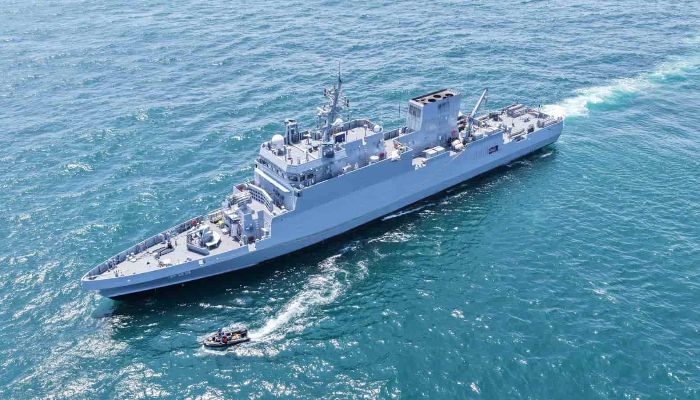
The Indian Navy’s Anti-Submarine Warfare (ASW) capabilities are soon going to receive a significant push after the commissioning of “Anjadip,” the third member of the Arnala-class eight-vessel ASW Shallow Water Craft (SWC) series.
Admiral Dinesh K. Tripathi, Chief of the Naval Staff, is scheduled to preside over the event on 27th February(Friday) when the warship will officially join the Eastern Naval Command at Chennai Port. The Navy has planned to put the second next-generation destroyer into service with the goal of finding enemy submarines in shallow waters.
The state-of-the-art marvel was created especially to handle the difficulties of the littoral warfare environment, which includes the shallow and coastal waters that are critical to the security of the country. The ship is intended to operate as a “Dolphin Hunter,” whose primary mission is to locate, track and destroy enemy submarines in coastal regions.
INDIAN NAVY TO COMMISSION ANJADIPThe Indian Navy is set to enhance its Anti-Submarine Warfare (ASW) capabilities with the commissioning of Anjadip, the third vessel of the eight-ship Anti-Submarine Warfare Shallow Water Craft (ASW-SWC) project. The warship will be formally… pic.twitter.com/XskjKT60I2— PIB India (@PIB_India) February 23, 2026
“The ship is a reincarnation of the erstwhile INS (Indian Naval Ship) Anjadip, a Petya class Corvette decommissioned in 2003. The ship derives its name from Anjadip Island located off the coast of Karwar, Karnataka, underscoring India’s commitment to safeguarding its expansive maritime domain,” the Navy outlined.
It further highlighted, “The Shankh symbolises divine energy, purity and the sound of creation. Anjadip’s operational prowess – encompassing its Anti-Submarine Capabilities is powerfully encapsulated by its motto – Seek the enemy, and be ever victorious.”
The ship, which was delivered to the Indian Navy on 22nd December in Chennai, has been designed and built locally by Garden Reach Shipbuilders and Engineers (GRSE), Kolkata.
#Anjadip – ‘Dolphin Hunters’ Unveiling the crest of Anjadip, the third ship of the eight ASW-SWC built by @OfficialGRSE.The Shankh symbolises divine energy, purity, and the sound of creation.Anjadip’s operational prowess – encompassing its Anti-SubmarineCapabilities is… pic.twitter.com/FuATfzsQRI— SpokespersonNavy (@indiannavy) February 23, 2026
“The ASW SWC ships have been designed and constructed as per the Classification Rules of Indian Register of Shipping (IRS) under a Public-Private-Partnership (PPP) of GRSE with M/s L&T (Larsen & Toubro) Shipyard, Kattupalli, thus demonstrating the success of collaborative defence manufacturing,” the Navy informed.
The ship’s prominent features and capacities
These vessels, which are about 77 metres long and powered by waterjets, are the biggest Indian Naval Warships. They are outfitted with cutting-edge lightweight torpedoes, indigenous anti-submarine rockets and shallow water sonar, which enable the efficient identification and confrontation of underwater threats. The ship would boost the Navy’s minelaying, coastal surveillance and anti-submarine capabilities.
It features ASW weaponry and sensor packages, including the Hull-Mounted Sonar Abhay. The agile and exceptionally manoeuvrable battleship is capable of performing search and rescue missions and Low-Intensity Maritime Operations (LIMO) in addition to its core ASW task. With its high-speed Water-Jet Propulsion system, it can reach a maximum speed of 25 knots for swift response and uninterrupted operation. It can be employed for both military and humanitarian purposes due to these attributes.
The official statement declared, “Anjadip’s delivery is yet another milestone in the Indian Navy’s quest for indigenous shipbuilding, ng upholding the government’s vision of Aatmanirbhar Bharat with over 80% indigenous content. The ship stands as a testament to a growing domestic defence manufacturing ecosystem and reducing dependency on imports.”
The Defence Acquisition Council (DAC) approved the purchase of 16 ASW ships in December 2013 at a cost of more than Rs 13,000 crore. Furthermore, contracts for the production of 16 ASW SWC were signed. Cochin Shipyard Limited is to construct 8 of these Mahe-class ships, while the remaining Arnala-class would be made by GRSE.
The recently commissioned Mahe, Malvan, Mangrol, Malpe, Mulki, Magdala and Machilipatnam are parts ofthe formero,rmer while Arnala, Androth, Anjadip, Amini, Abhay, Agray, Ajay, and Akshay constitute the latter. The success of indigenous warship design and building is best demonstrated by this substantial project.
A golden feather in the “Made-in-India” cap
Notably, coastal surveillance is crucial for Anti-Submarine Warfare (ASW) operations in India because of its vast 7,516-kilometre coastline, 12 major ports, 184 smaller ports and 1,197 island territories. Therefore, ASW SWC inductions are helping the Navy fill a prolonged operational gap by offering the vital strength for spotting and deterring stealthy diesel-electric submarines moving along the shore, an area that is inaccessible to bigger surface warships.
They are key to protecting harbour approaches, sea lanes connecting to main ports, offshore energy assets and operational bases, which are vulnerable and economically important marine assets because of their low draught, excellent sonars and great mobility.
The Indian Navy’s ability to protect the nation’s extensive marine interests and coastal approaches, such as the Tamil Nadu and Puducherry region, has been presently reinforced by Anjadip’s deployment. This accomplishment is yet another important step in making the Navy a powerful “Builder’s Navy.”
Similarly, India’s continuous efforts to become self-sufficient in shipbuilding and defence technology are reflected in the launch of Anjadip. The ASW SWC program also shows the nation’s dedication to generating innovative military platforms in the country through homegrown design, manufacture and advanced systems integration.