Indonesia bets big on Indian manufacturing: Mahindra and Ashok Leyland deals mark a significant leap in Make In India’s success story
Two recent deals announced in early February 2026 involving Mahindra & Mahindra’s largest-ever export order and Ashok Leyland’s defence and EV partnership signed a clear shift in India’s manufacturing story. What Indonesia is buying is not just vehicles but Indian-built systems designed to run at scale. The message is unmistakable that Make in India has moved from aspiration to international credibility. Mahindra’s 35,000-vehicle order: A rural logistics game-changer Mahindra & Mahindra has landed its biggest export deal to date, announcing the supply of 35000 pickup vehicles to Indonesia in 2026. The order was issued and placed by Indonesian state-owned enterprise Agrinas Pangan Nusantara for the Koperasi Desa/Kelurahan Merah Putih (KDKMP) project. It is notable as it surpasses Mahindra’s total vehicle exports in FY25, underscoring the scale and strategic nature of the deal. We are delighted to announce Mahindras largest ever export order of 35000 Scorpio Pickups for Indonesia to be delivered through 2026 . These pickups will be made at our Nasik plant in Maharashtra.This is truly a make in India for the world moment and we would like to thank…— Rajesh Jejurikar (@rajesh664) February 4, 2026 The truck will be distributed throughout Indonesia’s village-level cooperative (Koperasi) to improve rural logistics and supply chain efficiency. It is designed to function in harsh rural environments; the Scorpio pickups will handle first-mile aggregation by transporting produce directly from farms to cooperatives, as well as support intra-village movement of goods. This is projected to reduce post-harvest losses, increase farmers’ market access, and allow for more efficient distribution of key goods. The Scorpio LCV, manufactured entirely in India at Mahindra’s Nashik facility, is world-renowned for its durable design, high payload capacity, and low running costs, all of which are critical for large-scale rural deployment. The vehicles for the Indonesian project have been modified to fit local operating needs, such as rugged country roads and agricultural paths, making them ideal for long-term, high-utilisation operation. Beyond its business value, the transaction has broader strategic implications. It portrays Mahindra as a reliable mobility partner in Indonesia’s national development goal while also emphasising India’s expanding role as a provider of scalable, made-in-India mobility solutions. The deal also provides a significant boost to Mahindra’s international operations, bolstering India’s manufacturing reputation in foreign markets and increasing the worldwide footprint of the Make in India effort. Ashok Leyland and PT Pindad: From exports to co-development Ashok Leyland has signed a strategic MoU with PT Pindad, Indonesia’s government-owned defence and industrial company, going beyond traditional exports. The agreement focuses on the combined development and production of electric buses and defence vehicles that are specifically adapted to Indonesia’s mobility and national security needs. Unlike a typical buyer-seller contract, the collaboration focuses on co-development. Ashok Leyland brings competence in commercial vehicles, electric mobility and defence platforms, while PT Pindad provides local technical capabilities, manufacturing facilities, and deep integration with Indonesia’s defence ecosystem. The end result is a strategy that integrates Indian technology into locally made platforms, aligning with Indonesia’s goal of self-reliance. Ashok Leyland signs a landmark Memorandum of Understanding (MoU) with PT Pindad, Indonesia’s premier state-owned defence and industrial equipment manufacturer. The agreement, signed at Pindad’s headquarters in Bandung, marks a major milestone in strengthening bilateral… pic.twitter.com/HuJkOtVETi— Ashok Leyland (@ALIndiaOfficial) February 4, 2026 The MoU was signed in the presence of Prof. Sigit P. Santosa, CEO of PT Pindad; Mr Amandeep Singh, President of International Operations, Defence, LCV, and PSB at Ashok Leyland; and Lord Tariq, Advisor to the Board of Hinduja Auto, on 4th February 2026. A key pillar of the partnership is Switch Mobility, Ashok Leyland’s electric mobility subsidiary. Switch Mobility has created electric bus platforms with global applications; under this MoU, these platforms will be tailored to Indonesia’s geography, climate, infrastructure, and operational requirements. The electric buses are designed to help Indonesia shift to clean, energy-efficient public transportation, lowering emissions and boosting urban mobility. On the defence side, the collaboration focuses on tactical and military vehicles, which are strategically important. Co-development of defence vehicles demonstrates a high level of trust by sharing design expertise, performance criteria, and operational know-how. For Indonesia, it supports the goal of locally made defence platforms. For India, it indicates rising acceptance of Indian def
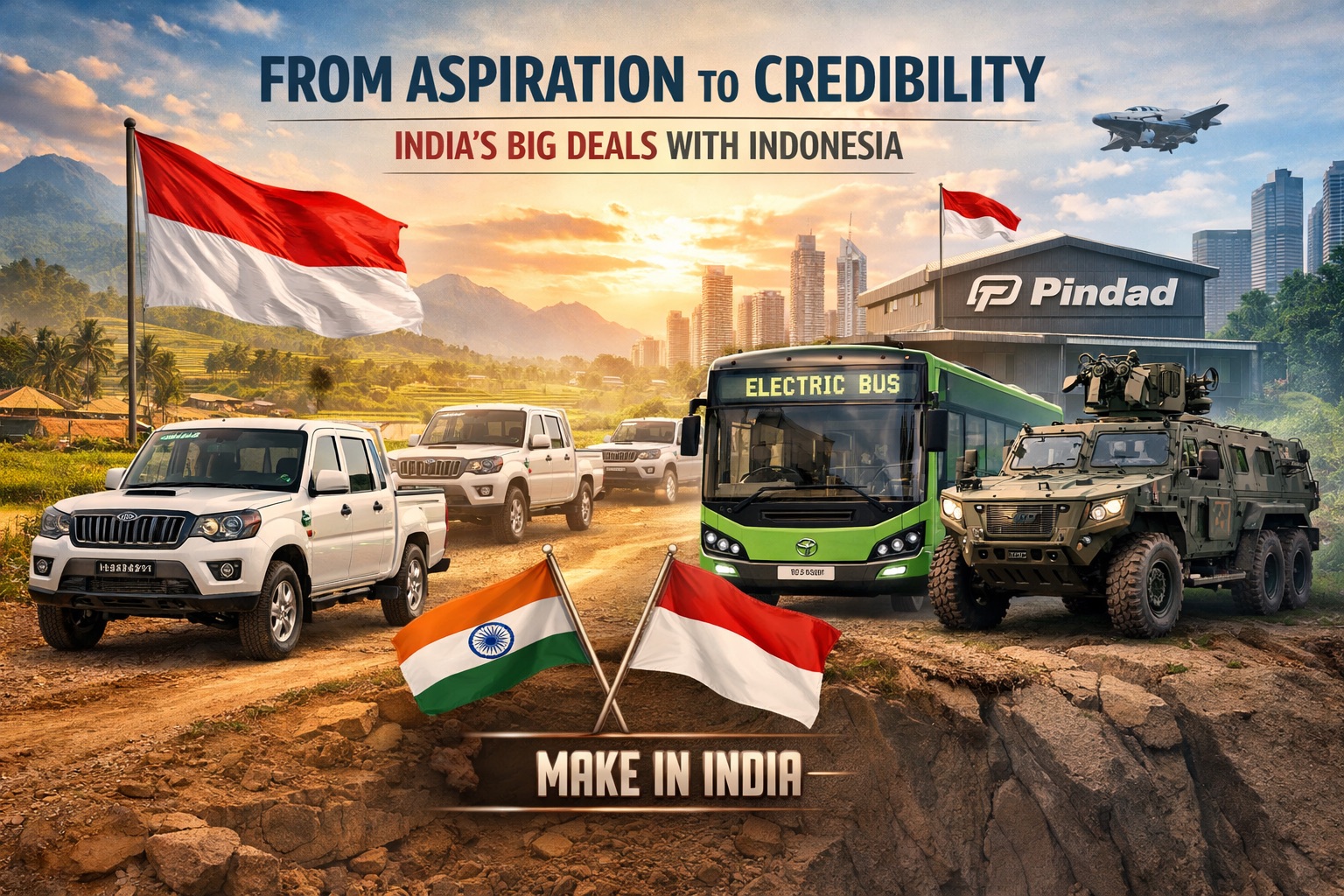

Two recent deals announced in early February 2026 involving Mahindra & Mahindra’s largest-ever export order and Ashok Leyland’s defence and EV partnership signed a clear shift in India’s manufacturing story. What Indonesia is buying is not just vehicles but Indian-built systems designed to run at scale. The message is unmistakable that Make in India has moved from aspiration to international credibility.
Mahindra’s 35,000-vehicle order: A rural logistics game-changer
Mahindra & Mahindra has landed its biggest export deal to date, announcing the supply of 35000 pickup vehicles to Indonesia in 2026. The order was issued and placed by Indonesian state-owned enterprise Agrinas Pangan Nusantara for the Koperasi Desa/Kelurahan Merah Putih (KDKMP) project. It is notable as it surpasses Mahindra’s total vehicle exports in FY25, underscoring the scale and strategic nature of the deal.
We are delighted to announce Mahindras largest ever export order of 35000 Scorpio Pickups for Indonesia to be delivered through 2026 . These pickups will be made at our Nasik plant in Maharashtra.This is truly a make in India for the world moment and we would like to thank…
— Rajesh Jejurikar (@rajesh664) February 4, 2026
The truck will be distributed throughout Indonesia’s village-level cooperative (Koperasi) to improve rural logistics and supply chain efficiency. It is designed to function in harsh rural environments; the Scorpio pickups will handle first-mile aggregation by transporting produce directly from farms to cooperatives, as well as support intra-village movement of goods. This is projected to reduce post-harvest losses, increase farmers’ market access, and allow for more efficient distribution of key goods.
The Scorpio LCV, manufactured entirely in India at Mahindra’s Nashik facility, is world-renowned for its durable design, high payload capacity, and low running costs, all of which are critical for large-scale rural deployment. The vehicles for the Indonesian project have been modified to fit local operating needs, such as rugged country roads and agricultural paths, making them ideal for long-term, high-utilisation operation.
Beyond its business value, the transaction has broader strategic implications. It portrays Mahindra as a reliable mobility partner in Indonesia’s national development goal while also emphasising India’s expanding role as a provider of scalable, made-in-India mobility solutions. The deal also provides a significant boost to Mahindra’s international operations, bolstering India’s manufacturing reputation in foreign markets and increasing the worldwide footprint of the Make in India effort.
Ashok Leyland and PT Pindad: From exports to co-development
Ashok Leyland has signed a strategic MoU with PT Pindad, Indonesia’s government-owned defence and industrial company, going beyond traditional exports. The agreement focuses on the combined development and production of electric buses and defence vehicles that are specifically adapted to Indonesia’s mobility and national security needs.
Unlike a typical buyer-seller contract, the collaboration focuses on co-development. Ashok Leyland brings competence in commercial vehicles, electric mobility and defence platforms, while PT Pindad provides local technical capabilities, manufacturing facilities, and deep integration with Indonesia’s defence ecosystem. The end result is a strategy that integrates Indian technology into locally made platforms, aligning with Indonesia’s goal of self-reliance.
Ashok Leyland signs a landmark Memorandum of Understanding (MoU) with PT Pindad, Indonesia’s premier state-owned defence and industrial equipment manufacturer. The agreement, signed at Pindad’s headquarters in Bandung, marks a major milestone in strengthening bilateral… pic.twitter.com/HuJkOtVETi
— Ashok Leyland (@ALIndiaOfficial) February 4, 2026
The MoU was signed in the presence of Prof. Sigit P. Santosa, CEO of PT Pindad; Mr Amandeep Singh, President of International Operations, Defence, LCV, and PSB at Ashok Leyland; and Lord Tariq, Advisor to the Board of Hinduja Auto, on 4th February 2026.
A key pillar of the partnership is Switch Mobility, Ashok Leyland’s electric mobility subsidiary. Switch Mobility has created electric bus platforms with global applications; under this MoU, these platforms will be tailored to Indonesia’s geography, climate, infrastructure, and operational requirements. The electric buses are designed to help Indonesia shift to clean, energy-efficient public transportation, lowering emissions and boosting urban mobility.
On the defence side, the collaboration focuses on tactical and military vehicles, which are strategically important. Co-development of defence vehicles demonstrates a high level of trust by sharing design expertise, performance criteria, and operational know-how. For Indonesia, it supports the goal of locally made defence platforms. For India, it indicates rising acceptance of Indian defence mobility solutions in international markets.
Strategically, the MoU represents a significant shift in how Indian manufacturing is seen abroad. Ashok Leyland does not present itself as a low-cost exporter but rather as a technological partner capable of developing future-ready mobility and defence solutions. For Make in India, this agreement reinforces a clear message: Indian companies are increasingly co-creating complex systems abroad rather than simply delivering finished items.
Why this is big for Make In India
Taken together, the Mahindra and Ashok Leyland purchases represent a watershed moment for Make in India. Vehicles designed and constructed in India are already powering foreign national initiatives ranging from Indonesia’s village-level logistics network to its public transportation and defence mobility plans. It demonstrates that Indian manufacturing operates on a national scale abroad rather than simply satisfying overseas orders. The emphasis has switched from exporting finished goods to exporting capabilities. Mahindra produces durable, cost-effective vehicles for widespread rural deployment, while Ashok Leyland introduces EV platforms and defence mobility knowledge into domestic manufacture. Crucially, Indian businesses are increasingly viewed as dependable long-term partners rather than low-cost alternatives, as evidenced by extensive partnerships on electric and defence vehicles, which demand faith in engineering quality and lifetime support. Together, these transactions show that Make in India now competes on scale, trust, and technology, indicating a shift from a local manufacturing mantra to a globally certified industrial competency.
Conclusion
From improving rural logistics to enabling electric mobility and co-developing defence platforms, India is moulding full-fledged mobility ecosystems around the world rather than just exporting vehicles. The Mahindra and Ashok Leyland deals mark a significant shift in how the Indian industry is seen abroad. Make in India has advanced beyond size to credibility, and its adoption by countries such as Indonesia is not a coincidence, but a determined strategic decision.