India’s golden economic year: Read how 2025 delivered high growth, low inflation, falling unemployment and bold reforms under PM Modi
The year 2025 proved to be a golden chapter in India’s economic journey. Despite global trade uncertainties, geopolitical tensions, and fears of an economic slowdown, India, driven by strong domestic demand, visionary policies, and bold reforms, not only maintained stability but also achieved new heights. Whether it was India’s growing military confidence reflected in Operation Sindoor or its expanding economic strength, the country continued to move forward steadily under the leadership of Prime Minister Narendra Modi. The year reinforced India’s image as a nation charting its own course, even in a challenging global environment. GDP growth touches a multi-quarter high According to official data, gross domestic product (GDP) growth in the second quarter (July-September 2025) of fiscal year 2025-26 was recorded at 8.2%, the highest in the last six quarters. This is significantly higher than 5.6% in the same quarter last year and 7.8% in the previous quarter. This strong performance has kept India at the top of the world’s fastest-growing major economies. India’s GDP has now reached US$4.18 trillion, making it the world’s fourth-largest economy, surpassing Japan. Economists believe that at the current pace, India could surpass Germany in the next 2.5 to 3 years to become the world’s third-largest economy. Projections suggest that India’s GDP could reach $7.3 trillion by 2030. Domestic consumption and reforms drive growth But the biggest factor has been strong private consumption, continuously acting as the backbone of the country’s economy. With increased income, improved consumer confidence, and lower inflation, household spending has increased. Meanwhile, the government’s emphasis on capital expenditure along with reforms like GST rationalization and simplification of income tax helped strengthen demand across sectors. Also, seeing broad-based momentum, the Reserve Bank of India revised upwards its GDP growth forecast for FY 2025-26 from 6.8% to 7.3%. Global agencies remain optimistic about India International institutions have also expressed similar optimism over India’s economic outlook. The World Bank projects 6.5% growth for 2026, while Moody’s estimated the country to grow 6.4% in 2026 and 6.5% in 2027, retaining its lead as the fastest-growing G20 economy. Where the International Monetary Fund IMF had revised its forecast upwards to 6.6% for the year 2025 and 6.2% for 2026, the OECD now sees growth of 6.7% this year, 6.2% next year, whereas S&P Global expects growth of 6.5% this year and 6.7% next year. The Asian Development Bank (ADB) raised its 2025 projection to 7.2%, and Fitch Ratings upgraded its FY26 forecast to 7.4%, citing strong consumer demand. These projections place India at the top among G20 nations. Three pillars of growth: Speed, Stability and Confidence Three key pillars have emerged in this development journey: high growth, stability, and confidence. Amid global trade uncertainties, India’s domestic demand has supported the economy. High-frequency indicators such as the Purchasing Managers’ Index (PMI), credit growth, and urban consumption are all showing positive signs. Strong credit flows to the commercial sector and strengthening corporate balance sheets have encouraged investment. Inflation falls sharply, offering major relief to households One of the most significant developments of 2025 was the sharp fall in inflation, providing much-needed relief to ordinary citizens. CPI-based inflation fell from 4.26% in January 2025 to just 0.71% by November, marking a multi-year low. This was well below the RBI’s target of 4% (±2%). The biggest reason was a drop in food prices, especially vegetables, pulses and grains. Food inflation turned negative at -3.91% in November. The RBI revised its inflation forecast for FY 2025–26 down from 2.6% to 2.0%. Wholesale price inflation (WPI) also stayed in negative territory at -0.32% in November. This benign inflation environment allowed the RBI to cut the repo rate by 25 basis points to 5.25%, creating what economists describe as a rare “Goldilocks phase”, strong growth with low inflation. Lower inflation helped boost household savings, support consumption and gave policymakers greater flexibility. Unemployment falls to a multi-month low as jobs increase Unemployment and the pace of economic activity are two sides of the same coin and complement each other. As growth accelerates, greater production of goods and services increases demand for labor, creating more employment opportunities and reducing unemployment. In this context, India’s declining unemployment rate reflects the strength of its economic momentum . Given the sustainability of growth, India’s improving employment outcomes demonstrate a good synergy between sustained growth and job creation. According to the Periodic Labour Force Survey (PLFS), the unemployment rate for women aged 15 and over fell to
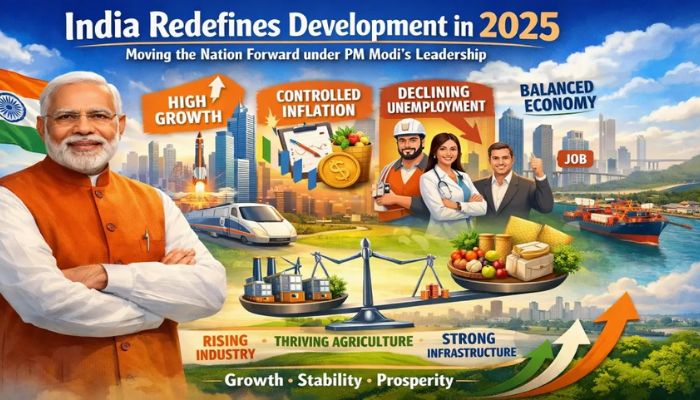

The year 2025 proved to be a golden chapter in India’s economic journey. Despite global trade uncertainties, geopolitical tensions, and fears of an economic slowdown, India, driven by strong domestic demand, visionary policies, and bold reforms, not only maintained stability but also achieved new heights.
Whether it was India’s growing military confidence reflected in Operation Sindoor or its expanding economic strength, the country continued to move forward steadily under the leadership of Prime Minister Narendra Modi. The year reinforced India’s image as a nation charting its own course, even in a challenging global environment.
GDP growth touches a multi-quarter high
According to official data, gross domestic product (GDP) growth in the second quarter (July-September 2025) of fiscal year 2025-26 was recorded at 8.2%, the highest in the last six quarters. This is significantly higher than 5.6% in the same quarter last year and 7.8% in the previous quarter.
This strong performance has kept India at the top of the world’s fastest-growing major economies. India’s GDP has now reached US$4.18 trillion, making it the world’s fourth-largest economy, surpassing Japan.
Economists believe that at the current pace, India could surpass Germany in the next 2.5 to 3 years to become the world’s third-largest economy. Projections suggest that India’s GDP could reach $7.3 trillion by 2030.
Domestic consumption and reforms drive growth
But the biggest factor has been strong private consumption, continuously acting as the backbone of the country’s economy. With increased income, improved consumer confidence, and lower inflation, household spending has increased.
Meanwhile, the government’s emphasis on capital expenditure along with reforms like GST rationalization and simplification of income tax helped strengthen demand across sectors.
Also, seeing broad-based momentum, the Reserve Bank of India revised upwards its GDP growth forecast for FY 2025-26 from 6.8% to 7.3%.
Global agencies remain optimistic about India
International institutions have also expressed similar optimism over India’s economic outlook. The World Bank projects 6.5% growth for 2026, while Moody’s estimated the country to grow 6.4% in 2026 and 6.5% in 2027, retaining its lead as the fastest-growing G20 economy.
Where the International Monetary Fund IMF had revised its forecast upwards to 6.6% for the year 2025 and 6.2% for 2026, the OECD now sees growth of 6.7% this year, 6.2% next year, whereas S&P Global expects growth of 6.5% this year and 6.7% next year.
The Asian Development Bank (ADB) raised its 2025 projection to 7.2%, and Fitch Ratings upgraded its FY26 forecast to 7.4%, citing strong consumer demand. These projections place India at the top among G20 nations.
Three pillars of growth: Speed, Stability and Confidence
Three key pillars have emerged in this development journey: high growth, stability, and confidence. Amid global trade uncertainties, India’s domestic demand has supported the economy.
High-frequency indicators such as the Purchasing Managers’ Index (PMI), credit growth, and urban consumption are all showing positive signs. Strong credit flows to the commercial sector and strengthening corporate balance sheets have encouraged investment.
Inflation falls sharply, offering major relief to households
One of the most significant developments of 2025 was the sharp fall in inflation, providing much-needed relief to ordinary citizens.
CPI-based inflation fell from 4.26% in January 2025 to just 0.71% by November, marking a multi-year low. This was well below the RBI’s target of 4% (±2%).
The biggest reason was a drop in food prices, especially vegetables, pulses and grains. Food inflation turned negative at -3.91% in November.
The RBI revised its inflation forecast for FY 2025–26 down from 2.6% to 2.0%. Wholesale price inflation (WPI) also stayed in negative territory at -0.32% in November.
This benign inflation environment allowed the RBI to cut the repo rate by 25 basis points to 5.25%, creating what economists describe as a rare “Goldilocks phase”, strong growth with low inflation.
Lower inflation helped boost household savings, support consumption and gave policymakers greater flexibility.
Unemployment falls to a multi-month low as jobs increase
Unemployment and the pace of economic activity are two sides of the same coin and complement each other. As growth accelerates, greater production of goods and services increases demand for labor, creating more employment opportunities and reducing unemployment.
In this context, India’s declining unemployment rate reflects the strength of its economic momentum . Given the sustainability of growth, India’s improving employment outcomes demonstrate a good synergy between sustained growth and job creation.
According to the Periodic Labour Force Survey (PLFS), the unemployment rate for women aged 15 and over fell to 4.8% in November 2025, its lowest level in several months.
Unemployment declined sharply among women, from 4.0%, in rural women to 3.4% and from 9.7% in urban women to 9.3%, while rural unemployment stood at 3.9% and urban unemployment at 6.5%.
The labor force participation rate (LFPR) reached a seven-month high of 55.8%, while the worker population ratio (WPR) fell to 53.2 %. These figures indicate that more people are joining the workforce and finding employment.
Agriculture and construction in rural areas and the services sector in urban areas drove employment growth. The increase in female participation is particularly encouraging.
With nearly 26% of India’s population aged between 10 and 24, experts say the country’s young demographic is a major advantage, provided job creation keeps pace.
Exports strengthen, India gains global market share
India’s external trade also showed strength. Merchandise exports rose to US$38.13 billion in November 2025, marking an increase of over 19% over the previous year.
Engineering goods led the growth with a 23% rise, along with strong performance from electronics, pharmaceuticals and petroleum products. Services exports remained robust, growing 8.65% between April and November, reaching close to $270 billion.
India’s foreign exchange reserves climbed to $686 billion, covering more than 11 months of imports. The current account deficit stayed contained at 1.3% of GDP.
Foreign direct investment also surged, with net FDI inflows jumping 127% between April and September. New trade agreements strengthened ties with countries such as New Zealand, Oman, the UK, Australia and EFTA nations.
Modi government pushes next-generation reforms
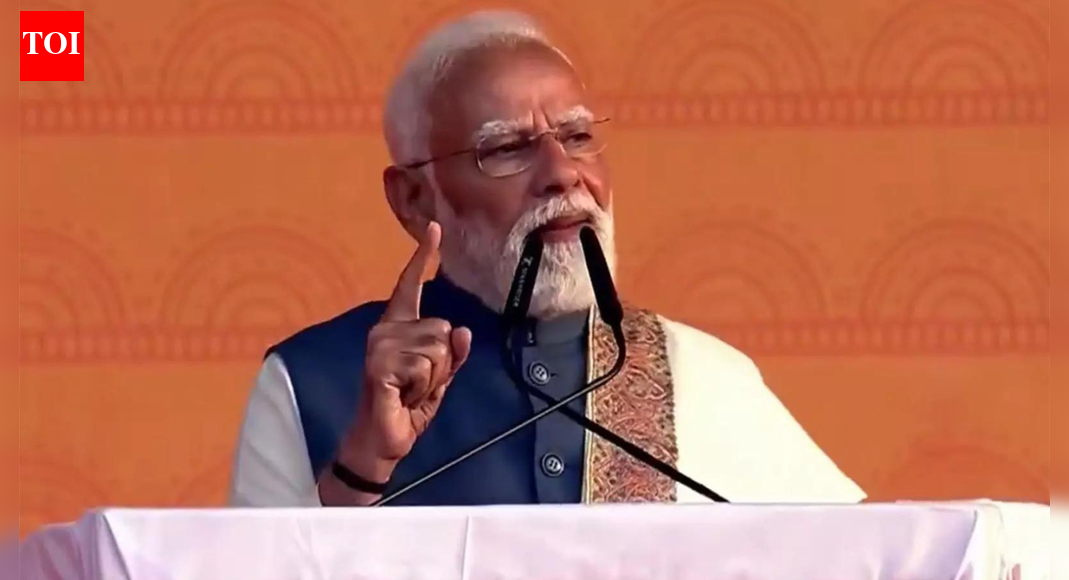
These achievements were not achieved without a solid foundation. In his article, Prime Minister Narendra Modi called 2025 the “Year of Reforms,” where India rode the “Reform Express.” The engine of reforms is India’s demographics, youthful energy, and the spirit of its people.
The GST reforms introduced two main slabs (5% and 18%). The tax burden on households, MSMEs, farmers, and labour-intensive sectors has been reduced. This aims to reduce disputes and ensure better compliance. These reforms have boosted consumer sentiment and demand. Sales have increased during the festive season following the implementation of the reforms.
This year, unprecedented income tax relief has been implemented. For the first time, individuals earning up to ₹12 lakh annually will not have to pay any income tax. The archaic Income Tax Act of 1961 has been replaced by the modern and simplified Income Tax Act, 2025. Together, these reforms are moving India toward a transparent, technology-driven tax administration.
Additionally, the government has expanded the definition of “small companies” for MSMEs to turnover up to ₹100 crore. This will reduce the compliance burden and associated costs for thousands of companies.
The Indian government has permitted 100% foreign direct investment (FDI) in Indian insurance companies. This will boost insurance coverage and protect citizens. As competition increases, people will have access to better insurance options.
Insurance, labour and nuclear energy reforms
The government allowed 100% FDI in the insurance sector, expected to improve coverage and offer better options to citizens.
Labour reforms merged 29 old laws into four labour codes, balancing worker protection with business flexibility. Contract and unorganised workers were brought under ESIC and EPFO, expanding formal employment.
The most significant step this year was the opening up of nuclear energy to private participation through the SHANTI Act. The SHANTI Act is a transformative step in India’s clean-energy and technology journey. It ensures a robust framework for the safe, sustainable, and responsible expansion of nuclear science and technology.
It helps India meet the growing energy needs of the AI era, such as powering data centers, advanced manufacturing, green hydrogen, and high-technology industries. All of this will lead to greater employment and growth.
The Modi government’s Employment Guarantee Framework for Developing India – GRAMG Act, 2025 has increased the employment guarantee period from 100 to 125 days. This will increase spending on strengthening rural infrastructure and livelihoods. The aim is to make rural work a means of ensuring higher income and better assets.
In the field of education, this year, the Modi government proposed a single education regulator. This would replace several overlapping bodies like the UGC, AICTE, and NCTE with the Vikasit Bharat Shiksha Adhishthan. This move would strengthen institutional autonomy in the country and promote innovation and research.
A strong step towards a developed India
The year 2025 proved that India can move ahead even amid global challenges. High growth, low inflation, falling unemployment and strong exports gave the economy fresh strength, while reforms laid a solid foundation for the future.
As India moves towards its 2047 ‘Viksit Bharat’ goal, 2025 stands out as a milestone year. The pace of reforms and growth, experts say, is unlikely to slow, India’s economic flight has truly taken off.