India set to assume the chairmanship of Kimberley Process: Read about the UN-backed initiative and its role in preventing “conflict diamonds” in the global trade
On 1st January, India is going to preside over as chair of the Kimberley Process (KP) for the third time. It is a worldwide forum supported by the United Nations that aims to prevent the trade of conflict diamonds. The information was shared by Union Commerce and Industry Minister Piyush Goyal on 25th December. He declared, “India’s KP leadership reinforces its credibility among diamond producing nations, trading centres, industry and civil society, placing us at the centre of efforts to strengthen transparency, continuity and unity in diamond governance in line with the Modi government’s commitment to fostering integrity & transparency in international trade.” The minister highlighted three main areas that are set to be under focus during India’s leadership. “Building consumer confidence in conflict-free diamonds, accelerating digital certification and traceability alongside strengthening transparency and accountability across the supply chain,” he mentioned. Proud to announce that India has been selected to be the Chair of the UN-backed Kimberley Process (KP) from January 1, 2026, for the third time.India's KP leadership reinforces its credibility among diamond producing nations, trading centres, industry and civil society, placing… pic.twitter.com/9IGX8XEecd— Piyush Goyal (@PiyushGoyal) December 25, 2025 Goyal added that the country is eager to collaborate with all KP members to strengthen rule-based and data-driven compliance in order to boost confidence in the international rough diamond trade via “reform-oriented and consensus-driven” guidance. India was chosen to serve as the plenary’s head for 2026 after the country took over as its vice-chair on 25th December. India has served as the chair in 2008 and 2019. The official statement highlighted that India is a major global centre for the production and trade of diamonds, and its leadership coincides with evolving geopolitics and an increasing focus on ethical and ecological sourcing. The Gem and Jewellery Export Promotion Council (GJEPC) has been designated as the Kimberley Process Certification Scheme (KPCS) “Importing and Exporting Authority” for India. GJEPC is in charge of both issuing KP certificates and keeping track of the ones that are obtained within the nation. What is the Kimberley Process The Kimberley Process began in May 2000 when states that produce diamonds in Southern Africa convened in Kimberley of South Africa, to deliberate on ways to end the trade in “conflict diamonds” and make sure that purchases of diamonds did not finance acts of violence by rebel groups and their allies who were trying to overthrow legitimate governments. A major resolution to create a worldwide certification system for rough diamonds was passed by the UN General Assembly in December 2000. The KPCS was created in November 2002 as a result of negotiations between governments, the global diamond industry and civil society organisations. The paper outlined the regulations controlling the manufacture and trade of rough diamonds. The Kimberley Process is a tripartite initiative involving governments, the global diamond industry and civil society. Its goal is to stop the trade in “conflict diamonds.” The official website conveys, “By enforcing rigorous certification protocols and compliance assessments, the KP ensures that all participating countries maintain high standards that keep conflict diamonds out of the international market.” Established in accordance with a United Nations resolution, the KPCS went into force on 1st January 2003, and has subsequently developed into a successful tool for reducing the trade in conflict diamonds. Any nation that imports or exports diamonds is eligible to become its part. There are currently 60 participants in the Kimberley Process, including the European Union and its member states, Russia, China and the United States, among others. It consists of 60 participants from 86 different countries. KP is the most extensive international system regulating this industry since its members collectively account for more than 99 per cent (99.8%) of the world’s rough diamond trade. It is implemented individually by these nations “to ensure that rough diamonds in the legitimate supply chain are KP-compliant.” Participant countries must enforce stringent legal and regulatory standards to control the import and export of rough diamonds and ensure adherence to KP requirements. The fundamental criteria must be met by the members. Participant countries must impose strict legal and regulatory norms to manage raw diamond imports and exports, as well as ensure compliance with the watchdog’s standards. The countries agree to maintain transparent practices, which are critical “for the integrity of the diamond supply chain, by exchanging accurate and timely statistical data.” Only certified KP members who completely adhere to these worldwide criteria are allowed to trade, protecting the diamond trade’
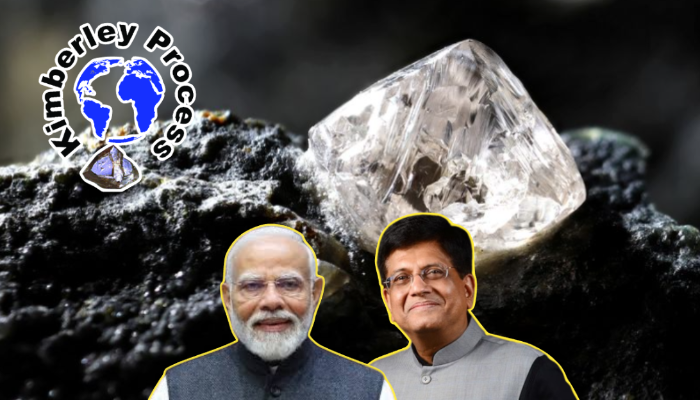

On 1st January, India is going to preside over as chair of the Kimberley Process (KP) for the third time. It is a worldwide forum supported by the United Nations that aims to prevent the trade of conflict diamonds. The information was shared by Union Commerce and Industry Minister Piyush Goyal on 25th December.
He declared, “India’s KP leadership reinforces its credibility among diamond producing nations, trading centres, industry and civil society, placing us at the centre of efforts to strengthen transparency, continuity and unity in diamond governance in line with the Modi government’s commitment to fostering integrity & transparency in international trade.”
The minister highlighted three main areas that are set to be under focus during India’s leadership. “Building consumer confidence in conflict-free diamonds, accelerating digital certification and traceability alongside strengthening transparency and accountability across the supply chain,” he mentioned.
Proud to announce that India has been selected to be the Chair of the UN-backed Kimberley Process (KP) from January 1, 2026, for the third time.
— Piyush Goyal (@PiyushGoyal) December 25, 2025
India's KP leadership reinforces its credibility among diamond producing nations, trading centres, industry and civil society, placing… pic.twitter.com/9IGX8XEecd
Goyal added that the country is eager to collaborate with all KP members to strengthen rule-based and data-driven compliance in order to boost confidence in the international rough diamond trade via “reform-oriented and consensus-driven” guidance. India was chosen to serve as the plenary’s head for 2026 after the country took over as its vice-chair on 25th December.
India has served as the chair in 2008 and 2019. The official statement highlighted that India is a major global centre for the production and trade of diamonds, and its leadership coincides with evolving geopolitics and an increasing focus on ethical and ecological sourcing.
The Gem and Jewellery Export Promotion Council (GJEPC) has been designated as the Kimberley Process Certification Scheme (KPCS) “Importing and Exporting Authority” for India. GJEPC is in charge of both issuing KP certificates and keeping track of the ones that are obtained within the nation.
What is the Kimberley Process
The Kimberley Process began in May 2000 when states that produce diamonds in Southern Africa convened in Kimberley of South Africa, to deliberate on ways to end the trade in “conflict diamonds” and make sure that purchases of diamonds did not finance acts of violence by rebel groups and their allies who were trying to overthrow legitimate governments.
A major resolution to create a worldwide certification system for rough diamonds was passed by the UN General Assembly in December 2000. The KPCS was created in November 2002 as a result of negotiations between governments, the global diamond industry and civil society organisations. The paper outlined the regulations controlling the manufacture and trade of rough diamonds.
The Kimberley Process is a tripartite initiative involving governments, the global diamond industry and civil society. Its goal is to stop the trade in “conflict diamonds.” The official website conveys, “By enforcing rigorous certification protocols and compliance assessments, the KP ensures that all participating countries maintain high standards that keep conflict diamonds out of the international market.”
Established in accordance with a United Nations resolution, the KPCS went into force on 1st January 2003, and has subsequently developed into a successful tool for reducing the trade in conflict diamonds. Any nation that imports or exports diamonds is eligible to become its part.
There are currently 60 participants in the Kimberley Process, including the European Union and its member states, Russia, China and the United States, among others. It consists of 60 participants from 86 different countries. KP is the most extensive international system regulating this industry since its members collectively account for more than 99 per cent (99.8%) of the world’s rough diamond trade.
It is implemented individually by these nations “to ensure that rough diamonds in the legitimate supply chain are KP-compliant.” Participant countries must enforce stringent legal and regulatory standards to control the import and export of rough diamonds and ensure adherence to KP requirements. The fundamental criteria must be met by the members.
Participant countries must impose strict legal and regulatory norms to manage raw diamond imports and exports, as well as ensure compliance with the watchdog’s standards. The countries agree to maintain transparent practices, which are critical “for the integrity of the diamond supply chain, by exchanging accurate and timely statistical data.”
Only certified KP members who completely adhere to these worldwide criteria are allowed to trade, protecting the diamond trade’s legitimacy. Every diamond export is thoroughly scrutinised and must be accompanied by a valid KP certificate stating that the diamonds are conflict-free, preventing the entry of illegal stones into the market.
“New terms established for KPCS participants in 2010 mandate stringent national legislation and institutional controls, commitment to transparency, and rigorous exchange of statistical data. Trading is allowed solely between compliant members, and international shipments of diamonds must be accompanied by a KP certificate confirming they are conflict-free,” the website points out.
What are conflict diamonds
Diamonds that are unlawfully mined and sold in conflict and war zones are known as “conflict” or “blood” diamonds. The World Diamond Council, which promotes the commercial diamond trade, explained that these diamonds are illegally traded to finance violence in war-torn regions, especially in central and western Africa.
The UN defined these as “diamonds that originate from areas controlled by forces or factions opposed to legitimate and internationally recognised governments, and are used to fund military action in opposition to those governments.”
They usually appear in “rough” condition, which indicates that they were just harvested and haven’t been cut yet. Conflict diamonds are believed to have accounted for about 4% of global diamond production during the height of Sierra Leone’s civil war. The extraordinarily violent dispute in the country in the 1990s brought these diamonds to the attention of the international media.
Thousands of men, women, and children are used as slaves to extract diamonds in nations like Sierra Leone, in addition to the innocent people entangled in the crises that the trade sustains.
The workers are made to employ crude, back-breaking techniques like using their bare hands to dig into mud or gravel along riverbanks. Hand-held sieves are then used to separate the gathered material as the proceeds from their trade are utilised to fund protracted uprisings, war and rebel activities.
Documentation of these acts has been more widespread in Sierra Leone, Liberia, Angola, the Ivory Coast, and the Democratic Republic of the Congo. Some of these nations have endured years and decades of destruction, resistance to a legal government, and civil war, all of which were primarily sponsored by the sales of conflict diamonds.
Significance of Kimberley Process
The Kimberley Agreement proposes to provide countries engaged in diamond sales with transparency. Every diamond that is sold comes with a certificate attesting to the fact that it was taken from a nation that does not use its sales revenues to finance rebel organisations or other parties who want to topple UN-recognised legitimate governments. Strict restrictions are imposed by this agreement on the import and export of diamonds to non-member nations.
Less than 0.1% of diamonds produced worldwide are currently conflict diamonds. KP and the UN collaborate to keep these gems off the legal market. Significant progress has been made in nations including Sierra Leone, Angola, Liberia, the Democratic Republic of the Congo (DRC) and the Ivory Coast that formerly saw hostilities partially financed by diamonds.