Govt orders GitHub to remove BitChat: Read how the app allows broadcasting messages at large protest sites when mobile and internet services are blocked
In a strongly worded late-night directive issued at 11:16 pm on 23 July 2026, the Indian Cyber Crime Coordination Centre (I4C) under the Ministry of Home Affairs ordered the global code-hosting platform GitHub to disable access to three specific repositories of the BitChat messaging application within three hours. The order was issued after reports of widespread use of the platform during the Cockroach Janta Party protests in Delhi’s Jantar Mantar. The notice issued under Section 79(3)(b) of the Information Technology Act, 2000 read with Rule 3(1)(d) of the Information Technology (Intermediary Guidelines and Digital Media Ethics Code) Rules, 2021, identified the repositories containing the main source code, the Android application and its release files. The order warned that failure to comply would result in GitHub losing its safe-harbour protection and facing possible criminal prosecution. The order described BitChat as a decentralised peer-to-peer messaging platform that operates over Bluetooth mesh networks without relying on mobile networks, internet connectivity or centralised servers, enabling anonymous communication without mandatory user registration or phone-number verification. The notice stated that this architecture significantly impedes lawful interception, attribution and investigation, and creates a substantial risk of misuse by anti-national elements, terrorist organisations and others seeking to coordinate unlawful assemblies, violent protests or circumvent lawful restrictions during internet shutdowns and situations of public disorder. The notice stated, “The technical architecture of the application significantly impedes lawful interception, attribution, and investigation by law enforcement agencies. Since communications occur directly between nearby devices through a decentralized mesh network, the platform can be misused to evade lawful surveillance, facilitate anonymous coordination, and circumvent lawful restrictions imposed by competent authorities during situations involving public disorder, riots, terrorism, organized crime, or internet shutdowns. 14C further added, “Intelligence inputs indicate that such decentralized communication platforms are capable of being exploited for coordinating unlawful assemblies, violent protests, dissemination of misinformation, radicalization, criminal conspiracies, and other activities prejudicial to the sovereignty and integrity of India, defence of India, security of the State, public order, and for facilitating the commission of cognizable offences. The absence of a centralized service provider also limits the ability of law enforcement agencies to obtain subscriber information. communication records, or timely assistance during investigations. The application’s design, which enables communication even during network restrictions, creates a substantial risk of misuse by anti-national elements, terrorist organizations, organized criminal groups, and cybercriminals seeking to evade lawful detection and continue communication despite legally imposed restrictions.” Because of these reasons, GitHub was ordered to “remove and disable access to the concerned URLs within 3 hours of the issue of this communication without vitiating the evidence in any manner.” Why GitHub issued the notice The order was issued to GitHub, not Google Play Store or Apple Store from where mobile apps are generally downloaded, because of the nature of the BitChat app. GitHub is a widely used online platform owned by Microsoft on which software developers across the world store, share and collaborate on computer programmes, particularly open-source projects that anyone can freely examine, download or modify. GitHub runs on Git, a free, open-source version control system created by Linus Torvalds, the creator of Linux. Developers use Git to track every change made to their code, create branches, merge work, and keep a complete history of a project. On the other hand, GitHub is a commercial web-based platform that is built on top of Git. While there are other Git platforms, and it can also be run offline, GitHub is the most widely used Git platform. The government directed the order at GitHub because BitChat is fully open-source and the complete source code along with ready-to-install Android packages are hosted on that very platform. By targeting these repositories, the authorities sought to remove the core technology itself from easy public access in India. BitChat and its use in large protests BitChat is a free and open-source decentralised messaging application developed by former Twitter chief Jack Dorsey. It allows users to exchange text messages using only the Bluetooth feature built into ordinary smartphones and requires neither an internet connection nor any central company server. The app requires no 4G, 5G, or Wi-Fi, it relies exclusively on Bluetooth Low Energy (BLE) to establish connections. The application is specifically design
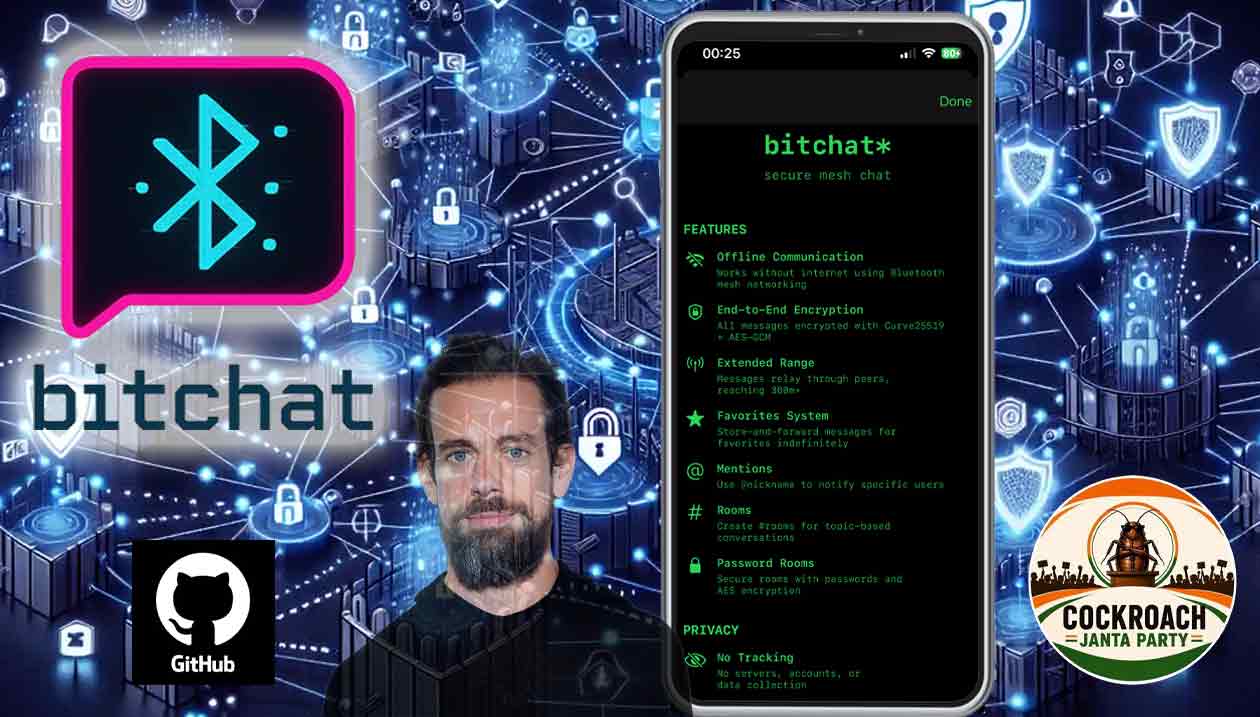
In a strongly worded late-night directive issued at 11:16 pm on 23 July 2026, the Indian Cyber Crime Coordination Centre (I4C) under the Ministry of Home Affairs ordered the global code-hosting platform GitHub to disable access to three specific repositories of the BitChat messaging application within three hours. The order was issued after reports of widespread use of the platform during the Cockroach Janta Party protests in Delhi’s Jantar Mantar.
The notice issued under Section 79(3)(b) of the Information Technology Act, 2000 read with Rule 3(1)(d) of the Information Technology (Intermediary Guidelines and Digital Media Ethics Code) Rules, 2021, identified the repositories containing the main source code, the Android application and its release files. The order warned that failure to comply would result in GitHub losing its safe-harbour protection and facing possible criminal prosecution.
The order described BitChat as a decentralised peer-to-peer messaging platform that operates over Bluetooth mesh networks without relying on mobile networks, internet connectivity or centralised servers, enabling anonymous communication without mandatory user registration or phone-number verification. The notice stated that this architecture significantly impedes lawful interception, attribution and investigation, and creates a substantial risk of misuse by anti-national elements, terrorist organisations and others seeking to coordinate unlawful assemblies, violent protests or circumvent lawful restrictions during internet shutdowns and situations of public disorder.
The notice stated, “The technical architecture of the application significantly impedes lawful interception, attribution, and investigation by law enforcement agencies. Since communications occur directly between nearby devices through a decentralized mesh network, the platform can be misused to evade lawful surveillance, facilitate anonymous coordination, and circumvent lawful restrictions imposed by competent authorities during situations involving public disorder, riots, terrorism, organized crime, or internet shutdowns.
14C further added, “Intelligence inputs indicate that such decentralized communication platforms are capable of being exploited for coordinating unlawful assemblies, violent protests, dissemination of misinformation, radicalization, criminal conspiracies, and other activities prejudicial to the sovereignty and integrity of India, defence of India, security of the State, public order, and for facilitating the commission of cognizable offences. The absence of a centralized service provider also limits the ability of law enforcement agencies to obtain subscriber information. communication records, or timely assistance during investigations. The application’s design, which enables communication even during network restrictions, creates a substantial risk of misuse by anti-national elements, terrorist organizations, organized criminal groups, and cybercriminals seeking to evade lawful detection and continue communication despite legally imposed restrictions.”
Because of these reasons, GitHub was ordered to “remove and disable access to the concerned URLs within 3 hours of the issue of this communication without vitiating the evidence in any manner.”
Why GitHub issued the notice
The order was issued to GitHub, not Google Play Store or Apple Store from where mobile apps are generally downloaded, because of the nature of the BitChat app. GitHub is a widely used online platform owned by Microsoft on which software developers across the world store, share and collaborate on computer programmes, particularly open-source projects that anyone can freely examine, download or modify.
GitHub runs on Git, a free, open-source version control system created by Linus Torvalds, the creator of Linux. Developers use Git to track every change made to their code, create branches, merge work, and keep a complete history of a project. On the other hand, GitHub is a commercial web-based platform that is built on top of Git. While there are other Git platforms, and it can also be run offline, GitHub is the most widely used Git platform.
The government directed the order at GitHub because BitChat is fully open-source and the complete source code along with ready-to-install Android packages are hosted on that very platform. By targeting these repositories, the authorities sought to remove the core technology itself from easy public access in India.
BitChat and its use in large protests
BitChat is a free and open-source decentralised messaging application developed by former Twitter chief Jack Dorsey. It allows users to exchange text messages using only the Bluetooth feature built into ordinary smartphones and requires neither an internet connection nor any central company server. The app requires no 4G, 5G, or Wi-Fi, it relies exclusively on Bluetooth Low Energy (BLE) to establish connections.
The application is specifically designed for situations such as large public gatherings where mobile networks and internet services are temporarily blocked. In its peer-to-peer Bluetooth mesh system, every phone that has the app installed functions simultaneously as a sender and a relay station. When a user types a message, the device broadcasts it over Bluetooth to other phones within a short range of about ten to thirty metres, to the phones that have the app installed and the Bluetooth feature turned on.
my weekend project to learn about bluetooth mesh networks, relays and store and forward models, message encryption models, and a few other things.bitchat: bluetooth mesh chat…IRC vibes.TestFlight: https://t.co/P5zRRX0TB3GitHub: https://t.co/Yphb3Izm0P pic.twitter.com/yxZxiMfMH2— jack (@jack) July 6, 2025
Those neighbouring devices automatically forward the message further to the next set of phones in the vicinity, creating a continuous chain or “mesh” network that can extend across a dense crowd of hundreds or thousands of people. Messages hop from handset to handset without ever passing through a mobile tower or the internet, rendering the communication immune to network shutdowns and signal jammers. In dense crowds, the network actually grows stronger and extends its communication range exponentially as more people in the gathering activate the app.
Another important feature is that BitChat is completely anonymous; it requires no account registrations, no phone number or e-mail IDs. As it is a peer-to-peer network, there is no centralised data logging.
As authorities frequently suspend mobile internet services and employ signal jammers during large protests, apps like Briar and BitChat are used by large groups of protesters to bypass such blockades to keep the communication flowing.
Use during CJP Protests
The order to remove the app was issued after reports of its use at the Cockroach Janta Party protests at Jantar Mantar in New Delhi, where mobile internet has been suspended multiple times in recent days along with the reported deployment of signal jammers. When mobile networks stopped working after the CJP protests turned violent, the protestors switched to the Bluetooth mesh application to stay connected. This made the blocking of internet services useless, as protest organisers are still being able to broadcast messages using such apps.
BitChat developer Jack Dorsey strongly objected to the govt of India order. He posted on X: “the government of india does not like technologies like bitchat and wants it taken down,” attaching screenshots of the official I4C order.
the government of india does not like technologies like bitchat and wants it taken down pic.twitter.com/gjzMg1NGCi— jack (@jack) July 24, 2026
Internet Freedom Foundation called the order unconstitutional and authoritarian. The group condemned the order in a detailed statement, saying that as thousands of activists are camping at the Jantar Mantar site, blocking mobile and internet services prevents them from contacting their friends and families.