From peddling fake news and cropped videos to misleading narratives: A deep dive into the propaganda handles that were restricted in India
In recent days, several social media accounts and content platforms such as 4PM, Molitics, and National Dastak have been withheld in India. Immediately after the restriction, sections of the left ecosystem framed the move as an attack on free speech, claiming that dissent was being silenced, and the claims gained traction across platforms. However, such a characterisation raises a more fundamental question: was this action arbitrary, or did it precede a consistent pattern of content warranting closer scrutiny? A closer look at what these platforms are putting out suggests the problem isn’t as simple as it seems. In many cases, their content seems to depend on sensational framing, selective fact-picking, and claims that are sometimes proven wrong by subsequent information or later verification. From narratives later deemed misleading and from repeated cases of speculation presented with a degree of certainty, the pattern points to a style of content in which impact often takes precedence over accuracy. In that context, the focus shifts from a singular act of restriction to a broader question of accountability within digital information ecosystems. The Ecosystem: Platforms, Personalities, and Narrative Building At first glance, Platforms such as 4PM, Molitics and National Dastak portray themselves as alternative voices. They present their content as bold, independent and unfiltered. Their appeal largely rests on the claim of challenging mainstream narratives and “speaking truth to power.” However, their content strategy appears to prioritise high-impact presentation over substantiated reporting. Common features include dramatic thumbnails, strong headlines, and framing that elicits an emotional response. Complex issues are frequently reduced to simplified narratives, in which speculation is presented with a degree of certainty while verification remains unclear or absent. This creates an ecosystem in which speculation is presented as near-certainty, isolated developments are framed as systemic collapse, and opinion-driven narratives are packaged as factual reporting. This is not just about where you stand on issues. Media platforms across the board have strong opinions. But the difference in the method is whether claims are supported by verifiable proof, or whether proof comes after the claim. On these platforms, the repeated use of amplification rather than authentication raises important questions about editorial standards and intent. Just not one post; this bigger ecosystem helps us understand why the government may have gotten involved. Layer 1: When Presentation Alters Perception In one instance, a post amplified by National Dastak referred to accused individuals using partial identifiers such as “Rajput” and “Rana.” This appeared to suggest as a Hindu identity. However, additional context later indicated that the individuals’ full identities did not align with the implied narrative. Actually, the accused names were “Azeem Rana” and “Azad Rajput”. Both accusers belonged to the Muslim identity, but the National Dastak was portraying the case as a crime committed by Hindu individuals. Notably, a community Note flagged the post as misleading, stating that partial naming was used in a way that could create a false impression. In other instances, claims or presentations circulated by these platforms were later found to be incomplete, misleading, or contradicted by additional context. One of the most widely amplified examples involved assertions that a significant portion of India’s gold reserves, valued at over ₹1 lakh crore, had gone “missing” from the Reserve Bank of India. The claim was presented in an alarming manner, often suggesting institutional opacity or large-scale financial irregularity. However, the Press Information Bureau has officially fact-checked the unit and later clarified that the claim was misleading, noting that the figures had been misinterpreted and taken out of context. Despite this clarification, the narrative continued to circulate across multiple handles, often without reference to the correction. The persistence of such claims highlights how high-impact financial misinformation can continue to shape perception even after being addressed. Taken together, these instances demonstrate how National Dastak and similar media organisations use selective presentation, the omission of context, or partial interpretation of facts to significantly alter public understanding of an issue. Layer 2: Visual Narratives and Context Gaps Another recurring pattern emerges in the use of short video clips and selective visuals, often presented without full context. In one instance, a clip showing Nitish Kumar holding an aarti plate was circulated with the caption “Samrat Chaudhary snatched the aarti plate from Nitish Kumar’s hands” It was presented in isolation; the visual appeared to suggest a particular message. However, without the full sequence
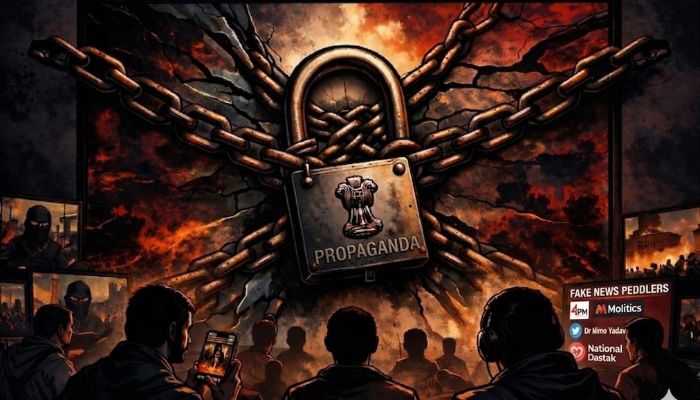
In recent days, several social media accounts and content platforms such as 4PM, Molitics, and National Dastak have been withheld in India. Immediately after the restriction, sections of the left ecosystem framed the move as an attack on free speech, claiming that dissent was being silenced, and the claims gained traction across platforms. However, such a characterisation raises a more fundamental question: was this action arbitrary, or did it precede a consistent pattern of content warranting closer scrutiny?
A closer look at what these platforms are putting out suggests the problem isn’t as simple as it seems. In many cases, their content seems to depend on sensational framing, selective fact-picking, and claims that are sometimes proven wrong by subsequent information or later verification. From narratives later deemed misleading and from repeated cases of speculation presented with a degree of certainty, the pattern points to a style of content in which impact often takes precedence over accuracy. In that context, the focus shifts from a singular act of restriction to a broader question of accountability within digital information ecosystems.
The Ecosystem: Platforms, Personalities, and Narrative Building
At first glance, Platforms such as 4PM, Molitics and National Dastak portray themselves as alternative voices. They present their content as bold, independent and unfiltered. Their appeal largely rests on the claim of challenging mainstream narratives and “speaking truth to power.” However, their content strategy appears to prioritise high-impact presentation over substantiated reporting.
Common features include dramatic thumbnails, strong headlines, and framing that elicits an emotional response. Complex issues are frequently reduced to simplified narratives, in which speculation is presented with a degree of certainty while verification remains unclear or absent.
This creates an ecosystem in which speculation is presented as near-certainty, isolated developments are framed as systemic collapse, and opinion-driven narratives are packaged as factual reporting. This is not just about where you stand on issues. Media platforms across the board have strong opinions. But the difference in the method is whether claims are supported by verifiable proof, or whether proof comes after the claim.
On these platforms, the repeated use of amplification rather than authentication raises important questions about editorial standards and intent. Just not one post; this bigger ecosystem helps us understand why the government may have gotten involved.
Layer 1: When Presentation Alters Perception
In one instance, a post amplified by National Dastak referred to accused individuals using partial identifiers such as “Rajput” and “Rana.” This appeared to suggest as a Hindu identity. However, additional context later indicated that the individuals’ full identities did not align with the implied narrative. Actually, the accused names were “Azeem Rana” and “Azad Rajput”. Both accusers belonged to the Muslim identity, but the National Dastak was portraying the case as a crime committed by Hindu individuals.
Notably, a community Note flagged the post as misleading, stating that partial naming was used in a way that could create a false impression. In other instances, claims or presentations circulated by these platforms were later found to be incomplete, misleading, or contradicted by additional context.
One of the most widely amplified examples involved assertions that a significant portion of India’s gold reserves, valued at over ₹1 lakh crore, had gone “missing” from the Reserve Bank of India. The claim was presented in an alarming manner, often suggesting institutional opacity or large-scale financial irregularity. However, the Press Information Bureau has officially fact-checked the unit and later clarified that the claim was misleading, noting that the figures had been misinterpreted and taken out of context.
Despite this clarification, the narrative continued to circulate across multiple handles, often without reference to the correction. The persistence of such claims highlights how high-impact financial misinformation can continue to shape perception even after being addressed.
Taken together, these instances demonstrate how National Dastak and similar media organisations use selective presentation, the omission of context, or partial interpretation of facts to significantly alter public understanding of an issue.
Layer 2: Visual Narratives and Context Gaps
Another recurring pattern emerges in the use of short video clips and selective visuals, often presented without full context. In one instance, a clip showing Nitish Kumar holding an aarti plate was circulated with the caption “Samrat Chaudhary snatched the aarti plate from Nitish Kumar’s hands” It was presented in isolation; the visual appeared to suggest a particular message. However, without the full sequence of events or surrounding context, such interpretations remain, at best, partial.
This method of presentation is not uncommon in high-velocity digital content ecosystems, where short clips are often detached from their original setting and repurposed to align with a broader narrative. In such cases, what is omitted can be as significant as what is shown. The concern here is not merely about a single video, but about a broader pattern in which visuals are curated to appear to support pre-existing conclusions. When context is limited or absent, audiences are left to interpret fragments as a complete reality. Over time, repeated exposure to such selectively framed visuals can reinforce specific perceptions regardless of whether the full context supports those conclusions.
Layer 3: Sensationalism as a Content Strategy
Beyond what is said or shown, another critical dimension lies in how content is packaged and presented to audiences. Platforms like Molitics rely consistently on high-intensity, attention-grabbing language. Phrases such as:“घपलेबाजी पकड़ी गई” (Scam exposed), “बड़ा खुलासा” (Big revelation), “तहलका मच गया” (Shockwaves created), “मोदी को बड़ा झटका” (Big blow to Modi) , “घपलेबाजी पकड़ी गई,” “नफरती हिंदुत्व,” and “आतंकी संगठन” are presented with a tone of certainty, often positioning complex or contested issues as settled conclusions.
They are frequently used in thumbnails, captions, and video titles, often conveying a sense of urgency and certainty, even when the corresponding evidence is not clearly presented.
This style of presentation is deliberate. Thumbnails act as the first point of engagement. Their framing shapes viewer perception before the content is consumed. Consistent use of dramatic language creates an environment in which every development is framed as a major scandal or crisis. Most of the time, their framing work is based on the Anti-Hindutva narrative, where Hindus are shown as the villain or oppressor. News with no significance is run through as sensational.
Sometimes, the intensity of the claim in the thumbnail or headline does not appear to be proportionate to the verifiable documentation or primary sources within the content itself. This gap between presentation and substantiation becomes significant, particularly when such content reaches large audiences.
Over time, repeated exposure to such framing can normalise a perception of constant upheaval and systemic wrongdoing, irrespective of whether each claim holds up under scrutiny.
Layer 4: Escalation into Defamatory and Speculative Narratives
Beyond patterns of sensationalism and selective framing, certain instances reflect a shift towards speculative, and at times potentially defamatory, assertions involving public institutions and individuals.
One such example involves content posted by the account named Dr Nimo Yadav 2.0, run by Prateek Sharma, which raised questions suggesting that offices of Union ministers were linked to an individual allegedly involved in terrorist training activities.
The post framed this as a possibility and called for investigation, despite no publicly established evidence being cited to substantiate such a serious implication. Even though they are worded as questions, these kinds of statements, especially when they are spread to large groups of people, can strongly suggest things that aren’t true.
In another case, commentary that accompanied a picture of Indian Army officials seemed to use satire to link their appearance to a policy decision on mid-day meals. Humour and satire are part of public discourse, but this kind of framing could be seen as making fun of or belittling institutions that people generally respect, and it also shows the mentality of those who make fun of their own army that fights to protect them.
The one who has never achieved in their life will always make fun of people who are running and protecting the whole country. Nimo Yadav and these accounts run on the payroll of the Anti-India agenda, where their whole work is to shift the narrative from talking about India to making fun and creating against India
Also, posts about India’s foreign policy and energy choices reached conclusions suggesting strategic or economic failure, even though publicly available data showed more complex realities, such as India securing cheaper crude oil from Russia despite global pressure.
Similarly, certain claims hinted at high-level diplomatic manoeuvres involving unrelated personalities, without citing verifiable evidence, thereby contributing to speculative narratives presented with an air of plausibility.
In addition to speculative assertions, certain instances involve highly provocative and offensive language directed at specific communities. For example, while reporting, the reporter of National Dashtak stated these provocative lines against the Brahmin community. He stated that the “Brahmins are a disgrace, beat them with shoes and throw them out” Such statements raise serious concerns about the normalisation of extreme language in public discourse and targeting a specific community.
These types of organisation then demand “free speech but the question is whether freedom of speech also exists for the brahmin community, on which they spread their narrative. When such content is amplified without restraint, it risks deepening social divisions and lowering the threshold of acceptable expression.
Taken together, these examples reflect a pattern in which accounts that make serious allegations and are framed as questions use satire to intersect with sensitive institutions and complex geopolitical developments, and are simplified into definitive conclusions, with the end goal of spreading misinformation and creating a fearmongering situation among civilians.
Layer 5: Predictive narratives presented as certainty
A particularly noticeable trend is the recurrence of political predictions, most notably in content from YouTube channels like 4PM. A review of their video titles, thumbnails and recurring narratives indicates a consistent projection of imminent political upheaval. Their entire content relies on a surge of fear-mongering, with phrases suggesting that the government is on the verge of collapse, that major “game-changing” developments are underway, or that leadership transitions are imminent, appearing with notable frequency.
These claims are often presented with a high degree of urgency and frequently portrayed as some insider information or unfolding developments. However, when we observed it over time, many such predictions do not appear to materialise as suggested.
This creates a recurring cycle that starts with Thumbnails featuring shocking words, a high-impact claim is introduced, amplified through dramatic presentation, and gradually replaced by a new prediction without acknowledging earlier outcomes. Over time, this pattern contributes to a perception of constant political instability, even in the absence of corresponding real-world developments.
It is important to note that political analysis and speculation are legitimate aspects of media discourse. However, the distinction lies in how such speculation is presented. When predictive assertions are repeatedly framed as near-certainties without any verifiable grounding or subsequent accountability. It raises questions about editorial intent and credibility. In effect, the issue is not a single incorrect prediction but a sustained pattern in which speculation is elevated to the level of expectation.
The Pattern That Emerges
Individually, each of these accounts, which are withheld in India, might be viewed as editorial choice, opinion or even a single error. However, when analysed collectively, a more consistent pattern emerges. From making false financial claims to identity framing to visual presentation, the content exhibits certain repeating features. Facts may be presented selectively or incompletely, claims may be unsubstantiated, and narratives may not fit with recent developments.
This trend is perpetuated by how content is packaged and distributed. Sensational headlines, emotionally charged images, and definitive language provide the impression of certainty even when the underlying evidence is uncertain or debatable.
Over time, such repetition can significantly shape audience perception. What begins as a claim or speculation can, through consistent amplification, acquire the appearance of credibility. There is a famous quote by Joseph Goebbels: “A lie told once remains a lie, but a lie told a thousand times becomes the truth.” The whole narrative of these accounts revolves around this quote.
The initial stage of this narrative begins with hating the government, which gradually turns into hatred for India, which eventually reflects in their content. For example, in the above section of Layer 4: Escalation into Defamatory and Speculative Narratives, the account named Nimo Yadav made fun of the Indian Army, which is not related to any political party, as the army of this country is far above politics, but these types of accounts are unable to stop at a critical level.
The concern, therefore, is not limited to individual posts but extends to a broader content ecosystem where narrative construction and engagement may take precedence over verification and contextual accuracy.
Conclusion: Between expression and accountability
The debate surrounding the restriction of these accounts has largely been framed in terms of free speech versus censorship. However, such a binary framing overlooks the underlying context. Freedom of expression remains a fundamental pillar of any democratic society. The ability to question, critique, and dissent is essential to public discourse. At the same time, the scale and speed at which information travels in the digital ecosystem introduce new challenges, particularly when content has the potential to misinform or mislead large audiences.
In this context, the issue is not about suppressing viewpoints, but about examining whether repeated patterns of selective framing, unverified claims, and narrative-driven content can be treated as reliable information dissemination. As submissions before the Delhi High Court indicate, concerns raised by authorities include the spread of misleading narratives, defamatory content, and potential implications for public order.
At the same time, platforms have raised questions about proportionality and due process, highlighting the complexity of regulating digital speech. Therefore, the conversation is not a simple one. But one aspect remains clear: when content consistently prioritises impact over accuracy, and repetition over verification, it invites scrutiny.