Dead body of Muslim man buried near a Hindu crematorium in Bhavnagar; Gujarat HC orders its relocation
In Gujarat’s Bhavnagar district, the administration has shifted the corpse of a Muslim man buried on a disputed piece of land near a Hindu crematorium to the village’s official Muslim cemetery after the Gujarat High Court ordered its relocation. The body was exhumed and reburied on Monday, 27th July 2026, under heavy police security after the deceased’s family failed to comply with the court’s directions within the stipulated time. The origin of the dispute This controversy started on 11th June, when a Muslim resident of Rupavati village in Gariyadhar taluka passed away. Instead of burying the deceased in the village’s designated Muslim cemetery, family members chose to conduct the burial on a 27-guntha disputed plot located next to a Hindu cremation ground. Despite the village having a separate Muslim cemetery with sufficient space, the burial ceremony was being held on 27 gunthas of land adjacent to the crematorium, raising objections from local Hindu villagers, alleging that an attempt was being made to disturb the peaceful atmosphere of the village by deliberately choosing such a location. As the dispute escalated, the villagers approached the Gariyadhar Taluka Mamlatdar and requested him to move the body. Meanwhile, based on the complaint of the Sarpanch, a case was also registered at the Gariyadhar police station against Maqbool, Mubarak, Razak, Altaf, etc. under several sections of the BNS. Panchayat issues notice, legal battle reaches High Court Following the controversy, the Gram Panchayat issued a notice to the deceased’s family, asking them to explain why the disputed land had been used despite the availability of an official Muslim cemetery in the village. The notice also stated that if the Muslim family failed to provide a satisfactory explanation, the body would be relocated to the designated cemetery while ensuring that all religious customs were respected. During this period, the Muslim family approached the Deputy Collector at Palitana, requesting that the disputed land be officially recognised as a Muslim burial ground. However, the application was rejected. The family then moved the Gujarat High Court, challenging both the Panchayat’s notice and the Deputy Collector’s decision. Muslim family claimed that the cemetery was full The petitioners claimed before the High Court that, as per the Gaekwadi revenue records of the old Vadodara state, some part of these 27 gunthas of land was earlier marked for burial; however, that note was later removed. The petitioners also argued that the existing cemetery was full and hence they had to perform the burial on the disputed land. Following these arguments, the High Court ordered the Revenue and Panchayat departments to conduct a site investigation. The report submitted to the High Court after the investigation stated that the official Muslim cemetery of the village is spread over an area of around 700 square meters, is surrounded by a compound wall and about half of it is still vacant. This report proved the claim made by the Muslim petitioners wrong. It also made it clear that although there was still enough space available in the cemetery, the body was buried near the Hindu crematorium on the disputed land. Therefore, the court did not accept the arguments. Similar incident happened in 2022 After the protest, a meeting was held between the people of both the communities in the presence of the Mamlatdar and the police, after which the body was taken out and shifted to the original cemetery. A written guarantee was also given that in future, no burial would ever be done at the place near the crematorium. However, recently, a similar incident happened again. The court ordered the removal of the body Finally, the Gujarat High Court dismissed the Muslim family’s petition, saying that when an official cemetery is available for the Muslim community and there is sufficient space there, no person can arbitrarily perform a burial on public or disputed land. Moreover, such an action cannot be considered legal. Referring to earlier incidents, the court said that the Muslim family had not challenged the decision to move the body and now, after four years, they cannot decide to perform the burial on the disputed land again on their own. In the order, the court said that even if the cemetery was a little far away or the family could not reach there, the court would have considered it, but here it is clear from the administration’s report that there was no such situation, so such a burial cannot be permitted. The Gujarat High Court on 13th July, 2026, ordered the petitioners to voluntarily move the body to the original cemetery within 10 days. The court also said that if the family does not take action within the stipulated time frame, the state government and the Panchayat system can enforce the court’s order. The court also instructed that if the body has to be removed, it should be done with full religio
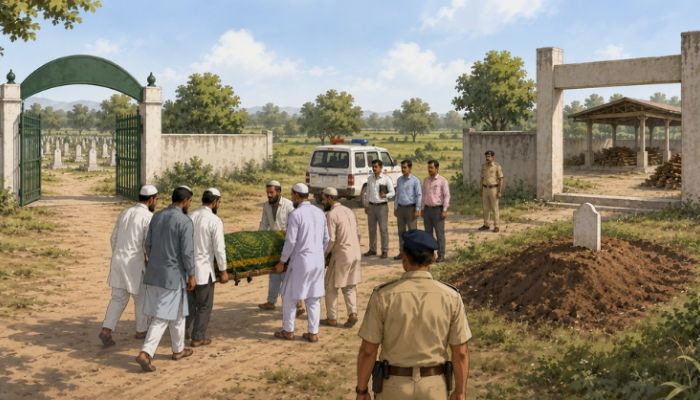
In Gujarat’s Bhavnagar district, the administration has shifted the corpse of a Muslim man buried on a disputed piece of land near a Hindu crematorium to the village’s official Muslim cemetery after the Gujarat High Court ordered its relocation. The body was exhumed and reburied on Monday, 27th July 2026, under heavy police security after the deceased’s family failed to comply with the court’s directions within the stipulated time.
The origin of the dispute
This controversy started on 11th June, when a Muslim resident of Rupavati village in Gariyadhar taluka passed away. Instead of burying the deceased in the village’s designated Muslim cemetery, family members chose to conduct the burial on a 27-guntha disputed plot located next to a Hindu cremation ground.
Despite the village having a separate Muslim cemetery with sufficient space, the burial ceremony was being held on 27 gunthas of land adjacent to the crematorium, raising objections from local Hindu villagers, alleging that an attempt was being made to disturb the peaceful atmosphere of the village by deliberately choosing such a location.
As the dispute escalated, the villagers approached the Gariyadhar Taluka Mamlatdar and requested him to move the body. Meanwhile, based on the complaint of the Sarpanch, a case was also registered at the Gariyadhar police station against Maqbool, Mubarak, Razak, Altaf, etc. under several sections of the BNS.
Panchayat issues notice, legal battle reaches High Court
Following the controversy, the Gram Panchayat issued a notice to the deceased’s family, asking them to explain why the disputed land had been used despite the availability of an official Muslim cemetery in the village.
The notice also stated that if the Muslim family failed to provide a satisfactory explanation, the body would be relocated to the designated cemetery while ensuring that all religious customs were respected.
During this period, the Muslim family approached the Deputy Collector at Palitana, requesting that the disputed land be officially recognised as a Muslim burial ground. However, the application was rejected. The family then moved the Gujarat High Court, challenging both the Panchayat’s notice and the Deputy Collector’s decision.
Muslim family claimed that the cemetery was full
The petitioners claimed before the High Court that, as per the Gaekwadi revenue records of the old Vadodara state, some part of these 27 gunthas of land was earlier marked for burial; however, that note was later removed. The petitioners also argued that the existing cemetery was full and hence they had to perform the burial on the disputed land.
Following these arguments, the High Court ordered the Revenue and Panchayat departments to conduct a site investigation. The report submitted to the High Court after the investigation stated that the official Muslim cemetery of the village is spread over an area of around 700 square meters, is surrounded by a compound wall and about half of it is still vacant.
This report proved the claim made by the Muslim petitioners wrong. It also made it clear that although there was still enough space available in the cemetery, the body was buried near the Hindu crematorium on the disputed land. Therefore, the court did not accept the arguments.
Similar incident happened in 2022
After the protest, a meeting was held between the people of both the communities in the presence of the Mamlatdar and the police, after which the body was taken out and shifted to the original cemetery. A written guarantee was also given that in future, no burial would ever be done at the place near the crematorium. However, recently, a similar incident happened again.
The court ordered the removal of the body
Finally, the Gujarat High Court dismissed the Muslim family’s petition, saying that when an official cemetery is available for the Muslim community and there is sufficient space there, no person can arbitrarily perform a burial on public or disputed land. Moreover, such an action cannot be considered legal. Referring to earlier incidents, the court said that the Muslim family had not challenged the decision to move the body and now, after four years, they cannot decide to perform the burial on the disputed land again on their own.
In the order, the court said that even if the cemetery was a little far away or the family could not reach there, the court would have considered it, but here it is clear from the administration’s report that there was no such situation, so such a burial cannot be permitted.
The Gujarat High Court on 13th July, 2026, ordered the petitioners to voluntarily move the body to the original cemetery within 10 days. The court also said that if the family does not take action within the stipulated time frame, the state government and the Panchayat system can enforce the court’s order. The court also instructed that if the body has to be removed, it should be done with full religious rituals and maintaining the dignity of the deceased.
Administration carries out court order
As a result, on 27th July, officials, including the Gariyadhar Mamlatdar, the Taluka Development Officer (TDO), senior revenue officials and a large police contingent, reached the disputed site to execute the court’s order.
The body was exhumed from the disputed land and reburied in the village’s official Muslim cemetery after completing all religious rituals. The entire operation was videographed in accordance with the High Court’s directions.
Mamlatdar B. G. Zala said, “The entire process was carried out peacefully under tight security. The body was shifted from the disputed land and reburied in the village cemetery after following all religious rituals. Law and order was maintained throughout the operation.”
Officials added that the relocation was completed without any untoward incident and that adequate security arrangements ensured peace was maintained in the village throughout the exercise.
(This article is a translation of the original article published on OpIndia Gujarati.)