CEC Gyanesh Kumar hands over Malda violence case to NIA: Here’s what SC observed, DM and Home Secretary didn’t reach scene, even food and water were denied to judicial officers
Mockery of democracy has become a routine affair in the Trinamool Congress-ruled West Bengal. On the 1st of April 2026, seven judicial officers, including three women, who were on election duty for the Special Intensive Revision (SIR) of electoral rolls, were gheraoed at a BDO office in the Muslim-dominated Malda district. The Supreme Court observations in the Malda violence case reveal how the judicial officers endured a nine-hour-long horror because of the Mamata Banerjee-led state administration’s nonfeasance. A Supreme Court bench comprising CJI Surya Kant, Justice Joymalya Bagchi and Justice Vipin Pancholi took sou motu cognisance of the Malda violence after being alerted by the Calcutta High Court CJI. The apex court came down heavily on the West Bengal government and the Malda district administration. Calculated and deliberate move The court noted that the incident was not routine but a “calculated and motivated move” to demoralise the judicial officers and to stop the ongoing process of adjudicating objections in the left-out cases. The court described the incident as a challenge to its authority. Moreover, the court observed that the targeting of judicial officers, who are, in essence, an “extension of this Court”, is a “brazen attempt not only to browbeat judicial officers, but also amounts to a challenge to the authority of this Court. This incident certainly cannot be construed to be a routine occurrence and, ex facie, appears to be a calculated, well-planned and deliberate act intended to demoralise judicial officers and obstruct the ongoing process of adjudication of objections in the remaining cases.” The Bench further observed that such attempts to create psychological fear in the minds of judicial officers to prevent them from discharging their duties, by disrupting law and order, will not be permitted. The court dubbed the gherao and harassment of judicial officers in Malda as a case of “criminal contempt”. “We have no hesitation in observing that we will not permit any person to take the law into their own hands so as to create a climate of psychological fear in the minds of judicial officers who are discharging their duties. Such conduct, undoubtedly, amounts to criminal contempt within the meaning of Section 2(cl of the Contempt of Courts Act, L97L,” the court said. The court further noted that the Malda incident “reflects a complete failure on the part of the civil and police administration, in so far as the law and order situation in Maldah District is concerned.” The Bench also took note of the information provided that the judicial officers were deliberately deprived of even essentials like food and water. “We are informed that the situation was so dire that even food and water were not permitted to be supplied to the judicial officers. The Hon’ble Chief Justice further pointed out that neither the District Magistrate nor the Superintendent of Police had reached the BDO office where the officers were gheraoed,” the Court stated. Conduct of administration “highly deplorable”: SC seeks explanation The Supreme Court highlighted the failure on the part of the Chief Secretary, the Home Secretary, the Director General of Police, the Collector and the Superintendent of Police in taking effective measures to safely evacuate the gheraoed judicial officers despite receiving information. “It also pains us to observe that the manner in which the Chief Secretary, the Home Secretary, the Director General of Police, the Collector and the Superintendent of Police have acted is highly deplorable. They owe an explanation to this Court as to why, upon being informed that the judicial officers had been gheraoed at around 03:30 p.m., no effective measures were taken to secure their safe evacuation,” the court said, “It was incumbent upon the State administration to immediately inform the Election Commission of India and seek deployment of central forces, wherever necessary, safety of the judicial officers,” it added. Orally, CJI Suryakant said that West Bengal is the “most polarised state” where “everyone speaks in political language”. The court also lamented that it was expected that everyone would welcome judicial officers, since they are court-appointed neutral agents; however, even “they were not spared from attacks”. Supreme Court issues multiple directives In the wake of the Malda incident, the Supreme Court issued a set of directives to ensure that “no obstruction or impediment is caused to the ongoing SIR process entrusted to the judicial officers, and that their life, liberty, property, and that of their family members are duly protected under the orders and directions of this Court.” The top court directed the Election Commission of India (ECI) to requisition “adequate central forces and for their deployment at all places where the judicial officers have been deputed for adjudication of objections under the SIR process.” In addition,
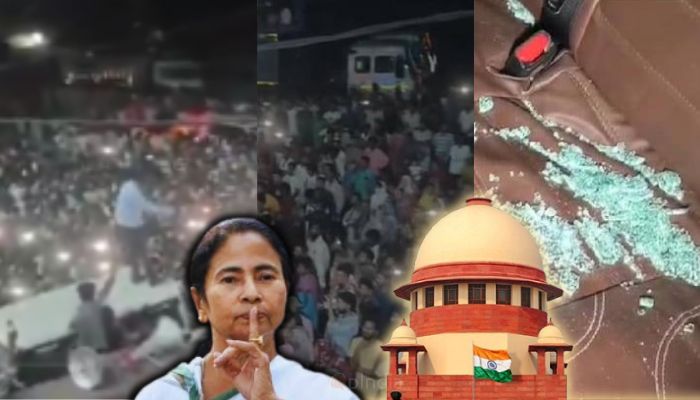
Mockery of democracy has become a routine affair in the Trinamool Congress-ruled West Bengal. On the 1st of April 2026, seven judicial officers, including three women, who were on election duty for the Special Intensive Revision (SIR) of electoral rolls, were gheraoed at a BDO office in the Muslim-dominated Malda district. The Supreme Court observations in the Malda violence case reveal how the judicial officers endured a nine-hour-long horror because of the Mamata Banerjee-led state administration’s nonfeasance.
A Supreme Court bench comprising CJI Surya Kant, Justice Joymalya Bagchi and Justice Vipin Pancholi took sou motu cognisance of the Malda violence after being alerted by the Calcutta High Court CJI. The apex court came down heavily on the West Bengal government and the Malda district administration.
Calculated and deliberate move
The court noted that the incident was not routine but a “calculated and motivated move” to demoralise the judicial officers and to stop the ongoing process of adjudicating objections in the left-out cases. The court described the incident as a challenge to its authority.
Moreover, the court observed that the targeting of judicial officers, who are, in essence, an “extension of this Court”, is a “brazen attempt not only to browbeat judicial officers, but also amounts to a challenge to the authority of this Court. This incident certainly cannot be construed to be a routine occurrence and, ex facie, appears to be a calculated, well-planned and deliberate act intended to demoralise judicial officers and obstruct the ongoing process of adjudication of objections in the remaining cases.”
The Bench further observed that such attempts to create psychological fear in the minds of judicial officers to prevent them from discharging their duties, by disrupting law and order, will not be permitted. The court dubbed the gherao and harassment of judicial officers in Malda as a case of “criminal contempt”.
“We have no hesitation in observing that we will not permit any person to take the law into their own hands so as to create a climate of psychological fear in the minds of judicial officers who are discharging their duties. Such conduct, undoubtedly, amounts to criminal contempt within the meaning of Section 2(cl of the Contempt of Courts Act, L97L,” the court said.
The court further noted that the Malda incident “reflects a complete failure on the part of the civil and police administration, in so far as the law and order situation in Maldah District is concerned.” The Bench also took note of the information provided that the judicial officers were deliberately deprived of even essentials like food and water.
“We are informed that the situation was so dire that even food and water were not permitted to be supplied to the judicial officers. The Hon’ble Chief Justice further pointed out that neither the District Magistrate nor the Superintendent of Police had reached the BDO office where the officers were gheraoed,” the Court stated.
Conduct of administration “highly deplorable”: SC seeks explanation
The Supreme Court highlighted the failure on the part of the Chief Secretary, the Home Secretary, the Director General of Police, the Collector and the Superintendent of Police in taking effective measures to safely evacuate the gheraoed judicial officers despite receiving information.
“It also pains us to observe that the manner in which the Chief Secretary, the Home Secretary, the Director General of Police, the Collector and the Superintendent of Police have acted is highly deplorable. They owe an explanation to this Court as to why, upon being informed that the judicial officers had been gheraoed at around 03:30 p.m., no effective measures were taken to secure their safe evacuation,” the court said,
“It was incumbent upon the State administration to immediately inform the Election Commission of India and seek deployment of central forces, wherever necessary, safety of the judicial officers,” it added.
Orally, CJI Suryakant said that West Bengal is the “most polarised state” where “everyone speaks in political language”. The court also lamented that it was expected that everyone would welcome judicial officers, since they are court-appointed neutral agents; however, even “they were not spared from attacks”.
Supreme Court issues multiple directives
In the wake of the Malda incident, the Supreme Court issued a set of directives to ensure that “no obstruction or impediment is caused to the ongoing SIR process entrusted to the judicial officers, and that their life, liberty, property, and that of their family members are duly protected under the orders and directions of this Court.”
The top court directed the Election Commission of India (ECI) to requisition “adequate central forces and for their deployment at all places where the judicial officers have been deputed for adjudication of objections under the SIR process.”
In addition, the court ordered that adequate security arrangements must be made at hotels and government guest houses, etc., where the judicial officers and their families are residing. The court also directed the police administration to assess threat perception apprised to them by on-duty judicial officers and take necessary measures accordingly and immediately.
Moreover, the court directed the ECI and the West Bengal government to “take all remedial measures that may be necessary to ensure the safety and smooth functioning of the responsibility entrusted upon the judicial officers.”
The Supreme Court directed the Chief Secretary, the Home Secretary, the Director General of Police, all the District Magistrates, Senior Superintendent of Police, and other police officers to ensure that not more than 5 persons enter the premises at any given time for the purpose of filing objections or during the hearing of such objections. These officers have also been ordered to submit a compliance report.
Pertinently, the apex court has directed the Chief Secretary, Malda DGP, DM and SP to show cause as to why suitable action should not be taken against them.
The most important directive issued by the Supreme Court is to the ECI to entrust an investigation into the Malda judicial officers gherao incident to an independent agency like the Central Bureau of Investigation or the National Investigation Agency (NIA). The court ordered the ECI to file a compliance report while the entrusted probe agency to submit a preliminary report post-investigation.
CEC Gyanesh Kumar hands over the Malda violence case to the NIA
In compliance with the Supreme Court directive to hand over the Malda violence probe to an independent investigation agency, the Chief Election Commissioner CEC) Gyanesh Kumar, wrote a letter to the NIA, entrusting the probe agency to investigate the case.
“I am directed to refer to the order dated 02.04.2026 of the Hon’ble Supreme Court in Suo Moto writ Petition (civil) No(s). 3/2026 (copy enclosed) in respect of the gherao of seven judicial officers involved in the Special Intensive Revision (SIR) of electoral rolls by anti-social elements at the BDO office, the Kaliachowk area of Maldah District. In this regard, I am directed to request that the necessary inquiry/investigation into the matter be conducted, and a preliminary inquiry report be submitted directly to the Hon’ble court as per the above directions,” the letter signed by ECI Secretary, Sujeet Kumar Mishra, reads.
Background of the Malda Violence case
The case relates to an incident in West Bengal’s Malda district, where seven judicial officers, including three women judges, were gheraoed by a huge mob on Wednesday evening (1st April) for over 9+ hours. The officers were working at the Block Development Officer (BDO) office in Muslim-dominated Kaliachak as part of the Special Intensive Revision (SIR) of electoral rolls.
The trouble began around 3:30 pm, when a large group of people gathered outside the office, protesting the deletion of their names from the voter list. The crowd blocked the premises, preventing the officers from leaving for several hours.
According to the court, the situation remained tense well into the night, with little immediate response from local authorities. It was only after the intervention of senior officials, including the Director General of Police and the Home Secretary, that the officers were finally rescued after midnight.
However, even after their release, the officers were not completely safe. As they were heading back, their vehicles were attacked with stones and sticks, raising serious concerns about their security. “Shockingly, when the judicial officers were released around midnight and were returning to their respective places of stay, their vehicles were pelted with stones and attacked with bamboo sticks and bricks,” the Supreme Court noted.
The Supreme Court stated that the Malda violence incident would have a chilling effect on the judicial officers who have been working tirelessly, without availing any leave.