Manufacturing a crisis: How BBC Hindi’s alarmist spin of ‘India has just 5 days of reserves’ ignores the ground reality of a 74-day supply and diversified imports
The latest piece by BBC Hindi on India’s Strategic Petroleum Reserve is not journalism in any rigorous sense; it is narrative construction masquerading as concern. Published on March 28, 2026, it fear-mongers about India’s petroleum reserves, arguing that India has just 5 days of Strategic Petroleum Reserve. Source: BBC Hindi However, it didn’t take long for social media users to call out the BBC for indulging in alarmism and peddling fear about another country, an approach that risks triggering artificial scarcity, as misinformation spreads rapidly and convinces people that fuel is genuinely in short supply in India. Sanjeev Sanyal took to X to condemn the BBC. He tweeted: “This is the state-owned media channel of one country trying to spread canards about oil supplies in another country.” This is the state-owned media channel of one country trying to spread canards about oil supplies in another country pic.twitter.com/vCrygORwuw— Sanjeev Sanyal (@sanjeevsanyal) March 28, 2026 “BBC News Hindi is spreading misinformation by claiming that India has only 5 days of petrol left. Such false reporting creates unnecessary panic and confusion among people. Strict action should be taken against the spread of misinformation @HMOIndia,” tweeted a social media user. BBC News Hindi is spreading misinformation by claiming that India has only 5 days of petrol left.Such false reporting creates unnecessary panic and confusion among people. Strict action should be taken against the spread of misinformation @HMOIndia https://t.co/Cgcw1qAof3— Akshay Kumar (@akshay_vicky) March 28, 2026 At a time when global anxieties around the Strait of Hormuz are already heightened, the article chooses not to inform but to inflame, not to contextualise but to selectively present fragments of truth in a way that manufactures panic. The Five-Day Myth: A statistic without context At the heart of BBC Hindi’s claim lies a clever but deeply misleading sleight of hand. The article asserts that India’s strategic reserves can barely meet five days of demand, a statistic presented as though it defines the country’s entire energy security architecture. What is conveniently downplayed, even though mentioned in passing, is that these strategic reserves are only one component of a much larger, layered system. India’s total petroleum buffer, when operational stocks held by oil marketing companies, crude in transit, refinery inventories, and strategic reserves are taken together, stands at roughly 74 days. The average reader, however, is nudged toward the five-day figure, because that serves the intended narrative of vulnerability. Government’s position: Ignored, not refuted This is where the contrast with the government’s position becomes stark. Union Petroleum Minister Hardeep Singh Puri has categorically clarified that India’s crude supply position is secure, that volumes have already been procured in excess of what the Strait of Hormuz would have delivered, and that there is no shortage of petrol, diesel, or LPG anywhere in the country. These are not rhetorical reassurances but grounded operational realities, further evidenced by the 28% surge in LPG production within days and the active diversification of sourcing from countries such as the United States, Russia, Norway, and Algeria. Yet, for BBC Hindi, these stabilising facts are not the story; they are inconvenient footnotes to be buried beneath alarmist framing. A familiar template: Crisis optics over context What emerges, then, is not an isolated editorial lapse but a pattern that has become all too familiar. Whether it was India’s handling of COVID-19, the constitutional abrogation of Article 370, or the construction of the Ram Mandir in Ayodhya, Western media outlets, and the BBC in particular, have repeatedly foregrounded crisis optics while backgrounding structural realities. The technique is consistent: zoom into points of friction, strip away context, and present a distorted picture that aligns with a preconceived narrative about India’s governance under Narendra Modi. Strategic reserves: Misunderstood by design The irony is that even within its own reporting, BBC Hindi inadvertently undermines its alarmism. The article acknowledges that maintaining excessively large reserves during periods of high crude prices is economically inefficient, a point energy experts themselves concede. Yet this nuance is quickly overshadowed by comparisons with countries like Japan or South Korea, whose storage capacities are cited without accounting for the fundamental differences in their energy models, economic structures, and strategic doctrines. Strategic petroleum reserves, by design, are emergency buffers, not primary supply channels. India’s model, which blends strategic reserves with robust commercial and transit stocks, is tailored to its own consumption patterns and geopolitical realities. To judge it through a simplistic, one-size-fits-a
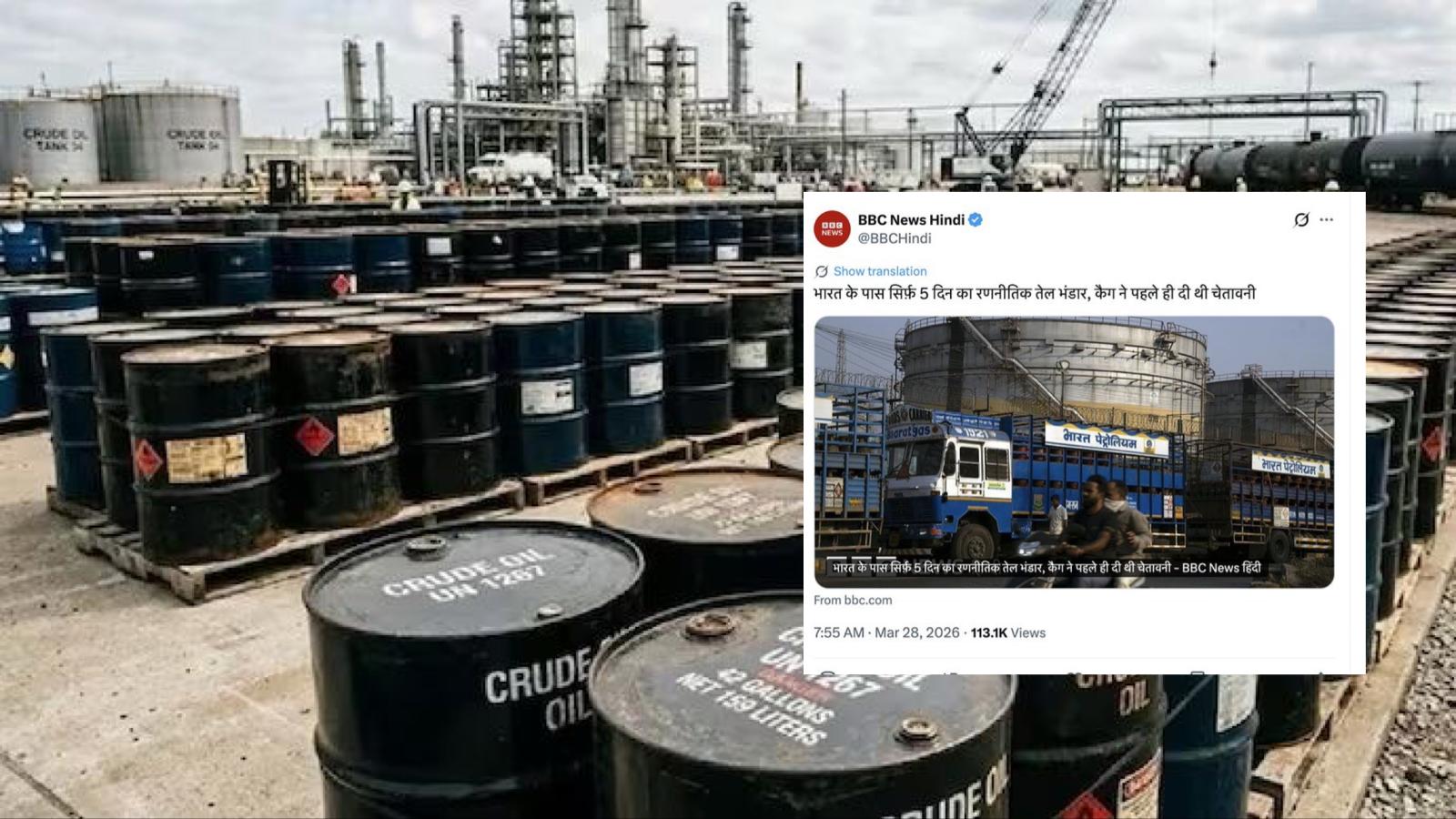
The latest piece by BBC Hindi on India’s Strategic Petroleum Reserve is not journalism in any rigorous sense; it is narrative construction masquerading as concern. Published on March 28, 2026, it fear-mongers about India’s petroleum reserves, arguing that India has just 5 days of Strategic Petroleum Reserve.
Source: BBC Hindi
However, it didn’t take long for social media users to call out the BBC for indulging in alarmism and peddling fear about another country, an approach that risks triggering artificial scarcity, as misinformation spreads rapidly and convinces people that fuel is genuinely in short supply in India.
Sanjeev Sanyal took to X to condemn the BBC. He tweeted: “This is the state-owned media channel of one country trying to spread canards about oil supplies in another country.”
This is the state-owned media channel of one country trying to spread canards about oil supplies in another country pic.twitter.com/vCrygORwuw— Sanjeev Sanyal (@sanjeevsanyal) March 28, 2026
“BBC News Hindi is spreading misinformation by claiming that India has only 5 days of petrol left. Such false reporting creates unnecessary panic and confusion among people. Strict action should be taken against the spread of misinformation @HMOIndia,” tweeted a social media user.
BBC News Hindi is spreading misinformation by claiming that India has only 5 days of petrol left.Such false reporting creates unnecessary panic and confusion among people. Strict action should be taken against the spread of misinformation @HMOIndia https://t.co/Cgcw1qAof3— Akshay Kumar (@akshay_vicky) March 28, 2026
At a time when global anxieties around the Strait of Hormuz are already heightened, the article chooses not to inform but to inflame, not to contextualise but to selectively present fragments of truth in a way that manufactures panic.
The Five-Day Myth: A statistic without context
At the heart of BBC Hindi’s claim lies a clever but deeply misleading sleight of hand. The article asserts that India’s strategic reserves can barely meet five days of demand, a statistic presented as though it defines the country’s entire energy security architecture. What is conveniently downplayed, even though mentioned in passing, is that these strategic reserves are only one component of a much larger, layered system.
India’s total petroleum buffer, when operational stocks held by oil marketing companies, crude in transit, refinery inventories, and strategic reserves are taken together, stands at roughly 74 days. The average reader, however, is nudged toward the five-day figure, because that serves the intended narrative of vulnerability.
Government’s position: Ignored, not refuted
This is where the contrast with the government’s position becomes stark. Union Petroleum Minister Hardeep Singh Puri has categorically clarified that India’s crude supply position is secure, that volumes have already been procured in excess of what the Strait of Hormuz would have delivered, and that there is no shortage of petrol, diesel, or LPG anywhere in the country.
These are not rhetorical reassurances but grounded operational realities, further evidenced by the 28% surge in LPG production within days and the active diversification of sourcing from countries such as the United States, Russia, Norway, and Algeria. Yet, for BBC Hindi, these stabilising facts are not the story; they are inconvenient footnotes to be buried beneath alarmist framing.
A familiar template: Crisis optics over context
What emerges, then, is not an isolated editorial lapse but a pattern that has become all too familiar. Whether it was India’s handling of COVID-19, the constitutional abrogation of Article 370, or the construction of the Ram Mandir in Ayodhya, Western media outlets, and the BBC in particular, have repeatedly foregrounded crisis optics while backgrounding structural realities.
The technique is consistent: zoom into points of friction, strip away context, and present a distorted picture that aligns with a preconceived narrative about India’s governance under Narendra Modi.
Strategic reserves: Misunderstood by design
The irony is that even within its own reporting, BBC Hindi inadvertently undermines its alarmism. The article acknowledges that maintaining excessively large reserves during periods of high crude prices is economically inefficient, a point energy experts themselves concede.
Yet this nuance is quickly overshadowed by comparisons with countries like Japan or South Korea, whose storage capacities are cited without accounting for the fundamental differences in their energy models, economic structures, and strategic doctrines. Strategic petroleum reserves, by design, are emergency buffers, not primary supply channels.
India’s model, which blends strategic reserves with robust commercial and transit stocks, is tailored to its own consumption patterns and geopolitical realities. To judge it through a simplistic, one-size-fits-all metric is not analysis; it is intellectual laziness dressed up as critique.
The geopolitical reality: Risk managed, not ignored
The broader geopolitical backdrop, of course, is real. Tensions in West Asia, disruptions in LNG production, and threats to the Strait of Hormuz do pose risks to global energy flows.
But what BBC Hindi fails to acknowledge with any seriousness is India’s proactive response to precisely these risks. The government has not passively awaited disruption; it has actively diversified supply chains, secured alternative cargoes, explored non-Hormuz routes despite higher logistics costs, and ensured a steady inflow of energy resources.
This is what strategic foresight looks like. Yet, in the BBC’s telling, preparedness becomes invisibilized while hypothetical scarcity is amplified.
The subtext: Manufacturing doubt, not delivering insight
There is also an unmistakable political subtext to this framing. By amplifying fears of fuel shortages, the article does more than misinform; it feeds into opposition-driven narratives of crisis and incompetence, subtly eroding public confidence in state capacity.
It reinforces a long-standing Western media trope that views India not as a complex, adaptive system but as a perpetually fragile state waiting to falter. That this framing persists despite repeated evidence of resilience says less about India and more about the ideological priors shaping such coverage.
When narrative overrides nuance
In the end, the issue is not that BBC Hindi chose to examine India’s petroleum reserves. Scrutiny is both necessary and welcome. The problem lies in how that scrutiny is conducted, through selective statistics, incomplete context, and a predisposition toward pessimism.
In matters of energy security, where variables are interconnected and dynamic, isolating a single data point to construct a narrative of impending crisis is not just misleading; it is irresponsible.
Strip away the framing, and the reality is far less dramatic. India is not staring at a fuel collapse; it is navigating a volatile global environment with a calibrated mix of reserves, diversification, and policy intervention. The BBC article would have you believe otherwise, not because the facts demand it, but because the narrative does.