Assam CM inaugurates memorial dedicated to martyrs of Assam Movement: Read about the Swahids who were brutally killed for demanding deportation of illegal immigrants
On 10th December, Assam observes “Swahid Divas (Martyr’s Day)” every year in remembrance of those who died during the Assam Movement demanding deportation of illegal immigrants from Bangladesh. On this day in 1979, Khargeswar Talukdar had become the first martyr of the movement. Around 860 agitators had died during the 6-year-long protests led by All Assam Students Union (AASU) and All Assam Gana Sangram Parishad (AAGSP). Notably, this tragic loss of life transpired due to the detrimental and brazen Muslim appeasement actions of Indian National Congress which governed the country for over 50 years since independence. The party ascended to power following the gruesome partition of the nation, in the name of representing the collective consciousness of a “secular” India. However, its extensive rule and unrestrained power were marred with multiple occurrences of oppressive actions, undermining democracy and Constitution, suppressing dissent and more. Similar to its current politics, the grand old party prioritised vote-bank and catering to its favourite community over national interest, integrity and the genuine concerns of its own citizens. It did not even hesitate to use the authority to force people to conform to its agenda through unrestrained violence. The same unfolded in Assam in a dreadful manner during the largely peaceful and momentous Assam Movement as more than 850 young people lost their lives. Prime Minister Narendra Modi payed tribute to the martyrs and stated that “we recall the valour of all those who were a part of the Assam Movement.” He mentioned that India’s history will always hold a special place for the struggle. “We reiterate our commitment to fulfilling the dreams of those who participated in the Assam Movement, notably the strengthening of culture and the all-round progress of the state,” he further conveyed. Today, on Swahid Diwas, we recall the valour of all those who were a part of the Assam Movement. The Movement will always have a prime place in our history. We reiterate our commitment to fulfilling the dreams of those who participated in the Assam Movement, notably the…— Narendra Modi (@narendramodi) December 10, 2025 Assam Chief Minister Himanta Biswa Sarma likewise offered “shraddhanjali to Khargeswar Talukdar and the over 850 bravehearts of the Assam Movement who gave their lives for Aai Asomi.” He added, “Their love for the motherland will forever be an inspiration for us as we remember their supreme sacrifice today.” On Swahid Divas, I offer my shraddhanjali to Khargeswar Talukdar and the over 850 bravehearts of the Assam Movement who gave their lives for Aai Asomi.Their love for the motherland will forever be an inspiration for us as we remember their supreme sacrifice today. pic.twitter.com/ntEnlYJYgX— Himanta Biswa Sarma (@himantabiswa) December 10, 2025 Swahid Smarak Kshetra inaugurated On the occasion of the Swahid Divas this year, Chief Minister Himanta Biswa Sarma inaugurated a centralised memorial named Swahid Smarak Kshetra at West Boragaon in Guwahati on Wednesday. The foundation stone for the memorial which was built at a cost of ₹178 crore was laid by the then Sarbananda Sonowal on December 10, 2019. The 150 bigha site has a 225 tall main memorial, 860 busts of the swahids, a meditation hall, a laser show area, a horticulture garden, a food court, an auditorium and a cycle track. It also features a digital library that has information about the entire Assam Movement, among other things. As photographs of around 400 martyrs were not available, their portraits and busts are being created using descriptions of their appearances by their families. Therefore, some spots are kept empty at present, and they will be filled as and when artworks are completed. The eternal flame known as “Swahid Pranam Jyoti” at the Swahid Smarak Kshetra was lit by Sarma, and 860 diyas were lit in memory of the 860 swahids. Family members of all the martrs were invited to attend the inauguration, apart from senior leaders of the Assam movement. At the inauguration ceremony, Bhupen Hazarika’s “Swahid Pranamo Tumak” was performed by a large number of artists after the recitation of the state anthem. Notably, Hazarika had created the song in honour of the martyes of the Assam movement. The Swahid Smarak Kshetra is the first centralised memorial to remember those who lost their lives demanding the detection, disenfranchisment and deportation of illegal aliens from Assam. AASU has built a large number of small memorials in almost every town, including in almost every school and college in Assam, but there was no centralised place. Even though AGP, the party born out of AASU and AAGSP, ruled Assam for two terms, no plan was made for a centralised memorial. What was Assam Movement The profound challenges faced by the ordinary and law-abiding Indian population against those in power unfortunately did not cease with the fall of the Brit

On 10th December, Assam observes “Swahid Divas (Martyr’s Day)” every year in remembrance of those who died during the Assam Movement demanding deportation of illegal immigrants from Bangladesh. On this day in 1979, Khargeswar Talukdar had become the first martyr of the movement. Around 860 agitators had died during the 6-year-long protests led by All Assam Students Union (AASU) and All Assam Gana Sangram Parishad (AAGSP).
Notably, this tragic loss of life transpired due to the detrimental and brazen Muslim appeasement actions of Indian National Congress which governed the country for over 50 years since independence. The party ascended to power following the gruesome partition of the nation, in the name of representing the collective consciousness of a “secular” India. However, its extensive rule and unrestrained power were marred with multiple occurrences of oppressive actions, undermining democracy and Constitution, suppressing dissent and more.
Similar to its current politics, the grand old party prioritised vote-bank and catering to its favourite community over national interest, integrity and the genuine concerns of its own citizens. It did not even hesitate to use the authority to force people to conform to its agenda through unrestrained violence. The same unfolded in Assam in a dreadful manner during the largely peaceful and momentous Assam Movement as more than 850 young people lost their lives.
Prime Minister Narendra Modi payed tribute to the martyrs and stated that “we recall the valour of all those who were a part of the Assam Movement.” He mentioned that India’s history will always hold a special place for the struggle. “We reiterate our commitment to fulfilling the dreams of those who participated in the Assam Movement, notably the strengthening of culture and the all-round progress of the state,” he further conveyed.
Today, on Swahid Diwas, we recall the valour of all those who were a part of the Assam Movement. The Movement will always have a prime place in our history. We reiterate our commitment to fulfilling the dreams of those who participated in the Assam Movement, notably the…
— Narendra Modi (@narendramodi) December 10, 2025
Assam Chief Minister Himanta Biswa Sarma likewise offered “shraddhanjali to Khargeswar Talukdar and the over 850 bravehearts of the Assam Movement who gave their lives for Aai Asomi.” He added, “Their love for the motherland will forever be an inspiration for us as we remember their supreme sacrifice today.”
On Swahid Divas, I offer my shraddhanjali to Khargeswar Talukdar and the over 850 bravehearts of the Assam Movement who gave their lives for Aai Asomi.
— Himanta Biswa Sarma (@himantabiswa) December 10, 2025
Their love for the motherland will forever be an inspiration for us as we remember their supreme sacrifice today. pic.twitter.com/ntEnlYJYgX
Swahid Smarak Kshetra inaugurated
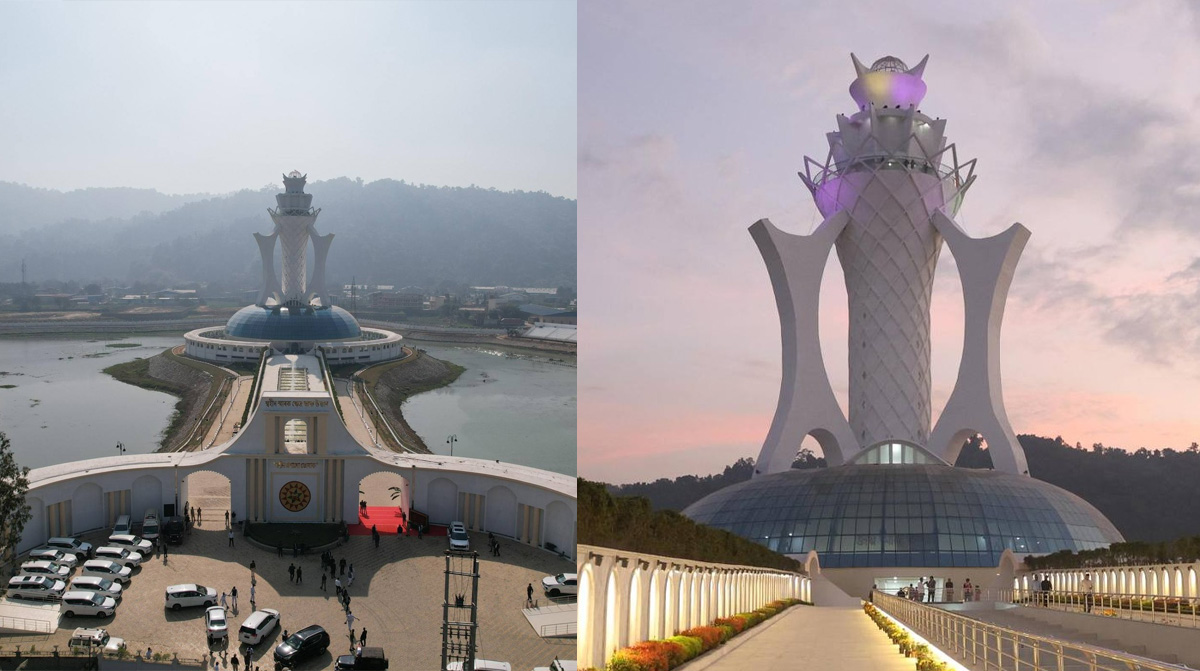
On the occasion of the Swahid Divas this year, Chief Minister Himanta Biswa Sarma inaugurated a centralised memorial named Swahid Smarak Kshetra at West Boragaon in Guwahati on Wednesday. The foundation stone for the memorial which was built at a cost of ₹178 crore was laid by the then Sarbananda Sonowal on December 10, 2019.

The 150 bigha site has a 225 tall main memorial, 860 busts of the swahids, a meditation hall, a laser show area, a horticulture garden, a food court, an auditorium and a cycle track. It also features a digital library that has information about the entire Assam Movement, among other things.
As photographs of around 400 martyrs were not available, their portraits and busts are being created using descriptions of their appearances by their families. Therefore, some spots are kept empty at present, and they will be filled as and when artworks are completed.
The eternal flame known as “Swahid Pranam Jyoti” at the Swahid Smarak Kshetra was lit by Sarma, and 860 diyas were lit in memory of the 860 swahids. Family members of all the martrs were invited to attend the inauguration, apart from senior leaders of the Assam movement.

At the inauguration ceremony, Bhupen Hazarika’s “Swahid Pranamo Tumak” was performed by a large number of artists after the recitation of the state anthem. Notably, Hazarika had created the song in honour of the martyes of the Assam movement.
The Swahid Smarak Kshetra is the first centralised memorial to remember those who lost their lives demanding the detection, disenfranchisment and deportation of illegal aliens from Assam. AASU has built a large number of small memorials in almost every town, including in almost every school and college in Assam, but there was no centralised place. Even though AGP, the party born out of AASU and AAGSP, ruled Assam for two terms, no plan was made for a centralised memorial.
What was Assam Movement
The profound challenges faced by the ordinary and law-abiding Indian population against those in power unfortunately did not cease with the fall of the British Raj, as the successors also focused on their own political objectives instead of the welfare, rights or security of those they pledged to protect under the Constitution.
The nation, akin to the present situation, was tackling with the grave problem of Bangladeshi infiltrators, particularly in the border regions and Assam was similarly affected. As a result, the All Assam Students Union (AASU) and the All Assam Gana Sangram Parishad (AAGSP) started a civil disobedience movement in 1979 to protest the unchecked inflow of illegal immigrants into Assam, especially from Bangladesh. It is regarded as one of the world’s longest student movements.

Furthermore, the state went through a volatile political period in the late 1970s and early 1980s, characterised by the overthrow of governments and the introduction of President’s Rule. Meanwhile, the massive illegal migration from Bangladesh triggered fears about the implications for resource exploitation, demographic change, the economy and underdevelopment, among other matters.
Hence, the inability of the administration to respond to the legitimate worries of the populace gave rise to the Assam Movement. It not only became one of the most well-known movements in post-colonial India but was a determined attempt to protect the state’s true identity which was gravely endangered by foreign intruders.
The anti-foreigner agitation was started in 1979 by the All Assam Students Union. The repatriation of foreigners who had entered Assam after 1951 was one of their key demands. The demonstration was also against a flawed voter registration that contained the names of countless unlawful immigrants, further escalating unrest.

Foreign nationals had been fraudulently entered into electoral rolls since 1963. The draft enrolments in Mangaldoi revealed a large number of non-citizens in 1979. According to Assam BJP leader Dilip Sharma, the Congress deceptively added over 40,000 East Bengali Muslims to the electoral records for the Dalgaon Assembly segment during the by-election which transpired after the death of MP Hiralal Patowary from the Mangaldoi Lok Sabha constituency.
Congress committed vote fraud in Assam…
— BJP Assam Pradesh (@BJP4Assam) November 22, 2025
The six-year-long Anti-Foreigners Movement that began in 1979 had its roots in Congress’ vote-stealing tactics.
That year, following the demise of Hiralal Patowary, the MP of the Mangaldoi Lok Sabha constituency, a by-election was to be… pic.twitter.com/YxIQ4qMHiZ
Afterward, AASU announced to boycott the 1980 Lok Sabha election and advocate for completely updated electoral records throughout the entire state. The Indira Gandhi government, however, chose not to accept the demands, as it would have impacted her electoral support. As a result, the movement only escalated, leading to economic blockades, tyranny, bloodshed and protracted hostilities.
Murder of AASU leader Khargeswar Talukdar
Khargeswar Talukdar, the 22-year-old general secretary of AASU’s Barpet unit was among the many young leaders who took a stand for the pivotal cause. However, his determination quickly made him a target and Bangladeshi Muslims mercilessly silenced his voice.
On the early hours of 10th December 1979, former president Fakhruddin Ali Ahmed’s wife Abida Ahmed went from Guwahati to Barpeta to file nomination for elections as a Congress candidate. The agitation was triggered by announcement of the polls without removing the names of illegal immigrants from the voter lists, and they were boycotting the polls.
AASU workers had tried to block Abida Ahmed in Guwahati and at various places on the way, but they were removed and mercilessly beaten by police. Similarly at Bhawanipur, local AASU members were on a picketting, but they were also targeted by the police. This included Khargeswar Talukdar, the 22-year-old general secretary of AASU’s Barpet unit and a 1st year student of Hawli College. He was dragged by the police, beaten to death, and then his body was thrown into a ditch on the side of the road close to Bhabanipur.
The heinous act was intended to quell the uprising but produced opposite result. After his death, his mortal remains were brought to Gauhati University, where the first Swahid Bedi or martyrs memorial was built.
Talukar became the movement’s first martyr and the killing shocked the entire state. The struggle turned personal and emotional for the grieving masses. The protests grew louder and gained traction.

As a result on 12th December 1979, the central government imposed President’s Rule in Assam, removing the Janata Party government, which was the first critical change in the state’s political landscape. However, the movement had evolved into an fight for the entire state. Students, farmers, intellectuals, and regular people protested in the streets, calling for the identification, disenfranchisement and expulsion of undocumented immigrants. The leaders of the protest also boycotted the 1983 Assembly elections.
On the other hand, several negotiations with the government did not succeed while the state faced consistent curfews, disruption of normal life, economic setbacks and widespread violence as hundreds of people sacrificed their lives to protect Assam from Bangladeshi intruders.

The centre eventually understood that the turmoil in Assam could not be disregarded after six arduous years of demonstrations, agitation and talks. On 15th August 1985, the officials of the Rajiv Gandhi government met with the leadership of AASU and AAGSP. They negotiated the landmark “Assam Accord” to deal with the fundamental issues presented by the movement. The agreement resulted in the creation of the critical National Register of Citizens (NRC) and pushed the subject of illegal immigration to the forefront of public discussion in India.
CM Sarma highlights insidious actions of Congress
“For years, Assam’s bravehearts didn’t have any permanent memorials in honour of their sacrifice in protecting the land, culture and identity of Assam. Correcting this historical anomaly, the Swahid Smarak in Guwahati today stands tall as a testament to their sacrifices,” CM Sarma expressed on the eve of Swahid Divas.
He outlined, “Over 860 young people lost their lives due to the brutality of the then Congress government in Assam. Their only fault was demanding a secured Assam, demanding an end to illegal infiltration.”
According to Sarma, the deceased were victims of “state brutality” and were penalised for asserting a justifiable demand for a “safe and secure Assam.”
“All that we have seen, youths died for demanding that Assam be made a safer place by deporting illegal immigrants in the state. However, unfortunately, more than 850 lives were lost due to the brutality unleashed by the state administration. At that time, Congress was in power at both the centre and the state. The Congress government was solely responsible for the loss of lives during the Assam agitation,” he mentioned.
The martyrs were remembered through get-togethers and private tributes for many years. Many of these martyrs were young people, mostly students, who had a resolve to uphold Assam’s real heritage and cultural roots. The central memorial has brought their stories to one location where they can be preserved, passed down and continue to inspire future generations. Their supreme sacrifice has now found a permanent place in the legacy of the state.
Conclusion
The Assam movement is yet another somber chapter of the sinister actions of the Congress to strengthen its electoral base at the expense of Indian citizens. It also stands as a grim reminder of the phrase, “The more things change, the more they stay the same” in the context of Indian politics, where the opposition’s pandering to Muslims extends even to intruders.
The outright objection to the Special Intensive Revision (SIR) drive, Citizenship Amendment Act (CAA) or NRC is a result of the same mindset, where these “secular” parties do not hesitate to compromise national security and interests, if it results in securing them some votes while the country and its natives suffer relentlessly.