100 years of ideological war: Why the Left is on the verge of extinction in India, while the RSS reaches every section of society
In the early decades of the twentieth century, India was not only fighting for independence, but a deep ideological battle was also taking shape within it. This battle was to define post-independence India. It had two poles: one side was contemplating whether India would move forward with its civilizational roots, cultural continuity, and a socially centralised approach, while the other side was considering whether India would reinvent itself with the help of an ideological framework imported from the West or other countries. The two main poles of this struggle were: the Left and the Rashtriya Swayamsevak Sangh (RSS). Ideological battles aren’t fought for days, months, or even years; they take decades and can rage on for hundreds of years. We are in the early decades of the 21st century, marking 100 years since the founding of the RSS and the CPI. In this century-long ideological conflict, the Left appears to be marginalised politically and socially in India, while the RSS has established its presence in nearly every segment of society, in every city and village. The emergence of the RSS and the downfall of the Left are not accidental but the result of several factors, which are discussed in this article. Imported ideology and strong cultural beginnings: CPI and RSS in the early days Ideologies like Marxism and Leninism, considered the origins of the Left, emerged from the industrial-social contexts of Europe and Russia. These ideas were imported into India. In 1920, while abroad, figures like M.N. Roy, Mohammad Ali, and M.P.T. Acharya founded the Communist Party of India in Tashkent. Later, in 1925, a conference was held in Kanpur, where communist organisations operating in different parts of India came together, formally establishing the CPI. The day was marked as the founding day of the CPI. Leftist ideology seemed attractive at that time because it spoke strongly against exploitation and inequality. However, its major limitation was that it viewed Indian society solely from the perspective of ‘rich and poor’ or ‘class,’ whereas Indian society is a complex structure composed of tradition, religion, caste, and culture. It was during this period that Keshav Baliram Hedgewar founded the Rashtriya Swayamsevak Sangh in 1925. The RSS’s objective was not to gain power but to strengthen society. It is considered the nation, not just a piece of land, but a vibrant cultural entity. Instead of imposing its ideology, the Sangh chose to work within society. From 1925 to the present, the RSS’s true strength lies in three aspects: its shakhas, pracharaks, and gurudakshina. Daily activities at the shakhas cultivate discipline and character. Pracharaks sacrifice their personal lives to take the organisation to every village. Gurudakshina keeps the RSS self-reliant and independent of external pressure. Together, these three have transformed the RSS into not just an idea but a vibrant movement for national service. Split in the Left Party and the expansion of the RSS While the early post-independence period marked a period of political strength for the Left, it was a difficult time for the RSS. In the first general election of 1951-52, the CPI emerged as the second largest party after the Congress, while attempts were made to ban the RSS by accusing it of the assassination of Mahatma Gandhi. However, the Sangh emerged from this struggle and remained firmly committed to serving the nation. After the formation of the Left government in Kerala in 1957, CPI was certainly looking strong. However, in the 1950-60s, the growing differences between the Soviet Union and China in the international communist movement had an impact on India as well. In 1964, due to this ideological conflict, the Communist Party of India (Marxist) (CPI(M)) was formed by separating from CPI. The Naxalbari movement of 1967 gave birth to a faction that adopted the path of armed revolution. In 1969, CPI (Marxist-Leninist) was formed, from which many Naxalite organisations were formed later. Finally, CPI (Maoist) was formed in 2004. While the Left movement was beginning to disintegrate, the RSS had formulated a long-range plan with ‘cultural nationalism’ at its core. Instead of working directly as a political party, the RSS established separate organisations for different sections of society. In 1948, the Akhil Bharatiya Vidyarthi Parishad (ABVP) was formed for students. In 1955, the Bharatiya Mazdoor Sangh (BMS) began working among the working class. Similarly, organisations like Vidya Bharati (education), Vishwa Hindu Parishad (religious-social sector), Seva Bharati (service work) were formed. The Sangh continued to expand through the ‘ancillary model’. Indian culture: RSS and the Left stand on two poles The Left’s biggest problem has been that it has never made an honest effort to understand India. Its ideological origins stem from the factories of Europe, the labour struggles there, and the battle between church and s
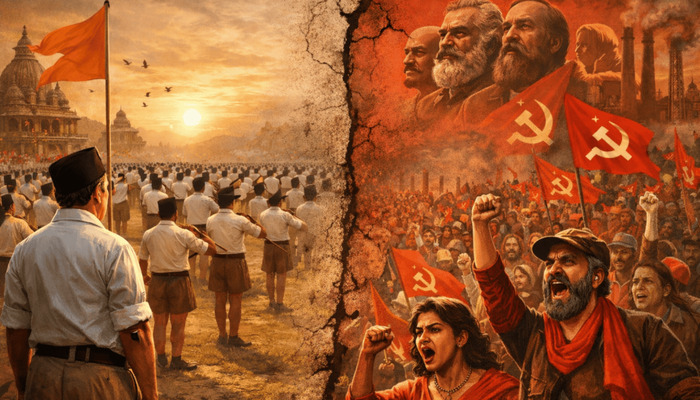

In the early decades of the twentieth century, India was not only fighting for independence, but a deep ideological battle was also taking shape within it. This battle was to define post-independence India. It had two poles: one side was contemplating whether India would move forward with its civilizational roots, cultural continuity, and a socially centralised approach, while the other side was considering whether India would reinvent itself with the help of an ideological framework imported from the West or other countries. The two main poles of this struggle were: the Left and the Rashtriya Swayamsevak Sangh (RSS).
Ideological battles aren’t fought for days, months, or even years; they take decades and can rage on for hundreds of years. We are in the early decades of the 21st century, marking 100 years since the founding of the RSS and the CPI. In this century-long ideological conflict, the Left appears to be marginalised politically and socially in India, while the RSS has established its presence in nearly every segment of society, in every city and village. The emergence of the RSS and the downfall of the Left are not accidental but the result of several factors, which are discussed in this article.
Imported ideology and strong cultural beginnings: CPI and RSS in the early days
Ideologies like Marxism and Leninism, considered the origins of the Left, emerged from the industrial-social contexts of Europe and Russia. These ideas were imported into India. In 1920, while abroad, figures like M.N. Roy, Mohammad Ali, and M.P.T. Acharya founded the Communist Party of India in Tashkent. Later, in 1925, a conference was held in Kanpur, where communist organisations operating in different parts of India came together, formally establishing the CPI. The day was marked as the founding day of the CPI.
Leftist ideology seemed attractive at that time because it spoke strongly against exploitation and inequality. However, its major limitation was that it viewed Indian society solely from the perspective of ‘rich and poor’ or ‘class,’ whereas Indian society is a complex structure composed of tradition, religion, caste, and culture.
It was during this period that Keshav Baliram Hedgewar founded the Rashtriya Swayamsevak Sangh in 1925. The RSS’s objective was not to gain power but to strengthen society. It is considered the nation, not just a piece of land, but a vibrant cultural entity. Instead of imposing its ideology, the Sangh chose to work within society.
From 1925 to the present, the RSS’s true strength lies in three aspects: its shakhas, pracharaks, and gurudakshina. Daily activities at the shakhas cultivate discipline and character. Pracharaks sacrifice their personal lives to take the organisation to every village. Gurudakshina keeps the RSS self-reliant and independent of external pressure. Together, these three have transformed the RSS into not just an idea but a vibrant movement for national service.
Split in the Left Party and the expansion of the RSS
While the early post-independence period marked a period of political strength for the Left, it was a difficult time for the RSS. In the first general election of 1951-52, the CPI emerged as the second largest party after the Congress, while attempts were made to ban the RSS by accusing it of the assassination of Mahatma Gandhi. However, the Sangh emerged from this struggle and remained firmly committed to serving the nation.
After the formation of the Left government in Kerala in 1957, CPI was certainly looking strong. However, in the 1950-60s, the growing differences between the Soviet Union and China in the international communist movement had an impact on India as well. In 1964, due to this ideological conflict, the Communist Party of India (Marxist) (CPI(M)) was formed by separating from CPI. The Naxalbari movement of 1967 gave birth to a faction that adopted the path of armed revolution. In 1969, CPI (Marxist-Leninist) was formed, from which many Naxalite organisations were formed later. Finally, CPI (Maoist) was formed in 2004.
While the Left movement was beginning to disintegrate, the RSS had formulated a long-range plan with ‘cultural nationalism’ at its core. Instead of working directly as a political party, the RSS established separate organisations for different sections of society. In 1948, the Akhil Bharatiya Vidyarthi Parishad (ABVP) was formed for students. In 1955, the Bharatiya Mazdoor Sangh (BMS) began working among the working class. Similarly, organisations like Vidya Bharati (education), Vishwa Hindu Parishad (religious-social sector), Seva Bharati (service work) were formed. The Sangh continued to expand through the ‘ancillary model’.
Indian culture: RSS and the Left stand on two poles
The Left’s biggest problem has been that it has never made an honest effort to understand India. Its ideological origins stem from the factories of Europe, the labour struggles there, and the battle between church and state. Karl Marx, the ideological father of the Left, called religion “opium for the masses” in the 19th century, and the Left in India also accepted the same. In India, religion has never been merely a ritual. Here, religion is a way of life, a culture, a bond that binds society. The Left never understood this difference and, without thinking, tried to impose the same foreign lens on India.
This is where the Left began to distance itself from India. It viewed temples, festivals, traditions, and national sentiments with suspicion. It described them as tools of exploitation and as signs of backwardness. Holi, Diwali, Ram, Krishna, the Gita—all of them were either ‘myths’ or ‘opium’ for the Left. The question is: if you constantly denigrate the very things that unite millions, will people join you or run away?
In contrast, the RSS took a path that accepted India as it was. The Sangh considered culture a strength, not a burden, and it continued to move forward, embracing tradition. The RSS even celebrated Hindu festivals at its branches. While the Left treated India’s identity as a problem, the RSS viewed the same identity as a solution. While the Left remained aloof from religion and the nation, the RSS used them to unite people.
Violence vs Service: Left vs RSS
The issue of violence has been a crucial aspect of this ideological battle. A significant part of the Leftist movements has been preoccupied with the concept of armed struggle and revolution. Naxalism is an extreme example of the Left ideology that legitimises a “war against the nation.” Naxalism deprived tribal areas of development, and caused disruption of basic services like education and health, and the common citizenry suffered from violence. Hundreds of security personnel have been killed due to the Left violence.
In Kerala, Leftists have targeted the RSS workers. The ideological war escalated to murder, and volunteers were physically attacked. Examples include volunteers like Sadanandan Master, who was nominated by the President as a Rajya Sabha MP. Communists mutilated his legs in 1994.
In contrast, the RSS did not embrace violence as an organisational tool. Despite the ban imposed after the assassination of Mahatma Gandhi in 1948 and persistent criticism, the RSS established itself through social work, disaster relief, education, and service. The organisation established itself as a grassroots organisation, and not as a group engaged in protest politics.
The RSS is transforming the lives of millions of people through its service in remote and neglected areas of the country. Dozens of organisations, from Vanvasi Kalyan Ashram to Seva Bharti, are engaged in service work in their own ways. Vanvasi Kalyan Ashram runs more than 20,000 Ekal Vidyalayas across the country, providing basic education to approximately 3 million tribal children. The Ekal Vidyalaya system is simple yet effective, with a single teacher teaching children from an entire village.
Meanwhile, organisations like Seva Bharati are working for the poor and needy in both cities and villages—whether it’s health camps, providing relief during disasters, or empowering women to become self-reliant. Through such efforts, over 160,000 RSS-inspired service projects are running across the country, where volunteers are selflessly contributing to social integration and nation-building. These works are being carried out not with the help of foreign funds or high-profile publicity, but through the sacrifice of millions of volunteers and the participation of society. The RSS has embraced service as a means to permanently empower society.
The failure of Leftist rule is a major reason for ideological decline
Until about two decades ago, left-wing parties were considered a decisive force in Indian politics. In the 2004 Lok Sabha elections, they won a total of 59 seats and were so influential in central power that the UPA government relied on their external support. The subsequent decline of the Left has now reached a near-existential crisis.
The Left, which began with 59 seats in 2004, shrank to 24 in 2009. This number dropped to just 10 in 2014, and in 2019, the Left was limited to just five Lok Sabha seats. While the total number of seats increased slightly in the 2024 Lok Sabha elections, it signals a political decline. Left parties won eight of these seats.
The situation is more or less the same in other states. West Bengal is the most glaring example of the failures of the Left rule. The CPI(M) held power in the state for 34 consecutive years, from 1977 to 2011. Such a long period provides any party with the opportunity to build a strong development model, but the opposite occurred in Bengal. During this period, industry fled the state, agricultural growth slowed, and the plight of the poor worsened compared to many other states in the country. The health and education systems collapsed, corruption increased, and political violence became common. As a result, the Left was thrown out of power by Mamata Banerjee’s Trinamool Congress in 2011. Today, the party is virtually irrelevant in Bengal.
A similar situation was witnessed in Tripura. The Left parties remained in power there for 25 years, from 1993 to 2018. Despite their long rule, they failed to adapt to the new aspirations of the people. Anti-incumbency, organisational inertia, and a lack of understanding of the changing political environment cost them in 2018 when the BJP ousted them from power.
Today, the last remaining stronghold of the Left in the country is Kerala. The state currently has a Leftist government, but warning signs are visible here, too, at the political level. In the 2024 Lok Sabha elections, Leftist parties won only one seat in all of Kerala. In the 2025 local body elections, non-Left fronts have also made gains, with the BJP winning the mayoral seat in Thiruvananthapuram for the first time. This shift suggests that even Kerala, once considered an impregnable fortress for the Left, is losing ground.
The decline of Leftist parties isn’t just a matter of electoral mathematics; they lack a solid development model that they can present to the nation as an inspiration. Despite decades in power, they have failed to build an economic and social structure in Bengal, Tripura, or other states that could be considered an achievement. As a result, leftist parties, which once shaped national politics, have now gradually been marginalised.
Leftism lagging on the intellectual front, too
For decades, Leftist ideology had a profound influence on India’s universities, media, and literary world. Whether it was JNU, Delhi University, or Hyderabad Central University, Leftist student organisations dominated these campuses, and Marxist analysis was considered the intellectual standard in the media. Today, this Leftist intellectual discourse is steadily weakening.
A major factor in this decline was the collapse of the Soviet Union in 1991. A New York Times report indicates that although India was never a communist country, the Indian Left drew ideological inspiration from global communism. The collapse of the Soviet Union dealt a severe blow to that ideological foundation. Even then, instead of introspection, the Indian Left remained entangled in old language and structures, leading to a lack of new ideas.
This shift is even more pronounced in universities. Once considered bastions of the Left-wing politics, JNU and Delhi University are now increasingly influenced by Right-wing and nationalist ideas. According to one study, the Left has failed to effectively understand and address complex social issues like caste. Its focus on class struggle has weakened it socially and alienated a large section of students.
Leftist influence in the media has also declined. The Indian Left is struggling with organisational fragmentation and a lack of resources. Its inability to adapt to the changing digital age and the new readership has also become a weakness. The void created by this ideological weakness of the Left has been filled by the RSS and its associated ideologues.
The RSS and its associated thinkers presented an alternative intellectual discourse on history, culture, and nationalism. This discourse was not limited to opposition or reaction to the Left, but rather sought to understand and present Hindu traditions in a modern context. It furthered the discussion on social integration and shared cultural identity.
In the field of history, RSS-affiliated thinkers have presented alternative discussions, gradually disrupting the narrative created by the Leftist writers, even in school textbooks. Correct and alternative history is being presented to students and society. Organisations like the RSS’s Iihas Sankalan Samiti or the Akhil Bharatiya Itihas Sankalan Yojana are engaged in the work of writing authentic, factual, and comprehensive historiography in the fields of history, culture, and tradition. This is helping in understanding nationalism from an Indian perspective, rather than a Western one. RSS-affiliated publications like Suruchi are making books on nationalism and the Sangh available to the public. Several organisations are preparing a platform for intellectual discourse with this in mind.
At the cultural level, the RSS has centralised concepts like “Akhand Bharat,” which emphasises the cultural influence of ancient India extending to Southeast Asia and other regions. This perspective views history as more than just political events, but also as a cultural interaction, exchange of ideas, and traditions, demonstrating the continuity and widespread influence of Indian civilisation. The RSS has evolved, and through the digital age, social media, and new communication channels, the Sangh’s vision has reached a broader audience.
Why did the Left get marginalised?
The Left’s fundamental approach has been a major factor in its ideological and political decline in India. The Left’s politics has always centred on power, the state, and the system. It is believed that society could be transformed through control over government and institutions. This is why, as the Left weakened electorally, its social and intellectual influence also shrank. Its grassroots base rapidly collapsed after it lost power in states like West Bengal and Tripura.
In contrast, the RSS never considered power its ultimate goal. For it, adapting to power was merely a means. Governments changed, political circumstances shifted, but the RSS’s organisation and its social work on the ground continued unabated. This is why, despite the fluctuations in power, its expansion remained unstoppable, and its hold on society remained intact.
A major ideological weakness of the Left was that it considered itself ‘progressive’ and the masses ‘backward.’ It tried to impose changes on society from the top. This approach created a distance between ordinary people and the Left leadership. The RSS, on the other hand, adopted a strategy of walking alongside society rather than preaching to it. Through shakhas, service work, and other activities, it established a direct connection with the people.
Over time, the Left’s discourse increasingly drifted away from the public sphere. Its politics and writings increasingly reflected the language and problems of farmers, labourers, and small-town youth. Its scope narrowed to universities, English newspapers, seminar halls, and air-conditioned debates. As a result, the public no longer felt connected to that discourse.
After every electoral and ideological setback, the Left found it easier to blame the public, the media, or the system rather than introspect. In contrast, the RSS, over time, adapted its strategy and working methods as needed, but never compromised on its core ideology. This difference is clearly visible today.
Today, the Left appears disheartened and fragmented. Meanwhile, the RSS, without much fanfare or declaring itself the sole intellectual authority, has steadily deepened its roots in society. This difference is key to understanding the decline of the Left in India and the emergence of a new socio-political discourse.
(This article is a translation of the original article published on OpIndia Hindi.)