Wikipedia co-founder Jimmy Wales ‘intervenes’ after edit war erupts to label Dhurandhar film ‘propaganda’: Read about anti-Hindu editor Kautilya 3 and OpIndia’s expose of the ‘free encyclopedia’
Wikipedia, notorious for letting anti-India and anti-Hindu editors use the platform for publicising biased information about individuals and entities, has sparked a fresh controversy rooted in the biasedness of its editors. Amidst an intense edit war on the Wikipedia page for the blockbuster film Dhurandhar and its even more successful 2026 sequel Dhurandhar: The Revenge, Wikipedia co-founder Jimmy Wales made a rare personal intervention on the article’s Talk page. Wales explicitly rejected the attempts made by one of the editors, “Kautilya 3” to label the movie a “propaganda film” in the article’s opening sentence using the so-called encyclopedia’s ‘neutral’ “WikiVoice”. Wales’s intervention was not about judging whether Aditya Dhar’s directorials are propaganda, but about protecting Wikipedia’s principle of Neutral Point of View (NPOV). “…it is also clear that the movie has no other motive other than” is your analysis. Our analysis, as Wikipedians, is not sufficient to override NPOV. In order to use a pejorative label in Wikipedia, we need consensus (which means very close to unanimity, not just a majority) in both the sources and in the community of editors in good standing. To say that this is “perfectly sourced” is obviously wrong as well – there are sources for the side of the debate that claims that the film is propaganda – but there are also sources detailing the controversy,” the Wikipedia co-founder wrote. Jimmy Wales stated that Wikipedia cannot pick sides, particularly on issues where reliable sources express strong disagreement. “Strong no – It is deeply inappropriate to take one side of a debate in the first sentence of an article by saying something in WikiVoice which is contested.. NPOV is policy which can not be overridden by anyone, not even by local consensus or an RfC. The many sources which call it propaganda are important, and should be reported on of course, but not in WikiVoice. Here are some direct quotes from policy which are crucial here and which must be upheld by anyone closing debates of this nature: “Wikipedia aims to describe disputes, but not engage in them.” “Avoid stating seriously contested assertions as facts. If different reliable sources make conflicting assertions about a matter, treat these assertions as opinions rather than facts, and do not present them as direct statements in wikivoice.” “Prefer nonjudgmental language.” That’s all from WP:NPOV. The best technique in situations like this is to attribute the views to the relevant parties,” Jimmy Wales wrote. As Jimmy Wales’s intervention upheld Wikipedia’s core Neutral Point of View (NPOV) policy, the pages for Dhurandhar films were temporarily locked to experienced editors to stop the warring. Ultimately, the explicit “propaganda film” tag was removed from the lead. However, the so-called ‘critical’ opinions calling the two films propaganda remain in the reception and “Factual accuracy and political messaging” sections. Anti-Hindu Wikipedia ‘Editor’ Kautilya 3 behind the push to label Dhurandhar as ‘propaganda’: Jimmy Wales’s intervention reinforces OpIndia investigation Ever since the release of the film Dhurandhar in 2025, the Islamo-leftist coterie in India, and Pakistani Islamists alike, have been burning the midnight oil to push the ‘propaganda’ tag against Dhurandhar. Anti-Modi/BJP ‘Journalists’, YouTubers like Dhruv Rathee, and social media trolls have intensified their attacks further after the release of Dhurandhar: The Revenge earlier this month. There is a collective effort ongoing to portray the movie as pro-Modi government propaganda. This nefarious agenda found its soldier on Wikipedia in one of the editors, Kautilya 3. Kautilya 3, is a UK-based Wikipedia editor, who was booked by Manipur police in 2024 for promoting enmity between communities in Manipur and propagating anti-Meitei hatred. OpIndia reported recently how the discussions on the talk pages of Ranveer Singh starrer films reveal a pattern where certain editors have consistently attempted to insert politically loaded descriptions into the Wikipedia articles on the films, while others have pushed back, accusing them of selective sourcing, cherry-picking, and pushing a one-sided narrative. Wikipedia editors openly pushed back against Kautilya 3’s attempt to label Dhurandhar films as a piece of propaganda. [Archive link 1] [Archive link 2] One of the editors, “KabirDH”, explicitly flagged bias and bad-faith sourcing. He stated, “Whilst I agree that elements of the film are definitely aimed at promoting or showing a certain party in a good light, the sources being used to do this, as are the users, are completely bad faith.” He further questioned the credibility of the sources that were being relied upon. He added, “This is an obviously pro-Trinamool Congress (and therefore, anti-BJP) individual, who is using the Calcutta Telegraph to further propagate his views.” Several editors flag
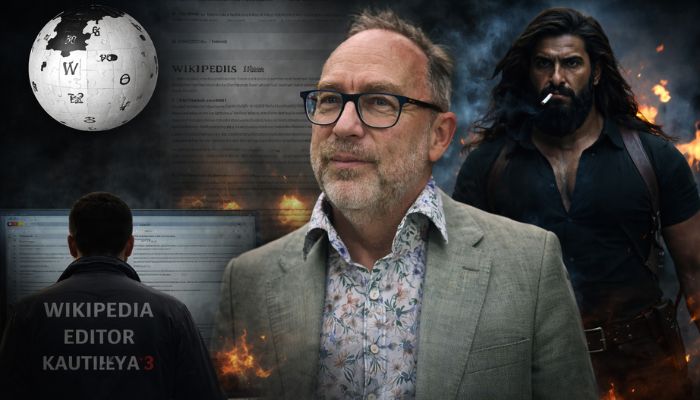
Wikipedia, notorious for letting anti-India and anti-Hindu editors use the platform for publicising biased information about individuals and entities, has sparked a fresh controversy rooted in the biasedness of its editors. Amidst an intense edit war on the Wikipedia page for the blockbuster film Dhurandhar and its even more successful 2026 sequel Dhurandhar: The Revenge, Wikipedia co-founder Jimmy Wales made a rare personal intervention on the article’s Talk page.
Wales explicitly rejected the attempts made by one of the editors, “Kautilya 3” to label the movie a “propaganda film” in the article’s opening sentence using the so-called encyclopedia’s ‘neutral’ “WikiVoice”.
Wales’s intervention was not about judging whether Aditya Dhar’s directorials are propaganda, but about protecting Wikipedia’s principle of Neutral Point of View (NPOV).
“…it is also clear that the movie has no other motive other than” is your analysis. Our analysis, as Wikipedians, is not sufficient to override NPOV. In order to use a pejorative label in Wikipedia, we need consensus (which means very close to unanimity, not just a majority) in both the sources and in the community of editors in good standing. To say that this is “perfectly sourced” is obviously wrong as well – there are sources for the side of the debate that claims that the film is propaganda – but there are also sources detailing the controversy,” the Wikipedia co-founder wrote.
Jimmy Wales stated that Wikipedia cannot pick sides, particularly on issues where reliable sources express strong disagreement.
“Strong no – It is deeply inappropriate to take one side of a debate in the first sentence of an article by saying something in WikiVoice which is contested.. NPOV is policy which can not be overridden by anyone, not even by local consensus or an RfC. The many sources which call it propaganda are important, and should be reported on of course, but not in WikiVoice. Here are some direct quotes from policy which are crucial here and which must be upheld by anyone closing debates of this nature: “Wikipedia aims to describe disputes, but not engage in them.” “Avoid stating seriously contested assertions as facts. If different reliable sources make conflicting assertions about a matter, treat these assertions as opinions rather than facts, and do not present them as direct statements in wikivoice.” “Prefer nonjudgmental language.” That’s all from WP:NPOV. The best technique in situations like this is to attribute the views to the relevant parties,” Jimmy Wales wrote.
As Jimmy Wales’s intervention upheld Wikipedia’s core Neutral Point of View (NPOV) policy, the pages for Dhurandhar films were temporarily locked to experienced editors to stop the warring. Ultimately, the explicit “propaganda film” tag was removed from the lead.
However, the so-called ‘critical’ opinions calling the two films propaganda remain in the reception and “Factual accuracy and political messaging” sections.
Anti-Hindu Wikipedia ‘Editor’ Kautilya 3 behind the push to label Dhurandhar as ‘propaganda’: Jimmy Wales’s intervention reinforces OpIndia investigation
Ever since the release of the film Dhurandhar in 2025, the Islamo-leftist coterie in India, and Pakistani Islamists alike, have been burning the midnight oil to push the ‘propaganda’ tag against Dhurandhar. Anti-Modi/BJP ‘Journalists’, YouTubers like Dhruv Rathee, and social media trolls have intensified their attacks further after the release of Dhurandhar: The Revenge earlier this month. There is a collective effort ongoing to portray the movie as pro-Modi government propaganda. This nefarious agenda found its soldier on Wikipedia in one of the editors, Kautilya 3.
Kautilya 3, is a UK-based Wikipedia editor, who was booked by Manipur police in 2024 for promoting enmity between communities in Manipur and propagating anti-Meitei hatred.
OpIndia reported recently how the discussions on the talk pages of Ranveer Singh starrer films reveal a pattern where certain editors have consistently attempted to insert politically loaded descriptions into the Wikipedia articles on the films, while others have pushed back, accusing them of selective sourcing, cherry-picking, and pushing a one-sided narrative.
Wikipedia editors openly pushed back against Kautilya 3’s attempt to label Dhurandhar films as a piece of propaganda. [Archive link 1] [Archive link 2]
One of the editors, “KabirDH”, explicitly flagged bias and bad-faith sourcing. He stated, “Whilst I agree that elements of the film are definitely aimed at promoting or showing a certain party in a good light, the sources being used to do this, as are the users, are completely bad faith.” He further questioned the credibility of the sources that were being relied upon. He added, “This is an obviously pro-Trinamool Congress (and therefore, anti-BJP) individual, who is using the Calcutta Telegraph to further propagate his views.”
Several editors flagged the violation of Wikipedia’s NPOV and other rules.
UnpetitproleX, one of the editors, rejected the claim that reliable sources had conclusively labelled the film as propaganda. “The fact remains that The Independent does not call the film a ‘propaganda film’ in its own voice.” Emphasising balance, he added, “But we also have a large number of sources that do not call the film propaganda… We cannot simply ignore these; we take into consideration all reliable sources when determining WP:DUE weight,” UnpetitproleX noted.
This blatant attempt at pushing a ‘propaganda’ tag against a film that does not toe the usual ‘Aman ki Asha’, Pakistan and Islamist-sympathising narratives was also seen when Dhurandhar 1 was released in December 2025.
The archived talk page of the first film, Dhurandhar, shows that the attempt to brand the film as propaganda began much earlier, and the controversial editor Kautilya3 played a crucial role in pushing this narrative. [Archive Link 1] [Archive Link 2]
On the talk page of the first film, Kautilya3 went beyond merely citing critics and instead advanced his own interpretation of the film’s messaging. In one of the most striking interventions, he wrote, “It is also demonstrated that it has propagandised the Modi government’s counterterrorism strategies.”
Uday Reddy elaborated his position, attempting to justify the use of the term “propaganda” by stating, “Propaganda means… ‘information, especially of a biased or misleading nature, used to promote a particular cause…’… In this case, there are [sources].”
In another comment, he doubled down, “My text… says that the film ‘propagandises’ Modi government’s policies. It is a fact that it does.”
Several editors, however, raised strong objections to Reddy using selective sources to push his ideological agenda against the film.
OpIndia dossier revealed anti-India and anti-Hindu shenanigans of Wikipedia and Kautilya 3
Back in 2024, OpIndia published a dossier detailing how Wikipedia is not a free, editorial-intervention-free encyclopaedia which relies on the voluntary work of thousands of unpaid, passionate volunteers across the globe, as claimed by the Wikimedia Foundation.
OpIndia concluded that Wikipedia’s “NPOV” (Neutral Point of View) guidelines do not mean that the entire spectrum of views would find equal representation in the article.
The outcome of NPOV is simply that whatever details are mentioned in the “reliable source” would be mentioned. The pool of “reliable sources” itself is tainted since the editors and administrators, who have disproportionate power in Wikipedia, ensure that “right-wing” (non-Left) sources are deprecated or blacklisted, essentially barring sources from being cited as reference material in any of the Wikipedia articles. The Dhurandhar-Wikipedia episode serves as a perfect example of this. Kautilya 3 cited the usual leftist sources like BBC and The Hindu, among others, to label the film as ‘propaganda’.
Kautilya 3 has consistently been pushing the Islamo-leftist agenda on Wikipedia. Earlier, a section on the 2020 anti-Hindu Delhi Riots was added to the Hindu terror Wikipedia article. In this section, Kautilya 3 added that a police investigation into the incident had revealed that the perpetrator belonged to AAP and therefore, it was a ‘conspiracy’ to create strife. Basically, the Wikipedia editor stated that the Delhi Police investigation should be removed since the Delhi police specifically is not a reliable source of information, while the left-leaning media is.
Kautilya3 is an Indian-origin UK-based doctor, Uday Reddy, who was booked in India for spreading disharmony between communities with his anti-India edits on Wikipedia. He works as a professor at a University in the United Kingdom. Reddy was booked by the Manipur Police over accusations of publishing inflammatory posts and statements on social media platforms. His X handle was withheld in India.
The complaint against him alleged that Reddy may have links with Khalistanis elements in Canada. The complaint stated that Uday Reddy has been working online to create tensions between Meitei and Kuki communities on religious grounds in Manipur. The FIR has been registered with a police station in Imphal East district under Sections 117 (abetment), 295-A (insulting religious sentiments), 153-A (promoting enmity between communities) and other relevant provisions of law.
“The accused person deliberately with malicious intention, insulted the Meitei’ religious beliefs and promoted enmity between the Meiteis and other communities on religious grounds,” the complaint stated.
Manipur Police had issued a statement wherein it said that Uday Reddy used to host spaces on social media platforms and allegedly directs people in Manipur on how to create unrest and trouble against law enforcement personnel.
Previously, Reddy was criticised for spreading propaganda about the Meitei community, particularly in the context of the Manipur crisis.
In one of the discussions, he was called out for his failure to accurately address Manipur’s history, specifically the Anglo-Kuki war.
Besides, Kautilya 3 also has a record of demonstrating his anti-Hindu bias. In April 2022, he accused Hindus of “weaponising” Ram Navami against Muslims. In a post on X, he wrote, “Hindutva nationalist organisations, spearheaded by RSS and BJP, have weaponised the festival to create Hindu Muslim frictions, causing riots and deaths, in which the Muslims have been the major sufferers.”
Contrary to Reddy’s claims, it was Muslims who attacked Hindus across India on Hindu festivals like Ram Navami and Hanuman Jayanti. In fact, processions related to festivals of Saraswati Puja and Ganesh Chaturthi too have been attacked, which are benign festivals related to the celebration of wisdom and knowledge.
The anti-Hindu bias of Wikipedia editors is also evident from its page about the 2002 Godhra carnage, in which 59 Hindus were burnt alive in a bogey of the Sabarmati Express while returning from Ayodhya. The train bogey was set ablaze by a Muslim mob. However, if one searches for it, a Wikipedia page titled “Godhra Train Burning” shows up. Wikipedia calls it ‘train burning’ since they do not believe that the fire was indeed set by a Muslim mob, essentially to burn Hindus alive.
Wikipedia article’s first paragraph says that the cause of the fire that burnt 59 Hindu pilgrims to death “remains disputed” even though multiple people have been convicted for burning the Sabarmati Express train in Godhra. Even Indian leftists have almost stopped claiming that it was an accident, but the Wiki article in the first paragraph says that “The cause of the fire remains disputed”.
The truth, however, is “disputed” only in the imagination of Wikipedia editors and not in reality.
On 27th February 2002, the Sabarmati Express was scheduled to reach Godhra station at about 3:30 am. On that day, the train was running four hours late. As such, it arrived at Godhra by 7:40 am. 8 minutes later, a mob of 2000 Islamists set 59 Hindus, including 25 women and 15 children, on fire in the coach S6 of the train in Godhra’s predominantly Muslim area – Signal Falia.
31 Islamists were found guilty of the Godhra massacre on February 22, 2011, by the trial court (with only 11 receiving the death penalty and 20 receiving life in prison), and all 31 convictions were affirmed by the Gujarat High Court in October 2017, resulting in everyone receiving a life sentence.
Not only this, in February 2003, an accused person made a judicial confession in which he acknowledged that Godhra was a well-planned attack and that he had personally participated in it.
Forget intellectual integrity or unbiasedness; one of the Wikipedia editors demonstrated that this Jihadi-sympathizing lot has a dearth of common sense as well. When confronted that the article was biased and that the court of India, with ample evidence, had convicted people for act of arson, Vanamonda93, a Wikipedia editor, known for anti-Hindu bias, claimed that the Wikipedia policy required them to maintain “neutral point of view” – which means summarising information from “reliable sources” – and not what the courts say.
Basically, leftist media reports are more reliable for Wikipedia editors and court judgments.
In addition, Wikipedia editors have also indulged in defamation of the sacred Hindu chant of Jai Shri Ram, relying on Islamo-leftist media reports. The opening paragraphs of the Wikipedia article itself disparage the religious chant, claiming it to be used as a war-cry to perpetrate communal violence against Hindus. The sources referenced to make this outlandish claim are mostly opinion pieces from Scroll, EPW, NYT and authors like Christophe Jaffrelot and Nandita Menon. The Wikipedia article essentially suggests that, contrary to its true meaning, Glory to Shri Ram, the chant Jai Shree Ram is a communal war cry, particularly invoked to target Muslims.
OpIndia dossier highlighted how Wikipedia picked up news reports from usual left-leaning sources, which framed non-communal cases of disputes between Hindus and Muslims, fake claims of ‘Jai Shri Ram-chanting mobs attacking Muslims, to vilify the sacred Hindu slogan.
Wikipedia page on Jai Shri Ram has been deliberately kept one-sided. The ‘talk’ page reveals that there was a section someone had added which spoke about the usage is in such fake cases; however, it was removed – the move justified due to flimsy reasons by ‘Kautilya3’, the very editor booked in Manipur for creating strife.
In this section, a clearly fake account (Postaltoad) lists down why the source mentioned for the fake Jai Shri Ram crimes is not reliable. Further, the account claims that the instances where either Muslims or sympathetic media blatantly lied about the involvement of Jai Shri Ram. Ram in the crime are “minor incidents” and therefore must not be added, making a case for the removal of the section completely. Thereafter, Kautilya3, the very man booked in Manipur, says that even if the Logical Indian was a “reliable source”, the section on fake crimes attributed to Jai Shri Ram should not be added because it just makes a “BIG DEAL” out of minor instances.
In another conversation, Kautilya3 says that fake cases are of no interest to “US” because Wikipedia is not a fact-checking website. Newslinger goes further, claiming that the co-founder of Wikipedia is also not a reliable source.
There was another conversation, a contributor says that the sentence in the introductory paragraph should be changed. His edit suggestion was rather reasonable, keeping intact that Left bias of the introduction as well; however, it was rejected by Kautilya3, saying that the most prominent use of Jai Shree Ram is to perpetrate violence against Muslims.
OpIndia analysis found that the page on Jai Shri Ram was created by an account which no longer exists. In his log, it is evident that he only made edits to some Bollywood pages and the only page of significance created was Jai Shri Ram. It is, therefore, entirely possible that this account was merely a pseudonym which was used to create the page and then deleted. Currently, the page is being manned by two main accounts – Kautilya3 and Newslinger.
Wikipedia also indulges in blacklisting sources, which reveals their inherent content bias. Most non-Left sources were banned for usage in Wikipedia. The list of deprecated sources and blacklisted sources indicate how the articles on Wikipedia are doomed to be biased because of the sources which are considered reliable and the ones which are not. The decision to deprecate sources itself stems from the Left bias that the editors seem to suffer from.
For Wikipedia, Qatar’s state-funded jihadi propaganda outlet Al Jazeera, which peddles fake news and has reporters with links to Islamic terrorist groups like Hamas, is a reliable source. The UK’s state-funded BBC is also a reliable source; however, the Indian state news channel Doordarshan does not feature in the list.
Right-wing media outlets like OpIndia and Swarajya are banned and blacklisted; however, Islamo-leftist rag TheWire, despite its several disinformation campaigns, Newslaundry, Scroll, Print, etc., are marked reliable.
When a retired naval officer publicly accused The Wire of misquoting him in an article that downplayed India’s naval achievements, his statement could not be added to The Wire’s Wikipedia page. His own clarification on Twitter was considered a “self-source”, and OpIndia, which reported his rebuttal, was blacklisted. As a result, The Wire’s misreport stood uncontested, a perfect illustration of how Wikipedia’s Neutral Point of View collapses when neutrality itself is defined by ideology.
In one case, the editors first agreed and then stonewalled the addition of a section about how TheWire fake news led to violence in the Northeast and other fake news that was spread by the publication. In the end, another editor said that the individual should go ahead and add the portion about TheWire causing violence with its fake news. However, when that information was added to the Wikipedia article, Kautilya3, who has been booked in Manipur for inciting hate, reverted that edit.
In another section, Kautilya3 and other editors ensure that an FIR against TheWire was not mentioned, claiming that FIRs are “very normal” according to TheWire and therefore, it should not be mentioned since they are very common.
However, in the case of blacklisted sources like OpIndia, the FIRs against those publications are prominently mentioned.
These examples are just a drop in the ocean, OpIndia’ dossier contains numerous such cases, and detailed information on how Wikipedia and its several of its editors are pushing anti-India and anti-Hindu narratives and lies in the content they claim to be ‘neutral’.
Is Wikipedia an unbiased intermediary or a biased publisher? What OpIndia research found
OpIndia’s research paper revealed that the structure of Wikipedia itself gives unmitigated power to a handful of individuals who are called ‘administrators’. There are only 435 active administrators in the entire world who have the power to ban editors, blacklist sources, ban contributors and decide the edits that should be made or reverted on articles.
Soon after OpIndia released the dossier, Facebook, another Left-leaning platform that has been accused of election interference in the USA and many such instances of furthering the political interest of a certain ideology, banned the dossier to restrict its viewership.
Wikipedia claims to be an intermediary which depends on the wisdom of the crowd without content intervention and editorial line, based on ‘reliable sources’ and maintaining a neutral point of view. This, however, is far from the truth, as evidenced in OpIndia research. Wikipedia meets all the standards of publishers. They collate information on current events and historical events, they pay their editors and administrators, and they are easily accessible by the people at large on the internet.
Given that Wikipedia has an editorial stand based on the personal opinions and biases of its editors and administrators, the evidence cited in the OpIndia dossier suggests that they are no longer eligible to be considered an intermediary. OpIndia recommended that once declared a publisher, Wikimedia would have to have its offices in India, set up a grievance redressal system and submit to Indian laws about illegal content which undermines the sovereignty of India or creates disaffection.
The findings of the research paper prepared by OpIndia Editor-in-Chief Nupur J Sharma reveal that despite not having offices or presence in India, Wikipedia has been funding entities and individuals with anti-India ideology and even links to Islamists and Khalistanis, to further its own business and ideological interests in the country. Wikipedia not only collects funds from India in the form of donations but also spends millions of dollars in India and toes an absolutely biased and rigid editorial line, all while claiming to be an intermediary and not a publisher to escape any accountability before the Indian law.
Besides, declaring Wikipedia as a publisher, OpIndia also recommended that Wikipedia’s financial transactions be scrutinised. The OpIndia dossier titled Wikipedia’s War on India can be read here.
Wikipedia co-founder, Jimmy Wales, once said Wikipedia’s mission was to “make the sum of all human knowledge available to everyone.” Today, that mission appears conditional, as knowledge is welcome only if it conforms to one side of the political spectrum. The very guideline that demands “Neutral Point of View” has been hollowed out, because neutrality now depends entirely on which sources are allowed into the conversation.
As the OpIndia dossier concluded, “If the pool of reliable sources itself is tainted with ideological bias, the ‘Neutral Point of View’ merely remains a requirement where all versions of the Left are prominently added.”
In an interview published by Politics Home in October 2025, Wales unapologetically defended Wikipedia’s own internal censorship, that is, the blacklisting of sources he has personally deemed unreliable in the past. He insisted that “the idea that we should take sites that routinely publish crazy conspiracy theories and nonsense just doesn’t make any sense.”
Previously, Jimmy Wales himself admitted as well that he is the final arbitrator of content on Wikipedia. “Final policy decisions are up to me, as always,” he once said.
According to Wikipedia itself, “The contributors or editors of Wikipedia participate subject to many policies and guidelines governing behaviour and content. These rules are supervised by various authorities: Jimmy Wales, nominally in a position of ultimate authority, although he has deferred in most instances to the leadership of Wikipedia, the ~34 present Bureaucrats or Crats, the ~700 active Administrators or Admins, and another group called the Arbitration Committee or ArbCom with 15-18 members or Arbs, depending upon the rules adopted each year. In July 2012, there were 14 active arbitrators identified, all of whom were administrators, although this is not a set rule. The Wikimedia Foundation or its designated agents also have the authority to impose bans against IP addresses for pages, topics, or the entire site. The Arbitration Committee “has no jurisdiction over official actions of the Wikimedia Foundation or its staff”.
In fact, Larry Sanger, the co-founder of Wikipedia, has categorically stated as well that Wikipedia has a pronounced Left bias. In several interviews and talks, he has spoken extensively about how Wikipedia skews the scale of balance, leading to the information being an inaccurate representation of reality, ridden with Left bias.
Jimmy Wales created an Arbitration Committee, which is essentially Wikipedia’s Supreme Court. This Committee is an extension of the decision-making power he formerly held as CEO of Bomis Inc., to take over his role in resolving complex disputes between users. Bomis Inc was a for-profit private company which was co-founded in 1996 by Jimmy Wales for ventures like Nupedia and Wikipedia.
By 2007, the for-profit company was shut down, and all the Wikipedia-related sources were transferred to Wikimedia Foundation, a nonprofit charitable organisation, also founded by Jimmy Wales.
The content on Nupedia, the predecessor of Wikipedia, was less in comparison to Wikipedia. For example, in its first year, Nupedia had only 21 articles while Wikipedia had 200. However, Larry Sanger has criticised how Jimmy Wales sacrificed authenticity for volume while shifting from Nupedia to Wikipedia. The Wikimedia Foundation was established in 2003, 2 years after Wikipedia was started by Jimmy Wales. OpIndia dossier highlighted the relationship between Google and Wikipedia, and how the former granted millions of dollars as ‘gifts’ to Wikipedia over the years through Tides Foundation.
Tides Foundation is notorious for funding several anti-Hindu, anti-India organisations and elements. The Foundation gave grants to Hindus for Human Rights (HfHR), which has links to Islamists and Khalistanis, and was formed in 2019 by two Islamist advocacy groups, the Indian American Muslim Council (IAMC) and Organisation for Minorities of India (OFMI). Tides also funded AMAN Public Charitable Trust (AMAN). This trust is connected to the NewsClick-China funding scandal, where it is alleged that Chinese entities funded NewsClick, a Delhi-based pro-China propaganda outlet funded by CCP stooge Neville Roy Singham, to disrupt Indian sovereignty.
Conclusion
OpIndia has consistently been highlighting how Wikipedia is populated by several editors who are driven by anti-Hindu and anti-India ideological biases and are inserting these biases in the pages they edit, as exemplified in the case of Dhurandhar films. Jimmy Wales’s intervention and direct calling out of his platform’s editors indulging in mindless labelling of a film as ‘propaganda’ based on biased sources, reinforces OpIndia’s investigation into Wikipedia, Jimmy Wales, Kautilya 3 and the anti-Hindu and anti-India activities the so-called ‘free-for-all-to-edit encyclopaedia’ indulges in.