Why are Asiatic Lions, which once roared from Greece to the Ganges, confined to Gir? A journey from the brink of extinction to a resilient population of 891
On the road connecting Junagadh and Amreli in Gujarat, mornings often reveal a scene that is difficult to imagine in most parts of the world. Cattle graze in open fields, Maldhari herders begin their daily routine, and somewhere nearby, an Asiatic lion may be resting under a tree or moving through agricultural land. In many countries, large predators and people are separated by fences, protected zones or vast distances. In Gujarat’s Gir, however, humans and lions have shared the same environment for generations. Today, the Asiatic lion survives naturally only in Gujarat. Anyone hoping to see these lions roaming freely in the wild must visit the Gir region and the surrounding areas of Kathiawad, also known as Saurashtra. While this achievement is a source of pride, it also raises an important question. How did a species that once occupied a vast territory across continents disappear almost everywhere, yet survive in one corner of western India? The answer lies in a unique combination of history, geography, community participation and decades of conservation efforts. A Lion that once ruled a vast territory The Asiatic lion was not always limited to Gujarat. Historical records and scientific studies show that lions once ranged across a huge area stretching from parts of Europe and North Africa to West Asia and the Indian subcontinent. Their presence was recorded from the Mediterranean region through present-day Iran and Iraq and into northern India. Within India, lions were found across regions that now include Rajasthan, Haryana, Punjab, Uttar Pradesh, Bihar and Madhya Pradesh. Ancient texts and historical accounts suggest that lions were familiar animals to people living across much of the subcontinent. The lion also occupied an important place in Indian culture. It appeared in mythology, religious traditions and royal symbolism. Goddess Durga is depicted riding a lion, while lions are frequently mentioned in ancient literature as symbols of courage and strength. The four lions of the Ashoka Pillar, which today form India’s national emblem, reflect this long-standing association. Yet cultural importance alone could not guarantee the species’ survival. The decline of the Asiatic lion By the nineteenth century, the future of the Asiatic lion had become uncertain. Large-scale hunting and habitat loss pushed the species towards extinction. For kings, nawabs, princes and British officials, lion hunting became a symbol of status and power. At the same time, forests were cleared to make way for agriculture and expanding human settlements. As natural habitats shrank, lions lost both space and prey. Large predators require extensive territory to survive. As forests disappeared and human activity increased, lion populations declined rapidly across their historic range. One region after another lost its lions until only the forests of Gir remained. By the end of the nineteenth century, estimates suggested that only a small number of Asiatic lions survived. Some accounts placed the population at little more than a dozen animals. A species that had once roamed thousands of kilometres was suddenly fighting for survival in a single landscape. Why Gir became their last refuge Many forests have water, vegetation and wildlife, but Gir offered something more. The region developed a stable ecosystem capable of supporting lions over a long period. The Gir landscape includes dry deciduous forests, thorn scrub, grasslands, riverine habitats and open spaces. This variety creates suitable conditions for large carnivores. Lions require shelter, breeding areas and access to prey, and Gir provided all three. The forest’s ecological diversity helped maintain a healthy balance between predators and prey. As a result, lions were able to continue surviving even when populations elsewhere disappeared. The Animals that sustained the Lions The survival of any large predator depends on the availability of prey. Gir’s rich wildlife population became one of the biggest reasons behind the lion’s continued existence. Species such as chital, sambar, nilgai, wild boar, chinkara and chausingha formed the foundation of the ecosystem. Over time, the numbers of these animals increased significantly. The growth of the chital population was particularly important because it ensured a stable food source for lions. Conservation experts often point out that protecting predators alone is not enough. The entire food chain must remain healthy. In Gir, the steady growth of prey populations strengthened the chances of lion recovery. The Maldharis and a rare example of coexistence One of the most remarkable aspects of the Gir story is the relationship between lions and the Maldhari community. The Maldharis are traditional pastoralists who have lived in and around the Gir region for centuries. Their settlements, known locally as ‘nes’ (nesda), are spread across the landscape. Livestock rearing ha
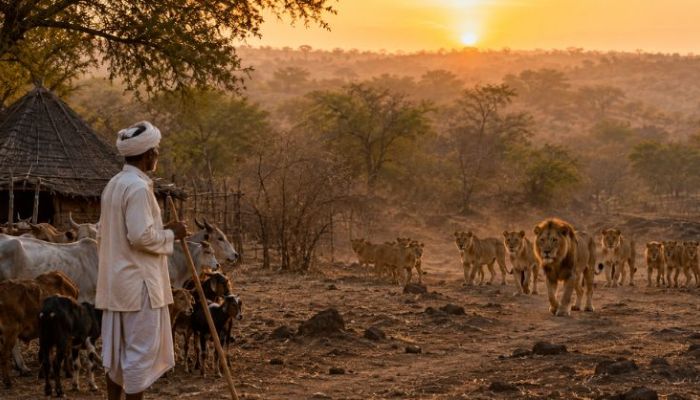
On the road connecting Junagadh and Amreli in Gujarat, mornings often reveal a scene that is difficult to imagine in most parts of the world. Cattle graze in open fields, Maldhari herders begin their daily routine, and somewhere nearby, an Asiatic lion may be resting under a tree or moving through agricultural land. In many countries, large predators and people are separated by fences, protected zones or vast distances. In Gujarat’s Gir, however, humans and lions have shared the same environment for generations.
Today, the Asiatic lion survives naturally only in Gujarat. Anyone hoping to see these lions roaming freely in the wild must visit the Gir region and the surrounding areas of Kathiawad, also known as Saurashtra. While this achievement is a source of pride, it also raises an important question. How did a species that once occupied a vast territory across continents disappear almost everywhere, yet survive in one corner of western India?
The answer lies in a unique combination of history, geography, community participation and decades of conservation efforts.
A Lion that once ruled a vast territory
The Asiatic lion was not always limited to Gujarat. Historical records and scientific studies show that lions once ranged across a huge area stretching from parts of Europe and North Africa to West Asia and the Indian subcontinent.
Their presence was recorded from the Mediterranean region through present-day Iran and Iraq and into northern India. Within India, lions were found across regions that now include Rajasthan, Haryana, Punjab, Uttar Pradesh, Bihar and Madhya Pradesh. Ancient texts and historical accounts suggest that lions were familiar animals to people living across much of the subcontinent.
The lion also occupied an important place in Indian culture. It appeared in mythology, religious traditions and royal symbolism. Goddess Durga is depicted riding a lion, while lions are frequently mentioned in ancient literature as symbols of courage and strength. The four lions of the Ashoka Pillar, which today form India’s national emblem, reflect this long-standing association.
Yet cultural importance alone could not guarantee the species’ survival.
The decline of the Asiatic lion
By the nineteenth century, the future of the Asiatic lion had become uncertain. Large-scale hunting and habitat loss pushed the species towards extinction.
For kings, nawabs, princes and British officials, lion hunting became a symbol of status and power. At the same time, forests were cleared to make way for agriculture and expanding human settlements. As natural habitats shrank, lions lost both space and prey.
Large predators require extensive territory to survive. As forests disappeared and human activity increased, lion populations declined rapidly across their historic range. One region after another lost its lions until only the forests of Gir remained.
By the end of the nineteenth century, estimates suggested that only a small number of Asiatic lions survived. Some accounts placed the population at little more than a dozen animals. A species that had once roamed thousands of kilometres was suddenly fighting for survival in a single landscape.
Why Gir became their last refuge
Many forests have water, vegetation and wildlife, but Gir offered something more. The region developed a stable ecosystem capable of supporting lions over a long period.
The Gir landscape includes dry deciduous forests, thorn scrub, grasslands, riverine habitats and open spaces. This variety creates suitable conditions for large carnivores. Lions require shelter, breeding areas and access to prey, and Gir provided all three.
The forest’s ecological diversity helped maintain a healthy balance between predators and prey. As a result, lions were able to continue surviving even when populations elsewhere disappeared.
The Animals that sustained the Lions
The survival of any large predator depends on the availability of prey. Gir’s rich wildlife population became one of the biggest reasons behind the lion’s continued existence.
Species such as chital, sambar, nilgai, wild boar, chinkara and chausingha formed the foundation of the ecosystem. Over time, the numbers of these animals increased significantly. The growth of the chital population was particularly important because it ensured a stable food source for lions.
Conservation experts often point out that protecting predators alone is not enough. The entire food chain must remain healthy. In Gir, the steady growth of prey populations strengthened the chances of lion recovery.
The Maldharis and a rare example of coexistence
One of the most remarkable aspects of the Gir story is the relationship between lions and the Maldhari community.
The Maldharis are traditional pastoralists who have lived in and around the Gir region for centuries. Their settlements, known locally as ‘nes’ (nesda), are spread across the landscape. Livestock rearing has long been their primary way of life.
In many parts of the world, conflicts between humans and large predators often lead to hostility. Livestock losses can result in retaliation against wildlife. In Gir, however, a different relationship evolved over generations.
This does not mean conflicts never occur. Lions do sometimes prey on livestock, causing losses for herders. Yet many Maldharis view lions as a natural part of their surroundings rather than as outsiders. Their attitude combines caution, respect and familiarity.
Older residents often speak about lions as they would speak about long-known neighbours. They understand lion behaviour, know when to remain alert and have learned how to share the landscape with them. This knowledge has been passed down through generations and has helped maintain a balance between people and wildlife.
A living culture, not just a conservation idea
The coexistence seen in Gir is not simply the result of government policies. It is part of everyday life.
As dawn breaks in a Maldhari settlement, cattle are taken out for grazing, milk is collected, and routine activities begin. Throughout these daily tasks, the presence of lions remains an accepted reality.
Over the years, some Maldhari families were relocated as part of conservation efforts. Even so, their connection with Gir remains strong. Their contribution to the region’s identity is deeply rooted and continues to be an important part of the lion conservation story.
Conservation efforts gain momentum
While coexistence played a major role, the recovery of the Asiatic lion also required organised conservation measures.
After Independence, it became increasingly clear that hunting restrictions alone would not save the species. Protecting the entire habitat was essential. In 1965, Gir was declared a wildlife sanctuary, marking a major step in conservation planning.
During the 1970s, detailed scientific studies were carried out to understand lion behaviour, habitat use and ecological needs. Researchers examined how lions moved across the landscape, how much territory they required and how prey populations influenced their survival.
At the same time, several Maldhari settlements were relocated from parts of the forest. Although the process was challenging, it allowed certain areas to regenerate naturally. Grasslands improved, vegetation recovered, and prey species benefited from the reduced pressure on the ecosystem.
Conservation efforts later expanded beyond Gir itself. Authorities began treating Gir, Girnar and neighbouring regions as a connected landscape capable of supporting a growing lion population.
Forest officials introduced regular monitoring systems, communication networks, community engagement programmes and safety measures such as covering open wells that posed risks to wildlife. These initiatives strengthened protection across the region.
The numbers from 177 to 891 tell the story
Perhaps the clearest evidence of success can be seen in the lion population figures.
The 1968 census recorded only 177 lions. Although the species had escaped extinction, its future remained uncertain.
The population gradually increased over the following decades. The count rose to 180 in 1974, 205 in 1979, 239 in 1984, 284 in 1990 and 327 in 1995. By 2005, the number had reached 359, while the 2010 census recorded 411 lions.
Growth accelerated in the following years. The population reached 674 in 2020, demonstrating that conservation efforts were producing results on a larger scale.
According to the latest count released by the Gujarat government in 2025, the number of Asiatic lions has reached 891. For a species that had once been reduced to a tiny surviving population, this represents one of the most remarkable wildlife recoveries in modern conservation history.
Lions beyond Gir
The growing population has also changed the geography of lion distribution. Earlier, most lions were concentrated within the Gir forests. Today, they occupy a much larger area across the Kathiawad region.
Lions are now regularly found in Girnar, coastal belts, agricultural landscapes and districts such as Amreli and Bhavnagar. Many animals live outside the traditional core forest area and have adapted to a broader landscape that includes human settlements.
This expansion brings new management challenges, but it also demonstrates the recovery of the species. The Asiatic lion is no longer confined to a small pocket of habitat.
A legacy preserved
The story of the Asiatic lion is not only about a predator. It is also a story about forests, prey animals, local communities, scientists, forest staff and decades of consistent conservation work.
Gir provided shelter when the species had nowhere else to go. Healthy prey populations ensured food. The Maldharis offered an example of long-term coexistence, while government agencies and conservationists created systems that helped the population recover.
At a time when the Asiatic lion seemed destined to disappear from the world, Gujarat helped keep the species alive. Today, every roar heard across the Gir landscape stands as a reminder that wildlife can recover when habitat protection, community support and scientific conservation work together.
The survival of the Asiatic lion is not simply a conservation achievement. It is proof that a species on the verge of extinction can return when people choose to protect it.