Who is pushing the ‘propaganda’ tag against Dhurandar on Wikipedia? How an anti-Hindu Wikipedia ‘Editor’ booked in Manipur for inciting violence cited fake news peddler Dhruv Rathee to tarnish the movie
The so-called encyclopedia, Wikipedia, is actively shaping the narrative around Hindi film Dhurandhar and Dhurandhar: The Revenge by pushing the claim that it is a “propaganda” movie. Discussions on the talk pages of Ranveer Singh starrer films reveal a pattern where certain editors have consistently attempted to insert politically loaded descriptions into the Wikipedia articles on the films, while others have pushed back, accusing them of selective sourcing, cherry-picking, and pushing a one-sided narrative. Propagandist YouTuber Dhruv Rathee has been used as a “source” for calling the film “propaganda”, which raises serious questions about the methodology Wikipedia editors have been using. The pages are currently locked for editing. How Wikipedia editors pushed the narrative of the film being ‘propaganda’ The attempt to label ‘Dhurandhar: The Revenge’ as a propaganda film was not a settled conclusion between the editors. It was a contested claim that several Wikipedia editors openly pushed back against. Discussions on the talk page reveal there was clear resistance to the forced narrative insertion. [Archive link 1] [Archive link 2] One of the editors, “KabirDH”, explicitly flagged bias and bad-faith sourcing. He stated, “Whilst I agree that elements of the film are definitely aimed at promoting or showing a certain party in a good light, the sources being used to do this, as are the users, are completely bad faith.” He further questioned the credibility of the sources that were being relied upon. He added, “This is an obviously pro-Trinamool Congress (and therefore, anti-BJP) individual, who is using the Calcutta Telegraph to further propagate his views.” Source: Wikipedia The concern was not limited to bias. There was also a violation of Wikipedia’s own rules. KabirDH warned, “It would be a brazen violation of WP:NPOV, WP:DUE, and WP:OR to use that single source for a broad, sweeping, genre classification with a wikilink to ‘propaganda film’ in the lead sentence.” Source: Wikipedia Another editor, UnpetitproleX, rejected the claim that reliable sources had conclusively labelled the film as propaganda. He noted, “The fact remains that The Independent does not call the film a ‘propaganda film’ in its own voice.” Emphasising balance, he added, “But we also have a large number of sources that do not call the film propaganda… We cannot simply ignore these, we take into consideration all reliable sources when determining WP:DUE weight.” Source: Wikipedia Highlighting the existence of an active dispute, UnpetitproleX further stated, “The issue is that a dispute exists around the labelling, and to state in wikivoice, as a matter of fact, that the film is propaganda, is akin to taking sides in such a dispute, whereas WP:NPOV guides us to ‘describe disputes, but not engage in them’.” Source: Wikipedia Frustration over the repeated attempts to insert the label was evident. KabirDH remarked, “Film being branded as ‘propaganda’ without reaching a consensus. This is getting increasingly hopeless.” He reiterated the lack of agreement, noting, “Consensus among editors has not been reached… It would be a brazen violation of Wikipedia guidelines and precedent for ‘propaganda’ to be added in the first line without near-universal acceptance (which is not the case).” Source: Wikipedia Even the reliability of certain sources was questioned. Editor ARandomName123 pointed out, “Grand Pinnacle Tribune is AI written, which is unreliable per WP:RSLLM.” Source: Wikipedia Taken together, the discussion shows that the “propaganda” label was not an established fact, but a disputed characterisation, resisted by multiple editors citing bias, source misrepresentation, and violation of Wikipedia’s neutrality norms. Similar narrative pushed on first Dhurandhar article, editor Kautilya3 at the centre of controversy A similar pattern was seen in the first part of the film as well. The archived talk page of the first film, Dhurandhar, shows that the attempt to brand the film as propaganda began much earlier, and the controversial editor Kautilya3 played a crucial role in pushing this narrative. [Archive Link 1] [Archive Link 2] On the talk page of the first film, Kautilya3 went beyond merely citing critics and instead advanced his own interpretation of the film’s messaging. In one of the most striking interventions, he wrote, “It is also demonstrated that it has propagandised Modi government’s counterterrorism strategies.” Source: Wikipedia This was not presented as an attributed opinion, but as a conclusion drawn from his own reading of the film and selected sources. He further elaborated his position, attempting to justify the use of the term “propaganda” by stating, “Propaganda means… ‘information, especially of a biased or misleading nature, used to promote a particular cause…’… In this case, there are [sources].” Source: Wikipedia In another comment, he made his intent
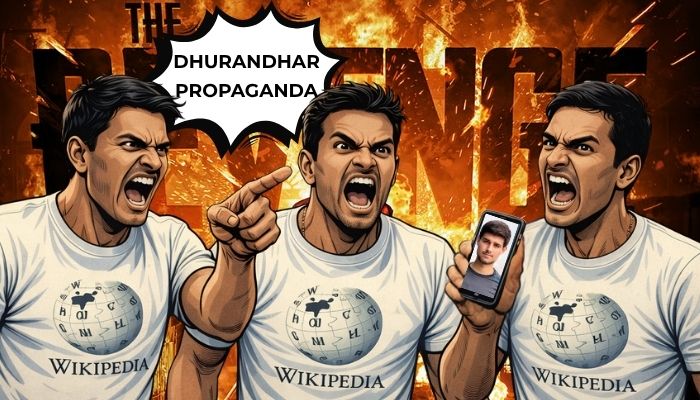
The so-called encyclopedia, Wikipedia, is actively shaping the narrative around Hindi film Dhurandhar and Dhurandhar: The Revenge by pushing the claim that it is a “propaganda” movie. Discussions on the talk pages of Ranveer Singh starrer films reveal a pattern where certain editors have consistently attempted to insert politically loaded descriptions into the Wikipedia articles on the films, while others have pushed back, accusing them of selective sourcing, cherry-picking, and pushing a one-sided narrative. Propagandist YouTuber Dhruv Rathee has been used as a “source” for calling the film “propaganda”, which raises serious questions about the methodology Wikipedia editors have been using. The pages are currently locked for editing.
How Wikipedia editors pushed the narrative of the film being ‘propaganda’
The attempt to label ‘Dhurandhar: The Revenge’ as a propaganda film was not a settled conclusion between the editors. It was a contested claim that several Wikipedia editors openly pushed back against. Discussions on the talk page reveal there was clear resistance to the forced narrative insertion. [Archive link 1] [Archive link 2]
One of the editors, “KabirDH”, explicitly flagged bias and bad-faith sourcing. He stated, “Whilst I agree that elements of the film are definitely aimed at promoting or showing a certain party in a good light, the sources being used to do this, as are the users, are completely bad faith.” He further questioned the credibility of the sources that were being relied upon. He added, “This is an obviously pro-Trinamool Congress (and therefore, anti-BJP) individual, who is using the Calcutta Telegraph to further propagate his views.”
Source: Wikipedia
The concern was not limited to bias. There was also a violation of Wikipedia’s own rules. KabirDH warned, “It would be a brazen violation of WP:NPOV, WP:DUE, and WP:OR to use that single source for a broad, sweeping, genre classification with a wikilink to ‘propaganda film’ in the lead sentence.”
Source: Wikipedia
Another editor, UnpetitproleX, rejected the claim that reliable sources had conclusively labelled the film as propaganda. He noted, “The fact remains that The Independent does not call the film a ‘propaganda film’ in its own voice.” Emphasising balance, he added, “But we also have a large number of sources that do not call the film propaganda… We cannot simply ignore these, we take into consideration all reliable sources when determining WP:DUE weight.”
Source: Wikipedia
Highlighting the existence of an active dispute, UnpetitproleX further stated, “The issue is that a dispute exists around the labelling, and to state in wikivoice, as a matter of fact, that the film is propaganda, is akin to taking sides in such a dispute, whereas WP:NPOV guides us to ‘describe disputes, but not engage in them’.”
Source: Wikipedia
Frustration over the repeated attempts to insert the label was evident. KabirDH remarked, “Film being branded as ‘propaganda’ without reaching a consensus. This is getting increasingly hopeless.” He reiterated the lack of agreement, noting, “Consensus among editors has not been reached… It would be a brazen violation of Wikipedia guidelines and precedent for ‘propaganda’ to be added in the first line without near-universal acceptance (which is not the case).”
Source: Wikipedia
Even the reliability of certain sources was questioned. Editor ARandomName123 pointed out, “Grand Pinnacle Tribune is AI written, which is unreliable per WP:RSLLM.”
Source: Wikipedia
Taken together, the discussion shows that the “propaganda” label was not an established fact, but a disputed characterisation, resisted by multiple editors citing bias, source misrepresentation, and violation of Wikipedia’s neutrality norms.
Similar narrative pushed on first Dhurandhar article, editor Kautilya3 at the centre of controversy
A similar pattern was seen in the first part of the film as well. The archived talk page of the first film, Dhurandhar, shows that the attempt to brand the film as propaganda began much earlier, and the controversial editor Kautilya3 played a crucial role in pushing this narrative. [Archive Link 1] [Archive Link 2]
On the talk page of the first film, Kautilya3 went beyond merely citing critics and instead advanced his own interpretation of the film’s messaging. In one of the most striking interventions, he wrote, “It is also demonstrated that it has propagandised Modi government’s counterterrorism strategies.”
Source: Wikipedia
This was not presented as an attributed opinion, but as a conclusion drawn from his own reading of the film and selected sources. He further elaborated his position, attempting to justify the use of the term “propaganda” by stating, “Propaganda means… ‘information, especially of a biased or misleading nature, used to promote a particular cause…’… In this case, there are [sources].”
Source: Wikipedia
In another comment, he made his intent even clearer, asserting, “My text… says that the film ‘propagandises’ Modi government’s policies. It is a fact that it does.”
Source: Wikipedia
Such statements reveal a clear shift from reporting criticism to asserting ideological interpretation as fact, something that multiple editors immediately challenged.
Other contributors pointed out glaring inconsistencies in this framing. One editor directly questioned the timeline argument, stating, “How can it ever propagandise for the Modi Government, if he wasn’t even in rule in 2008–09?”
Source: Wikipedia
Another editor highlighted the imbalance in sourcing and narrative construction, arguing, “Particularly 3-4 selective sources… are cited… You literally wrote the whole essay without any discussion as if you are trying to represent this page in negative way.”
Source: Wikipedia
There were also repeated objections to the creation of an entire section titled “Factual accuracy and political messaging”, which many editors felt was disproportionately built around a narrow set of critical viewpoints. One editor explicitly demanded, “Remove propoganda word. and remove that essay subheader ‘Factual accuracy and political messaging’.” The resistance was not limited to content alone, but extended to editorial behaviour. Kautilya3 was accused of repeatedly reverting edits and pushing his version of the narrative despite objections. One editor remarked, “He single handedly wrote everything without any discussions and not letting others to do anything at page.”
Another accused him of selectively weighting sources to push a particular viewpoint, stating that he was “cherry-picking sources and peddling propaganda by unfair weighting.”
Despite these objections, Kautilya3 consistently defended his approach by invoking Wikipedia policies, particularly those related to reliable sources and neutrality. In one response, he stated, “Wikipedia discussions proceed based on WP:V and WP:NPOV, not personal views.”
However, other editors argued that this very framework was being used selectively, allowing certain viewpoints to dominate while dismissing others as unreliable or irrelevant.
The discussion also exposed how controversial opinions were being elevated through indirect sourcing. References to Dhruv Rathee’s criticism once again surfaced, with editors questioning why his views were being given importance. One editor asked, “How is Dhruv rathee’s political bs a clear source?”
Source: Wikipedia
Another added, “You have cited Dhruv Rathee opinions on Dhurandhar wow”
Source: Wikipedia
Interestingly, Kautilya3 called Dhruv Rathee a “notable source”.
Source: Wikipedia
Yet, as seen in the sequel’s discussion as well, once such opinions were reported by media outlets, they were defended as valid under Wikipedia’s sourcing rules.
What becomes evident from the first film’s talk page is that the attempt to frame Dhurandhar as propaganda was not a spontaneous reflection of consensus, but the result of sustained editorial push, selective interpretation, and repeated reliance on a narrow band of sources.
The same arguments, the same resistance, and the same patterns of conflict would later reappear in the discussions around the sequel, indicating a continuing effort to shape the narrative in a particular direction.
Notably, UK-based Wikipedia editor Kautilya3, whose name is Uday Reddy, was booked by Manipur police in 2024 for promoting enmity between communities in Manipur and propagating anti-Meitei hatred.
OpIndia’s dossier on Wikipedia bias and how Dhurandhar fits the pattern
OpIndia’s dossier on Wikipedia had already flagged how the so-called encyclopedia is not merely documenting information but actively shaping narratives through a network of editors, selective sourcing, and policy driven gatekeeping. The dossier highlighted how a small group of entrenched editors often dominate pages, rely on a narrow ecosystem of “acceptable” publications, and use Wikipedia’s internal rules to push specific ideological framings while sidelining others.
The developments around Dhurandhar and Dhurandhar: The Revenge fit perfectly into the pattern described in that dossier. As seen in the talk page discussions, the push to label the film as “propaganda” did not emerge from broad consensus but from repeated attempts by certain editors to elevate a limited set of critical opinions into a defining narrative.
The resistance from other editors, who pointed out “Picking few selective articles and generalising the statements is something looking very fishy” and “3-4 opinions from certain newspapers will not generalise the whole film,” directly mirrors the concerns raised in OpIndia’s findings.
The dossier had specifically noted how Wikipedia’s dependence on a fixed pool of “reliable sources” allows particular narratives to gain disproportionate visibility. This mechanism is clearly visible in the Dhurandhar discussions, where criticism amplified by a handful of publications, including commentary linked to Dhruv Rathee, was repeatedly pushed into the article, while broader reception and opposing views were dismissed or downplayed.
Another key observation from the OpIndia dossier was the role of dominant editors in shaping page content. In the case of Dhurandhar, multiple contributors accused editor Kautilya3 of doing exactly that, with one editor stating, “he single-handedly wrote everything without any discussions and not letting others to do anything at page,” while another raised concerns about “cherry-picking sources and peddling propaganda by unfair weighting.”
This aligns with OpIndia’s broader finding that Wikipedia’s openness often masks a reality where a handful of persistent editors, well versed in policy language, are able to control narratives far more effectively than casual contributors.
The dossier had also underlined how indirect sourcing is used to introduce controversial viewpoints. The reliance on Dhruv Rathee’s criticism is a textbook example of this process. As seen in the talk page itself, editors questioned this approach, asking, “How is Dhruv rathee’s political bs a clear source?” and asserting that “A YouTuber’s opinions is not reliable by any means.” Yet the argument that such views become valid once covered by certain publications allowed them to remain part of the discussion.
In this sense, the Dhurandhar case does not stand alone, it reinforces the systemic issues already identified by OpIndia. It shows how Wikipedia’s editorial structure, far from being a neutral mechanism, can be used to amplify specific narratives under the cover of policy compliance.
A so-called encyclopedia or a platform for ideological narrative building
The Dhurandhar discussions, when viewed alongside OpIndia’s dossier, raise a larger question about Wikipedia’s credibility as a neutral knowledge platform. What is presented as a collaborative, open-source encyclopedia increasingly appears to function as a curated space where narratives are negotiated, filtered, and, at times, pushed in particular directions.
The repeated attempts to brand Dhurandhar as propaganda, despite clear disagreement among editors and lack of unanimity in sources, show how narratives can be constructed through persistence and procedural leverage. When an editor states, “It is also demonstrated that it has propagandised Modi government’s counterterrorism strategies” and insists “It is a fact that it does,” the line between reporting and interpretation begins to blur.
At the same time, opposing voices are constrained within the framework of Wikipedia’s rules, often dismissed as “original research” or “personal opinion,” even when they are pointing out inconsistencies or broader context. This creates a situation where neutrality is not an inherent outcome, but something that can be shaped by those who are most adept at navigating the system.
The dossier had warned that Wikipedia’s reliance on a limited set of publications as “reliable sources” effectively creates an ideological filter. The Dhurandhar case shows how that filter operates in practice. Once a narrative gains traction within that ecosystem, whether through opinion pieces, selective reviews, or amplified commentary, it can be elevated into the article as a significant viewpoint, regardless of how contested it may be outside that circle.
This raises serious concerns about the platform’s role in shaping public perception. When widely read pages begin to reflect narrow or contested interpretations as prominent narratives, the impact goes beyond Wikipedia itself. It influences how subjects are understood, discussed, and even judged by a broader audience.
In that sense, the question is no longer whether Wikipedia has bias, but how that bias operates. The answer, as both the dossier and the Dhurandhar discussions suggest, lies in the intersection of editorial dominance, selective sourcing, and policy driven validation.
While Wikipedia continues to position itself as a neutral repository of knowledge, there is enough evidence against it. Still, it is being used as a primary source of information by search engine giant Google to show summaries about topics, including Hindi film Dhurandhar.