When the Portuguese held the Strait of Hormuz: A century of rule, controlling trade routes from Arabia to India, until British and Persia joined forces
The rising tension between the United States, Israel, and Iran has evolved into a major threat to stability and peace in the Middle East, with repercussions extended beyond the region, threatening to draw other nations into the conflict. It has had a profound impact on the global supply chain, disrupting the flow of crude oil and gas, as a potential energy crisis looms over other economies. The current predicament has developed after Tehran closed the “Strait of Hormuz,” with the intention of inflicting a heavy toll on Washington and Jerusalem in response to the assassination of its Supreme Leader, Ayatollah Ali Khamenei. The country has taken over the passage since the 1979 Iranian Revolution, which overthrew the American-backed Shah monarchy and established the Islamic Republic. The 104 miles or 167 kilometres strait, which is only 20 miles wide at its narrowest point and links the Persian Gulf to the Gulf of Oman and the Arabian Sea, is a geographical “choke point” for tankers transporting 20 million barrels of oil a day from Gulf nations including Saudi Arabia, Iran, Iraq and Kuwait. It provides access from the Indian Ocean to the Persian Gulf’s waters and beyond, along with serving as a crucial location for international maritime commerce. The area has been a source of longstanding historical interest as a key hub of thriving global trade, owing to its strategically significant location and has become a battleground for world powers vying to assert their authority over it. Portugal, which opened the door for European colonisation in India, has also left its legacy in relation to the contestation of the strait. Portuguese plan in motion Manuel I, the King of Portugal, who had already sent several armadas to India, decided in 1505 to obstruct Muslim trade in the Indian Ocean by seizing Aden to limit traffic through Alexandria, Hormuz or Ormuz to hinder the route through Beirut and Malacca to regulate the business with China. This plan eventually culminated in the takeover of Hormuz. General Afonso de Albuquerque, known for the conquest of Goa, commanded two major military operations in 1507 and 1515 and successfully acquired possession of the critical pathway. He tried to gain ownership of the strategic emporia cities of trade throughout the Indian Ocean for his country after achieving a headquarters for the Portuguese Empire of the East (Estado da India) at Goa in 1510 with the aim to dominate commerce and set up a monopoly. The island of Hormuz existed at a strong site at the confluence of the strait previously called Jarun or New Hormuz after its capital was moved for military reasons around 1296 CE. Albuquerque attacked it in 1507 to create the Castle of Ormuz, which contributed to the territory’s capture. The Portuguese maintained complete influence over trade across the Persian Gulf between Europe and India as a result of this victory. Portuguese map of Hormuz, 17th century. (Source: Wikipedia) According to Portuguese reports, the island of Socotra was home to Nestorian Christians and could be helpful in this quest. Thus, two fleets of 16 ships, headed by Tristao da Cunha dispatched from Lisbon in April 1506 to grab the region and build a fort there. Albuquerque, who had been appointed captain-major of the Sea of Arabia and was asked to blockade Muslim shipping in the Red Sea, helped him. The mission was completed in 1507. Afterwards, a few ships remained under Albuquerque while the majority of the fleet departed for India. However, he recognised that Socotra was unsuitable as a military base and his troops would not be able to take the heavily guarded city of Aden. Hence, he moved to annex the island of Hormuz, defying orders to travel to India. “When I saw myself this ruined, and the fleet lacking supplies, and a hundred and twenty men sick, lacking whatsoever to feed them, and a hundred men that the king had us stationed there, I was forced to change course, so as not to lose the fleet and the fortress, and discard the journey to Cambay, and seek the Strait of Hormuz to find supplies, and die like knights, rather than starving little by little, till we wrecked the ships,” Albuquerque wrote about their hardships in a letter on 27th October 1507. The incursion of Oman Oman’s coastal cities were under the administration of the Kingdom of Hormuz in the early 16th century. On 22nd August 1507, Albuquerque and his crew arrived in Qalhat, a prominent harbour that delivered dates and horses to India. Its governor chose to negotiate an offer and exchange hostages after learning about Socotra’s fate. However, Qurayyat erected stockades and made an effort to resist, but the town was attacked and overrun. A eunuch and former slave of the monarch of Hormuz ruled Muscat at the time. He submitted to Albuquerque, but the garrison rejected his request, and the town was also sacked. Afonso de Albuquerque (Source: Heritage History) Sohar was the only town in
The rising tension between the United States, Israel, and Iran has evolved into a major threat to stability and peace in the Middle East, with repercussions extended beyond the region, threatening to draw other nations into the conflict. It has had a profound impact on the global supply chain, disrupting the flow of crude oil and gas, as a potential energy crisis looms over other economies.
The current predicament has developed after Tehran closed the “Strait of Hormuz,” with the intention of inflicting a heavy toll on Washington and Jerusalem in response to the assassination of its Supreme Leader, Ayatollah Ali Khamenei. The country has taken over the passage since the 1979 Iranian Revolution, which overthrew the American-backed Shah monarchy and established the Islamic Republic.
The 104 miles or 167 kilometres strait, which is only 20 miles wide at its narrowest point and links the Persian Gulf to the Gulf of Oman and the Arabian Sea, is a geographical “choke point” for tankers transporting 20 million barrels of oil a day from Gulf nations including Saudi Arabia, Iran, Iraq and Kuwait. It provides access from the Indian Ocean to the Persian Gulf’s waters and beyond, along with serving as a crucial location for international maritime commerce.
The area has been a source of longstanding historical interest as a key hub of thriving global trade, owing to its strategically significant location and has become a battleground for world powers vying to assert their authority over it. Portugal, which opened the door for European colonisation in India, has also left its legacy in relation to the contestation of the strait.
Portuguese plan in motion
Manuel I, the King of Portugal, who had already sent several armadas to India, decided in 1505 to obstruct Muslim trade in the Indian Ocean by seizing Aden to limit traffic through Alexandria, Hormuz or Ormuz to hinder the route through Beirut and Malacca to regulate the business with China. This plan eventually culminated in the takeover of Hormuz.
General Afonso de Albuquerque, known for the conquest of Goa, commanded two major military operations in 1507 and 1515 and successfully acquired possession of the critical pathway. He tried to gain ownership of the strategic emporia cities of trade throughout the Indian Ocean for his country after achieving a headquarters for the Portuguese Empire of the East (Estado da India) at Goa in 1510 with the aim to dominate commerce and set up a monopoly.
The island of Hormuz existed at a strong site at the confluence of the strait previously called Jarun or New Hormuz after its capital was moved for military reasons around 1296 CE. Albuquerque attacked it in 1507 to create the Castle of Ormuz, which contributed to the territory’s capture. The Portuguese maintained complete influence over trade across the Persian Gulf between Europe and India as a result of this victory.
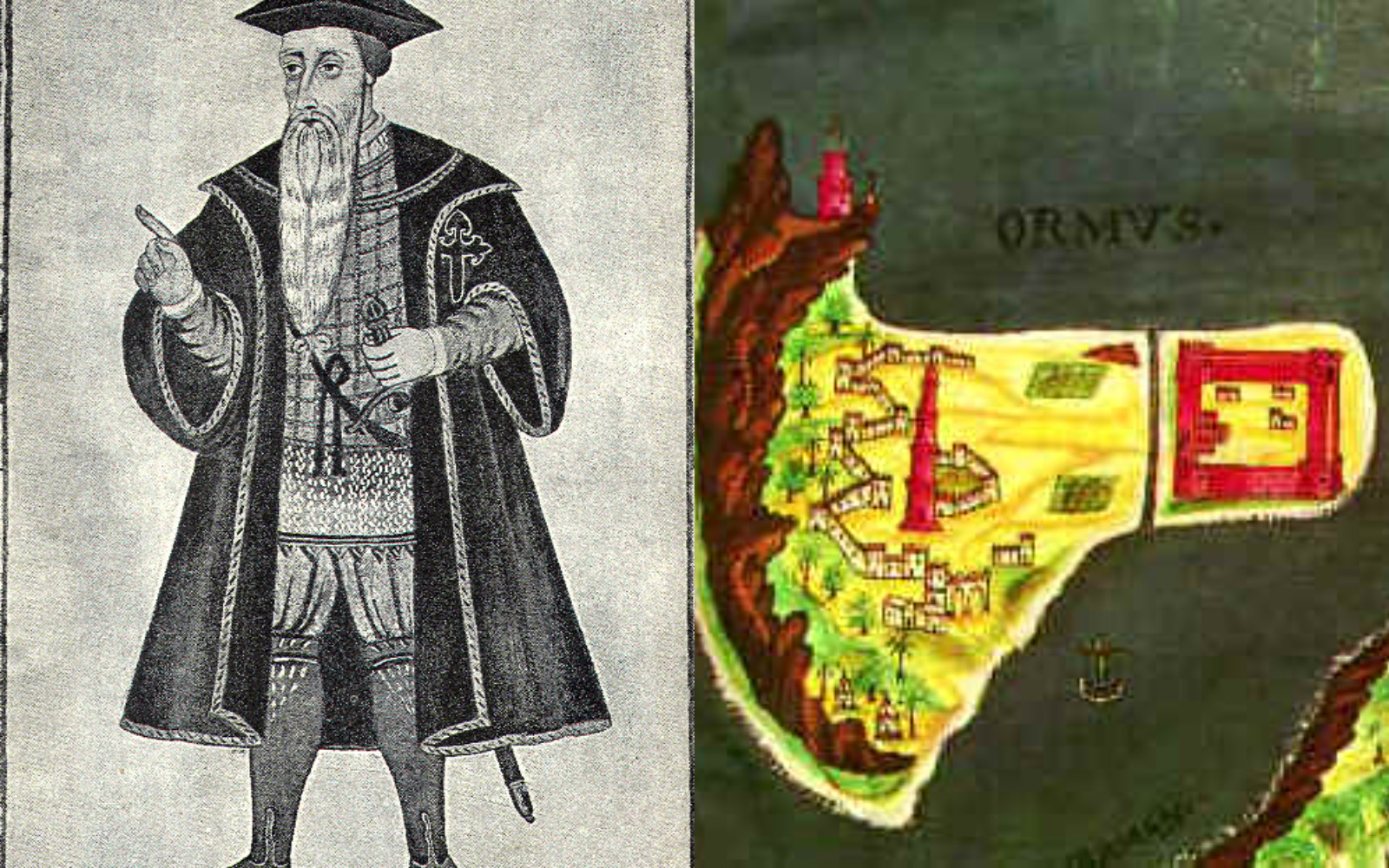
Portuguese map of Hormuz, 17th century. (Source: Wikipedia)
According to Portuguese reports, the island of Socotra was home to Nestorian Christians and could be helpful in this quest. Thus, two fleets of 16 ships, headed by Tristao da Cunha dispatched from Lisbon in April 1506 to grab the region and build a fort there. Albuquerque, who had been appointed captain-major of the Sea of Arabia and was asked to blockade Muslim shipping in the Red Sea, helped him.
The mission was completed in 1507. Afterwards, a few ships remained under Albuquerque while the majority of the fleet departed for India. However, he recognised that Socotra was unsuitable as a military base and his troops would not be able to take the heavily guarded city of Aden. Hence, he moved to annex the island of Hormuz, defying orders to travel to India.
“When I saw myself this ruined, and the fleet lacking supplies, and a hundred and twenty men sick, lacking whatsoever to feed them, and a hundred men that the king had us stationed there, I was forced to change course, so as not to lose the fleet and the fortress, and discard the journey to Cambay, and seek the Strait of Hormuz to find supplies, and die like knights, rather than starving little by little, till we wrecked the ships,” Albuquerque wrote about their hardships in a letter on 27th October 1507.
The incursion of Oman
Oman’s coastal cities were under the administration of the Kingdom of Hormuz in the early 16th century. On 22nd August 1507, Albuquerque and his crew arrived in Qalhat, a prominent harbour that delivered dates and horses to India.
Its governor chose to negotiate an offer and exchange hostages after learning about Socotra’s fate. However, Qurayyat erected stockades and made an effort to resist, but the town was attacked and overrun. A eunuch and former slave of the monarch of Hormuz ruled Muscat at the time. He submitted to Albuquerque, but the garrison rejected his request, and the town was also sacked.
Afonso de Albuquerque (Source: Heritage History)
Sohar was the only town in Oman with a minor fort, but it opted for capitulation just as the Portuguese landed there. It was spared, presents were traded, and its governor was given a Portuguese flag to fly in exchange for a vassalage vow. He was also permitted to maintain the yearly tribute given to the king of Hormuz. A signed paper outlining the terms of surrender and allegiance was presented by him.
The Portuguese subsequently made their journey to the lucrative strait, which they held for a prolonged period, affording them a notable advantage in world trade and enhancing their status.
The first entry into Hormuz
The Portuguese approached Hormuz’s harbour late on 26th September 1507, appropriately decorated with flags and attacked around the city for 30 minutes. The city was greatly distressed by the news of the invasion of Oman, and there were rumours that they had even consumed people.
A Prospect of the Island of Ormus. (Source: capasia.eu)
Therefore, Albuquerque was not welcomed by any representatives with whom he might form diplomatic ties. Afterwards, he summoned the captain of the biggest ship, an 800-ton Gujarati commerce vessel, to his own and threatened to sink it if the person failed to comply. He claimed that King Manuel had instructed him to bring Hormuz under his authority and protection, but he allowed them an opportunity to surrender peacefully.
The old vizier, a Bengali eunuch, Cogeatar (Hwaga Ata), was in charge of Hormuz instead of the 15-year-old king Seyf Ad-Din. The former was unfazed by the relatively tiny fleet of 6 ships with almost 500 men. However, a plot began to materialise in his mind, and he communicated his willingness to talk and offered to let Portuguese soldiers visit ashore if they desired, a deception designed to give him a notion of their numbers.
Albuquerque directed that a decision be announced by 8 p.m. and declined both the present and his invitation. On the other hand, Cogeatar launched an offensive and issued a directive to apprehend as many Portuguese alive as possible to force them into his service.
The Portuguese were flanked by about 120 and 200 light oarvessels on the sea side and 50 to 60 large armed merchant ships on the land side. Albuquerque did not try to break free from this encirclement and exploited the excessive number of hostile ships to maximise the impact of the artillery.
The Portuguese capitalised on their superior naval armament technology to unleash cannon fire that destroyed the enemy ships and shore defences. Cirne, Albuquerque’s flagship, released fire after an impasse in negotiations at 9 a.m., and the rest of the fleet did the same. They had a definite edge over the natives in the exchange of volleys, and visibility was severely hampered by the formation of thick clouds of smoke surrounding the ships.
Battle at Hormuz. (Source: Wikipedia)
The Portuguese were hit in large numbers by the light-oar ships, which were loaded with mercenary Persian bowmen. However, their gunners found the small group of shallow enemy crafts to be a perfect target, and roughly a dozen of them were sunk, and many more were disabled, obstructing the way of the others.
The ruler of Hormuz accepts his defeat.
The action disoriented and confused the residents as the Portuguese won after merely 6 hours, as they captured or destroyed most adversary ships and ignited fire on the outskirts of Hormuz. Cogeatar signalled the surrender by raising a white flag over the royal palace out of fear of a brutal attack, and a Tunisian ambassador was sent to plead for peace. Albuquerque swiftly embraced the offer since he was afraid of the ramifications of seeking to overrun such a big city with few soldiers.
Albuquerque met with the king, his vizier, and his right-hand man, Rais Nureddin Fali, on 10th October 1507 to sign the conditions, which included a 15,000 ashrafi tribute and an exemption from paying customs duties after protracted talks. Moreover, they were permitted to build a fortress on the island with aid from locals, and the merchants whose ships were taken during the confrontation were restored to them. The agreement was in exchange for Seyf Ad-Din retaining his role under the protection of the Portuguese military.
Albuquerque assigned his soldiers the task of installing the fort on the island’s northernmost point in shifts. The Portuguese reembarked each night before appearing the next morning to conceal their true strength. They showed up every day with a variety of weapons and equipment to trick their hosts. This proved effective because Cogeatar calculated that the Portuguese had 1200 men.
The city and fortress of Hormuz in the 16th century, depicted by Gaspar Correia in Lendas da Índia. (Source: Wikipedia)
On 27th October 1507, the construction commenced, and initially he intended to staff it with a garrison; however, other Portuguese captains disagreed with the decision to stay in Hormuz as the tiring work started to take its toll in the severe climate. Four sailors who had escaped to Cogeatar in December told him about the Portuguese’s actual numbers and the discord within their ranks.
Captains Manuel Teles, António do Campo, and Afonso Lopes da Costa abandoned their ships to move to Cochin after a mutiny at the end of January 1508. Albuquerque was compelled to leave on 8th February after realising his vulnerable position. However, he had pledged not to cut his beard till he seized Hormuz.
The second Portuguese conquest of Hormuz
Albuquerque was elected as the governor of Portuguese India on 4th November 1509. However, he continued to obtain intelligence on Hormuz, swapped embassies and communicated with its viziers. Albuquerque ultimately put together a fleet of 27 ships, 1,500 Portuguese and 700 Malabarese at Goa and the Portuguese anchored before Hormuz in March 1515.
King Turan Shah and Rais Nureddin surprisingly did not challenge him in the hopes that he might act as an ally against Rais Ahmed, even though Hormuz was fortified and equipped for a long battle. The Portuguese flag was finally raised over the island on 1st April 1508 when King Turan Shah authorised Albuquerque to land his forces and officially retake Hormuz without causing any casualties.
He then revealed to Albuquerque that Reis Ahmed had plotted his murder. Interestingly, the expectation of receiving assistance from the Portuguese admiral materialised when he murdered the king’s nemesis in his presence at a palace.
Portuguese fortress of Hormuz. (Source: Wikipedia)
Albuquerque won Hormuz and began to construct the fortress with the aid of his soldiers and locals. It was erected near the northernmost point of the island, with strategic exposures over the city and the harbours on either side. It has seven towers grouped in an irregular pentagon. It was named “Fortaleza da Nossa Senhora da Conceicao de Hormuz” after the religious figure of “Our Lady of Conception.”
Its garrison consisted of 400 Portuguese soldiers. Later, a sizable courtyard was created between the city and the citadel, and a massive pillory was set up in the marketplace. In 1550, architect Inofre de Carvalho restored and expanded the existing castle, creating a larger fortress more suited to the principles of modern gunpowder warfare.
However, a power is absolute only until a greater power replaces it, and the same happened with the Portuguese, who prospered from trade across the Strait of Hormuz for a century. However, a coalition of the English East India Company and Abbas I, the Safavid dynasty’s Shah of Persia from 1588 to 1629, drove them out as their garrison became inundated by the joint Anglo-Persian forces in 1622, resulting in trade between the victorious sides. The English provided the Safavids with naval prowess for beneficial deals, and it entirely altered the global commerce and power dynamics.