UGC Regulations vs Mandal Commission: Why Gen Z is surprisingly more caste-conscious, and won’t toe the same lines as their parents
Before proceeding, for the uninitiated, let me summarize who belongs to what generation: Gen X – someone born between 1965-1980Gen Y (Millennials) – born between 1981-96Gen Z (Zoomers) – born between 1997-2012 Those born in 2013 or afterwards are known as Gen Alpha, while those not falling in any of these would mostly be Baby Boomers or older generations, if alive. For someone born in 1980, technically there is now a third generation after me (not in my family; but generally, how a generation is defined i.e. a period of 15 years) and I feel outdated like any AI product from 2024. But this realization also means that I try to listen more and understand various points of views, especially of the younger generation. One of the things that I’ve been interested in is their attitude towards caste identity, especially among the general caste, or let’s say ‘upper-caste’ youth. I was surprised to see that many had more ‘conservative’ and less apologetic views on it as compared to mine. And no, my attempts to explore this didn’t begin after the outrage around the UGC regulations. While no doubt many older generation folks are also jumping into this outrage around UGC regulations and some have even become the face of the outrage/movement, the resistance primarily came from Gen Z folks who could be convinced (and they were right) that their supposed best years as college-going youth can be spoiled by these regulations just because of their caste identity. It is ironic that Congress spent literally crores of rupees in trying to create unrest through Gen Z, but none of those gimmicks worked. Heck, they even spent money to paint Rahul Gandhi as someone whom Gen Z considers as a ‘sex symbol’ who could sway them into doing whatever he wanted, but Congress couldn’t get the Gen Z into the streets. What finally brought them out was something that was not triggered by a Congressi ppt, but a sarkari pdf. As an aside, someone in Congress must be taking credit for having orchestrated this ‘Gen Z unrest’ and asking Rahul Gandhi to increase the budget of their team, but this outrage has indeed been driven mostly through organic reach rather than paid attempts (which could be there as well in some cases, given the nature of social media). Coming back to the approach towards caste identity among the younger upper-caste folks, one of the first attempts I had made was before the 2024 general elections when some Rajput groups were outraged over two things, first the controversy around Raja Mihir Bhoj, who was celebrated as Gurjar king rather than a Rajput king (this was grouse of Rajput groups) and then the statements of BJP leader Parshottam Rupala who had ended up angering Rajputs while trying to argue that Dalits were ‘more loyal’ to their national and Hindu identity than Rajput kings (Rupala had apologized later). I thought both these were not such a big issue. My reasoning being, if the Dalits or OBC communities are given reasons to associate themselves with Hindu iconography and heritage with pride (and even some aggression), upper castes should ‘accommodate’ because this is better than Ambedkarite narrative of completely divorcing history of such groups from anything Hindu. But young Rajput folks whom I tried to engage simply didn’t buy this argument, or rather optimism. They maintained that this was not some attempt at social harmony, but it was theft, rather dacoity. “They are going to claim our ancestry and valor today, tomorrow they would claim our ancestral property and dignity” was what of the guys argued, before adding that “we will not go down without a fight”. Slippery slope arguments are always tricky, but I didn’t further argue as my intention was never to argue but to understand. I was amused that caste consciousness was rather high in this young guy while I thought it will dissipate or weaken in subsequent generations. Well, that guy today can come back and tell me that “See, I was right. First, they asked us to do away with our history and heritage, and now there is an attack on dignity by painting every upper-caste person as an oppressor”. He hasn’t, though I can see him outraging on UGC on X. This post isn’t on UGC regulations per se, much has been spoken on that, and the court has stayed them too, but a little attempt on why the upper-caste urban Gen Z appears more caste conscious than earlier generations. I’m obviously guilty of generalization and not everyone in Gen Z would be like that, but anecdotal ‘evidence’ and the outrage around UGC show that I might not be way off the mark. Primary reason I feel is ‘lived experience’ (incidentally a term favorite with the leftists). I’d again be guilty of generalization, but I think the lived experiences of different generations of the urban ‘upper castes’ can be summarized as below: From Boomers to Gen Z: How caste consciousness has varied Baby Boomers did not only see that there indeed was upper-caste hegemony in some
Before proceeding, for the uninitiated, let me summarize who belongs to what generation:
Gen X – someone born between 1965-1980Gen Y (Millennials) – born between 1981-96Gen Z (Zoomers) – born between 1997-2012
Those born in 2013 or afterwards are known as Gen Alpha, while those not falling in any of these would mostly be Baby Boomers or older generations, if alive.
For someone born in 1980, technically there is now a third generation after me (not in my family; but generally, how a generation is defined i.e. a period of 15 years) and I feel outdated like any AI product from 2024.
But this realization also means that I try to listen more and understand various points of views, especially of the younger generation. One of the things that I’ve been interested in is their attitude towards caste identity, especially among the general caste, or let’s say ‘upper-caste’ youth. I was surprised to see that many had more ‘conservative’ and less apologetic views on it as compared to mine.
And no, my attempts to explore this didn’t begin after the outrage around the UGC regulations.
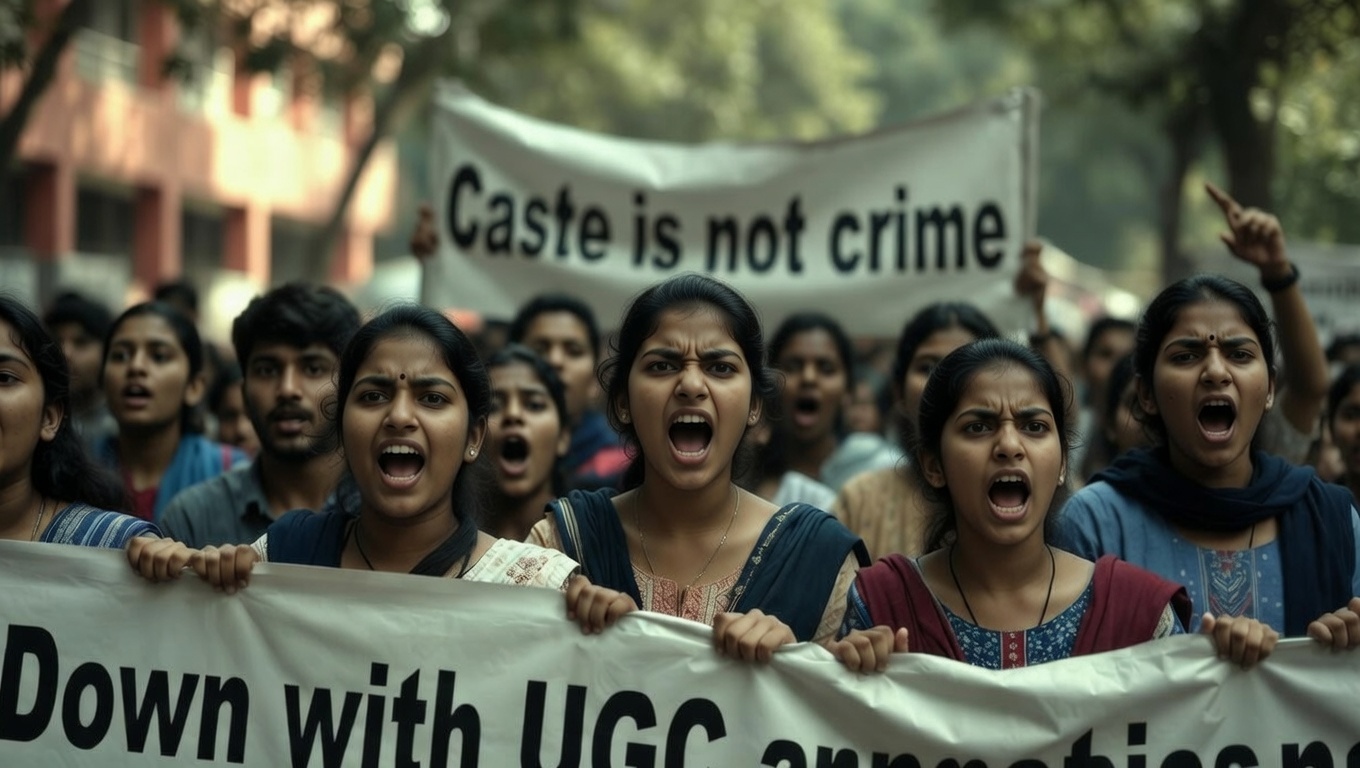
While no doubt many older generation folks are also jumping into this outrage around UGC regulations and some have even become the face of the outrage/movement, the resistance primarily came from Gen Z folks who could be convinced (and they were right) that their supposed best years as college-going youth can be spoiled by these regulations just because of their caste identity.
It is ironic that Congress spent literally crores of rupees in trying to create unrest through Gen Z, but none of those gimmicks worked. Heck, they even spent money to paint Rahul Gandhi as someone whom Gen Z considers as a ‘sex symbol’ who could sway them into doing whatever he wanted, but Congress couldn’t get the Gen Z into the streets. What finally brought them out was something that was not triggered by a Congressi ppt, but a sarkari pdf.
As an aside, someone in Congress must be taking credit for having orchestrated this ‘Gen Z unrest’ and asking Rahul Gandhi to increase the budget of their team, but this outrage has indeed been driven mostly through organic reach rather than paid attempts (which could be there as well in some cases, given the nature of social media).
Coming back to the approach towards caste identity among the younger upper-caste folks, one of the first attempts I had made was before the 2024 general elections when some Rajput groups were outraged over two things, first the controversy around Raja Mihir Bhoj, who was celebrated as Gurjar king rather than a Rajput king (this was grouse of Rajput groups) and then the statements of BJP leader Parshottam Rupala who had ended up angering Rajputs while trying to argue that Dalits were ‘more loyal’ to their national and Hindu identity than Rajput kings (Rupala had apologized later).
I thought both these were not such a big issue. My reasoning being, if the Dalits or OBC communities are given reasons to associate themselves with Hindu iconography and heritage with pride (and even some aggression), upper castes should ‘accommodate’ because this is better than Ambedkarite narrative of completely divorcing history of such groups from anything Hindu.
But young Rajput folks whom I tried to engage simply didn’t buy this argument, or rather optimism. They maintained that this was not some attempt at social harmony, but it was theft, rather dacoity. “They are going to claim our ancestry and valor today, tomorrow they would claim our ancestral property and dignity” was what of the guys argued, before adding that “we will not go down without a fight”.
Slippery slope arguments are always tricky, but I didn’t further argue as my intention was never to argue but to understand. I was amused that caste consciousness was rather high in this young guy while I thought it will dissipate or weaken in subsequent generations.
Well, that guy today can come back and tell me that “See, I was right. First, they asked us to do away with our history and heritage, and now there is an attack on dignity by painting every upper-caste person as an oppressor”. He hasn’t, though I can see him outraging on UGC on X.
This post isn’t on UGC regulations per se, much has been spoken on that, and the court has stayed them too, but a little attempt on why the upper-caste urban Gen Z appears more caste conscious than earlier generations. I’m obviously guilty of generalization and not everyone in Gen Z would be like that, but anecdotal ‘evidence’ and the outrage around UGC show that I might not be way off the mark.
Primary reason I feel is ‘lived experience’ (incidentally a term favorite with the leftists). I’d again be guilty of generalization, but I think the lived experiences of different generations of the urban ‘upper castes’ can be summarized as below:
From Boomers to Gen Z: How caste consciousness has varied
Baby Boomers did not only see that there indeed was upper-caste hegemony in some sectors, but they might even be harbouring some supremacist beliefs in some form at some point in time in their lives. Therefore, a good number from this generation could have a ‘guilty conscience’, for they have witnessed some of the ‘atrocities’ first hand, and consequently, the elites among them, additionally influenced by colonial narrative, proactively supported affirmative actions. Let’s remember that the constituent assembly of post-partition India was dominated by upper-caste Hindus.
While there indeed exists made-up ‘atrocity literature’ and even more made-up diagnoses of reasons why those atrocities happened, one would be very dishonest to claim no inequality ever existed, especially in the 20th century. In general, the Boomers, and more so the earlier generation, agreed upon some sections being historically disadvantaged and discriminated against, and thus the constitution allowed for reservations and other policies that tantamount to ‘positive discrimination’.
While Gen X witnessed less of the inequalities first hand, they were more or less influenced by the Boomer narrative. I think a good part of that guilty conscience was passed on to them, because they definitely witnessed the mindset if not ‘atrocities’ themselves. If not guilty conscience, one can argue that they had a bit sympathetic approach towards affirmative action, because the claims of discrimination or inequality didn’t appear entirely fictional to them, especially when it came to SC/ST community.
Incidentally, Gen X was the generation that protested in the streets against the Mandal Commission recommendations that advocated for OBC reservations. It was a bitter experience. Possibly a defeatist attitude additionally crept into their psyche after realizing how their protests, which included self-immolation, came to achieve nothing. They were essentially made to feel that their life was not more important than “social justice”. In all probability, this generation decided to just ‘accept the fate’ and try to salvage whatever is left. Some just decided to leave the country and settle abroad.
Millenials and caste identity
Then came the Millennials. Many of them actually witnessed or heard about ‘reverse discrimination’ more than the original claims of caste discrimination. Not to say that India was free of any discrimination against ‘lower castes’ by this time, but this is the generation that started using internet. As a result, it wasn’t entirely captive to the accepted mainstream narratives from the Boomers or Gen X era anymore. However, I’d argue that many still retained a bit of empathy, if not sympathy or guilty conscience, towards the issue of affirmative actions or reservations. Primarily because there was nothing like Mandal Commission that hit their generation that could have ignited their caste consciousness.
The decision of UPA government in the year 2006 to extend OBC reservations to premier educational institutes like IITs, IIMs, and AIIMs was a little blip, but it couldn’t have the same kind of effect as original Mandal Commission, there were two reasons: one, the affected territory was limited, and two, the courts ensured that the seats available to the upper castes didn’t go down due to reservations. Institutes were asked to expand capacity to keep the number of unreserved seats unaffected. This wasn’t as bitter an experience like that of Gen X where no one cared even when they self-immolated, at least a resolution was offered this time.
I’d argue that upper-caste urban millennials were possibly the least conscious about their caste identity, as they thought that the worst was over and the post-broadband-and-smartphones world was a different place. That’s why when PM Modi asked to give up subsidies voluntarily (like LPG cylinder subsidy), I don’t recall seeing any quip like “why should upper-castes give up anything when the money thus collected will be used for welfare of soshit-vanchit only?” which I’m sure will be thrown today by many I follow on X if a similar call is given by the government.
That thought just didn’t cross anyone’s mind at all, and they were sending SMS, including myself, to opt out of the subsidy. Constant glorification of Ambedkar didn’t raise any red flags, because I believe that millennials didn’t just think that the worst was over; they retained a bit of empathy towards the issue of caste discrimination and inequality. And obviously, the ‘nationalist’ narrative overpowered everything else.
And now we have the Gen Z.
Why Gen Z are more likely to be caste-conscious
Nope, they are not the monsters without empathy, but they are the generation that has not witnessed the ‘atrocities’ first-hand and possibly hasn’t even seen that mentality among their parents (being the children born to Gen X). The urban bunch among them has more reasons to believe that ‘reverse discrimination’ exists than otherwise.
They have also seen how some news reports about discrimination against lower-castes end up being spiced up (many times the perpetrators being OBC than ‘upper castes’) and have grown hearing about misuse of SC/ST act. They have also been exposed to extreme Ambedkarite narratives in crude form thanks to the internet and social media (they had much more free and uncensored access than millennials).
You can’t expect this generation to have a guilty conscience because their lived experience is very different. Any empathy that this generation could have developed has been evaporated by the neo-Ambedkarites making cringe and crude reels targeting their caste identity. Celebrities and media platforms too have endorsed many such abusive ‘content creators’ in the name of dissent and ‘anti-caste’ activism. Such experiences have led to the development of caste consciousness among this generation, which I was a bit amused to discover a couple of years ago.
The only way this generation can have a guilty conscience is if the education system is entirely taken over by Cultural Marxists, who teach this oppressor-oppressed framework around ethnic identities as some sort of axiomatic fact. Ah, now you see why those rabid professors exist in humanities departments (though not just in humanities) in various universities? You’ve to give it to the leftists that they know the challenges and work towards the solutions. Perhaps they thought that Gen Z was already ‘taken care of’, but clearly, they haven’t been.
A section of the UGC regulations, especially how the caste-based discrimination was defined, was entirely subservient to this oppressor-oppressed framework. The fact that Gen Z decided to resist it rather than surrender to the “social justice” narrative shows that the battle is not entirely lost.
‘Affirmative action’ vs Gen Z’s own lived experience
This is not to say that India now needs no affirmative action, but the government and policy makers have to factor in the upper-caste urban Gen Z, whose lived experiences are very different from their own generation. A casual extreme thought could cross the mind that why not give Gen Z the ‘same treatment’ that Gen X was given during the Mandal Commission? But that would be counter-productive, because Gen Z is not Gen X and the respective worlds in which they operated are very different.
On the other hand, the forces fighting against Cultural Marxism or Ambedkarite narrative also need to realize that while the Gen Z has increased caste consciousness, it doesn’t mean they are ready to jump on to your side and become flag-bearers of whatever is your pet project, resurgence of traditional Hinduism, cultural nationalism, “right wing” or whatever – though a window of opportunity is surely there to reach out to the bunch. They are not ready to take the knee, but that doesn’t mean they are ready to take up swords.
UGC is just a symptom, the issue is that of caste consciousness that has made a comeback due to various reasons, some I tried to summarise, at the risk of broad-brushing the entire issue.
And while I write all this, Generation Alpha is playing in their schools. Wait for them to discover their caste and ask AI about what it means.