UAE announces exit from OPEC+ and OPEC: Read Abu Dhabi’s motives behind the decision and what it means for oil prices and global markets
The United Arab Emirates announced its exit from the Organisation of the Petroleum Exporting Countries and the broader OPEC+ alliance on Tuesday, 28th April. The decision will come into effect from 1st May. The announcement, reported by the country’s state news agency, cited Abu Dhabi’s long-term economic vision as the key reason behind the move. It comes at a time when global oil markets are already under pressure due to the ongoing tensions linked to the US-Iran war, which has disrupted supply routes and raised concerns about energy security worldwide. What is OPEC and the UAE’s role in it OPEC is one of the world’s largest and most powerful oil cartels, formed in 1960. The organisation’s primary objective is to organise and regulate the oil production of member countries and keep global crude oil prices balanced by controlling supply. The United Arab Emirates has been one of the integral members of the cartel from the beginning. The country joined the group in 1971, coinciding with the emergence of the seven-emirate federation. However, Abu Dhabi, which holds a staggering 95% of the UAE‘s oil reserves, actually joined the group even earlier, in 1967. Back in the 70s, OPEC was at the height of its power. It completely changed the balance of power between countries that produce oil and those that consume it, helping former colonies take control of their own natural resources away from Western dominance. The UAE’s oil production capacity has long outgrown its Opec limits. As capacity rises towards 5 million barrels per day, a widening gap with Opec+ quotas and years of mounting tensions over output limits and policy decisions have ultimately led to the UAE’s exit from Opec.The… pic.twitter.com/NUfdRRVXtE— The National (@TheNationalNews) April 28, 2026 In 2016, OPEC further enhanced its market position by establishing OPEC+. The organisation now includes such non-OPEC oil giants as Russia, thus gaining a monopoly over 40% of global crude oil production and 60% of globally traded petroleum. By leaving, the UAE removes one of the few “swing producers” that can quickly change production levels. This seriously weakens OPEC’s ability to react to fast-moving market changes in the future. Unlike smaller exits in the past, such as Qatar in 2019 or Angola in 2024. OPEC’s role in the Global economy OPEC has often been compared to a central bank for the global oil market. Its biggest tool is its ability to control supply. By setting production quotas for each member country, OPEC ensures that oil production is adjusted according to global demand. If there’s too much oil in the market and demand is low, they order members to pump less to prevent a price crash. On the flip side, if there’s a shortage, they can increase production to stop prices from skyrocketing. For countries that rely almost entirely on oil money to fund their schools, hospitals, and roads, these mandates are a safety net that protects their domestic budgets from sudden market shocks. These quotas, however, also mean that countries cannot always produce oil at their full capacity. For some members, especially those looking to expand production, this has often been a point of frustration. Why the UAE decided to exit The UAE’s decision to leave OPEC did not come out of nowhere. For several years, there have been differences between Abu Dhabi and Saudi Arabia over how oil production should be managed. These differences became visible during OPEC+ meetings in 2020 and 2021. At the time, the UAE wanted to increase production after cuts made during the COVID-19 pandemic, while Saudi Arabia preferred to keep output low to maintain high oil prices. This difference reflects the economic realities of both countries. Saudi Arabia relies heavily on high oil prices to fund its large-scale projects. The UAE, on the other hand, has a more diversified economy and has been less dependent on oil revenues. Instead of restricting output, Abu Dhabi has been investing heavily in expanding its production capacity. It aims to increase output from around 3.4 million barrels per day to 5 million barrels per day by 2027. This shows a clear intention to produce and sell more oil while demand still exists, especially as the world slowly moves towards cleaner energy. After leaving OPEC, the UAE can now freely increase its oil production, thanks to the Fujairah Pipeline that bypasses the Strait of Hormuz.The Emirates had planned and developed this independent export route for years, enabling it to add up to 2 million barrels per day.A… pic.twitter.com/rqQpwq7hB0— سيف الدرعي| Saif alderei (@saif_aldareei) April 28, 2026 UAE Energy Minister Suhail Mohamed al-Mazrouei confirmed that the move was carefully planned. “This is a policy decision. It has been done after a careful look at current and future policies related to the level of production,” he said. Energy Minister Suhail Mohamed Al Mazrouei says the UAE’s exit from
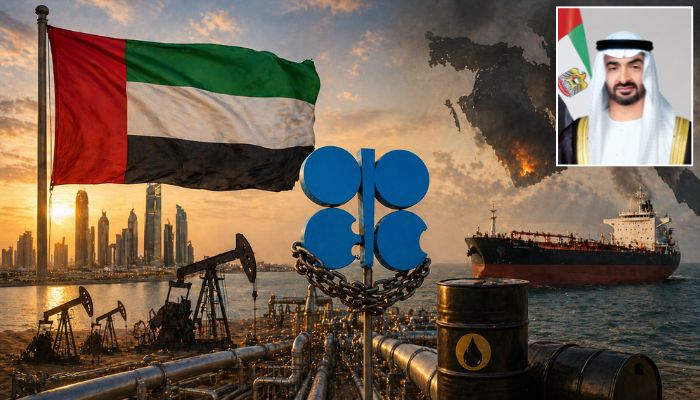
The United Arab Emirates announced its exit from the Organisation of the Petroleum Exporting Countries and the broader OPEC+ alliance on Tuesday, 28th April. The decision will come into effect from 1st May.
The announcement, reported by the country’s state news agency, cited Abu Dhabi’s long-term economic vision as the key reason behind the move. It comes at a time when global oil markets are already under pressure due to the ongoing tensions linked to the US-Iran war, which has disrupted supply routes and raised concerns about energy security worldwide.
What is OPEC and the UAE’s role in it
OPEC is one of the world’s largest and most powerful oil cartels, formed in 1960. The organisation’s primary objective is to organise and regulate the oil production of member countries and keep global crude oil prices balanced by controlling supply.
The United Arab Emirates has been one of the integral members of the cartel from the beginning. The country joined the group in 1971, coinciding with the emergence of the seven-emirate federation.
However, Abu Dhabi, which holds a staggering 95% of the UAE‘s oil reserves, actually joined the group even earlier, in 1967. Back in the 70s, OPEC was at the height of its power. It completely changed the balance of power between countries that produce oil and those that consume it, helping former colonies take control of their own natural resources away from Western dominance.
The UAE’s oil production capacity has long outgrown its Opec limits. As capacity rises towards 5 million barrels per day, a widening gap with Opec+ quotas and years of mounting tensions over output limits and policy decisions have ultimately led to the UAE’s exit from Opec.The… pic.twitter.com/NUfdRRVXtE— The National (@TheNationalNews) April 28, 2026
In 2016, OPEC further enhanced its market position by establishing OPEC+. The organisation now includes such non-OPEC oil giants as Russia, thus gaining a monopoly over 40% of global crude oil production and 60% of globally traded petroleum.
By leaving, the UAE removes one of the few “swing producers” that can quickly change production levels. This seriously weakens OPEC’s ability to react to fast-moving market changes in the future. Unlike smaller exits in the past, such as Qatar in 2019 or Angola in 2024.
OPEC’s role in the Global economy
OPEC has often been compared to a central bank for the global oil market. Its biggest tool is its ability to control supply. By setting production quotas for each member country, OPEC ensures that oil production is adjusted according to global demand.
If there’s too much oil in the market and demand is low, they order members to pump less to prevent a price crash. On the flip side, if there’s a shortage, they can increase production to stop prices from skyrocketing. For countries that rely almost entirely on oil money to fund their schools, hospitals, and roads, these mandates are a safety net that protects their domestic budgets from sudden market shocks.
These quotas, however, also mean that countries cannot always produce oil at their full capacity. For some members, especially those looking to expand production, this has often been a point of frustration.
Why the UAE decided to exit
The UAE’s decision to leave OPEC did not come out of nowhere. For several years, there have been differences between Abu Dhabi and Saudi Arabia over how oil production should be managed.
These differences became visible during OPEC+ meetings in 2020 and 2021. At the time, the UAE wanted to increase production after cuts made during the COVID-19 pandemic, while Saudi Arabia preferred to keep output low to maintain high oil prices.
This difference reflects the economic realities of both countries. Saudi Arabia relies heavily on high oil prices to fund its large-scale projects. The UAE, on the other hand, has a more diversified economy and has been less dependent on oil revenues.
Instead of restricting output, Abu Dhabi has been investing heavily in expanding its production capacity. It aims to increase output from around 3.4 million barrels per day to 5 million barrels per day by 2027. This shows a clear intention to produce and sell more oil while demand still exists, especially as the world slowly moves towards cleaner energy.
After leaving OPEC, the UAE can now freely increase its oil production, thanks to the Fujairah Pipeline that bypasses the Strait of Hormuz.The Emirates had planned and developed this independent export route for years, enabling it to add up to 2 million barrels per day.A… pic.twitter.com/rqQpwq7hB0— سيف الدرعي| Saif alderei (@saif_aldareei) April 28, 2026
UAE Energy Minister Suhail Mohamed al-Mazrouei confirmed that the move was carefully planned. “This is a policy decision. It has been done after a careful look at current and future policies related to the level of production,” he said.
Energy Minister Suhail Mohamed Al Mazrouei says the UAE’s exit from OPEC and OPEC+ marks an evolution in strategy while reaffirming Abu Dhabi’s commitment to energy security, reliable low-emission supply, and stable global markets. pic.twitter.com/aVEyH0gYxt— Al Arabiya English (@AlArabiya_Eng) April 28, 2026
Another key factor is infrastructure. The UAE has developed independent export routes like the Fujairah pipeline, which allows it to bypass the Strait of Hormuz and export oil more freely. This gives it the flexibility to increase production without being tied down by OPEC quotas.
Role of the Iran War and regional tensions
The ongoing tensions linked to the US-Iran conflict have also played a major role in shaping the UAE’s decision. The Strait of Hormuz, one of the world’s most important oil routes, has seen disruptions, with fewer ships passing through due to security concerns.
Before the conflict, nearly one-fifth of the world’s oil supply moved through this narrow passage. However, recent attacks and instability have made the region more unpredictable. Oil infrastructure in the Gulf has also been at risk, adding to the uncertainty.
With Iran itself being a founding member of OPEC, the organisation’s consensus-based system can limit how quickly countries like the UAE respond to such challenges. By exiting OPEC, the UAE now gains more control over its oil policy and can act independently to secure its exports.
There is also a larger geopolitical shift at play. Gulf countries have traditionally depended on the United States for security. However, recent events have raised questions about how effective that protection is during regional conflicts.
By stepping out of OPEC, the UAE is giving itself more room to use its oil resources strategically, not just for economic gain, but also to build new global partnerships and strengthen its position beyond traditional alliances.
A shift towards a broader economic vision
Beyond immediate concerns, the UAE’s exit from OPEC also aligns with its long-term strategy. The UAE has been making efforts towards economic diversification, with investments in industries such as technology, education, tourism, and finance.
However, the UAE knows that oil exports play a critical role in financing these efforts. By ramping up oil exports now, the UAE aims to capitalise on the value of its reserves in anticipation of falling demand for oil globally in the coming years.
With substantial investments via the Abu Dhabi National Oil Company, the UAE intends to enhance its agility and competitiveness in the international energy market. Being a member of OPEC could potentially hinder the UAE in meeting its strategic objectives.
In many aspects, this step by the UAE reveals its unwillingness to be associated exclusively with oil production and its dependence on cartel policies. Instead, the UAE sees itself as a player in the global economy that is capable of making decisions based on its own interests.