Madrasa in Kashmir linked to terrorists locked under UAPA: Read how Darul Uloom Jamia Siraj-ul-Uloom was connected to the Pulwama attack and other activities
One of South Kashmir’s largest religious seminaries, Darul Uloom Jamia Siraj-ul-Uloom in Shopian’s Imam Sahib area, has been sealed by the Jammu and Kashmir administration under the Unlawful Activities (Prevention) Act (UAPA), 1967. The action was taken after authorities found links between the madrasa and anti-national activities, including suspected terror funding, radicalisation, and irregular operations. The order to declare the institution an unlawful entity was issued by Kashmir Divisional Commissioner Anshul Garg, who exercised powers under Section 8(1) of the law. This provision allows the government to seal premises and freeze assets if a place is found to be used for unlawful activities. This is the first time in Jammu and Kashmir that a seminary of such scale has been declared unlawful. Links to Jamaat-e-Islami raised serious concerns Authorities say the madrasa had deep and continued connections with the banned outfit Jamaat-e-Islami, which has been outlawed in India since 2019. According to official records, individuals linked to this organisation were holding key administrative and academic positions in the institution. Investigations and intelligence inputs suggested that the madrasa was not just functioning as a religious education centre but was also operating outside legal oversight. Officials pointed to a lack of proper registration, questionable land acquisition, and attempts to avoid regulatory checks. The administration also highlighted unusual financial patterns. There were serious gaps between the funds received and how they were spent, raising fears that money may have been diverted for unlawful purposes. A 15-acre madrasa has been under scrutiny for years Siraj-ul-Uloom has been on the radar of security agencies for quite some time. Multiple investigations by agencies, including the National Investigation Agency and Jammu and Kashmir Police, had examined its activities over the years. The institution, spread across nearly 15 acres with a large campus and garden, had around 500 to 800 students at different times. It also ran a school offering both religious and modern education, affiliated with the Jammu and Kashmir Board of School Education. Despite its academic presence, authorities say the environment inside the madrasa gradually became a concern. Reports indicated that over time, it created conditions that encouraged Jihadi mindset among some students. Connection to the Pulwama terror attack One of the most serious concerns linked to the madrasa is its connection to the Pulwama attack, in which 40 CRPF personnel lost their lives. Investigations revealed that Sajjad Ahmad Bhat, who played a key role in the attack by arranging the vehicle used in the bombing, had studied at this madrasa. He remained associated with the institution until around 2017. After the Pulwama investigation, it also came to light that several former students of the madrasa had joined terrorist organisations. The madrasa’s own management reportedly admitted that at least 11 students had turned to terrorism over time. Among them were names like Mohammad Shafi Butt and Adil Ahmed, who were later killed in encounters. Many of these individuals were linked to Pakistan-based terror groups such as Lashkar-e-Taiba and Jaish-e-Mohammed. Students, teachers and overground workers involved in terrorist activities The concerns were not limited to students alone. Authorities say that even some teachers associated with the madrasa were involved in terrorist networks. One such case is that of Shaukat Ahmed Sheikh, a teacher who was later arrested by the National Investigation Agency. Investigators found that he was linked to Lashkar-e-Taiba and had played a role in recruiting young students into terrorism. Reports suggest that he influenced and radicalised around 20 students. In addition to this, several overground workers (OGWs) who assist terrorists with logistics and support were also traced back to the madrasa. In 2020, three such individuals arrested in Shopian were found to have studied at Siraj-ul-Uloom and were linked to Jamaat-e-Islami networks. Financial irregularities and illegal activities Another major factor behind the sealing of the madrasa was its financial conduct. Officials found what they described as “financial opacity,” meaning that the handling of funds was unclear and suspicious. The institution was accused of having a flawed financial control system, with frequent changes in how funds were managed. This raised doubts about whether the money was being used for legitimate educational purposes. #DNAमित्रों | जमात-ए-इस्लामी के 'जामिया' पर 'ताला' लगा,साउथ कश्मीर के सबसे बड़े मदरसे का 'शटर डाउन'#DNA #DNAWithRahulSinha #JammuKashmir #Madarasa @RahulSinhaTV pic.twitter.com/GJMHvBWP3a— Zee News (@ZeeNews) April 27, 2026 Authorities also pointed out that the madrasa was not properly registered and had encroached upon government land. It
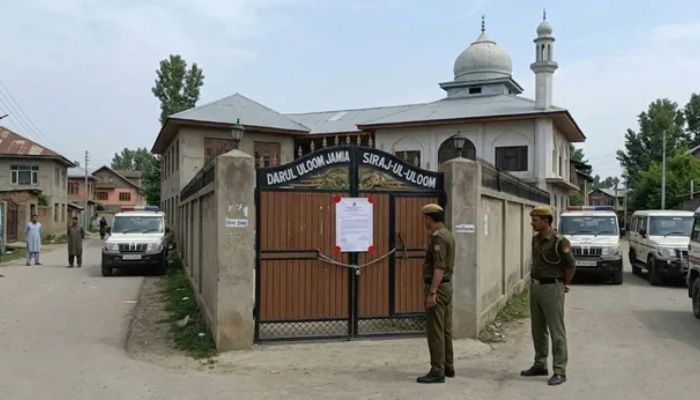
One of South Kashmir’s largest religious seminaries, Darul Uloom Jamia Siraj-ul-Uloom in Shopian’s Imam Sahib area, has been sealed by the Jammu and Kashmir administration under the Unlawful Activities (Prevention) Act (UAPA), 1967. The action was taken after authorities found links between the madrasa and anti-national activities, including suspected terror funding, radicalisation, and irregular operations.
The order to declare the institution an unlawful entity was issued by Kashmir Divisional Commissioner Anshul Garg, who exercised powers under Section 8(1) of the law. This provision allows the government to seal premises and freeze assets if a place is found to be used for unlawful activities.
This is the first time in Jammu and Kashmir that a seminary of such scale has been declared unlawful.
Links to Jamaat-e-Islami raised serious concerns
Authorities say the madrasa had deep and continued connections with the banned outfit Jamaat-e-Islami, which has been outlawed in India since 2019. According to official records, individuals linked to this organisation were holding key administrative and academic positions in the institution.
Investigations and intelligence inputs suggested that the madrasa was not just functioning as a religious education centre but was also operating outside legal oversight. Officials pointed to a lack of proper registration, questionable land acquisition, and attempts to avoid regulatory checks.
The administration also highlighted unusual financial patterns. There were serious gaps between the funds received and how they were spent, raising fears that money may have been diverted for unlawful purposes.
A 15-acre madrasa has been under scrutiny for years
Siraj-ul-Uloom has been on the radar of security agencies for quite some time. Multiple investigations by agencies, including the National Investigation Agency and Jammu and Kashmir Police, had examined its activities over the years.
The institution, spread across nearly 15 acres with a large campus and garden, had around 500 to 800 students at different times. It also ran a school offering both religious and modern education, affiliated with the Jammu and Kashmir Board of School Education.
Despite its academic presence, authorities say the environment inside the madrasa gradually became a concern. Reports indicated that over time, it created conditions that encouraged Jihadi mindset among some students.
Connection to the Pulwama terror attack
One of the most serious concerns linked to the madrasa is its connection to the Pulwama attack, in which 40 CRPF personnel lost their lives.
Investigations revealed that Sajjad Ahmad Bhat, who played a key role in the attack by arranging the vehicle used in the bombing, had studied at this madrasa. He remained associated with the institution until around 2017.
After the Pulwama investigation, it also came to light that several former students of the madrasa had joined terrorist organisations. The madrasa’s own management reportedly admitted that at least 11 students had turned to terrorism over time.
Among them were names like Mohammad Shafi Butt and Adil Ahmed, who were later killed in encounters. Many of these individuals were linked to Pakistan-based terror groups such as Lashkar-e-Taiba and Jaish-e-Mohammed.
Students, teachers and overground workers involved in terrorist activities
The concerns were not limited to students alone. Authorities say that even some teachers associated with the madrasa were involved in terrorist networks.
One such case is that of Shaukat Ahmed Sheikh, a teacher who was later arrested by the National Investigation Agency. Investigators found that he was linked to Lashkar-e-Taiba and had played a role in recruiting young students into terrorism. Reports suggest that he influenced and radicalised around 20 students.
In addition to this, several overground workers (OGWs) who assist terrorists with logistics and support were also traced back to the madrasa. In 2020, three such individuals arrested in Shopian were found to have studied at Siraj-ul-Uloom and were linked to Jamaat-e-Islami networks.
Financial irregularities and illegal activities
Another major factor behind the sealing of the madrasa was its financial conduct. Officials found what they described as “financial opacity,” meaning that the handling of funds was unclear and suspicious.
The institution was accused of having a flawed financial control system, with frequent changes in how funds were managed. This raised doubts about whether the money was being used for legitimate educational purposes.
#DNAमित्रों | जमात-ए-इस्लामी के 'जामिया' पर 'ताला' लगा,साउथ कश्मीर के सबसे बड़े मदरसे का 'शटर डाउन'#DNA #DNAWithRahulSinha #JammuKashmir #Madarasa @RahulSinhaTV pic.twitter.com/GJMHvBWP3a— Zee News (@ZeeNews) April 27, 2026
Authorities also pointed out that the madrasa was not properly registered and had encroached upon government land. It was said to be using various methods to bypass legal scrutiny and continue operations without accountability.
A show-cause notice was issued to the management, asking them to explain these issues. However, the response was found to be weak and not convincing.
Government action and sealing of premises
After reviewing the evidence, the administration concluded that the premises were being used in ways that supported unlawful activities. As a result, the madrasa was declared an unlawful entity and sealed.
Security forces have been deployed outside the campus, and posters announcing the sealing have been placed at the gates. The action also allows authorities to take further steps, including freezing assets and taking control of the property.
Officials have clarified that this action is preventive in nature. It is aimed at stopping the misuse of the institution rather than waiting for criminal cases to be proven beyond a doubt.
PDP chief Mehbooba Mufti condemns the sealing of the madrasa
The sealing of Siraj-ul-Uloom has triggered political reactions in Kashmir. Mehbooba Mufti, leader of the People’s Democratic Party(PDP), strongly criticised the move.
Every single day the j&k government acts as a mute bystander & a timid enabler of vicious assaults on J&Ks identity & dignity. Declaring Dar Ul Uloom Jamia Siraj Ul Uloom as an unlawful entity under UAPA is a flagrant injustice to the poor underprivileged sections of society.… pic.twitter.com/kkkvWNSQWA— Mehbooba Mufti (@MehboobaMufti) April 27, 2026
She said that the madrasa had produced many professionals, including doctors and engineers, who have contributed positively to society. According to her, declaring the institution unlawful is unfair and ignores its educational role.
Similarly, National Conference MP Ruhullah Mehdi also opposed the decision. In his public statements, he said that shutting down such institutions affects hundreds of students and deprives them of educational opportunities.
These reactions have added a political dimension to the issue, with debates focusing on security concerns versus educational impact.
The larger network of madrasas
Siraj-ul-Uloom was reportedly linked to a broader network of institutions supported by Jamaat-e-Islami through its trust, Falah-e-Aam. At one point, hundreds of madrasas across Kashmir were connected to this network. In recent days, the Jammu and Kashmir administration has taken over 58 schools affiliated to the Falah-e-Aam trust.
Authorities believe that some of these institutions were used to influence young students, especially those from economically weaker backgrounds. According to investigations, certain students were exposed to extremist ideas and later recruited into terrorist groups.
A case that reflects a larger security challenge
The sealing of Siraj-ul-Uloom highlights the ongoing challenge faced by authorities in Kashmir, balancing education, religious institutions, and national security.
While the madrasa had a long history and provided education to many, the findings of investigations pointed towards a pattern of misuse that could not be ignored. By linking the institution to terror funding, recruitment, and even a major attack like Pulwama, the administration has made it clear why it considers the action necessary.