The mask is off: Diljit Dosanjh’s ‘Satluj’ shows what OpIndia had warned about for years
For years, Diljit Dosanjh has been sold as a harmless global Punjabi star. A singer, an actor and a soft-spoken celebrity who is loved by millions, if not by all. A man who sings about Punjab and speaks of love, farmers and identity. However, the newly released film ‘Satluj’ has brought out what years of image management had kept under the drapes. The mask is off. Satluj, a propaganda movie Satluj is not just a film that talks about the insurgency period in Punjab. It has a deeper aim. The movie was stuck for years because its politics was suspect. First, the movie was named Ghallughara (holocaust). The name did not go down well with the Central Board of Film Certification (CBFC), along with some scenes. The name was then changed to ‘Punjab 95’ and finally got released three years after it was made. The movie was quietly released on the Zee5 OTT platform as ‘Satluj’ on 3rd July. On 6th July, the movie was removed from the platform without citing the exact reason. Notably, the film has vanished only for the Indian audience, not for the international audience, and Zee5’s international portal still runs it. The Ministry of Information and Broadcasting has now set up a three-member committee to examine the issue. The problem is not that the film talks about police excesses in Punjab. Any honest society must be able to discuss such issues. The problem with ‘Satluj’ is the way it has presented Punjab’s insurgency years. Khalistani terrorists and Sikh extremists have been softened in the film while the Indian state has been turned into the only villain. When the assassination of then-CM Beant Singh was shown in the film, it was portrayed as “revenge”. Those who do not understand the history of the Punjab insurgency will get the whole context wrong. In a way, the viewer was nudged to justify terror. Furthermore, Jaswant Singh Khalra’s decision to take the matter to international platforms painted the Indian authorities of that time in a very bad light. KPS Gill, the man who literally ended militancy in Punjab, was shown as IPS Bitta, a bad cop. Killings of Hindus did not find space in the film, not even as a simple reference. The reason behind strict police action was never explained. There was no hint of how Khalistani terrorists were killing Hindus, Sikhs who opposed militancy, police personnel and officials without any mercy. OpIndia had flagged the pattern years ago Diljit’s political ideology thus becomes relevant. OpIndia has said for years that his public image and his political messaging do not match. In 2020, during the farmers’ protests, it was evident that the movement was hijacked by Khalistani elements. Diljit emerged as one of the loudest celebrity voices in their favour. He openly attacked those who questioned the protest ecosystem. The actor-singer was celebrated by the usual left-liberal crowd as a brave “Punjabi icon”. In June 2020, then-Ludhiana MP from Congress, Ravneet Singh Bittu, who is also the grandson of Beant Singh, had demanded FIRs to be registered against Diljit Dosanjh and others for supporting Gurpatwant Singh Pannun of the Khalistani terrorist outfit Sikhs for Justice (SFJ). Bittu had pointed to SFJ’s anti-India stand during the India-China faceoff and its attempt to lure Sikh soldiers. OpIndia had reported how Diljit had come under fire over his support for the pro-Khalistan separatist outfit. From Operation Bluestar to Jagtar Singh Johal Diljit has a long history of being surrounded by controversies. He had also faced criticism after the lyrics of the song “Rangrut”, sung by him for the film ‘Punjab 1984’, openly asked to pick guns and take revenge (for 1984). The lyrics say “Sodha zaalma nu launa AK-47iya ne”, which translates to “AK-47s will settle scores with the oppressors”. Congress MP Ravneet Bittu had then accused him of disturbing peace after 36 years of Operation Bluestar. Then came his support for Khalistani terrorist Jagtar Singh Johal, who has been named in NIA charge sheets in murder cases involving Hindu and RSS leaders. Johal has been named as an accused in the murder of Brigadier Jagdish Kumar Gagneja, Ravinder Gosain, Amit Sharma and others. Diljit spoke about claims of torture and a free trial for Johal. While a free and fair trial is the legal right of everyone, the selective urgency was visible in Diljit’s support. When Hindu leaders were killed in Punjab, where was this celebrity conscience? The refusal to clearly condemn Khalistan The pattern became clearer during his online spat with actor-turned-MP Kangana Ranaut. During the farmers’ protests, Kangana repeatedly asked him to simply say that he did not support Khalistan and that he condemned Khalistani elements. Diljit dodged the demand and troll armies attacked Kangana on social media. Diljit never clearly condemned Khalistanis. Old controversies now look like a pattern These instances show that there is indeed a pattern. Support for the protest ecosystem
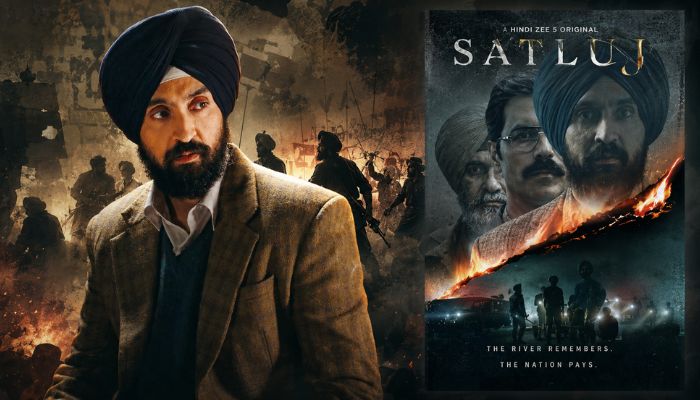
For years, Diljit Dosanjh has been sold as a harmless global Punjabi star. A singer, an actor and a soft-spoken celebrity who is loved by millions, if not by all. A man who sings about Punjab and speaks of love, farmers and identity. However, the newly released film ‘Satluj’ has brought out what years of image management had kept under the drapes. The mask is off.
Satluj, a propaganda movie
Satluj is not just a film that talks about the insurgency period in Punjab. It has a deeper aim. The movie was stuck for years because its politics was suspect. First, the movie was named Ghallughara (holocaust). The name did not go down well with the Central Board of Film Certification (CBFC), along with some scenes. The name was then changed to ‘Punjab 95’ and finally got released three years after it was made.
The movie was quietly released on the Zee5 OTT platform as ‘Satluj’ on 3rd July. On 6th July, the movie was removed from the platform without citing the exact reason. Notably, the film has vanished only for the Indian audience, not for the international audience, and Zee5’s international portal still runs it. The Ministry of Information and Broadcasting has now set up a three-member committee to examine the issue.
The problem is not that the film talks about police excesses in Punjab. Any honest society must be able to discuss such issues. The problem with ‘Satluj’ is the way it has presented Punjab’s insurgency years. Khalistani terrorists and Sikh extremists have been softened in the film while the Indian state has been turned into the only villain.
When the assassination of then-CM Beant Singh was shown in the film, it was portrayed as “revenge”. Those who do not understand the history of the Punjab insurgency will get the whole context wrong. In a way, the viewer was nudged to justify terror.
Furthermore, Jaswant Singh Khalra’s decision to take the matter to international platforms painted the Indian authorities of that time in a very bad light. KPS Gill, the man who literally ended militancy in Punjab, was shown as IPS Bitta, a bad cop.
Killings of Hindus did not find space in the film, not even as a simple reference. The reason behind strict police action was never explained. There was no hint of how Khalistani terrorists were killing Hindus, Sikhs who opposed militancy, police personnel and officials without any mercy.
OpIndia had flagged the pattern years ago
Diljit’s political ideology thus becomes relevant. OpIndia has said for years that his public image and his political messaging do not match. In 2020, during the farmers’ protests, it was evident that the movement was hijacked by Khalistani elements. Diljit emerged as one of the loudest celebrity voices in their favour. He openly attacked those who questioned the protest ecosystem. The actor-singer was celebrated by the usual left-liberal crowd as a brave “Punjabi icon”.
In June 2020, then-Ludhiana MP from Congress, Ravneet Singh Bittu, who is also the grandson of Beant Singh, had demanded FIRs to be registered against Diljit Dosanjh and others for supporting Gurpatwant Singh Pannun of the Khalistani terrorist outfit Sikhs for Justice (SFJ). Bittu had pointed to SFJ’s anti-India stand during the India-China faceoff and its attempt to lure Sikh soldiers. OpIndia had reported how Diljit had come under fire over his support for the pro-Khalistan separatist outfit.
From Operation Bluestar to Jagtar Singh Johal
Diljit has a long history of being surrounded by controversies. He had also faced criticism after the lyrics of the song “Rangrut”, sung by him for the film ‘Punjab 1984’, openly asked to pick guns and take revenge (for 1984). The lyrics say “Sodha zaalma nu launa AK-47iya ne”, which translates to “AK-47s will settle scores with the oppressors”. Congress MP Ravneet Bittu had then accused him of disturbing peace after 36 years of Operation Bluestar.
Then came his support for Khalistani terrorist Jagtar Singh Johal, who has been named in NIA charge sheets in murder cases involving Hindu and RSS leaders. Johal has been named as an accused in the murder of Brigadier Jagdish Kumar Gagneja, Ravinder Gosain, Amit Sharma and others. Diljit spoke about claims of torture and a free trial for Johal. While a free and fair trial is the legal right of everyone, the selective urgency was visible in Diljit’s support. When Hindu leaders were killed in Punjab, where was this celebrity conscience?
The refusal to clearly condemn Khalistan
The pattern became clearer during his online spat with actor-turned-MP Kangana Ranaut. During the farmers’ protests, Kangana repeatedly asked him to simply say that he did not support Khalistan and that he condemned Khalistani elements. Diljit dodged the demand and troll armies attacked Kangana on social media. Diljit never clearly condemned Khalistanis.
Old controversies now look like a pattern
These instances show that there is indeed a pattern. Support for the protest ecosystem when Khalistani elements were visible, refusal to clearly condemn Khalistan when directly asked, sympathy for those accused in targeted killings of Hindu leaders, and now, Satluj.
The reaction to Satluj has exposed the ecosystem even more. After the film was removed from Zee5, jailed pro-Khalistani MP Amritpal Singh’s party Akali Dal (Waris Punjab De) reportedly began organising public screenings across Punjab. Downloaded copies were shown in villages through projectors and large screens. Party leader Rashpal Singh Sosan promoted the screenings and even shared an old video of Amritpal Singh praising Jaswant Singh Khalra.
This is not a minor detail. If a film is being embraced and circulated by jailed pro-Khalistani MP Amritpal Singh’s party, it shows that the movie has political utility. His party is not screening Satluj as cinema. It is using the film as political material. It is using Diljit’s face and Khalra’s story to revive a narrative around Punjab, victimhood and separatist sentiment.
This is how terror is repackaged as resistance
Satluj is not merely a film. It is the latest chapter in a long-running attempt to repackage the Khalistani insurgency as moral resistance. It is an old trick which first erases the victims of terrorism, then humanises the extremist, then demonises the state alone and finally calls anyone questioning the propaganda “anti-Sikh”.
It has to be noted that questioning Khalistani propaganda is not anti-Sikh but pro-India. It is also pro-Punjab. The state has suffered because of Khalistani terrorism. Hindus, Sikhs who opposed extremism and police personnel were killed. Families were destroyed. The state made mistakes and excesses happened, but that cannot become an excuse to glorify separatists and terrorists.
The superstar image remains, but the politics is exposed
Diljit Dosanjh had years to clear the air. He had years to say, without clever wording, that Khalistan is unacceptable and that terrorism in Punjab cannot be romanticised. Instead, every new controversy has pushed the needle in the same direction.
With Satluj, the mask is off. The superstar image remains. The global concerts remain. The polished PR remains. But behind it stands the same politics and ideology that OpIndia had warned about for years.