The Guardian peddles fake news about the BAPS temple, attempts to divide Hindus by falsely claiming that Dalit workers were exploited: Read the truth about the case and how US court put an end to the lies
Months after a US court closed the case in September last year, British daily The Guardian has once again stirred controversy by publishing a report that repeats allegations about the construction of the BAPS Swaminarayan Akshardham in New Jersey, US. The development has reignited a debate that had already been settled after a detailed federal investigation in the United States found no wrongdoing. The Guardian, a UK-based newspaper, published an article on Thursday, 2nd April, claiming that the construction of the temple involved worker abuse and medical negligence. However, the report is recycling claims that were already examined and dismissed by US authorities months ago. Screengrab of the article published by The Guardian A grand temple built through a global volunteer effort The BAPS Swaminarayan Akshardham temple of Robbinsville, New Jersey, is the biggest Hindu temple in the Western Hemisphere. Built in 2023, the grand temple is more than just a place of worship; it represents devotion and pride among Hindu devotees around the world. What makes the temple unique is the scale of participation behind its construction. Over 12,500 volunteers from North America and other countries contributed to building the temple over a span of 12 years. Many of them did not have any formal background in construction, but temple authorities have consistently maintained that their contribution was a form of “seva,” or spiritual service rooted in faith and devotion. The temple’s intricate architecture, hand-carved stones, and vast campus have made it a major spiritual and tourist attraction since its opening. Allegations raised again by The Guardian In its latest article, The Guardian alleged that beneath the temple’s grandeur lies a “darker story” involving claims of worker exploitation. The report claimed that workers faced issues such as “worker abuse, visa fraud and medical neglect” during the construction period between 2015 and 2023. According to the article, some workers believed that at least two labourers, Ramesh Meena and Devi Lal, died due to silicosis, a lung disease caused by inhaling fine silica dust during stone carving. The report also mentioned claims of workers suffering from respiratory illnesses like tuberculosis and chronic bronchitis. Quoting anonymous workers, the article described harsh working conditions, including long working hours of up to 90 hours a week and wages allegedly as low as $1.20 per hour. It further claimed that workers’ passports were taken away and that they had limited contact with their families. The report also raised fake claims about safety practices, alleging that workers were not provided proper protective equipment. It stated that some workers used cloth or surgical masks instead of the recommended N95 masks while working in dusty conditions. Additionally, the article claimed that medical facilities were inadequate and that workers were discouraged from seeking treatment outside the temple’s internal system. The article also claims that around two hundred Dalit workers, members of the lowest caste in India’s rigid social hierarchy, came from Rajasthan to New Jersey to work on the temple. Historically subjected to extreme social and economic marginalisation, Dalits have long been relegated to the most dangerous and lowest-paid labour. The article further alleged that the Dalit workers are also not allowed to worship in these temples because of their low caste ranking. The temple authorities, however, have denied all these allegations and maintained that their practices were in line with legal and religious frameworks. They have also invoked the “ministerial exception,” a legal principle in the United States that protects religious organisations from interference in matters related to religious roles and duties. BAPS has consistently disputed the allegations, saying the workers were volunteers performing religious service, known as seva, rather than employees. Leaders of the Hindu denomination have said the artisans were motivated by faith and tradition, not coercion, and that some plaintiffs later withdrew from the case after claiming they were misled into joining the lawsuit. Despite these denials, The Guardian’s report has brought back claims that were already part of a long-running legal and media debate. U.S. authorities had already closed the case last year The renewed controversy comes despite the fact that US authorities had already investigated the matter in detail and closed the case. On 18th September last year, the United States Department of Justice and the United States Attorney’s Office for the District of New Jersey officially ended their investigation into the temple’s construction. The DOJ had been investigating claims made by dozens of former workers who alleged they were recruited from India under religious visas, forced to work long hours on temple construction, and paid as little as $1.20
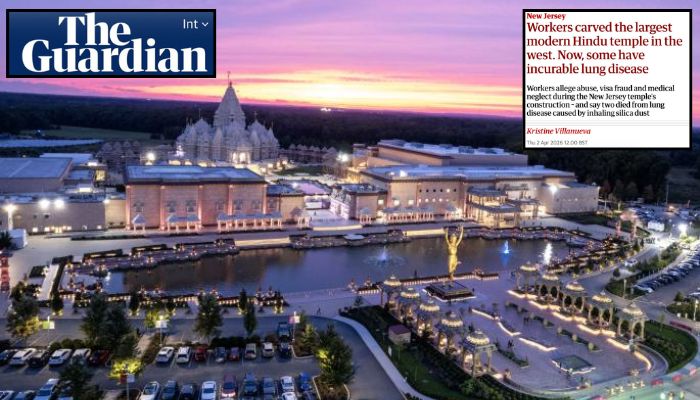
Months after a US court closed the case in September last year, British daily The Guardian has once again stirred controversy by publishing a report that repeats allegations about the construction of the BAPS Swaminarayan Akshardham in New Jersey, US. The development has reignited a debate that had already been settled after a detailed federal investigation in the United States found no wrongdoing.
The Guardian, a UK-based newspaper, published an article on Thursday, 2nd April, claiming that the construction of the temple involved worker abuse and medical negligence. However, the report is recycling claims that were already examined and dismissed by US authorities months ago.
Screengrab of the article published by The Guardian
A grand temple built through a global volunteer effort
The BAPS Swaminarayan Akshardham temple of Robbinsville, New Jersey, is the biggest Hindu temple in the Western Hemisphere. Built in 2023, the grand temple is more than just a place of worship; it represents devotion and pride among Hindu devotees around the world.
What makes the temple unique is the scale of participation behind its construction. Over 12,500 volunteers from North America and other countries contributed to building the temple over a span of 12 years. Many of them did not have any formal background in construction, but temple authorities have consistently maintained that their contribution was a form of “seva,” or spiritual service rooted in faith and devotion.
The temple’s intricate architecture, hand-carved stones, and vast campus have made it a major spiritual and tourist attraction since its opening.
Allegations raised again by The Guardian
In its latest article, The Guardian alleged that beneath the temple’s grandeur lies a “darker story” involving claims of worker exploitation. The report claimed that workers faced issues such as “worker abuse, visa fraud and medical neglect” during the construction period between 2015 and 2023.
According to the article, some workers believed that at least two labourers, Ramesh Meena and Devi Lal, died due to silicosis, a lung disease caused by inhaling fine silica dust during stone carving. The report also mentioned claims of workers suffering from respiratory illnesses like tuberculosis and chronic bronchitis.
Quoting anonymous workers, the article described harsh working conditions, including long working hours of up to 90 hours a week and wages allegedly as low as $1.20 per hour. It further claimed that workers’ passports were taken away and that they had limited contact with their families.
The report also raised fake claims about safety practices, alleging that workers were not provided proper protective equipment. It stated that some workers used cloth or surgical masks instead of the recommended N95 masks while working in dusty conditions. Additionally, the article claimed that medical facilities were inadequate and that workers were discouraged from seeking treatment outside the temple’s internal system.
The article also claims that around two hundred Dalit workers, members of the lowest caste in India’s rigid social hierarchy, came from Rajasthan to New Jersey to work on the temple. Historically subjected to extreme social and economic marginalisation, Dalits have long been relegated to the most dangerous and lowest-paid labour.
The article further alleged that the Dalit workers are also not allowed to worship in these temples because of their low caste ranking.
The temple authorities, however, have denied all these allegations and maintained that their practices were in line with legal and religious frameworks. They have also invoked the “ministerial exception,” a legal principle in the United States that protects religious organisations from interference in matters related to religious roles and duties.
BAPS has consistently disputed the allegations, saying the workers were volunteers performing religious service, known as seva, rather than employees.
Leaders of the Hindu denomination have said the artisans were motivated by faith and tradition, not coercion, and that some plaintiffs later withdrew from the case after claiming they were misled into joining the lawsuit.
Despite these denials, The Guardian’s report has brought back claims that were already part of a long-running legal and media debate.
U.S. authorities had already closed the case last year
The renewed controversy comes despite the fact that US authorities had already investigated the matter in detail and closed the case. On 18th September last year, the United States Department of Justice and the United States Attorney’s Office for the District of New Jersey officially ended their investigation into the temple’s construction.
The DOJ had been investigating claims made by dozens of former workers who alleged they were recruited from India under religious visas, forced to work long hours on temple construction, and paid as little as $1.20 an hour.
The plaintiffs in the civil lawsuit, many of whom are from marginalised Dalit communities in India, filed their initial complaint in May 2021, the same day federal agents raided the Robbinsville temple complex.
According to statements issued at the time, the investigation lasted nearly four years and concluded without any charges being filed. This was seen as a major relief for the Bochasanwasi Akshar Purushottam Swaminarayan Sanstha, the organisation behind the temple.
Reacting to the decision, Swami Brahmaviharidas, head of the BAPS Hindu Mandir in Abu Dhabi, strongly rejected the allegations and welcomed the closure of the case. He said, “Satyamev Jayate! We build a temple with love, faith, devotion and a spirit of volunteerism… Some people with little vested interest file false accusations regarding when the temple was built and the craftsmanship.”
#WATCH | Abu Dhabi, UAE | BAPS Swaminarayan Mandir saint Swami Brahmaviharidas says, "Nobody had imagined and even historians told us that a beautiful temple in this region is unthinkable… His Holiness Pramukh Swami Maharaj, who has built over 1200 temples across the world, had… pic.twitter.com/IoFtQXbpWg— ANI (@ANI) September 18, 2025
He further added, “The US government carried out an investigation into the temple for 4 years and finally closed it, saying no charges were ever filed and no charges were ever true. This restores faith in justice.”
In its official statement, BAPS also said that the US government’s decision sends a “clear and powerful message” supporting the organisation’s long-standing position. It described the temple as “a place of peace, service, and devotion” built through the dedication of thousands of volunteers.
The organisation also emphasised its spiritual philosophy, stating that even in difficult times, it remains committed to “faith, cooperation, humility, and a commitment to truth.”
Pattern of allegations in Foreign Media to divide Hindus
This is not the first time that foreign media outlets have published critical reports about the temple. In the past, publications like The New York Times have also carried stories alleging forced labour, caste discrimination, and poor working conditions.
In a report published in 2023, The New York Times claimed that federal agents had raided the temple construction site in 2021 after some workers made allegations about their working conditions. However, many observers later pointed out that even after the raid and a detailed investigation, no charges were ultimately proven or filed in the case.
The timing of such reports has also raised questions. One of the articles by The New York Times came out just a few days after the grand opening of the temple in October 2023. This was a time when the Hindu community across the world was celebrating the completion of the temple.
In May 2021, a group of Indian artisans in the US filed a lawsuit alleging human trafficking and forced labour and claimed they were confined and forced to work for as low as USD 1 on the construction of the Swaminarayan temple in New Jersey’s Robbinsville. BAPS was accused of luring labourers from India to work on temples near Atlanta, Chicago, Houston and Los Angeles, along with New Jersey, while paying only USD 450 a month.
Back then, BAPS denied the claims and said worship through seva is an integral part of Bhakti in the sect, and volunteers from around the world contribute to the same. The volunteers who take part in such construction activities of the temple regularly interact with people who come to visit. The Hindu organisation had also said the volunteers were regularly in touch with their family members back home.
It must be recalled that the BAPS Temple in New Jersey was also targeted by the left-liberal newspaper The New York Times. In a propaganda piece published in October 2023, the NYT claimed, “Federal law enforcement agents raided the temple construction site in 2021 after workers accused the builders, a prominent Hindu sect with ties to Prime Minister Narendra Modi of India and his ruling party, of forced labour, low wages and poor working conditions.”
“Their lawyers said workers who were Dalit, the lowest rung in India’s caste system, were specifically targeted. A federal criminal investigation is ongoing, as is a wage claim lawsuit,” the leftist newspaper further alleged.
This came even as it had been 2 years since the raid on the construction site of Akshardham Mahamandir in 2021, and no charges could be established.
In July 2023, over a dozen artisans, who were part of a lawsuit against the BAPS temple in New Jersey, withdrew their names from the case. At that time, Rajasthan High Court Advocate Aaditya SB Soni issued a press release on behalf of the artisans under the banner of Bharatiya Majdoor Sangh and Patthar Gadhai Sangh, stating the artisans were threatened to be part of the deep-rooted conspiracy to stall the construction of the grand Hindu Temple.
Larger debate around representation and narrative
The recurring allegations and their coverage have sparked a broader debate about how Hindu institutions are portrayed in international media. Such reports only focus on controversy and know-how peddling lies while overlooking the scale of volunteer participation and the cultural significance of projects like the Akshardham temple.
The latest report by The Guardian has once again brought the spotlight back on the BAPS Swaminarayan Akshardham temple in New Jersey. While the allegations it highlights are serious, they are not new and were already examined during a multi-year investigation by US authorities that ended without charges.
As the debate continues, the episode raises important questions about how such issues are reported and revisited, especially when official findings have already been made. For many, the temple remains a symbol of faith and collective effort, while for others, it continues to be a subject of scrutiny and discussion.