The anatomy of Unnao rape case: Kuldeep Sengar’s bail, allegations, questions and contradictions in a story that began in 2017
On 29th December, the Supreme Court of India stayed the Delhi High Court’s decision to grant bail to former Uttar Pradesh MLA Kuldeep Singh Sengar in the 2017 Unnao rape case. A Bench comprising Chief Justice of India Surya Kant, Justice JK Maheshwari and Justice Augustine George Masih issued the stay while hearing an appeal filed by the Central Bureau of Investigation (CBI) against the High Court’s decision. During the hearing, the apex court noted that there were serious questions of law involved in the matter. The court observed that the Delhi High Court’s interpretation of the term “public servant” under Section 5 of the Protection of Children from Sexual Offences (POCSO) Act may be flawed. The court stated such interpretation could result in exclusion of legislators from liability under aggravated sexual assault provisions. The Bench remarked, “We are worried that a constable shall be a public servant under the Act but a Member of Legislative Assembly will be excluded.” While staying the Delhi High Court’s bail order, the apex court issued notice to Sengar and directed he should not be released from jail. The Bench said, “We are conscious of the fact that when a convict has been released, such orders are not ordinarily stayed. But given the peculiar facts, we stay the High Court order dated 23rd December.” Notably, while Sengar was granted bail, he remained in jail due to his involvement in other cases. Appearing for the CBI, Solicitor General Tushar Mehta argued that the High Court had erred in holding that the offence under Section 5(c) of the POCSO Act was not made out since Sengar was not a public servant. He pointed out that Sengar held a position of public trust as an MLA and had already been convicted for the custodial death of the victim’s father. SG Mehta also cited Section 42A of the POCSO Act, which gives it overriding effect over other laws. Senior advocates Siddhartha Dave and N Hariharan, representing Sengar, defended the High Court’s order, stating that the sentence was imposed only because the trial court classified him as a public servant, and such classification was legally questionable. Sengar’s family expressed dismay over court order Speaking to the media, Sengar’s daughter Aishwarya Sengar expressed dismay, stating they could not “even start arguing on the merits of the case”. She pointed out that the victim in the case had changed her statement several times and altered the timing of the alleged crime on three occasions. Supreme Court stays the order of the Delhi High Court, which suspended the life sentence of expelled Bharatiya Janata Party (BJP) leader Kuldeep Singh Sengar in the 2017 Unnao rape case of a minor girl.Aishwarya Sengar, daughter of Kuldeep Singh Sengar, says, "We couldn’t even…— ANI (@ANI) December 29, 2025 She said, “We couldn’t even start arguing on the merits of the case today, that she has changed her statement several times, changed the timing thrice, starting from 2 pm, 6 pm and then finally 8 pm. There’s a finding of the AIIMS medical board that she was more than 18… I’ve been fighting for justice for the past 8 years, but maybe the sorrows of me and my family mean nothing. We have been stripped of our dignity, our peace, and even our fundamental right to be heard. Still hope for justice. I request that the media not spread any misinformation.” Sengar’s other daughter, Ishita, also released a public statement expressing her distress and disillusionment with the judicial and public response to the case over the past eight years. In her statement, she said that her family had remained silent, trusting institutions and due process, but had faced persistent social hostility and threats, including death and rape threats on social media. ToThe Hon’ble Authorities of the Republic of India,I am writing this letter as a daughter who is exhausted, frightened, and slowly losing faith, but still holding on to hope because there is nowhere else left to go.For eight years, my family and I have waited. Quietly.…— Dr Ishita Sengar (@IshitaSengar) December 29, 2025 She described the emotional, financial and reputational toll on her family and criticised what she called an atmosphere of fear and public pressure that, in her view, had overshadowed evidence and legal procedure. She concluded by urging authorities to allow the law to operate free from influence and reiterated her faith in the justice system while appealing for fairness and dignity. High Court grants bail citing absence of aggravated offence Earlier, on 23rd December, the Delhi High Court had suspended Sengar’s life sentence and granted him conditional bail pending appeal. The Division Bench of Justice Subramonium Prasad and Justice Harish Vaidyanathan Shankar ruled that Sengar did not fall within the definition of “public servant” under Section 5(c) of the POCSO Act that aggravated the offence of penetrative sexual assault. The court further held that he also did not q
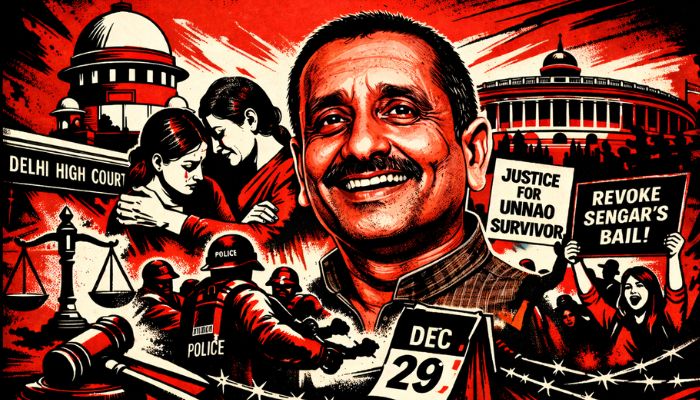

On 29th December, the Supreme Court of India stayed the Delhi High Court’s decision to grant bail to former Uttar Pradesh MLA Kuldeep Singh Sengar in the 2017 Unnao rape case. A Bench comprising Chief Justice of India Surya Kant, Justice JK Maheshwari and Justice Augustine George Masih issued the stay while hearing an appeal filed by the Central Bureau of Investigation (CBI) against the High Court’s decision.
During the hearing, the apex court noted that there were serious questions of law involved in the matter. The court observed that the Delhi High Court’s interpretation of the term “public servant” under Section 5 of the Protection of Children from Sexual Offences (POCSO) Act may be flawed. The court stated such interpretation could result in exclusion of legislators from liability under aggravated sexual assault provisions. The Bench remarked, “We are worried that a constable shall be a public servant under the Act but a Member of Legislative Assembly will be excluded.”
While staying the Delhi High Court’s bail order, the apex court issued notice to Sengar and directed he should not be released from jail. The Bench said, “We are conscious of the fact that when a convict has been released, such orders are not ordinarily stayed. But given the peculiar facts, we stay the High Court order dated 23rd December.” Notably, while Sengar was granted bail, he remained in jail due to his involvement in other cases.
Appearing for the CBI, Solicitor General Tushar Mehta argued that the High Court had erred in holding that the offence under Section 5(c) of the POCSO Act was not made out since Sengar was not a public servant. He pointed out that Sengar held a position of public trust as an MLA and had already been convicted for the custodial death of the victim’s father. SG Mehta also cited Section 42A of the POCSO Act, which gives it overriding effect over other laws.
Senior advocates Siddhartha Dave and N Hariharan, representing Sengar, defended the High Court’s order, stating that the sentence was imposed only because the trial court classified him as a public servant, and such classification was legally questionable.
Sengar’s family expressed dismay over court order
Speaking to the media, Sengar’s daughter Aishwarya Sengar expressed dismay, stating they could not “even start arguing on the merits of the case”. She pointed out that the victim in the case had changed her statement several times and altered the timing of the alleged crime on three occasions.
Supreme Court stays the order of the Delhi High Court, which suspended the life sentence of expelled Bharatiya Janata Party (BJP) leader Kuldeep Singh Sengar in the 2017 Unnao rape case of a minor girl.
— ANI (@ANI) December 29, 2025
Aishwarya Sengar, daughter of Kuldeep Singh Sengar, says, "We couldn’t even…
She said, “We couldn’t even start arguing on the merits of the case today, that she has changed her statement several times, changed the timing thrice, starting from 2 pm, 6 pm and then finally 8 pm. There’s a finding of the AIIMS medical board that she was more than 18… I’ve been fighting for justice for the past 8 years, but maybe the sorrows of me and my family mean nothing. We have been stripped of our dignity, our peace, and even our fundamental right to be heard. Still hope for justice. I request that the media not spread any misinformation.”
Sengar’s other daughter, Ishita, also released a public statement expressing her distress and disillusionment with the judicial and public response to the case over the past eight years. In her statement, she said that her family had remained silent, trusting institutions and due process, but had faced persistent social hostility and threats, including death and rape threats on social media.
To
— Dr Ishita Sengar (@IshitaSengar) December 29, 2025
The Hon’ble Authorities of the Republic of India,
I am writing this letter as a daughter who is exhausted, frightened, and slowly losing faith, but still holding on to hope because there is nowhere else left to go.
For eight years, my family and I have waited. Quietly.…
She described the emotional, financial and reputational toll on her family and criticised what she called an atmosphere of fear and public pressure that, in her view, had overshadowed evidence and legal procedure. She concluded by urging authorities to allow the law to operate free from influence and reiterated her faith in the justice system while appealing for fairness and dignity.
High Court grants bail citing absence of aggravated offence
Earlier, on 23rd December, the Delhi High Court had suspended Sengar’s life sentence and granted him conditional bail pending appeal. The Division Bench of Justice Subramonium Prasad and Justice Harish Vaidyanathan Shankar ruled that Sengar did not fall within the definition of “public servant” under Section 5(c) of the POCSO Act that aggravated the offence of penetrative sexual assault. The court further held that he also did not qualify as being in a “position of trust or authority” under Section 5(p) of the said Act.
In its order, the Delhi High Court noted that as per Section 2(2) of the POCSO Act, definitions must be taken from the Indian Penal Code (IPC), CrPC, Juvenile Justice Act or IT Act, and under Section 21 of IPC, an MLA is not classified as a public servant.
Based on these findings, the court held that the aggravated offence under Section 5 did not apply, and since Kuldeep Singh Sengar had already spent over 7 years and 5 months in custody, more than the 7-year minimum for the base offence under Section 4 POCSO, bail was justified pending appeal. It is noteworthy that the Delhi High Court granted him bail but did not acquit him of any of the offences. He was granted bail on a technicality of the case and not on the merit.
Claims of false implication and inconsistencies cited by social media users
Several social media users and commentators have raised concerns regarding alleged inconsistencies in the Unnao rape case, claiming that Kuldeep Singh Sengar may have been falsely implicated. These claims cite multiple points drawn from court records and media reports.
रेप केस में किसी को कैसे फंसाया जाता है इसका classic example उन्नाव मामला है। आरोप लगाने वाली लड़की अपना पहला बयान दर्ज कराती है। पूरी घटना विस्तार में बताती है। इसका-उसका नाम बताती है। कहीं भी मुख्य आरोपी शुभम सिंह की बहन नाम नहीं आता। फिर अचानक उसे और बयान दर्ज कराने वालों याद… pic.twitter.com/YYtdB5fQS1
— Divya Kumar Soti (@DivyaSoti) December 28, 2025
One point raised involves discrepancies in the alleged time of the incident. According to a summary referenced in court documents, the survivor mentioned three different times for when the incident occurred, 2:00 pm in a letter to the Chief Minister dated 17th August 2017, 6:00 pm in a media interview on 12th September 2017, and between 8:00 pm to 8:30 pm in the prosecution’s theory.
Another frequently cited issue is the conflicting records regarding the survivor’s age. Documents submitted from different sources, including school admission registers and medical opinions, record her date of birth variously as 17th August 2001, 5th July 1998, and August 2002. Medical assessments from RML Hospital, CMO Unnao, and AIIMS suggest she was over 18 years old at the time of the alleged offence, while school records and court testimony indicate she was a minor.
Users have also questioned the credibility of the accusations based on the survivor’s timeline of reporting. It has been noted that she did not report the alleged incident immediately and added new names to her complaint at later stages, some of which were later dropped with the explanation that she was “misguided” by lawyers.
A separate viral claim suggests that the name of one female accused was inserted into the statement at a later stage, using a caret mark to include the word “barabar” (equally), implying that her role was revised to match that of the main accused. Critics argue that such editing raises questions about the manner in which charges were framed.
Protests against bail order
Following the Delhi High Court’s decision to grant Kuldeep Sengar bail on 23rd December 2025, protests erupted across New Delhi. On 26th December, around 30 activists, including the Unnao survivor’s mother and members of the All-India Democratic Women’s Association (AIDWA), demonstrated outside the High Court, holding placards and chanting slogans such as “stop protecting rapists.”
Later that evening, the Indian Youth Congress (IYC) organised a candlelight march condemning the bail order as “deeply disturbing and shameful.” On 27th December, activist Yogita Bhayana and Congress leader Mumtaz Patel led a sit-in protest near Parliament, which ended in police detentions after officers declared the area a non-permitted protest zone.
On 28th December, several women’s rights organisations, including the Centre for Struggling Women, Pragatisheel Mahila Sangathan, and All India Mahila Sanskritik Sangathan, along with student groups, staged a demonstration at Jantar Mantar. The Unnao survivor and her mother also joined, demanding cancellation of Sengar’s bail and reinstatement of his life sentence.
Timeline of Unnao rape case
2017 – Initial allegation and FIRs
On 4th June 2017, a 17-year-old girl from Makhi village claimed that Sengar raped her after luring her to his residence under the pretext of providing employment. She claimed that Sengar threatened her not to speak out. Between 11th and 20th June 2017, the survivor was allegedly abducted and gang-raped by local men. On 20th June, an FIR was registered against them under IPC Sections 363, 366 and 376. Sengar was not named in the FIR.
In August 2017, upon her return, the survivor attempted to register a complaint against Sengar. Police allegedly refused to include his name. In February 2018, she moved to the court to include Sengar’s name in the case.
2018 – Custodial death and CBI probe
On 3rd April 2018, the survivor’s father was beaten up by Sengar’s brother Atul and others. On 5th April, the father was jailed on fabricated Arms Act charges. During investigation, it was revealed that the country-made pistol found on survivor’s father was planted. On 8th April, the survivor attempted self-immolation outside Chief Minister’s residence in protest.
On 9th April, her father died in judicial custody. The post-mortem revealed 14 injury marks. On 10th April, Atul Sengar was arrested and the case drew national attention. On 12th April, the case was handed over to the CBI, which registered an FIR against Kuldeep Sengar.
The Allahabad High Court criticised the delay and ordered his arrest. On 13th April, Sengar was arrested by the CBI. On 15th April, Shashi Singh, accused of taking the girl to Sengar’s house, was arrested. On 18th April, the survivor recorded her statement before a magistrate; the age of the victim became a point of contention.
2018 – Chargesheets and trials
On 11th July 2018, the CBI filed a chargesheet against Sengar and Shashi Singh for rape and kidnapping. On 13th July, a second chargesheet was filed in the custodial death of the survivor’s father, naming Atul Sengar and others.
2019 – Supreme Court intervention and convictions
On 28th July 2019, the survivor and her family were involved in a fatal car crash. Two relatives were killed; she and her lawyer were critically injured. On 29th July, an FIR was filed for murder and conspiracy against Sengar and others.
On 31st July, the Supreme Court transferred all related cases to Delhi and ordered CRPF protection for the survivor and her family. On 5th August 2019, the rape trial began in Delhi’s Tis Hazari court. On 11th September, the survivor testified in a special in-camera hearing at AIIMS hospital. On 16th December 2019, Sengar was convicted of raping the minor under IPC and POCSO. On 20th December 2019, he was sentenced to life imprisonment for the remainder of his natural life and fined Rs 25 lakh.
2020 – Custodial death conviction
On 4th March 2020, Sengar and others were convicted in the custodial death case for culpable homicide not amounting to murder. On 13th March 2020, he was sentenced to 10 years in prison in this case.
2021-2024 – Appeals and security
During this period, Sengar remained in jail. Multiple bail pleas were denied. The survivor continued living under CRPF protection with her family. On 23rd May 2025, the Supreme Court permitted scaling back of security for the survivor’s relatives but directed that protection for the survivor herself must continue.
2025 – High Court bail and Supreme Court stay
On 23rd December 2025, the Delhi High Court suspended Sengar’s life sentence and granted him bail, holding that he is not a public servant under the POCSO Act and had served sufficient time for the base offence. The court reasoned that the aggravated offence provisions did not apply to him, and since he had already spent over seven years in custody, exceeding the minimum sentence under Section 4 of the Act, bail was justified pending appeal.
On 29th December 2025, the Supreme Court stayed the High Court’s order and barred his release from prison. The Bench expressed serious concerns about the legal implications of excluding legislators from “public servant” status under POCSO. The court observed that such an interpretation could exempt lawmakers from aggravated assault provisions and agreed to examine the matter in detail.
Conclusion
The Unnao case continues to receive national attention as legal proceedings remain ongoing. The Delhi High Court granted Kuldeep Sengar bail, but the Supreme Court has stayed the order and will hear the matter in detail. Protests have taken place in several cities following the bail order. The case has raised legal and procedural questions that are now before the courts for further consideration.