Strait of Hormuz crisis: Why India’s energy transition under PM Modi is crucial for energy security
The escalating Iran–US–Israel confrontation has once again exposed the fragility of the global energy system. As tensions rise in West Asia and the Strait of Hormuz becomes the centre of geopolitical confrontation, global oil markets have reacted instantly. Brent crude prices have surged, and LPG costs have begun rising, triggering fresh concerns about supply disruptions. Nearly one-fifth of the world’s oil trade passes through the Strait of Hormuz, making it one of the most critical energy chokepoints on the planet. For energy-importing nations like India, any instability in the region can rapidly translate into higher fuel prices, inflationary pressure and economic uncertainty. However, the current crisis is also revealing something important: India is significantly better prepared today than it was a decade ago, largely because of the long-term energy transition strategy pursued under PM Modi since 2014. What critics once dismissed as ambitious climate rhetoric is now emerging as a strategic hedge against geopolitical energy shocks. From energy dependence to energy resilience For decades, India’s energy strategy revolved around importing fossil fuels, particularly crude oil from the Middle East. The result was a structural vulnerability where geopolitical tensions thousands of kilometres away could immediately impact India’s economy. Recognising this risk early, the Modi government began pursuing a multi-layered strategy focused on diversification, renewables, electrification and domestic production. Even today, India continues to rely on imports for crude oil. However, the broader energy ecosystem has undergone a major transformation over the past decade. Domestic production and infrastructure improvements have already reduced some vulnerabilities. India’s domestic LPG production now meets around 45 per cent of demand, while domestic LNG production covers roughly half of the country’s requirements. Alongside this, major investments in refining, pipelines and storage infrastructure have significantly improved the efficiency and resilience of the energy supply chain. The dramatic transformation of India’s power sector The most striking transformation has occurred in India’s power generation capacity. In 2014, India’s total installed power capacity stood at about 249 gigawatts. Renewable energy, excluding large hydro, accounted for only 35.85 gigawatts, while solar power was still in its infancy with a capacity of just 2.82 gigawatts. Over the next decade, this picture changed dramatically. By January 2026, India’s total installed power capacity had reached 520.5 gigawatts, more than doubling in just over a decade. Even more significant is the shift in the composition of this capacity. Non-fossil sources now account for approximately 271.97 gigawatts, surpassing fossil fuel capacity of 248.5 gigawatts. Within this non-fossil segment, renewable energy contributes the largest share at about 263.2 gigawatts, while nuclear power accounts for around 8.78 gigawatts. This means that for the first time in India’s history, non-fossil sources account for more than 52 percent of the country’s installed power capacity, allowing India to achieve a key climate commitment five years ahead of schedule. The pace of expansion continues to accelerate. In the financial year 2025-26 alone, India added more than 50 gigawatts of new power capacity. Out of this, nearly 39,657 megawatts came from renewable sources, marking one of the largest annual renewable expansions in the world. This rapid growth is already beginning to alter India’s energy dynamics. Coal power plants are witnessing a gradual decline in plant load factors, suggesting the beginning of a structural moderation in coal dependence. Building domestic manufacturing strength India’s energy transition is not limited to installing renewable capacity; it is also about building a domestic manufacturing ecosystem to reduce dependence on imports. To achieve this, the government launched the Production Linked Incentive scheme for high-efficiency solar modules in 2020, later expanding it in 2022 with an outlay of ₹24,000 crore. The objective of the scheme is to build a fully integrated domestic solar manufacturing supply chain and reduce reliance on Chinese imports. The results have been dramatic. In 2014, India’s solar module manufacturing capacity was around 2.3 gigawatts. By 2026, that capacity has expanded to approximately 144 gigawatts, transforming India into a major global manufacturing hub for solar equipment. The scheme has also played a crucial role in accelerating renewable installations. In 2025 alone, India added around 35 gigawatts of solar capacity, making it one of the fastest-growing solar markets globally. Battery manufacturing is also being strengthened through the Production Linked Incentive scheme for Advanced Chemistry Cells, which carries an outlay of ₹18,100 crore. This initiative is aimed at build
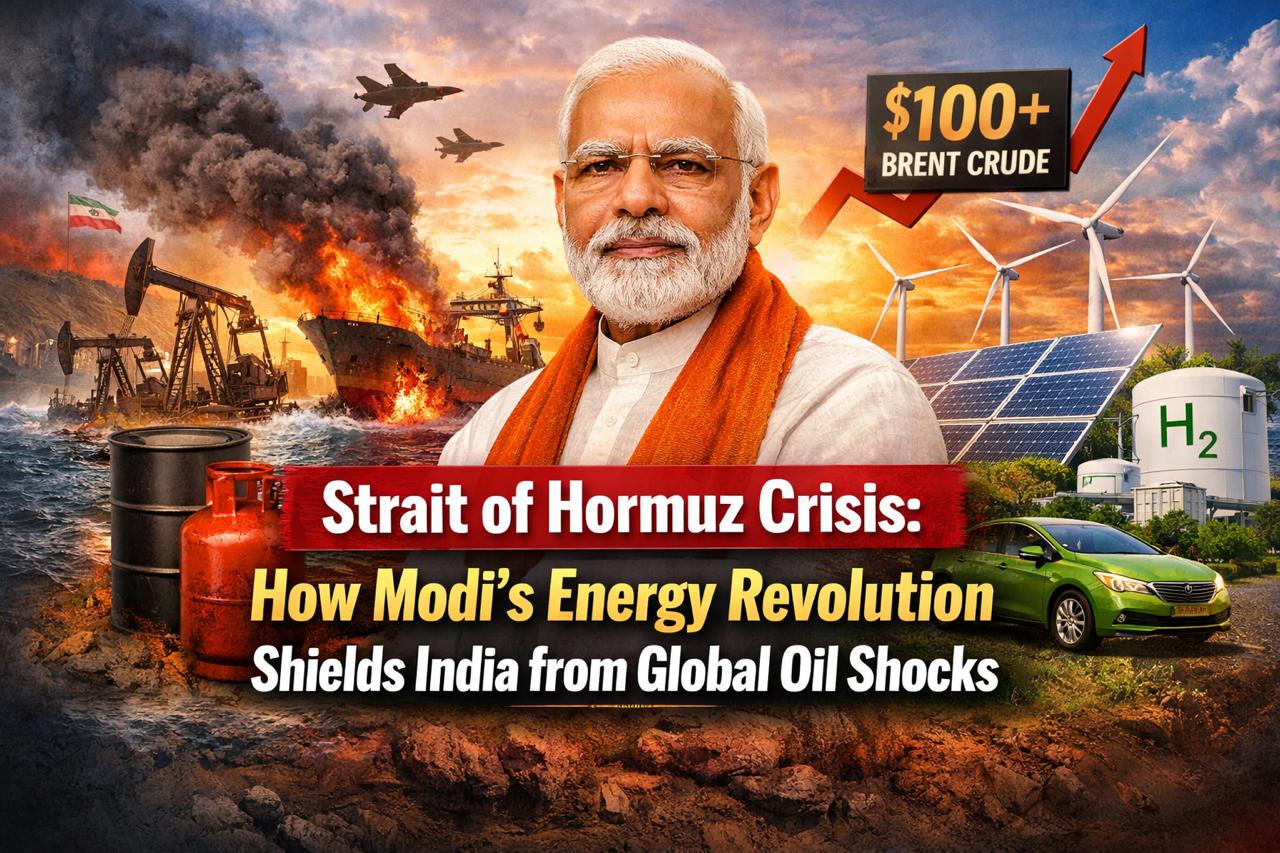
The escalating Iran–US–Israel confrontation has once again exposed the fragility of the global energy system. As tensions rise in West Asia and the Strait of Hormuz becomes the centre of geopolitical confrontation, global oil markets have reacted instantly. Brent crude prices have surged, and LPG costs have begun rising, triggering fresh concerns about supply disruptions.
Nearly one-fifth of the world’s oil trade passes through the Strait of Hormuz, making it one of the most critical energy chokepoints on the planet. For energy-importing nations like India, any instability in the region can rapidly translate into higher fuel prices, inflationary pressure and economic uncertainty.
However, the current crisis is also revealing something important: India is significantly better prepared today than it was a decade ago, largely because of the long-term energy transition strategy pursued under PM Modi since 2014. What critics once dismissed as ambitious climate rhetoric is now emerging as a strategic hedge against geopolitical energy shocks.
From energy dependence to energy resilience
For decades, India’s energy strategy revolved around importing fossil fuels, particularly crude oil from the Middle East. The result was a structural vulnerability where geopolitical tensions thousands of kilometres away could immediately impact India’s economy.
Recognising this risk early, the Modi government began pursuing a multi-layered strategy focused on diversification, renewables, electrification and domestic production. Even today, India continues to rely on imports for crude oil. However, the broader energy ecosystem has undergone a major transformation over the past decade.
Domestic production and infrastructure improvements have already reduced some vulnerabilities. India’s domestic LPG production now meets around 45 per cent of demand, while domestic LNG production covers roughly half of the country’s requirements. Alongside this, major investments in refining, pipelines and storage infrastructure have significantly improved the efficiency and resilience of the energy supply chain.
The dramatic transformation of India’s power sector
The most striking transformation has occurred in India’s power generation capacity. In 2014, India’s total installed power capacity stood at about 249 gigawatts. Renewable energy, excluding large hydro, accounted for only 35.85 gigawatts, while solar power was still in its infancy with a capacity of just 2.82 gigawatts.
Over the next decade, this picture changed dramatically. By January 2026, India’s total installed power capacity had reached 520.5 gigawatts, more than doubling in just over a decade. Even more significant is the shift in the composition of this capacity. Non-fossil sources now account for approximately 271.97 gigawatts, surpassing fossil fuel capacity of 248.5 gigawatts.
Within this non-fossil segment, renewable energy contributes the largest share at about 263.2 gigawatts, while nuclear power accounts for around 8.78 gigawatts. This means that for the first time in India’s history, non-fossil sources account for more than 52 percent of the country’s installed power capacity, allowing India to achieve a key climate commitment five years ahead of schedule.
The pace of expansion continues to accelerate. In the financial year 2025-26 alone, India added more than 50 gigawatts of new power capacity. Out of this, nearly 39,657 megawatts came from renewable sources, marking one of the largest annual renewable expansions in the world.
This rapid growth is already beginning to alter India’s energy dynamics. Coal power plants are witnessing a gradual decline in plant load factors, suggesting the beginning of a structural moderation in coal dependence.
Building domestic manufacturing strength
India’s energy transition is not limited to installing renewable capacity; it is also about building a domestic manufacturing ecosystem to reduce dependence on imports.
To achieve this, the government launched the Production Linked Incentive scheme for high-efficiency solar modules in 2020, later expanding it in 2022 with an outlay of ₹24,000 crore. The objective of the scheme is to build a fully integrated domestic solar manufacturing supply chain and reduce reliance on Chinese imports.
The results have been dramatic. In 2014, India’s solar module manufacturing capacity was around 2.3 gigawatts. By 2026, that capacity has expanded to approximately 144 gigawatts, transforming India into a major global manufacturing hub for solar equipment.
The scheme has also played a crucial role in accelerating renewable installations. In 2025 alone, India added around 35 gigawatts of solar capacity, making it one of the fastest-growing solar markets globally.
Battery manufacturing is also being strengthened through the Production Linked Incentive scheme for Advanced Chemistry Cells, which carries an outlay of ₹18,100 crore. This initiative is aimed at building domestic battery manufacturing capabilities that will support both renewable energy storage and electric mobility.
Under this programme, about 40 gigawatt-hours of battery manufacturing capacity have already been awarded to companies, while 1.4 gigawatt-hours have been commissioned so far.
Rooftop solar: decentralising energy production
One of the most ambitious initiatives in India’s energy transition is the PM Surya Ghar: Muft Bijli Yojana, launched in February 2024.
The scheme aims to install rooftop solar systems across one crore households, effectively transforming ordinary citizens into energy producers. By decentralising electricity generation, the programme reduces pressure on centralised power infrastructure while also lowering household electricity costs.
The response to the scheme has been remarkable. Within two years, more than 55.62 lakh applications have been received, and around 21.43 lakh households have already installed rooftop solar systems. The government has disbursed over ₹14,771 crore in subsidies to support the installations.
This decentralised model represents a fundamental shift in India’s energy architecture, enabling households to generate their own electricity while reducing dependence on coal-based power generation.
Electrifying India’s transportation sector
India’s transportation sector, which has traditionally been a major consumer of petroleum products, is also transforming.
Through the FAME-II scheme and the newer PM E-DRIVE programme, the government has introduced large-scale incentives to promote electric mobility.
So far, about 16.71 lakh electric vehicles have been supported under the FAME-II scheme, including electric two-wheelers, three-wheelers and cars. The programme has also facilitated the deployment of 5,195 electric buses across various Indian cities.
Building on this progress, the PM E-DRIVE scheme aims to support the deployment of nearly 28 lakh additional electric vehicles across the country. The gradual electrification of transportation has the potential to significantly reduce India’s dependence on imported crude oil.
Farmers and villages joining the energy transition
The energy transition is also reaching India’s agricultural sector through the PM-KUSUM scheme.
This programme focuses on solarising agricultural pumps and installing decentralised solar power plants in rural areas. More than 10 gigawatts of grid-connected solar capacity have been sanctioned under the scheme so far.
In addition, around 13 lakh standalone solar pumps have been approved, with nearly 10 lakh already installed. Another 55,000 grid-connected pumps have been solarised.
By replacing diesel pumps with solar alternatives, the scheme reduces fuel consumption in agriculture while also allowing farmers to earn additional income by selling surplus electricity back to the grid.
Hydrogen and nuclear: The next frontier
India’s long-term energy strategy also includes emerging technologies such as green hydrogen and expanded nuclear power.
The National Green Hydrogen Mission, launched in 2023 with a budget outlay of ₹19,744 crore, aims to position India as a global hub for green hydrogen production. Already, production capacity of about 0.86 million tonnes per annum has been awarded to 18 companies.
Green hydrogen is expected to play a crucial role in decarbonising energy-intensive industries such as steel manufacturing, fertilisers and heavy transport.
At the same time, nuclear power capacity in India has grown from 4.78 gigawatts in 2014 to 8.78 gigawatts in 2026, with 24 reactors currently operational.
Legislative reforms under the SHANTI Bill of 2025 have introduced provisions for private sector participation and a new liability framework, with an ambitious long-term target of achieving 100 gigawatts of nuclear power capacity by 2047.