Somnath was never just a temple: Meet the Acharyas and Kings who kept Shaivite civilisation alive after every invasion
Some places in India are far more than just religious sites. They become symbols of the country’s civilizational journey, cultural identity and spiritual continuity. The ancient Somnath temple at Prabhas Patan in Gujarat is one such place. For centuries, Somnath has stood not merely as a temple dedicated to Lord Shiva, but as a living symbol of faith, resistance, knowledge, devotion and cultural revival. Recently, during the celebrations of the Somnath Pranpratishtha Amrit Mahotsav marking 75 years of the reconstruction of the temple in independent India, Prime Minister Narendra Modi spoke about the long and uninterrupted history of Somnath. He highlighted how saints, kings, scholars, warriors and devotees across different centuries protected and revived the temple whenever it faced destruction. His speech presented Somnath not only as a temple rebuilt many times, but as a continuing civilizational tradition that survived every challenge. Somnath more than a temple The story of Somnath is not limited to medieval invasions or political conflicts. Its roots go back to ancient India, when Prabhas emerged as an important centre of Shaivite philosophy and spiritual learning. Long before the attacks that later became famous in history books, Somnath had already developed into one of western India’s major centres of worship, penance and philosophical discussions. Ancient sages and Acharyas transformed the region into a major centre of Shivaism. Over time, Somnath became connected with the Pashupata tradition, one of the oldest Shaivite sects in India. The temple complex was not just a place where devotees offered prayers. It also became a place where scholars debated philosophy, yogis practised penance, and spiritual teachers guided disciples. This intellectual and spiritual atmosphere helped Somnath gain importance across India. Pilgrims, saints, traders and seekers travelled to Prabhas from different regions, turning it into a major cultural and spiritual hub. Soma Sharma and the rise of Prabhas Among the earliest names associated with the spiritual history of Somnath is Soma Sharma. According to Shaivite traditions, he is regarded as the 27th incarnation of Rudra and is remembered as one of the sages who laid the foundation of the Pashupata tradition at Prabhas. Traditional narratives also mention that Soma Sharma established the earliest golden temple dedicated to Lord Shiva at Somnath. However, his importance goes far beyond temple construction. He played a major role in shaping the spiritual identity of Prabhas during a period when many religious traditions and schools of thought were developing in the Indian subcontinent. The Shaivite philosophy, linked with Soma Sharma, later influenced western India deeply. Traditions connected to him also mention the “Som Siddhant,” which gave philosophical direction to Shaivite practices and spiritual discipline. Because of this, Prabhas gradually became known not just as a pilgrimage site but also as a centre of learning and meditation. Lakulish and the Pashupata tradition After Soma Sharma, one of the most important figures in the Shaivite history of western India was Lakulish. Born in Kayavarohan in present-day Gujarat, Lakulish is considered the 28th incarnation of Rudra and is regarded as the great teacher who gave organized form to the Pashupata sect. The name Lakulish comes from the word “lakut,” meaning staff or rod. In sculptures and depictions, he is often shown seated in a yogic posture while holding a staff, symbolising penance, discipline and spiritual power. According to tradition, Lakulish was born to Vishwaroop and Sudarshana. Several stories connected to his childhood and spiritual journey remain popular in Gujarat. Places like Kayavarohan, Devkhat Lake and Brahmashwar Shiva Temple continue to hold importance in his tradition. Historians also find references to Lakulish through inscriptions. A Mathura inscription from around 380-381 AD mentions the tenth generation of his disciple Kusika. This has led many scholars to believe that Lakulish may have lived during the second century AD. Lakulish’s teachings spread through his four major disciples: Kusika, Garga, Mitra and Kaurusha. Their followers carried the Pashupata tradition to different parts of western India. The Kausika branch became influential in Mewar, the Gargya branch in Gujarat, the Maitraka branch in Saurashtra and the Kaurusha branch in nearby regions. Because of this expansion, places like Prabhas and Kayavarohan became major centres of Shaivite learning and worship. Acharyas who kept the tradition alive The growth of Somnath was not possible through royal support alone. Spiritual teachers and Pashupata Acharyas continuously strengthened the intellectual and religious traditions connected with the temple. One such important figure mentioned by Prime Minister Modi was Bhava Brihaspati. Though not widely known among the general public
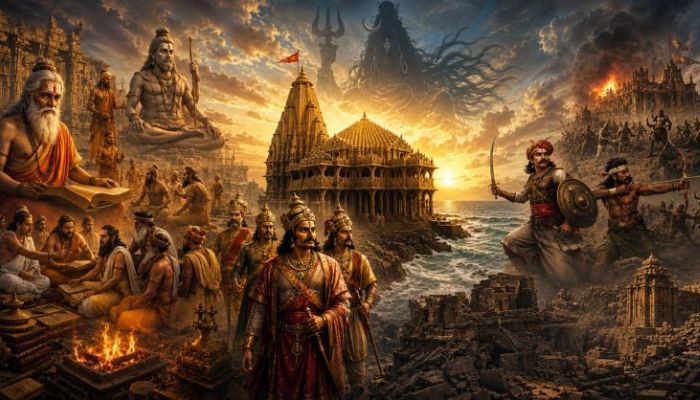
Some places in India are far more than just religious sites. They become symbols of the country’s civilizational journey, cultural identity and spiritual continuity. The ancient Somnath temple at Prabhas Patan in Gujarat is one such place. For centuries, Somnath has stood not merely as a temple dedicated to Lord Shiva, but as a living symbol of faith, resistance, knowledge, devotion and cultural revival.
Recently, during the celebrations of the Somnath Pranpratishtha Amrit Mahotsav marking 75 years of the reconstruction of the temple in independent India, Prime Minister Narendra Modi spoke about the long and uninterrupted history of Somnath. He highlighted how saints, kings, scholars, warriors and devotees across different centuries protected and revived the temple whenever it faced destruction. His speech presented Somnath not only as a temple rebuilt many times, but as a continuing civilizational tradition that survived every challenge.
Somnath more than a temple
The story of Somnath is not limited to medieval invasions or political conflicts. Its roots go back to ancient India, when Prabhas emerged as an important centre of Shaivite philosophy and spiritual learning. Long before the attacks that later became famous in history books, Somnath had already developed into one of western India’s major centres of worship, penance and philosophical discussions.
Ancient sages and Acharyas transformed the region into a major centre of Shivaism. Over time, Somnath became connected with the Pashupata tradition, one of the oldest Shaivite sects in India. The temple complex was not just a place where devotees offered prayers. It also became a place where scholars debated philosophy, yogis practised penance, and spiritual teachers guided disciples.
This intellectual and spiritual atmosphere helped Somnath gain importance across India. Pilgrims, saints, traders and seekers travelled to Prabhas from different regions, turning it into a major cultural and spiritual hub.
Soma Sharma and the rise of Prabhas
Among the earliest names associated with the spiritual history of Somnath is Soma Sharma. According to Shaivite traditions, he is regarded as the 27th incarnation of Rudra and is remembered as one of the sages who laid the foundation of the Pashupata tradition at Prabhas.
Traditional narratives also mention that Soma Sharma established the earliest golden temple dedicated to Lord Shiva at Somnath. However, his importance goes far beyond temple construction. He played a major role in shaping the spiritual identity of Prabhas during a period when many religious traditions and schools of thought were developing in the Indian subcontinent.
The Shaivite philosophy, linked with Soma Sharma, later influenced western India deeply. Traditions connected to him also mention the “Som Siddhant,” which gave philosophical direction to Shaivite practices and spiritual discipline. Because of this, Prabhas gradually became known not just as a pilgrimage site but also as a centre of learning and meditation.
Lakulish and the Pashupata tradition
After Soma Sharma, one of the most important figures in the Shaivite history of western India was Lakulish. Born in Kayavarohan in present-day Gujarat, Lakulish is considered the 28th incarnation of Rudra and is regarded as the great teacher who gave organized form to the Pashupata sect.
The name Lakulish comes from the word “lakut,” meaning staff or rod. In sculptures and depictions, he is often shown seated in a yogic posture while holding a staff, symbolising penance, discipline and spiritual power.
According to tradition, Lakulish was born to Vishwaroop and Sudarshana. Several stories connected to his childhood and spiritual journey remain popular in Gujarat. Places like Kayavarohan, Devkhat Lake and Brahmashwar Shiva Temple continue to hold importance in his tradition.
Historians also find references to Lakulish through inscriptions. A Mathura inscription from around 380-381 AD mentions the tenth generation of his disciple Kusika. This has led many scholars to believe that Lakulish may have lived during the second century AD.
Lakulish’s teachings spread through his four major disciples: Kusika, Garga, Mitra and Kaurusha. Their followers carried the Pashupata tradition to different parts of western India. The Kausika branch became influential in Mewar, the Gargya branch in Gujarat, the Maitraka branch in Saurashtra and the Kaurusha branch in nearby regions.
Because of this expansion, places like Prabhas and Kayavarohan became major centres of Shaivite learning and worship.
Acharyas who kept the tradition alive
The growth of Somnath was not possible through royal support alone. Spiritual teachers and Pashupata Acharyas continuously strengthened the intellectual and religious traditions connected with the temple.
One such important figure mentioned by Prime Minister Modi was Bhava Brihaspati. Though not widely known among the general public today, he played a key role in establishing Somnath as both a centre of worship and a centre of knowledge.
In ancient India, temples often functioned like universities. Scholars discussed philosophy, grammar, scriptures, yoga and spiritual practices inside temple complexes. Somnath also followed this tradition. Teachers like Bhava Brihaspati ensured that the temple remained connected with learning and spiritual debate.
The Pashupata Acharyas were not just priests. They were philosophers, yogis, teachers and guides. Their presence ensured that Somnath remained spiritually alive even during politically difficult periods.
Royal patronage and ancient reconstruction
The continuity of Somnath was also protected by many rulers who supported the temple over centuries. One of the earliest rulers linked with its reconstruction was Chakravarti Maharaja Dharsen of the Maitraka dynasty.
His contribution is important because it shows that the history of Somnath is much older than medieval conflicts. During the Maitraka period, Valabhi became an important centre of education and culture in western India. Shaivite traditions also received royal support during this era.
Dharsen’s reconstruction helped restore the religious and cultural importance of Prabhas. In ancient India, temples were not only spiritual centres. They also supported trade, travel, education and social activities. Since Prabhas Patan was located close to important sea trade routes, Somnath gained influence far beyond Gujarat.
Mahmud Ghazni’s attack and the revival
One of the most discussed chapters in Somnath’s history is the attack by Mahmud of Ghazni in the 11th century. However, equally important is the story of how the temple and its traditions were revived afterwards.
After the destruction caused during Ghazni’s invasion, Gujarat faced a difficult political and religious situation. At that time, Solanki ruler Bhimdev I emerged as an important figure connected with the rebuilding and revival of Somnath.
Bhimdev I, was not only a political ruler but also someone who worked to preserve Gujarat’s cultural identity. Historical accounts mention that he supported reconstruction efforts and helped restore religious traditions linked to the temple.
The Solanki period later became one of Gujarat’s greatest cultural eras. Temple architecture, trade, water systems, sculpture and literature flourished during this time. Bhimdev’s role in reviving Somnath became part of that larger cultural renaissance.
The wider struggle against invasions
The history of Somnath is also connected with the larger resistance against invasions in northwestern India. Hindu Shahi rulers Jayapal and Anandpal are remembered for fighting Turkish and Ghaznavid forces for years.
Though they were not directly linked to the administration of Somnath, their battles represented a broader struggle to defend Indian kingdoms and traditions. Jayapal fought against Sabuktigin and later against Mahmud Ghazni. His son Anandpal continued that resistance.
Their inclusion in the larger narrative of Somnath shows that the temple’s story was not limited to Gujarat alone. Different rulers across the Indian subcontinent were fighting to protect political independence and cultural identity during that period.
Maharaja Bhoj and cultural pride
Another major ruler associated with Somnath’s revival is Maharaja Bhoj of Malwa. He is remembered not only as a powerful king but also as a scholar, poet, architect and patron of culture.
Historical traditions credit Bhoj with contributing to the rebuilding of Somnath. For rulers like him, temples represented much more than religious places. They symbolised the spiritual and cultural strength of a kingdom.
Bhoj’s support reflected the idea that preserving temples also meant preserving India’s knowledge traditions, arts and civilizational memory.
Solanki kings and Gujarat’s golden age
The Solanki dynasty played one of the biggest roles in keeping Somnath alive after repeated attacks and political turmoil.
Karnadev Solanki strengthened Gujarat politically and culturally during a time when the region was emerging as a major power in western India. Temple construction, urban development, water management and trade grew rapidly under the Solanki rule.
The Solankis saw temples as symbols of prosperity and pride. Their support helped restore Somnath’s position as a sacred and respected pilgrimage centre.
Later rulers like Siddharaj Jaisingh further expanded Gujarat’s cultural influence. Under him, educational institutions, lakes, temples and cities flourished. His reign is often described as one of Gujarat’s golden periods.
Siddharaj not only strengthened the kingdom militarily but also supported religious institutions that shaped Gujarat’s cultural identity. Somnath remained one of the most important symbols of that identity.
Kumarpal Solanki continued this tradition. Though often remembered for his association with Jain Acharya Hemchandra, Kumarpal also supported Shaivite traditions. During his period, temples, pilgrimage centres, and centres of learning received strong royal support.
Bhava Brihaspati is often mentioned alongside Kumarpal because of their shared role in strengthening Somnath’s religious and intellectual traditions.
Vaghela rulers and spiritual guardians
After the Solankis, the Vaghela dynasty emerged in Gujarat. Though the political situation became more difficult during this period, efforts to preserve Somnath’s traditions continued.
Visaldev Vaghela is remembered as one of the rulers who tried to protect Gujarat’s cultural and religious institutions. Prime Minister Modi also referred to Tripurantak, who is seen in Shaivite traditions as a protector of spiritual knowledge.
Their importance lies in the fact that Somnath survived not only because of military resistance, but also because people preserved its traditions, teachings and memories across generations.
Revival after Islamic invasions
Repeated invasions left Somnath damaged several times. There were periods when local devotees became afraid to openly visit the temple. Yet the tradition never completely disappeared.
The Chudasama rulers of Junagadh played a major role in reviving worship at Somnath during difficult times. Mahipal Chudasama and Ra’ Khengar are remembered for restoring religious practices and supporting temple traditions after destruction.
For these rulers, Somnath represented the pride and identity of Saurashtra. Even when political conditions were unstable, they ensured that worship and pilgrimage continued.
Ahilyabai Holkar’s contribution
Centuries later, Queen Ahilyabai Holkar emerged as one of the greatest patrons of Indian pilgrimage sites. Her name is associated with the restoration and revival of several major temples across India, including Kashi Vishwanath and Somnath.
At a time when many ancient pilgrimage centres were struggling because of political and economic instability, Ahilyabai worked to keep religious traditions alive. Her efforts helped ensure that Somnath remained connected with worship and devotion even during difficult periods.
The Gaekwads and Pilgrim Protection
The Gaekwad rulers of Baroda also contributed to protecting Somnath and supporting pilgrims. Though their role is not discussed as frequently, they helped preserve the pilgrimage tradition during a time when British influence was expanding in western India.
Maintaining old temple traditions during colonial rule was not always easy. Yet rulers like the Gaekwads helped ensure that Somnath continued to remain spiritually active.
Forgotten heroes of Somnath
The history of Somnath is not only about kings and saints. It is also about ordinary warriors and local heroes who sacrificed their lives for the temple.
Among the most remembered names in Saurashtra’s folk memory are Hamirji Gohil and Vegdaji Bhil. Stories about Hamirji are still sung in folk songs across the region. He is remembered as a young warrior who gave his life while defending Somnath.
Vegdaji Bhil is similarly remembered as a symbol of sacrifice and resistance. Their stories reflect how deeply Somnath was connected with the emotions and identity of local communities.
The modern reconstruction of Somnath
The modern chapter of Somnath began after India’s independence. Following the integration of Junagadh into India, Sardar Vallabhbhai Patel visited Prabhas Patan and declared that Somnath would be rebuilt.
This decision was seen not only as the reconstruction of a temple, but also as a symbol of cultural confidence in newly independent India.
K. M. Munshi played a major role in turning this vision into reality. Jam Saheb Digvijaysinhji of Nawanagar and many others also supported the reconstruction effort.
Finally, in 1951, the reconstructed temple was inaugurated in the presence of India’s first President, Rajendra Prasad. Despite opposition from Jawaharlal Nehru regarding the President’s participation, Rajendra Prasad attended the ceremony and described Somnath as a symbol of India’s cultural revival.
An unbroken civilizational journey
The story of Somnath stretches across centuries and connects sages, saints, rulers, warriors and ordinary devotees. From Soma Sharma and Lakulish to Bhava Brihaspati, from Bhimdev and Bhoj to Ahilyabai Holkar, from Hamirji Gohil to Sardar Patel, every generation added a chapter to the temple’s survival.
Somnath was attacked many times, but its traditions never disappeared. That continuity is what makes Somnath unique. The temple survived because it lived not only in stone structures, but also in the cultural memory of people.
Even today, Somnath stands as more than a pilgrimage site. It represents continuity, resilience and the civilizational confidence of India.