Russian tanker reaches Cuba with humanitarian cargo of 700,000 barrels of oil: Read how US embargo is crippling the country as Trump tries another regime change
On 31st March (Tuesday), the United States permitted a Russian-flagged ship “Anatoly Kolodkin” bearing 100,000 tonnes of oil to enter Cuban seas. The vessel reportedly arrived at the Matanzas port of the island nation reeling under severe fuel blockade by the White House, prompting a critical energy crisis which has even resulted in deaths. Russian Embassy in Cuba:On March 31, Russian tanker Anatoly Kolodkin arrived at the Cuban port of Matanzas carrying a humanitarian cargo of 100,000 tonnes of oil. Russia considers it its duty to provide the necessary assistance to our Cuban friends.#RussiaHelps pic.twitter.com/1j0Uwfu2W0— MFA Russia (@mfa_russia) March 31, 2026 “I can only confirm that this issue was indeed raised in advance during contacts with our American counterparts,” mentioned Dmitry Peskov while confirming the development, reported CNN. The spokesman for President Vladimir Putin added that “its their duty to step up and provide necessary assistance to our Cuban friends.” There is no moderation in our policy: US However, the Trump administration declared that it would determine the extent to which foreign oil flows to Cuba on an individual basis. It indicated that Washington’s stance of upholding the interdiction against Havana has not changed by enabling access to a Russian oil tanker. “This is not a policy change. There has not been a formal change in sanctions policy. As the president said last night, we allowed this ship to reach Cuba in order to provide humanitarian needs to the Cuban people,” White House press secretary Karoline Leavitt stated before the media. She added, “The US still reserves the right to seize vessels, if legally applicable, that are headed toward Cuba and violate US sanctions policy.” “We have a tanker out there. We don’t mind having somebody get a boatload, because they have to survive. If a country wants to send some oil into Cuba right now, I have no problem with that, whether it’s Russia or not. I’d prefer letting it in, whether it’s Russia or anybody else, because the people need heat and cooling and all of the other things that you need,” President Donald Trump expressed, a day earlier. He insisted, “Cuba is finished. They have a bad regime. They have very bad and corrupt leadership, and whether or not they get a boat of oil, it’s not going to matter.” The tensions in West Asia triggered a massive interruption in global supply chain of energy and the prices skyrocketed after which the US granted a license for the sale of Russian oil that is stranded at sea. The authorisation which expires on 11th April does not cover Iran, North Korea, Cuba and Crimea. However, the Russian oil is going to offer only modest relief to the 10 million strong nation and won’t even last long. Mexico tries to resume oil shipments to Cuba Mexican President Claudia Sheinbaum stated that governments of Mexico and Cuba are collaborating to resume oil exports via their respective trade agreements. “Mexico has every right to send fuel, whether for humanitarian or commercial reasons, but we do not want to harm the country with tariffs resulting from Donald Trump’s oil embargo. We are working with them on both issues,” she conveyed and pointed out that her government “always seeks (to send) humanitarian aid, and it is in that context that we will make the decision.” According to Sheinbaum, private Cuban enterprises, including hotels, reached out to the country about acquiring oil from Pemex, the state-owned energy company. “There are private companies that buy oil from Mexico and report where they are taking it. Because it’s not necessarily a government-to-government agreement, there are companies that specialise in fuel transportation,” the president highlighted. She promised that Mexico would keep delivering humanitarian help to the Caribbean country and voiced, “There should be no blockades, because trade blockades harm the people. Formally, they’re directed against governments, but who do they harm? The people. Mexico has been shipping hydrocarbons to Cuba since 1993 in small quantities, but the volume rose dramatically in 2024, one month after Sheinbaum took power. On the other hand, two sailboats transporting humanitarian aid from southern Mexico to Cuba disappeared for several days and were spotted by the Mexican Navy after which they anchored at Havana on 28th March (Saturday). On 20th March, the boats with 8 or 9 passengers from Poland, France, Cuba and the US on board left Quintana Roo’s Isla Mujeres and lost contact giving rise to alarm. “They were located 80 nautical miles northwest of Havana,” Mexico revealed. #ÚltimaHora La Secretaría de Marina informa que una aeronave de la Armada de México localizó a las embarcaciones tipo catamarán que se estaban buscando en el Caribe.Fueron localizados a 80 millas náuticas al noroeste de La Habana, Cuba.Un buque de esta Institución ya se… pic.twitter.com/Vg8UeRTN4R— SEMAR México (@SEMAR_mx)
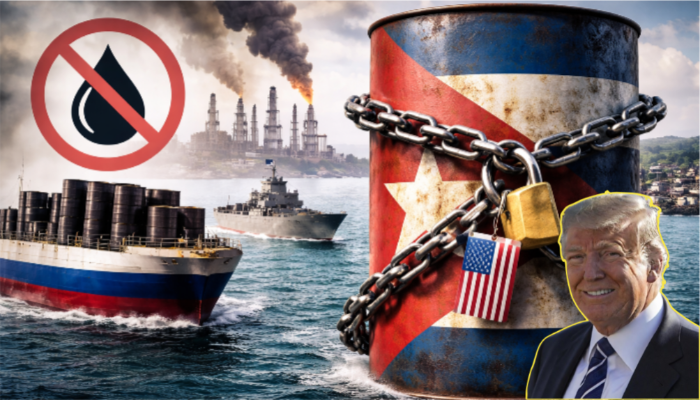
On 31st March (Tuesday), the United States permitted a Russian-flagged ship “Anatoly Kolodkin” bearing 100,000 tonnes of oil to enter Cuban seas. The vessel reportedly arrived at the Matanzas port of the island nation reeling under severe fuel blockade by the White House, prompting a critical energy crisis which has even resulted in deaths.
Russian Embassy in Cuba:On March 31, Russian tanker Anatoly Kolodkin arrived at the Cuban port of Matanzas carrying a humanitarian cargo of 100,000 tonnes of oil. Russia considers it its duty to provide the necessary assistance to our Cuban friends.#RussiaHelps pic.twitter.com/1j0Uwfu2W0— MFA Russia (@mfa_russia) March 31, 2026
“I can only confirm that this issue was indeed raised in advance during contacts with our American counterparts,” mentioned Dmitry Peskov while confirming the development, reported CNN. The spokesman for President Vladimir Putin added that “its their duty to step up and provide necessary assistance to our Cuban friends.”
There is no moderation in our policy: US
However, the Trump administration declared that it would determine the extent to which foreign oil flows to Cuba on an individual basis. It indicated that Washington’s stance of upholding the interdiction against Havana has not changed by enabling access to a Russian oil tanker.
“This is not a policy change. There has not been a formal change in sanctions policy. As the president said last night, we allowed this ship to reach Cuba in order to provide humanitarian needs to the Cuban people,” White House press secretary Karoline Leavitt stated before the media. She added, “The US still reserves the right to seize vessels, if legally applicable, that are headed toward Cuba and violate US sanctions policy.”
“We have a tanker out there. We don’t mind having somebody get a boatload, because they have to survive. If a country wants to send some oil into Cuba right now, I have no problem with that, whether it’s Russia or not. I’d prefer letting it in, whether it’s Russia or anybody else, because the people need heat and cooling and all of the other things that you need,” President Donald Trump expressed, a day earlier.
He insisted, “Cuba is finished. They have a bad regime. They have very bad and corrupt leadership, and whether or not they get a boat of oil, it’s not going to matter.”
The tensions in West Asia triggered a massive interruption in global supply chain of energy and the prices skyrocketed after which the US granted a license for the sale of Russian oil that is stranded at sea. The authorisation which expires on 11th April does not cover Iran, North Korea, Cuba and Crimea. However, the Russian oil is going to offer only modest relief to the 10 million strong nation and won’t even last long.
Mexico tries to resume oil shipments to Cuba
Mexican President Claudia Sheinbaum stated that governments of Mexico and Cuba are collaborating to resume oil exports via their respective trade agreements.
“Mexico has every right to send fuel, whether for humanitarian or commercial reasons, but we do not want to harm the country with tariffs resulting from Donald Trump’s oil embargo. We are working with them on both issues,” she conveyed and pointed out that her government “always seeks (to send) humanitarian aid, and it is in that context that we will make the decision.”
According to Sheinbaum, private Cuban enterprises, including hotels, reached out to the country about acquiring oil from Pemex, the state-owned energy company. “There are private companies that buy oil from Mexico and report where they are taking it. Because it’s not necessarily a government-to-government agreement, there are companies that specialise in fuel transportation,” the president highlighted.
She promised that Mexico would keep delivering humanitarian help to the Caribbean country and voiced, “There should be no blockades, because trade blockades harm the people. Formally, they’re directed against governments, but who do they harm? The people. Mexico has been shipping hydrocarbons to Cuba since 1993 in small quantities, but the volume rose dramatically in 2024, one month after Sheinbaum took power.
On the other hand, two sailboats transporting humanitarian aid from southern Mexico to Cuba disappeared for several days and were spotted by the Mexican Navy after which they anchored at Havana on 28th March (Saturday). On 20th March, the boats with 8 or 9 passengers from Poland, France, Cuba and the US on board left Quintana Roo’s Isla Mujeres and lost contact giving rise to alarm. “They were located 80 nautical miles northwest of Havana,” Mexico revealed.
#ÚltimaHora La Secretaría de Marina informa que una aeronave de la Armada de México localizó a las embarcaciones tipo catamarán que se estaban buscando en el Caribe.Fueron localizados a 80 millas náuticas al noroeste de La Habana, Cuba.Un buque de esta Institución ya se… pic.twitter.com/Vg8UeRTN4R— SEMAR México (@SEMAR_mx) March 28, 2026
The sailing convoy’s coordinator, Adnaan Stumo, later disclosed that the delay was brought on by inclement weather as they were forced to take an extended course, but the sailors were “never in any serious danger.”
Cuba faces mounting problems and US threatens military intervention
According to President Miguel Diaz-Canel, Cuba had not received an oil tanker in 3 months, aggravating an energy shortage that caused regular nationwide blackouts for many hours, inflation, rigorous gasoline rationing and put public transit, hospitals and agricultural output in danger of crumbling. “A total disconnection of the SEN (Electro-Energy System) has occurred. The causes are being investigated and protocols for restoration are beginning to be activated,” Ministry of Energy and Mines posted on 16th March.
Se ha producido una desconexión total del SEN, se investigan las causas y comienzan a activarse los protocolos para el restablecimiento.— Ministerio de Energía y Minas Cuba (@EnergiaMinasCub) March 16, 2026
Havana has similarly seen power outages, a build-up of trash as hospitals are finding it difficult to accommodate patients and maintain operating rooms. Cuban health professionals fear that the situation has heightened a possibility of death for cancer patients, particularly youngsters. The lack of fuel has prompted the United Nations to alert people of an approaching humanitarian “collapse” there.
The present circumstances are the outcome of punishing American action to exert pressure on President Miguel Diaz-Canel’s communist government. Long-standing structural issues and policy moves, such as lack of investment in the energy sector, have contributed to Cuba’s economic and energy woes, but Trump’s return to office deteriorated the situation.
On 11th March, Trump pronounced that Cuba will not be given “more oil or money” from Venezuela which endured a US incursion. On 29th January, his administration published an executive order vowing to levy taxes on any country that provides fuel to Cuba. According to senior US officials, the ultimate objective of these efforts is to liberalise Cuban economy and politics, including the potential ouster of Miguel.
“Cuba’s non-functional economy cannot be fixed unless they undergo dramatic political and leadership change, but there has been no formal change,” Secretary of State Marco Rubio has reiterated frequently. Interestingly, his parents migrated from Cuba to Florida prior to Fidel Castro’s rule.
Trump also alluded at an attack on Cuba, repeating military operations in Venezuela and Iran. “I built this great military. I said, you’ll never have to use it. But sometimes you have to use it. And Cuba is next, by the way,” he threatened on 27th March (Friday) and then added, “But pretend I didn’t say that.”
On 16th March, Trump remarked, “I think Cuba is seeing the end.” Moreover, he declared intend to earn the “honour” of “taking Cuba in some form” and alleged that he could “free it” or “take it” and is even capable of doing “anything” he wants with the “very weak” country.
Meanwhile, US officials asserted that negotiations are underway, and Trump suggested that a deal might be concluded. However, alternative possibilities are available. He noted that all attention will be directed at Cuba after the war in Iran.