After a 15-year gap, India’s first fully digital Census 2027 starts on 1st April: All you need to know about the questionnaire and the process
Census 2027 will be the 16th in the series and the 8th after Independence. This census, which is starting from 1st April, 2026, will prove to be historic for India as it is going to be the first completely digital census of the country after a gap of fifteen years. Registrar General and Census Commissioner of India addresses Press Conference on Census-2027, in New Delhi World's largest census to be conducted in two phases, first phase to begin from 1st April 2026 For the first time, the #Census will be conducted digitally, and for… pic.twitter.com/RaDqJJWFBE— PIB India (@PIB_India) March 30, 2026 Census in India is not just a process of collecting statistical data but a strong pillar of the socio-economic planning of the country. Systematic census in India started in 1872 during the British period. The tradition of conducting a census every ten years has been going on continuously since 1881. The last in this series was the 15th census conducted in 2011, which gave a clear picture of the population and geographical situation of India as per the data at that time. In India, the Census is conducted under the provisions of the Census Act, 1948 and the Census Rules, 1990, as amended from time to time. As per the rules, the 16th Census was to be conducted in the year 2021. However, the process had to be postponed indefinitely due to the COVID-19 pandemic that spread across the world in 2020 and the nationwide lockdown imposed due to it. This was the first time in the history of independent India that a decade-end census was delayed. This time, instead of paper forms, information will be collected through mobile apps and ‘Self Enumeration’ portals, which will demonstrate the digital transformation of modern India. The Central Government has announced a list of 33 questions for the House Listing and Housing Census (HLO) and has also made 33 FAQs (Frequently Asked Questions) available on the portal. It is noteworthy that the Central Government has approved a total budget of ₹11,718.24 crore for the upcoming 16th Census. This amount will be used mainly for the honorarium of the employees associated with the census work and their intensive training. In addition, since this time, the census is digital for the first time, adequate provisions have also been made in the budget to create a strong IT infrastructure, build data centres, and provide necessary logistics facilities. STORY | Cabinet nod for Census 2027; Rs 11,718 crore sanctionedUnion minister Ashwini Vaishnaw said the government has approved Rs 11,718 crore for the conduct of the Census of India 2027.READ | https://t.co/lkUEKj1qWx pic.twitter.com/UgBxJDjgGd— Press Trust of India (@PTI_News) December 12, 2025 Census preparations To ensure the Census 2027 is flawless, a complete ‘pre-test’ (rehearsal) was conducted in 5000 blocks across the country in November 2025, in which all digital methods from appointment to data processing were tested. To ensure accuracy in this enumeration, the administrative boundaries of 7,092 districts, talukas and about 6.39 lakh villages of all 28 states and 8 Union Territories of the country have been frozen from 1st January 2026 to March 2027, so that no geographical changes become a hindrance during the enumeration. A robust three-tier training structure has been prepared for this massive national campaign, in which 45,000 field trainers have been trained by 100 national trainers and 2000 master trainers. These field trainers are now providing intensive training to approximately 31 lakh enumerators and supervisors across the country in about 80 thousand batches. All training materials have been provided to these enumerators in their regional languages, so that they can collect quality and accurate information from the people on time without any hassle. It is noteworthy that this time the census will be conducted in 2 phases. First stage begins on 1st April The first phase of the 16th Census of India will officially begin from 1st April, 2026 and will continue till 30th September, 2026. According to Registrar General of India (RGI) Mrityunjay Kumar Narayan, the field operation will be carried out as per the different schedules decided by various states and union territories. Hence, the operation will start in some parts of the country in April, while in other parts, the process will be carried out in June, July or August as per geographical and administrative convenience. The first phase of the census, known as the ‘House Listing and Housing Census’ (HLO), will be conducted from April to September 2026. Each state and union territory will complete this work by fixing any 30 days of these six months, at its convenience. The speciality of this phase is that exactly 15 days before the enumerator visits your home, an option of ‘self-enumeration’ will be given, through which the details can be filled in manually through online means. The main objective of this first phase is to know the cond
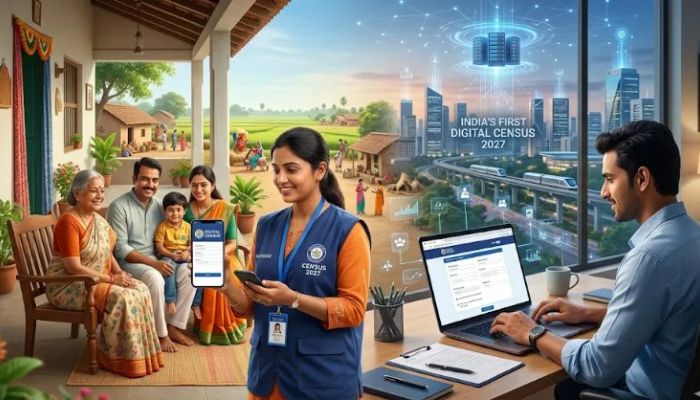
Census 2027 will be the 16th in the series and the 8th after Independence. This census, which is starting from 1st April, 2026, will prove to be historic for India as it is going to be the first completely digital census of the country after a gap of fifteen years.
Registrar General and Census Commissioner of India addresses Press Conference on Census-2027, in New Delhi World's largest census to be conducted in two phases, first phase to begin from 1st April 2026 For the first time, the #Census will be conducted digitally, and for… pic.twitter.com/RaDqJJWFBE— PIB India (@PIB_India) March 30, 2026
Census in India is not just a process of collecting statistical data but a strong pillar of the socio-economic planning of the country. Systematic census in India started in 1872 during the British period. The tradition of conducting a census every ten years has been going on continuously since 1881. The last in this series was the 15th census conducted in 2011, which gave a clear picture of the population and geographical situation of India as per the data at that time.
In India, the Census is conducted under the provisions of the Census Act, 1948 and the Census Rules, 1990, as amended from time to time. As per the rules, the 16th Census was to be conducted in the year 2021. However, the process had to be postponed indefinitely due to the COVID-19 pandemic that spread across the world in 2020 and the nationwide lockdown imposed due to it. This was the first time in the history of independent India that a decade-end census was delayed.
This time, instead of paper forms, information will be collected through mobile apps and ‘Self Enumeration’ portals, which will demonstrate the digital transformation of modern India. The Central Government has announced a list of 33 questions for the House Listing and Housing Census (HLO) and has also made 33 FAQs (Frequently Asked Questions) available on the portal.
It is noteworthy that the Central Government has approved a total budget of ₹11,718.24 crore for the upcoming 16th Census. This amount will be used mainly for the honorarium of the employees associated with the census work and their intensive training. In addition, since this time, the census is digital for the first time, adequate provisions have also been made in the budget to create a strong IT infrastructure, build data centres, and provide necessary logistics facilities.
STORY | Cabinet nod for Census 2027; Rs 11,718 crore sanctionedUnion minister Ashwini Vaishnaw said the government has approved Rs 11,718 crore for the conduct of the Census of India 2027.READ | https://t.co/lkUEKj1qWx pic.twitter.com/UgBxJDjgGd— Press Trust of India (@PTI_News) December 12, 2025
Census preparations
To ensure the Census 2027 is flawless, a complete ‘pre-test’ (rehearsal) was conducted in 5000 blocks across the country in November 2025, in which all digital methods from appointment to data processing were tested. To ensure accuracy in this enumeration, the administrative boundaries of 7,092 districts, talukas and about 6.39 lakh villages of all 28 states and 8 Union Territories of the country have been frozen from 1st January 2026 to March 2027, so that no geographical changes become a hindrance during the enumeration.
A robust three-tier training structure has been prepared for this massive national campaign, in which 45,000 field trainers have been trained by 100 national trainers and 2000 master trainers. These field trainers are now providing intensive training to approximately 31 lakh enumerators and supervisors across the country in about 80 thousand batches. All training materials have been provided to these enumerators in their regional languages, so that they can collect quality and accurate information from the people on time without any hassle. It is noteworthy that this time the census will be conducted in 2 phases.
First stage begins on 1st April
The first phase of the 16th Census of India will officially begin from 1st April, 2026 and will continue till 30th September, 2026. According to Registrar General of India (RGI) Mrityunjay Kumar Narayan, the field operation will be carried out as per the different schedules decided by various states and union territories. Hence, the operation will start in some parts of the country in April, while in other parts, the process will be carried out in June, July or August as per geographical and administrative convenience.
The first phase of the census, known as the ‘House Listing and Housing Census’ (HLO), will be conducted from April to September 2026. Each state and union territory will complete this work by fixing any 30 days of these six months, at its convenience. The speciality of this phase is that exactly 15 days before the enumerator visits your home, an option of ‘self-enumeration’ will be given, through which the details can be filled in manually through online means.
The main objective of this first phase is to know the condition of houses and the lifestyle of families in the country. It will mainly collect information on what kind of house it is, what basic facilities like drinking water, electricity and toilets are available to the family and what assets like TV, vehicle or internet are available in the house. A list of questions that will be asked for this process has also been released.
The census work will begin at different stages in different states of the country. The first group includes Andaman and Nicobar, Delhi (NDMC and Cantonment), Goa, Karnataka, Lakshadweep, Mizoram, Odisha and Sikkim. Citizens in these states will be able to do ‘self-enumeration’ online from 1st to 15th April, 2026, while enumerators will go door-to-door from 16th April to 15th May to record details of houses.
The second group includes states like Madhya Pradesh, Andhra Pradesh, Arunachal Pradesh, Chandigarh, Chhattisgarh and Haryana. The period for self-enumeration in these states has been fixed from 16th to 30th April, 2026, after which the process of house listing will be carried out from 1st to 30th May. The detailed schedule of all the remaining states and union territories has been given in the appendix issued by the government.
State/Union TerritorySelf-Enumeration PeriodHouse Listing and Housing Census (HLO) PeriodAndaman and Nicobar Islands, Delhi (NDMC/Cantonment), Goa, Karnataka, Lakshadweep, Mizoram, Odisha and Sikkim1st April to 15th April16th April to 15th MayGujarat, Dadra and Nagar Haveli, Daman and Diu5th April to 19th April20th April to 19th MayUttarakhand10th April to 24th April25th April to 24th MayMadhya Pradesh, Andhra Pradesh, Arunachal Pradesh, Chandigarh, Chhattisgarh and Haryana16th April to 30th April1st May to 30th MayBihar17th April to 1st May2nd May to 31st MayTelangana26th April to 10th May11th May to 9th JunePunjab30th April to 14th May15th May to 13th June 13Delhi (MCD), Maharashtra, Meghalaya, Rajasthan and Jharkhand1st May to 15th May16th May to 14th JuneUttar Pradesh7th May to 21st May22nd May to 20th JuneJammu and Kashmir, Ladakh and Puducherry17th May to 31st May1st June to 30th JuneHimachal Pradesh1st June to 15th June16th June to 15th JulyKerala and Nagaland16th June to 30th June1st July to 30th JulyTamil Nadu and Tripura17th July to 31st July1st August to 30th AugustAssam2nd August to 16th August17th August to 15th SeptemberManipur17th August to 31st August1st September to 30th SeptemberWest BengalWill be announced later.Will be announced later.
How will the process be done?
Census 2027 will be India’s first fully digital census. In this process, enumerators will use their smartphones and a special mobile application instead of paper and pen. The information they collect from door to door can be directly submitted online through the app. To make this process easier, the mobile app and the ‘self-enumeration’ portal will be made available in a total of 19 languages, including Gujarati, Hindi and English, so that accurate information can be collected without language barriers.
PTI INFOGRAPHICS | RGI announces state-wise schedule for first phase of Census 2027 in which 33 questions will be posedThe government, on March 30, announced the state-wise schedule for the first phase of the upcoming Census, which will feature 33 questions notified in January… pic.twitter.com/PWAsBNJqfM— Press Trust of India (@PTI_News) March 30, 2026
The facility of ‘self-enumeration’ is an important aspect for the citizens this time. People will be able to fill in the details of their families by going to the online portal themselves. Apart from this, a state-of-the-art central portal has been created to manage the entire campaign.
VIDEO | Delhi: On upcoming Census 2027, Registrar General and Census Commissioner of India Mritunjay Kumar Narayan says, “…For conducting the census process, detailed instruction manuals are prepared for enumerators and supervisors, and keeping India’s linguistic diversity in… pic.twitter.com/ZhJkJtFF9I— Press Trust of India (@PTI_News) March 30, 2026
This portal will handle the appointment of enumerators, generation of their ID cards, allocation of work to them and management of their training. This digital system will also enable real-time monitoring of the extent to which the enumeration work has been completed.
VIDEO | Delhi: On upcoming Census 2027, Registrar General and Census Commissioner of India Mritunjay Kumar Narayan says, “Option of Self enumeration is available only for people residing in the country.”(Full video available on PTI Videos – https://t.co/n147TvrpG7) pic.twitter.com/cxrlvWOdQE— Press Trust of India (@PTI_News) March 30, 2026
To bring accuracy at the administrative level, this time ‘House Listing Blocks’ (HLBs) will be prepared using ‘Web Mapping Application’, so that no house or area is left out of the census. Being a digital medium, sufficient vigilance has also been taken regarding the security of people’s personal information. Extremely strong firewalls and protocols have been implemented for data security, so that the data of citizens remains completely safe and confidential.
How can self-enumeration be done?
In Census 2027, a special facility has been provided to the citizens, through which they will be able to fill out their details online even before the enumerator comes to their home. For this, one will have to log in to the official SE portal (se.census.gov.in) using their mobile number. This process can be completed anytime and from anywhere, as per their convenience.
After logging in to the portal, the person will have to mark the exact location of their house on the map and fill in the necessary details of the family. After filling in all the information, when the form is submitted, a 16-digit unique ‘Self-Enumeration ID’ (SE ID) will be generated by the system. This ID is very important because when the census staff visits the house in person, they will have to give only this SE ID.
Notably, self-enumeration is an additional optional facility provided to the citizens. Even if a person is unable to fill in the details online, the enumerators will still visit the house in person and collect the information just like in the previous census. The staff will also visit the houses of those who have filled in the details online for verification, but instead of asking them for all the details again, the data will be confirmed only through SE ID, and the person will be included in the census.
Second stage is the important phase of the Census
The second and most important phase of the census, called ‘Population Census’, will be mainly conducted during February 2027. However, in snow-covered and inaccessible areas like Ladakh, Jammu and Kashmir, Uttarakhand and Himachal Pradesh, this process will be completed earlier, i.e. in September 2026. The biggest feature of this phase is that, as per the government’s decision, this time, along with the population census, a caste-based census will also be conducted, which will help in obtaining social statistics.
During this second phase, enumerators will collect personal and detailed information about every citizen of the country. This includes important aspects such as a person’s education, social and economic status, residential migration and fertility. The exact questions that will be asked for this phase and its exact dates will be officially announced by the government in the near future.
Which FAQs (questions) are included in the first phase?
During the first phase of the census, citizens will be asked 33 questions, the list of which has been announced on Monday, 30th March. The main objective of these 33 questions is to get accurate information about the standard of living of citizens, housing facilities, family structure and use of technical devices. Now, let’s know what those 33 questions are, which will have to be answered in every household.
Notification of questionnaire of Phase I of Census of India 2027 – Houselisting & Housing Census has been issued. The questionnaire for Phase II i.e. Population Enumeration will be notified in due course.भारत की जनगणना 2027 के प्रथम चरण – मकानसूचीकरण और मकानों की गणना हेतु… pic.twitter.com/1BHbxmA8fN— Census India 2027 (@CensusIndia2027) January 22, 2026
Building and residence details:
1. Building Number: A number assigned by a municipality, local body, or census.
2. Calculation House Number: A number for the unique identification of the house.
3. Flooring material: The main material used in the flooring of a house (tiles, cement, wood, etc.).
4. Wall material: The main material used in building the walls of the house (brick, stone, concrete, etc.).
5. Roof material: What material is the roof of the house made of (thatch, pipes, sheets, etc.)?
6. Use of the house: Details of whether the house is used for residence, shop or other purpose.
7. House condition: The current condition of the house (new, old or dilapidated).
Family and Head Details:
8. Number of families: The number of families living in a house.
9. Total number of persons: Total number of members usually living in the household.
10. Name of the head of the household: Name of the head of the household.
11. Gender of the head: Is the head male, female or transgender?
12. Social Class: The majority belong to the Scheduled Caste (SC), the Scheduled Tribe (ST) or other classes.
13. Ownership status: Is the residence owned or rented?
Accommodation facilities:
14. Number of rooms: How many rooms does the family have to live in?
15. Married couples: Number of married couples living in the household.
16. Source of drinking water: Where is the water obtained from (tap, hand pump, well, etc.).
17. Availability of water: Is drinking water available within the premises, or does it have to be brought from outside?
18. Source of light: The main source of light in the house (electricity, solar, kerosene, etc.).
Hygiene and cooking:
19. Toilet facilities: Whether there is a toilet in the house or not.
20. Toilet type: What type of toilet is it (flush, pit, etc.)?
21. Wastewater disposal: Details of the drainage or sewerage system.
22. Bathing facilities: Whether or not there is a separate space or bathroom for bathing in the house.
23. Kitchen and gas connection: Is there a separate kitchen and LPG/PNG connection facility or not?
24. Cooking fuel: What fuel is mainly used for cooking (gas, wood, electricity, etc.)?
Assets and resources:
25. Radio/Transistor: Is this device available in the house or not?
26. Television (TV): Whether there is a TV facility or not.
27. Internet facility: Whether or not there is an internet access facility in the house.
28. Laptop/Computer: Whether or not there is a computer or laptop in the house.
29. Phone facility: Availability of landline, mobile or smartphone.
30. Two-wheeled vehicle: Whether it is a bicycle, scooter or motorcycle.
31. Four-wheeled vehicle: Availability of a vehicle such as a car, jeep or van.
Other details:
32. Main grain: Which grain (wheat, rice, millet, etc.) does the family mainly use in food?
33. Mobile Number: Family’s mobile number for future contact and verification.
Change in current calculation
The biggest difference between the previous census and the upcoming 2027 census is in its methodology. While the process was completely paper-based from the British era till 2011, the 2027 census will be India’s first ‘fully digital’ census. This time, enumerators will use a mobile app, and citizens will get a new facility of ‘self-enumeration’ in 16 languages, which will reduce the data processing time from years to just 6-9 months. At the technological level, real-time monitoring will be done by making the exact location if each house through GPS tagging and geofencing, which will be more accurate than the physical mapping method of 2011.
In terms of time and phases, the earlier census was conducted simultaneously, whereas in 2027, two clear phases were decided. The first phase (April-September 2026) will be for the list of houses and amenities, and the second phase (February-March 2027) will be for personal details. There are also important changes in the questionnaire. In which banking questions have been removed and new details like internet, smartphone and mobile number have been added as per the digital age. The questions on migration have also been kept more detailed this time.
A historic change from a social and administrative perspective is the ‘Caste Census’; in 2011, only SC/STs were counted, but in 2027, for the first time since independence, a complete caste census will be conducted for all communities. The central government has allocated a budget of ₹11,718 crore for this massive digital infrastructure, which is much higher than the expenditure in 2011. A major part of this amount will be used for training 31 lakh employees and building a robust IT infrastructure.
The previous census was traditional and relatively slow, while the 2027 census will be more transparent, fast and inclusive. With new protocols for data security and privacy through digital means, this census will present an accurate picture of the changing geographical and social situation of the country. The data collected through this census, especially the caste-based enumeration and personal details of the second phase, will prove to be a strong pillar in accurate policy making for welfare schemes like education, health and housing for the next decade.
(This article is a translation of the original article published on OpIndia Gujarati.)