Reclaiming the Eternal Way: Hindu sampradayas are free to have their own identity but they should preserve their roots in Sanatan Dharma
It is a quiet irony of our times that while many spiritual traditions born of the Indian subcontinent—such as Buddhism—have found global acceptance, the source from which they emerged, Sanatan Dharma, remains largely unknown or misunderstood in many parts of the world. One may walk into a Zen monastery in Japan, atheravāda retreat in Thailand, or a mindfulness centre in California, and rarely find mention of the philosophical river from which all these tributaries flowed. Buddha, the great awakened one, was born into the cultural and spiritual soil of Sanatan Dharma. His teachings were not a rebellion but a reform—an inner flowering of truths that were already seeded in the Upanishads and embraced through the disciplines of dhyana and vairagya. And yet, today, there is a growing disconnect. The world reveres the flowers, but forgets the root. Even within India, that root is being buried under layers of ritualism, branding, and external symbolism. We are at a moment in history where the spiritual traditions that emerged from Sanatan Dharma—rather than serving as paths that lead back to the essence—are increasingly seen as self-contained identities. This shift is not inherently wrong, but it poses a question: have we begun to mistake the doorway for the destination? Even our Constitution recognises this spiritual plurality. Under Article 25, every individual has the freedom to practice and profess their faith, while Article 26 grants communities the right to manage their religious institutions. But this legal space for sects and denominations was never meant to fragment the unity of Dharma into competing brands. The Constitution honours diversity within a tradition, not spiritual severance from it. Similarly, under Article 18 of the Universal Declaration of Human Rights, people are free to express their religion—but such freedom is not a license to abandon truth. One may form structures, rituals, and communities—but not cut themselves off from the timeless essence of Sanatan Dharma, which is the original spiritual current that flows beneath them all. Where are we headed? The so-called small factions of Sanatan Dharma—meant to serve as enriching tributaries—are now asserting themselves as rivers independent of the very source that gave them life. They are growing in popularity, but not always in depth. What we are witnessing is not just diversification, but dilution. In the quest for distinctiveness, they are abandoning the spiritual integrity of their origins. This is a matter of concern. Hinduism is not merely a religion of temples and deities. It is the most ancient, refined, and intellectually profound spiritual tradition known to humanity. It is the womb of the Dvaita and Advaita philosophies. It introduced the world to the concept of Brahman—the eternal, formless, limitless consciousness that transcends space and time. It explored planetary movements long before modern telescopes existed, calculated time with astonishing precision, and discovered the atom (Anu) through the insights of Rishi Kanad. Our seers mapped distances not just on earth, but between celestial bodies—documented in the Vedas. Saints like Tulsidas didn’t just write poetry; they embedded timeless psychological truths within verses. Yoga, which is now a global fitness fad, was once a deeply spiritual discipline intended to unite the individual soul (Jeev) with the cosmic soul (Brahman). Ayurveda, India’s ancient medical science, offered a holistic understanding of the human body and mind long before Western medicine began to scratch the surface of psychosomatic wellness. But today, these treasures are gathering dust while rituals are gaining glitter. The core is being sacrificed for the shell. In a world increasingly driven by capitalism and consumerism, even religion is not spared. It is the age of religious branding, where charisma overshadows content, and spectacle triumphs over silence. We now have “spiritual influencers” more than seers. The cults package and sell rituals, but forget to teach contemplation. They create communities but forget to cultivate consciousness. As a result, Hinduism is being perceived more as a chaotic festival of colours, elephants, and chants than as a rigorous school of metaphysics, ethics, and existential inquiry. To form a sect is lawful but to forget the source is not dharmic. In our own land, the spiritual impulse that once emphasised silence, contemplation, and self-inquiry is being eclipsed by noise, spectacle, and showmanship. The modern seeker often finds themselves drawn to grand temples, vibrant processions, and branded forms of devotion—but rarely to the stillness of the soul where true Dharma reveals itself. Even profound movements once centred on Vedantic exploration or yogic discipline now risk being reduced to identities or organisational cultures, detached from their deeper metaphysical moorings. This is not a critique of any group or institution. Ea
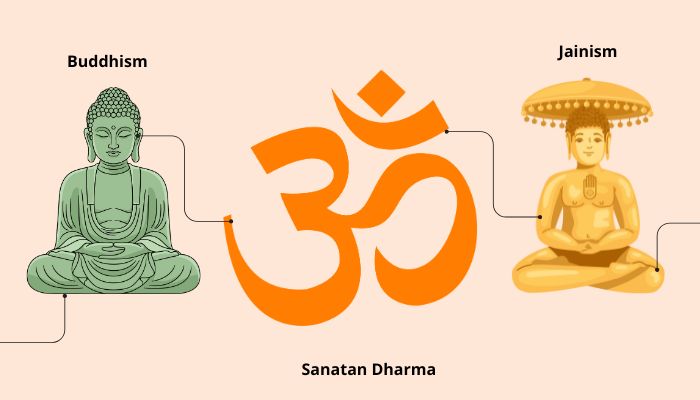

It is a quiet irony of our times that while many spiritual traditions born of the Indian subcontinent—such as Buddhism—have found global acceptance, the source from which they emerged, Sanatan Dharma, remains largely unknown or misunderstood in many parts of the world. One may walk into a Zen monastery in Japan, atheravāda retreat in Thailand, or a mindfulness centre in California, and rarely find mention of the philosophical river from which all these tributaries flowed.
Buddha, the great awakened one, was born into the cultural and spiritual soil of Sanatan Dharma. His teachings were not a rebellion but a reform—an inner flowering of truths that were already seeded in the Upanishads and embraced through the disciplines of dhyana and vairagya. And yet, today, there is a growing disconnect. The world reveres the flowers, but forgets the root. Even within India, that root is being buried under layers of ritualism, branding, and external symbolism.
We are at a moment in history where the spiritual traditions that emerged from Sanatan Dharma—rather than serving as paths that lead back to the essence—are increasingly seen as self-contained identities. This shift is not inherently wrong, but it poses a question: have we begun to mistake the doorway for the destination?
Even our Constitution recognises this spiritual plurality. Under Article 25, every individual has the freedom to practice and profess their faith, while Article 26 grants communities the right to manage their religious institutions. But this legal space for sects and denominations was never meant to fragment the unity of Dharma into competing brands. The Constitution honours diversity within a tradition, not spiritual severance from it.
Similarly, under Article 18 of the Universal Declaration of Human Rights, people are free to express their religion—but such freedom is not a license to abandon truth. One may form structures, rituals, and communities—but not cut themselves off from the timeless essence of Sanatan Dharma, which is the original spiritual current that flows beneath them all.
Where are we headed?
The so-called small factions of Sanatan Dharma—meant to serve as enriching tributaries—are now asserting themselves as rivers independent of the very source that gave them life. They are growing in popularity, but not always in depth. What we are witnessing is not just diversification, but dilution. In the quest for distinctiveness, they are abandoning the spiritual integrity of their origins.
This is a matter of concern. Hinduism is not merely a religion of temples and deities. It is the most ancient, refined, and intellectually profound spiritual tradition known to humanity. It is the womb of the Dvaita and Advaita philosophies. It introduced the world to the concept of Brahman—the eternal, formless, limitless consciousness that transcends space and time. It explored planetary movements long before modern telescopes existed, calculated time with astonishing precision, and discovered the atom (Anu) through the insights of Rishi Kanad.
Our seers mapped distances not just on earth, but between celestial bodies—documented in the Vedas. Saints like Tulsidas didn’t just write poetry; they embedded timeless psychological truths within verses. Yoga, which is now a global fitness fad, was once a deeply spiritual discipline intended to unite the individual soul (Jeev) with the cosmic soul (Brahman). Ayurveda, India’s ancient medical science, offered a holistic understanding of the human body and mind long before Western medicine began to scratch the surface of psychosomatic wellness.
But today, these treasures are gathering dust while rituals are gaining glitter. The core is being sacrificed for the shell. In a world increasingly driven by capitalism and consumerism, even religion is not spared. It is the age of religious branding, where charisma overshadows content, and spectacle triumphs over silence.
We now have “spiritual influencers” more than seers. The cults package and sell rituals, but forget to teach contemplation. They create communities but forget to cultivate consciousness. As a result, Hinduism is being perceived more as a chaotic festival of colours, elephants, and chants than as a rigorous school of metaphysics, ethics, and existential inquiry.
To form a sect is lawful but to forget the source is not dharmic.
In our own land, the spiritual impulse that once emphasised silence, contemplation, and self-inquiry is being eclipsed by noise, spectacle, and showmanship. The modern seeker often finds themselves drawn to grand temples, vibrant processions, and branded forms of devotion—but rarely to the stillness of the soul where true Dharma reveals itself. Even profound movements once centred on Vedantic exploration or yogic discipline now risk being reduced to identities or organisational cultures, detached from their deeper metaphysical moorings.
This is not a critique of any group or institution. Each has played its role in keeping some flame alive. But the concern is spiritual, not sociological. The danger lies not in the diversity of expression, but in the dilution of depth. The treasure of Sanatan Dharma—its insight into the eternal Self (Atman), the formless Absolute (Brahman), the path of dharma beyond dogma—is being forgotten even as its names and festivals are celebrated.
Sanatan Dharma is not a fixed religion. It is the eternal way of inner unfolding. It is not confined to texts or traditions—it lives through realisation, not ritual; through awakening, not affiliation.
And yet, in our temples and homes, the deeper conversations are fading. Where, once the Gita was reflected upon for guidance in action, now it is often displayed as a symbol. Where once the Upanishads stirred a longing for truth, now they gather dust beside popular handbooks on instant peace. Our saints and seers meditated not for display, but for dissolution of the ego. They wrote not for popularity, but to transmit eternal truths to generations unborn.
This is not a call for rejection—but for remembrance.
We now have “spiritual influencers” more than seers. The cults package and sell rituals, but forget to teach contemplation. They create communities but forget to cultivate consciousness. As a result, Hinduism is being perceived more as a chaotic festival of colours, elephants, and chants than as a rigorous school of metaphysics, ethics, and existential inquiry.
This is the tragedy of our times.
The universal religion—the Dharma that accepted every path, revered every prophet, absorbed every idea, and gave the world a framework to live in harmony with nature and the self—is becoming incomprehensible in its own birthplace. We have become so focused on the branches, that we are losing the tree.
And in the eyes of the world, the confusion is complete. Hinduism appears fragmented, cultish, and mythological rather than philosophical. It is being measured not by its capacity to awaken the soul, but by its ability to entertain the senses. Where, once sages meditated under banyan trees, we now have festivals that resemble marketing carnivals.
Conclusion
This is a call to introspection, not rejection. The cults have done valuable work in spreading fragments of our tradition. They have kept the flame alive, albeit in coloured glass. But it is time to return to the essence. To revisit the Vedas, the Upanishads, the Yoga Sutras, and the Bhagavad Gita, not as religious texts, but as life manuals. To talk less of rituals and more of realisation.
It is time to remind the world, and ourselves, that Hinduism is not a religion to be followed, but a Dharma to be lived. Not a club to belong to, but a consciousness to be awakened.
Let us not allow the tributaries to forget the river. Let the cults be gateways, not fortresses. And let us, as inheritors of the oldest wisdom tradition of humanity, reclaim our role not as marketers of religion, but as custodians of eternal truths.
The world is looking for meaning. Let us not give them spectacle instead.