Raksha Mantri Rajnath Singh’s statement based on facts, documents reveal Jawaharlal Nehru favoured wanted to spend govt money on Babri Masjid
Defence Minister Rajnath Singh recently sparked a major political debate with a striking claim about India’s first Prime Minister, Jawaharlal Nehru. Speaking at a ‘Unity March’ on Tuesday, 2nd December, in Gujarat to mark the 150th birth anniversary of Sardar Vallabhbhai Patel, he said Nehru wanted the Babri Masjid in Ayodhya to be built using government funds. According to him, it was Sardar Patel who firmly opposed this proposal and stopped public money from being spent on constructing a mosque. #WATCH | Gujarat: Defence minister Rajnath Singh addressed the 'Sardar Sabha' in Vadodara. He said, "Sardar Vallabhbhai Patel was truly secular… When Pt. Jawaharlal Nehru spoke about spending government funds on the Babri Masjid issue, Sardar Vallabhbhai Patel opposed it. At… pic.twitter.com/KtRqbmkIzH— ANI (@ANI) December 3, 2025 Rajnath Singh said this in front of a huge gathering in Vadodara, praising Patel’s commitment to national unity. His comments have immediately triggered strong reactions across political circles, especially from the Congress party. VIDEO | Vadodara, Gujarat: Defence Minister Rajnath Singh, speaking at the Sardar@150 Unity March in Vadodara, said, "Pandit Jawaharlal Nehru wanted to build the Babri Masjid using public funds. If anyone opposed this proposal, it was Sardar Vallabhbhai Patel."(Full video… pic.twitter.com/jeqUhgpGge— Press Trust of India (@PTI_News) December 2, 2025 Rajnath Singh has not made this claim without documentation. Important details supporting his statement are found in the book “The Inside Story of Sardar Patel – Diary of Maniben Patel.” The book contains Patel’s notes and details of his interactions with Nehru, written at the time when these events were actually happening. मुझे लगता है कि कांग्रेस के नेताओं को अपने ही नेताओं के बारे में जानकारी लेने की आदत छूट गई है। पढ़ना-लिखना छोड़ दिया है। नेहरू–गांधी के बारे में भी उन्हें पता नहीं होता है। रक्षामंत्री माननीय राजनाथ सिंह जी ने जो कहा है, कि नेहरु जी ने बाबरी मस्जिद बनवाने का प्रयास किया था और… pic.twitter.com/XBXdz9SnlQ— Dr. Sudhanshu Trivedi (@SudhanshuTrived) December 3, 2025 According to page 24 of this book, Nehru had raised the issue of spending government money on the Babri Masjid. However, Patel strongly objected and made it clear that the government could not fund the construction of a mosque. This was the exact situation Rajnath Singh referred to in his speech. Congress dismisses Rajnath Singh’s claim Soon after Rajnath Singh’s speech, several Congress leaders strongly objected to the remarks. Priyanka Gandhi Vadra said such statements are meant to divert attention from real issues affecting people. She accused the BJP of trying to create distractions every day. Congress MP Imran Pratapgarhi says, “Where did he even get such information from? He is the Defence Minister of the country. He has been a Chief Minister. He is considered a serious political figure, not like Modi ji. So he should at least maintain that dignity that whenever you make such statements, especially in a historical context, you must have factual evidence for it…” VIDEO | Parliament Winter Session: On Defence Minister Rajnath Singh's 'Nehru sought public funds to build Babri Masjid' remark, Congress MP Imran Pratapgarhi (@ShayarImran) says, "Where did he even get such information from? He is the Defence Minister of the country. He has been… pic.twitter.com/QLs9aE7wWb— Press Trust of India (@PTI_News) December 3, 2025 Congress spokesperson Pawan Khera challenged Rajnath Singh to produce documents as proof. He questioned the logic of the claim, pointing out that the Babri structure existed long before Nehru was even born, and Patel died in 1950. He said if Nehru had actually wanted to build the mosque using state money, he had 14 more years in power after Patel’s death, so why didn’t he do it then? Party’s Saharanpur MP Imran Masood also questioned Singh’s claim. “I don’t know why he is making such remarks. We only know of one historical document. If it concerns Pandit Jawaharlal Nehru, they should have the document…,” Masood told reporters. “Nobody will accept it just because he says so. Yes, there is one document in which Sardar Patel took action to ban the RSS… All of this was done by Pandit Jawaharlal Nehru. His roadmap is the very path on which the country is progressing today. He also fostered scientific thinking,” he said. Other Congress MPs like Manickam Tagore said Nehru’s principles were very clear: public money should not be used to build temples, mosques or churches. Government funds are meant for institutions like IITs, IIMs and development projects. Manish Tewari and Imran Masood also rejected the claim, calling it “twisting history”. Tariq Anwar accused the BJP of “digging up old controversies” because Nehru is not alive to respond. Historical evidence backing Rajnath Singh’s claim A documented source supporting the statement of Rajnath Singh is found in the boo

Defence Minister Rajnath Singh recently sparked a major political debate with a striking claim about India’s first Prime Minister, Jawaharlal Nehru. Speaking at a ‘Unity March’ on Tuesday, 2nd December, in Gujarat to mark the 150th birth anniversary of Sardar Vallabhbhai Patel, he said Nehru wanted the Babri Masjid in Ayodhya to be built using government funds. According to him, it was Sardar Patel who firmly opposed this proposal and stopped public money from being spent on constructing a mosque.
#WATCH | Gujarat: Defence minister Rajnath Singh addressed the 'Sardar Sabha' in Vadodara.
— ANI (@ANI) December 3, 2025
He said, "Sardar Vallabhbhai Patel was truly secular… When Pt. Jawaharlal Nehru spoke about spending government funds on the Babri Masjid issue, Sardar Vallabhbhai Patel opposed it. At… pic.twitter.com/KtRqbmkIzH
Rajnath Singh said this in front of a huge gathering in Vadodara, praising Patel’s commitment to national unity. His comments have immediately triggered strong reactions across political circles, especially from the Congress party.
VIDEO | Vadodara, Gujarat: Defence Minister Rajnath Singh, speaking at the Sardar@150 Unity March in Vadodara, said, "Pandit Jawaharlal Nehru wanted to build the Babri Masjid using public funds. If anyone opposed this proposal, it was Sardar Vallabhbhai Patel."
— Press Trust of India (@PTI_News) December 2, 2025
(Full video… pic.twitter.com/jeqUhgpGge
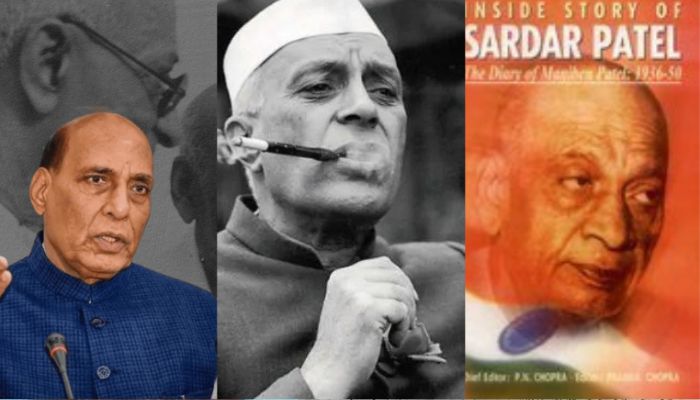
Rajnath Singh has not made this claim without documentation. Important details supporting his statement are found in the book “The Inside Story of Sardar Patel – Diary of Maniben Patel.” The book contains Patel’s notes and details of his interactions with Nehru, written at the time when these events were actually happening.
मुझे लगता है कि कांग्रेस के नेताओं को अपने ही नेताओं के बारे में जानकारी लेने की आदत छूट गई है। पढ़ना-लिखना छोड़ दिया है। नेहरू–गांधी के बारे में भी उन्हें पता नहीं होता है। रक्षामंत्री माननीय राजनाथ सिंह जी ने जो कहा है, कि नेहरु जी ने बाबरी मस्जिद बनवाने का प्रयास किया था और… pic.twitter.com/XBXdz9SnlQ
— Dr. Sudhanshu Trivedi (@SudhanshuTrived) December 3, 2025
According to page 24 of this book, Nehru had raised the issue of spending government money on the Babri Masjid. However, Patel strongly objected and made it clear that the government could not fund the construction of a mosque. This was the exact situation Rajnath Singh referred to in his speech.
Congress dismisses Rajnath Singh’s claim
Soon after Rajnath Singh’s speech, several Congress leaders strongly objected to the remarks. Priyanka Gandhi Vadra said such statements are meant to divert attention from real issues affecting people. She accused the BJP of trying to create distractions every day.
Congress MP Imran Pratapgarhi says, “Where did he even get such information from? He is the Defence Minister of the country. He has been a Chief Minister. He is considered a serious political figure, not like Modi ji. So he should at least maintain that dignity that whenever you make such statements, especially in a historical context, you must have factual evidence for it…”
VIDEO | Parliament Winter Session: On Defence Minister Rajnath Singh's 'Nehru sought public funds to build Babri Masjid' remark, Congress MP Imran Pratapgarhi (@ShayarImran) says, "Where did he even get such information from? He is the Defence Minister of the country. He has been… pic.twitter.com/QLs9aE7wWb
— Press Trust of India (@PTI_News) December 3, 2025
Congress spokesperson Pawan Khera challenged Rajnath Singh to produce documents as proof. He questioned the logic of the claim, pointing out that the Babri structure existed long before Nehru was even born, and Patel died in 1950. He said if Nehru had actually wanted to build the mosque using state money, he had 14 more years in power after Patel’s death, so why didn’t he do it then?
Party’s Saharanpur MP Imran Masood also questioned Singh’s claim.
“I don’t know why he is making such remarks. We only know of one historical document. If it concerns Pandit Jawaharlal Nehru, they should have the document…,” Masood told reporters.
“Nobody will accept it just because he says so. Yes, there is one document in which Sardar Patel took action to ban the RSS… All of this was done by Pandit Jawaharlal Nehru. His roadmap is the very path on which the country is progressing today. He also fostered scientific thinking,” he said.
Other Congress MPs like Manickam Tagore said Nehru’s principles were very clear: public money should not be used to build temples, mosques or churches. Government funds are meant for institutions like IITs, IIMs and development projects. Manish Tewari and Imran Masood also rejected the claim, calling it “twisting history”.
Tariq Anwar accused the BJP of “digging up old controversies” because Nehru is not alive to respond.
Historical evidence backing Rajnath Singh’s claim
A documented source supporting the statement of Rajnath Singh is found in the book “The Inside Story of Sardar Patel – Diary of Maniben Patel”, a record of day-to-day events written by Sardar Patel’s daughter. On page 24, there is a clear reference to a discussion between Nehru and Patel regarding the Babri Masjid.
According to the diary entry dated 20th September 1950, Nehru raised a question regarding the Babri Masjid, suggesting that government funds could be used. Patel immediately objected and told Nehru that the government could not spend public money on building a mosque. He reminded Nehru that the Somnath Temple reconstruction was different because a dedicated public trust had already raised ₹30 lakh and not a single rupee came from the government. After Patel’s firm reply, Nehru reportedly became silent.

This makes the diary entry a key document that aligns with Rajnath Singh’s statement.
Evidence of deep differences between Nehru and Patel
The same book also shows that this was not the only incident of disagreement between the two leaders. The diary provides multiple examples of big differences in national policy and internal party leadership.
In the page no. 25 of the book, G.D. Birla told Patel that the country could have united more strongly under the slogan of Hindutva, but Nehru was committed to secularism. Patel disagreed and pointed out that Nehru’s earlier socialist slogan had created hatred in society.
On 20th September 1950, Patel remembered how Nehru had used his help whenever needed, especially during the pact with Pakistan, but now Nehru had started ignoring him.

By 22nd October 1950, Patel felt that Nehru had become almost autocratic after Gandhi’s death. He believed Nehru was interfering in his ministries, replacing officials with his own favourites like Rafi Ahmed Kidwai and Maulana Abul Kalam Azad. Patel felt helpless and ignored on major national issues.
Nehru tried to remove idols from Ram Janmbhoomi
There is another chapter from history that shows Nehru’s strong opposition to the Ayodhya temple movement. Shortly after Independence, when idols of Lord Ram appeared inside the Babri structure in 1949, Nehru wanted them removed. He instructed Uttar Pradesh Chief Minister Govind Ballabh Pant to take action.
To deal with rising Hindu-Muslim tension, District Magistrate K.K. Nair was asked to prepare a report on the issue. He assigned the task to his colleague Gurudutt Singh, who recommended the construction of a grand Ram Temple at the birthplace.
Despite this recommendation, the government issued an order to remove the idols. But DM K.K. Nair refused, saying Hindus worshipped there and the idols could not be relocated. The Congress government suspended him for not obeying orders. The court later reinstated him, but Nair refused to continue working under Nehru’s government.
This incident is often cited to show that Congress had long opposed the Ram Temple movement. BJP leaders argue that Nehru once publicly said he felt depressed while walking in large temple corridors in South India. He had also stopped President Dr. Rajendra Prasad from attending the inauguration of the rebuilt Somnath Temple, because he was against its reconstruction from the beginning.
Rajnath Singh’s statement has once again reopened historical debates from the early years of the republic. Congress has completely rejected his claim and demanded evidence. But references from Maniben Patel’s diary suggest that the Defence Minister’s comments were not made without basis.