Indian Rupee breaches the 90-mark against the Dollar: Here are the reasons behind this historic depreciation
For the first time ever, the Indian Rupee (INR) breached the psychologically significant Rs90 mark against the Dollar, reaching an intraday low of Rs90.30 before closing at Rs 90.19 on 3rd December 2025. This marks the third consecutive low in recent days, extending an eight-month slide that has witnessed the India Rupee depreciate by over 5% year-to-date. These developments have made the India Rupee the worst-performing major currency in the year 2025. This depreciation is not sudden; it is the culmination of a rapid fall from below Rs 89.9475 on 2nd December and Rs 89.76 on 1st December. The Reserve Bank of India (RBI) has made modest intervention, selling around $30 billion in USD between June and October, to curb excessive volatility; however, its calibrated approach grants the market more room, and helps prioritise long-term resilience over rigid defence of psychologically disheartening 90-threshold. Predictably, the opposition parties and the extended anti-Modi cabal have seized the opportunity to attack the Modi government and accuse it of gross economic mismanagement. The Modi detractors are trying to portray the depreciation of rupee against dollar as a governance failure, including unemployment, high inflation, and eroding trust of investors under PM Modi’s leadership. सोचा याद दिला दूँ, महामानव ने कितना बंटाधार किया हैडॉलर vs रुपया 26 मई 2014 : 58.864 दिसंबर 2025 : 90.28देश आपसे जवाब माँग रहा है PM मोदी— Supriya Shrinate (@SupriyaShrinate) December 4, 2025 However, such an interpretation of the situation is dishonest and stems from the political imperative of targeting the government and not genuine concerns about the Indian economy and currency. This is because a proper reading of the situation is incomplete without looking into the external factors. Contrary to the political narratives being coalesced with an economic phenomenon, the Indian Rupee’s weakness is not entirely driven by domestic factors or policy lapses; rather, it is significantly driven by global headwinds and structural trade imbalances. Not to forget, India’s economic fundamentals remain strong. In the third quarter of FY26, the country’s GDP grew at an impressive 8.2%, beating 7.3% forecasts. Inflation is also at record lows, and corporate earnings, too, are rebounding. Indian Rupee’s fall driven by a trifecta of external factors In times where countries are trading their sovereignty and self-respect to be in the good books of US President Donald Trump, fearing his tariff threats, India is the only country that did not succumb to pressure tactics and agree to any Faustian bargain. This standing up to economic and geopolitical pressure comes at a cost. Trump made preposterous claims that India somehow is ‘funding’ the Russian war machine and whatnot, to impose 50% tariffs. While the Indian economy, contrary to Trump’s ‘dead economy’ jibe, is strong, steady and growing, everything cannot be as right as rain. Since the tariff hikes were announced, the Indian Rupee has depreciated by 5.5% against the USD. The sharp depreciation of the Indian Rupee against the Dollar accelerated after the Trump administration in the US imposed 50% tariffs on Indian exports earlier this year. This directly hit approximately $45 billion worth of annual exports in various sectors. India’s exports to the US, one of the country’s largest export markets, dropped sharply. Merchandise exports plummeted by 11.8% year-on-year in October 2025, slumping to an eleven-month low of $34.4 billion. What drove this was increased US tariffs and unfavourable base. It must be recalled that in October 2024, exports had grown a strong 16.6%. It is essential to note that to offset a decline in US exports, India is diversifying into new markets, a notable example of which is the India-UK FTA signed in July this year, bolstering domestic demand through tax cuts and implementing government support measures like the Export Promotion Mission and credit guarantees for exporters. Oil prices slumped by 10.5%, dropping to a nine-month low of $3.9 billion as global crude prices declined. Similar has been the situation in non-oil exports, which contracted 12% to $30.4 billion, marking an eleven-month low. Almost every export category except electronic goods, including engineering goods, gems and jewellery, chemicals, and ready-made garments, witnessed a year-on-year decline. On one hand, exports dipped, on the other, imports in certain segments like merchandise and gold increased. In a nutshell, the external sector has been under pressure. Tariffs, softened demand from major markets, and the undeterred demand for imported goods have posed challenges to export competitiveness. This is something the stakeholders and the government must look into, as further widening of the trade deficit in the coming times could exacerbate INR depreciation and cause trouble in the balance of payments. In addition, foreign portfolio outflows have pulled o
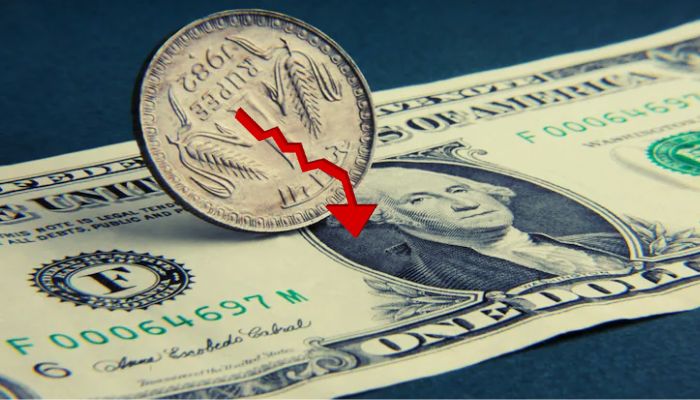

For the first time ever, the Indian Rupee (INR) breached the psychologically significant Rs90 mark against the Dollar, reaching an intraday low of Rs90.30 before closing at Rs 90.19 on 3rd December 2025. This marks the third consecutive low in recent days, extending an eight-month slide that has witnessed the India Rupee depreciate by over 5% year-to-date. These developments have made the India Rupee the worst-performing major currency in the year 2025.
This depreciation is not sudden; it is the culmination of a rapid fall from below Rs 89.9475 on 2nd December and Rs 89.76 on 1st December. The Reserve Bank of India (RBI) has made modest intervention, selling around $30 billion in USD between June and October, to curb excessive volatility; however, its calibrated approach grants the market more room, and helps prioritise long-term resilience over rigid defence of psychologically disheartening 90-threshold.
Predictably, the opposition parties and the extended anti-Modi cabal have seized the opportunity to attack the Modi government and accuse it of gross economic mismanagement. The Modi detractors are trying to portray the depreciation of rupee against dollar as a governance failure, including unemployment, high inflation, and eroding trust of investors under PM Modi’s leadership.
सोचा याद दिला दूँ, महामानव ने कितना बंटाधार किया है
— Supriya Shrinate (@SupriyaShrinate) December 4, 2025
डॉलर vs रुपया
26 मई 2014 : 58.86
4 दिसंबर 2025 : 90.28
देश आपसे जवाब माँग रहा है PM मोदी
However, such an interpretation of the situation is dishonest and stems from the political imperative of targeting the government and not genuine concerns about the Indian economy and currency. This is because a proper reading of the situation is incomplete without looking into the external factors.
Contrary to the political narratives being coalesced with an economic phenomenon, the Indian Rupee’s weakness is not entirely driven by domestic factors or policy lapses; rather, it is significantly driven by global headwinds and structural trade imbalances.
Not to forget, India’s economic fundamentals remain strong. In the third quarter of FY26, the country’s GDP grew at an impressive 8.2%, beating 7.3% forecasts. Inflation is also at record lows, and corporate earnings, too, are rebounding.
Indian Rupee’s fall driven by a trifecta of external factors
In times where countries are trading their sovereignty and self-respect to be in the good books of US President Donald Trump, fearing his tariff threats, India is the only country that did not succumb to pressure tactics and agree to any Faustian bargain. This standing up to economic and geopolitical pressure comes at a cost. Trump made preposterous claims that India somehow is ‘funding’ the Russian war machine and whatnot, to impose 50% tariffs.
While the Indian economy, contrary to Trump’s ‘dead economy’ jibe, is strong, steady and growing, everything cannot be as right as rain. Since the tariff hikes were announced, the Indian Rupee has depreciated by 5.5% against the USD.
The sharp depreciation of the Indian Rupee against the Dollar accelerated after the Trump administration in the US imposed 50% tariffs on Indian exports earlier this year. This directly hit approximately $45 billion worth of annual exports in various sectors.
India’s exports to the US, one of the country’s largest export markets, dropped sharply. Merchandise exports plummeted by 11.8% year-on-year in October 2025, slumping to an eleven-month low of $34.4 billion. What drove this was increased US tariffs and unfavourable base. It must be recalled that in October 2024, exports had grown a strong 16.6%.
It is essential to note that to offset a decline in US exports, India is diversifying into new markets, a notable example of which is the India-UK FTA signed in July this year, bolstering domestic demand through tax cuts and implementing government support measures like the Export Promotion Mission and credit guarantees for exporters.
Oil prices slumped by 10.5%, dropping to a nine-month low of $3.9 billion as global crude prices declined. Similar has been the situation in non-oil exports, which contracted 12% to $30.4 billion, marking an eleven-month low. Almost every export category except electronic goods, including engineering goods, gems and jewellery, chemicals, and ready-made garments, witnessed a year-on-year decline.
On one hand, exports dipped, on the other, imports in certain segments like merchandise and gold increased. In a nutshell, the external sector has been under pressure. Tariffs, softened demand from major markets, and the undeterred demand for imported goods have posed challenges to export competitiveness. This is something the stakeholders and the government must look into, as further widening of the trade deficit in the coming times could exacerbate INR depreciation and cause trouble in the balance of payments.
In addition, foreign portfolio outflows have pulled out a staggering Rs 16.78 billion so far this year from Indian equities. This is attributed largely to interest-rate differentials between the US and India, which have narrowed to less than 2.5%. This has exponentially raised the dollar demand. As per an SBI analysis, between July and October, a rare imbalance was recorded when the combined excess demand in spot and forward merchant markets reached up to $102.5 billion.
What exacerbated the situation were the offshore Non-Deliverable Forward (NDF) markets, as panic hedging pushed one-month NDF quotes 7–8 paise above the interest-rate differential.
Speaking about the role of NDFs in INR depreciation, Ritesh Bhansali, deputy chief executive officer at Mecklai Financial Services, said, “In the NDF market, we have seen a lot of shorting of the rupee happening, which is creating pressure on the rupee. Even if you don’t account for speculative activities, from a demand-supply basis, the demand for dollars is higher as compared to the supply.”
He added that importers are frontloading their import payments because of the rupee depreciation, while exporters are not hedging hawkishly. “Domestic fundamentals are creating their own headwinds, a widening current account deficit and a softening balance of payments (BoP) position are contributing to an unfavourable demand–supply dynamic for the currency,” Reddy opined.

Taking to X, veteran banker Uday Kotak highlighted that the ongoing Indian Rupee depreciation against dollar is directly connected with foreign investor behaviour. He said that INR’s fall was fuelled by overseas exits across portfolio flows and private equity under FDI.
“₹@90. The proximate reason: foreign selling of Indian stocks both FPI & PE under FDI. Indian investors buying. Time will tell who is smarter. For now, foreigners seem smarter. 1 year nifty $ return is 0. But this a long game. Time for Indian business to shake out of comfort zone,” Kotak wrote.
₹@90. The proximate reason: foreign selling of Indian stocks both FPI & PE under FDI. Indian investors buying. Time will tell who is smarter. For now foreigners seem smarter. 1 year nifty $ return is 0. But this a long game. Time for Indian business to shake out of comfort zone.
— Uday Kotak (@udaykotak) December 3, 2025
Notably, the foreign portfolio inflows (FPI) have witnessed a dramatic slowdown and external borrowings have also weakened, indicating a tougher global fiscal situation. Since January this year, FPIs have withdrawn Rs 1.48 lakh crore from domestic equities. This significant pullback came even as India’s macroeconomic backdrop is largely stable.
Meanwhile, Rama Chandra Reddy, treasury deputy general manager at Karur Vysya Bank, opines that as traditional suppliers of global carry-trade capital, the US and Japan, are “grappling with elevated interest rates, the flow of low-cost capital into emerging markets has weakened noticeably.”
Reddy says that this environment has not only limited fresh carry-trade inflows into India but also raised the risk of unwinding existing positions, adding incremental pressure on the Indian Rupee.
Notably, in October this year, India recorded its widest-ever monthly trade deficit of $41.68 billion. This was driven by a 16.6% increase in imports, particularly crude oil (85% imported), commodities, and a festive-season spike in gold purchases. The current account deficit expanded to $12.3 billion, or 1.3% of GDP, fuelled by a magnifying trade deficit that rose to 9% of GDP, due to multiple factors, including a surge in gold imports amid higher global prices. These factors contributed to the creation of relentless dollar demand from importers.
Although the Dollar Index itself is reported to have fallen 8.5% year-to-date and closed at 99.22 on 3rd December, the Indian Rupee weakened more than most Asian nations is due to the India-specific external shocks in addition to the RBI’s deliberate shift toward managing volatility rather than rigidly defending a specific depreciation level. The RBI has sold only about $30 billion in 2025 while keeping its forex reserves comfortably at about $690 billion. A weak, fragile or collapsing economy cannot do that.
An absence of the much-hyped India-US trade deal or Bilateral Trade Agreement (BTA) also remains a matter of concern. For months, India and the US have been holding negotiations to go forward with the deal; however, India’s reluctance to open up agriculture and dairy markets for US goods and Trump’s intransigence to arm-twist India into signing a heavily pro-US or one-sided trade deal have caused delays in its signing. This ambiguity is fuelling the erosion of investors’ trust. However, comments by the Indian and American sides lately suggest that both countries are close to sealing a swift India-US trade deal, which would naturally contribute to the stabilisation of the Indian Rupee through reduced tariffs and revitalised trade ties.
Does strong currency alone indicate a strong economy? If that were the case, Afghanistan would have been an economic powerhouse
While India is navigating its way through challenges thrown its way, the usual suspects are attacking the Modi government with ridiculous arguments like “even Afghanistan’s currency is stronger than ours”. However, these are juvenile arguments stemming from a sheer lack of understanding or deliberate ignorance of how economics works.

The Taliban-ruled Afghanistan’s currency, “Afghani”, is one of the strongest and most stable in the world. This is not because the country has become economically stronger but because of Taliban-imposed restrictions on the use of the US dollar and Pakistani rupee. This has eliminated demand for foreign currency. Most transactions in Afghanistan are conducted using the local Afghani currency.

Limited exports, little foreign investment, and negligible international trade, although the Taliban is opening up a bit on that front, are the key factors why Afghanistan’s currency remains artificially stable. This ‘stability’, however, does not essentially translate into economic stability. Unlike Afghanistan’s economy, the Indian economy is neither small nor isolated.
Afghanistan has minimal industrial activity and investment; in contrast, India is a significant economic giant and a hub of industrial activity and investment. Afghanistan’s currency is stronger than that of Japan; however, Afghanistan is nowhere close to Japan in terms of economic growth, stability, investment and global market share.

Although depreciation is a matter of concern, Indian currency is not volatile; rather, at this point, it is acting as a shock absorber against global headwinds. Many experts, including those at HSBC, opine that “the Indian rupee is a shock absorber for the economy, and an automatic stabiliser for external finances.” A depreciating rupee against dollar is not essentially a result of policy failure and does not entirely mean an economic weakening.