Qualify for PG medical seats even with negative marks? Read why netizens are outraged at latest NEET PG cut-off marks
On 13th January, the National Board of Examinations in Medical Sciences (NBEMS) revised the qualifying cut-off scores for NEET PG 2025 after the Ministry of Health and Family Welfare directed a lowering of qualifying percentiles. The move has triggered intense discussion online after it emerged that candidates with negative marks under the SC, ST and OBC categories are now eligible to participate in counselling. In the official notice, NBEMS stated that the minimum qualifying percentile for counselling in the third round of NEET PG 2025–26 had been reduced across categories in accordance with directions issued by the Union health ministry. What the revised qualifying criteria state As per the revised criteria, the qualifying percentile for General and EWS candidates has been reduced from the 50th percentile to the 7th percentile, with the corresponding cut-off score lowered to 103 out of 800. For General persons with benchmark disability, the qualifying percentile has been reduced from the 45th percentile to the 5th percentile, translating to a cut-off score of 90. Source: NBEMS For SC, ST and OBC candidates, including persons with benchmark disability in these categories, the qualifying percentile has been reduced from the 40th percentile to the 0th percentile. The corresponding cut-off score has been fixed at minus 40 out of 800, owing to the negative marking scheme followed in the examination. NBEMS has clarified that there is no change in the NEET PG 2025 ranks that were declared on 19th August 2025. Furthermore, the revision only determines eligibility to participate in counselling. Eligibility remains provisional The notice further stated that candidature remains purely provisional and subject to fulfilment of eligibility conditions as per the NEET PG 2025 information bulletin. Aggregate marks obtained in MBBS professional examinations or the Foreign Medical Graduate Examination, as declared by candidates in their application forms, will be verified against original documents at the time of admission. NBEMS also cautioned that if incorrect information has been used to resolve a tie in ranking, the concerned candidate’s candidature would be cancelled. Any use of unfair means during the examination would attract penal action by NBEMS, the Medical Counselling Committee, or the admitting authority. Why the cut-offs were lowered The government took the decision to lower the qualifying cut-offs amid concerns over a large number of vacant postgraduate medical seats. According to officials, despite around 2.4 lakh candidates appearing for NEET PG 2025, higher cut-offs had resulted in thousands of seats remaining unfilled after multiple rounds of counselling. There are around 65,000 to 70,000 postgraduate medical seats in India. Officials indicated that allowing a significant number of seats to remain vacant could affect the functioning of teaching hospitals, particularly government institutions that rely heavily on resident doctors for clinical services and academic work. The revision came at a time when the Indian Medical Association had also written to Union Health Minister JP Nadda seeking a “rational revision” of cut-offs to prevent large scale wastage of training capacity. What netizens are saying The revised cut-offs have drawn mixed reactions on social media. Users are debating whether the move should be viewed purely as an administrative measure or as a signal of dilution in academic thresholds. Some users have contextualised the decision. They have emphasised that the revised cut-offs only expand eligibility for counselling and do not guarantee admission. Tech policy commentator Himanshu Jain said in a post on social media platform X that while it is accurate that candidates with minus 40 marks can now participate in counselling, the broader context is often missing from online discussions. NEET-PG 2025 | CLARIFICATIONYes, the –40 marks counselling claim is real — but the context matters.• NBEMS (as per MoHFW) lowered cut-offs on 13 Jan 2026 to avoid ~9,000 PG seats going vacant• Eligibility ≠ guaranteed admission• Such ranks usually translate to… pic.twitter.com/9CQb1GCSOD— Himanshu Jain (@HemanNamo) January 14, 2026 He pointed out that NBEMS lowered the cut-offs primarily to avoid nearly 9,000 PG medical seats going vacant. Furthermore, eligibility for counselling should not be seen as assured admission. Candidates qualifying at such low cut-offs generally end up in non-clinical or low demand branches, or in high fee private institutions that are often left unfilled by higher ranked candidates. According to Himanshu, the policy decision was focused on capacity utilisation and not on altering passing standards. He pointed out that NEET PG functions as a ranking examination for candidates who have already completed MBBS and cleared university level assessments. However, several other users raised concerns over the implications of allo
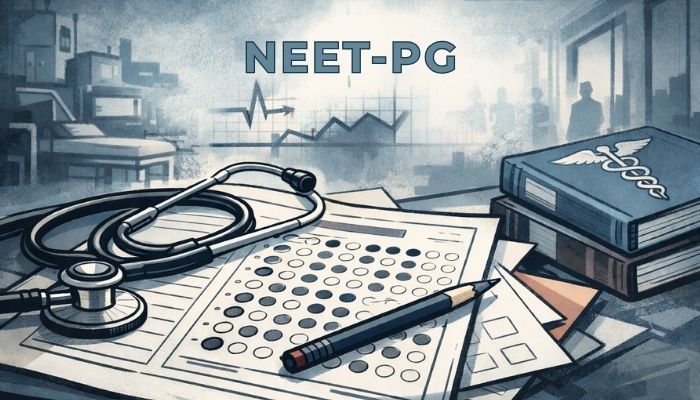

On 13th January, the National Board of Examinations in Medical Sciences (NBEMS) revised the qualifying cut-off scores for NEET PG 2025 after the Ministry of Health and Family Welfare directed a lowering of qualifying percentiles. The move has triggered intense discussion online after it emerged that candidates with negative marks under the SC, ST and OBC categories are now eligible to participate in counselling.
In the official notice, NBEMS stated that the minimum qualifying percentile for counselling in the third round of NEET PG 2025–26 had been reduced across categories in accordance with directions issued by the Union health ministry.
What the revised qualifying criteria state
As per the revised criteria, the qualifying percentile for General and EWS candidates has been reduced from the 50th percentile to the 7th percentile, with the corresponding cut-off score lowered to 103 out of 800. For General persons with benchmark disability, the qualifying percentile has been reduced from the 45th percentile to the 5th percentile, translating to a cut-off score of 90.

For SC, ST and OBC candidates, including persons with benchmark disability in these categories, the qualifying percentile has been reduced from the 40th percentile to the 0th percentile. The corresponding cut-off score has been fixed at minus 40 out of 800, owing to the negative marking scheme followed in the examination.
NBEMS has clarified that there is no change in the NEET PG 2025 ranks that were declared on 19th August 2025. Furthermore, the revision only determines eligibility to participate in counselling.
Eligibility remains provisional
The notice further stated that candidature remains purely provisional and subject to fulfilment of eligibility conditions as per the NEET PG 2025 information bulletin. Aggregate marks obtained in MBBS professional examinations or the Foreign Medical Graduate Examination, as declared by candidates in their application forms, will be verified against original documents at the time of admission.
NBEMS also cautioned that if incorrect information has been used to resolve a tie in ranking, the concerned candidate’s candidature would be cancelled. Any use of unfair means during the examination would attract penal action by NBEMS, the Medical Counselling Committee, or the admitting authority.
Why the cut-offs were lowered
The government took the decision to lower the qualifying cut-offs amid concerns over a large number of vacant postgraduate medical seats. According to officials, despite around 2.4 lakh candidates appearing for NEET PG 2025, higher cut-offs had resulted in thousands of seats remaining unfilled after multiple rounds of counselling.
There are around 65,000 to 70,000 postgraduate medical seats in India. Officials indicated that allowing a significant number of seats to remain vacant could affect the functioning of teaching hospitals, particularly government institutions that rely heavily on resident doctors for clinical services and academic work.
The revision came at a time when the Indian Medical Association had also written to Union Health Minister JP Nadda seeking a “rational revision” of cut-offs to prevent large scale wastage of training capacity.
What netizens are saying
The revised cut-offs have drawn mixed reactions on social media. Users are debating whether the move should be viewed purely as an administrative measure or as a signal of dilution in academic thresholds.
Some users have contextualised the decision. They have emphasised that the revised cut-offs only expand eligibility for counselling and do not guarantee admission. Tech policy commentator Himanshu Jain said in a post on social media platform X that while it is accurate that candidates with minus 40 marks can now participate in counselling, the broader context is often missing from online discussions.

Related Posts


In Ambernath, Sena deals a blow to BJP after high drama,...
Shiv Sena secured the deputy president post in Ambernath Municipal Council through...

Paramount Skydance mandates office return: 600 take severance...
Paramount Skydance has implemented its return-to-office policy, requiring employees...

I-PAC Raid: Big showdown outside Amit Shah's residence,...
Trinamool Congress MP Mahua Moitra and colleagues were detained by Delhi Police...

Should you upgrade your Wi-Fi router to mesh? I compared...
Do you need one access point or full-home coverage? Here's what a networking expert...
'Stranger Things Season 5’: Millie Bobby Brown and David...
The final table read for Stranger Things season 5 saw an emotional outpouring from...

Celina Jaitly says husband served divorce notice on 15th...
Celina Jaitly revealed her husband Peter Haag served her divorce papers disguised...

'The Raja Saab' Box Office collection day 5: Prabhas film...
Prabhas's 'Raja Saab' is facing a significant box office downturn, with collections...

‘No more oil or money’: Trump issues ultimatum to Cuba;...
Former US President Donald Trump has warned Cuba to strike a deal, stating that...


Venezuela releases multiple American citizens from prison...
At least four Americans detained under Nicolás Maduro's regime were released by...