‘Poor tribal Hindus lured into converting via financial and other inducements’: Inside the Gujarat HC’s rejection of Muslim clerics’ Discharge Pleas in Bharuch Mass Conversion case
The Gujarat High Court has turned down the petition filed by two clerics requesting discharge in the mass conversion case that arose in the Amod taluka of Bharuch in 2021. This order was issued by a single-judge bench of Justice Geeta Gopi on 30th March. While dismissing the petition, the court remarked that a prima facie analysis of the witness statements and the evidence on record showed indications of conversion-related activities. Therefore, there were no valid grounds to challenge the Trial Court’s ruling regarding the accused. The incident originates from November 2021, when a First Information Report (FIR) concerning a conversion case was filed at the Amod Police Station. As per the complaint, over 100 people from around 37 Hindu families in Kankariya village of Amod taluka and nearby tribal regions were unlawfully converted to Islam through various enticements. The police have thus far submitted a third supplementary chargesheet against multiple perpetrators in relation to this matter. Two individuals charged in this case, Sarfaraz also known as Javid Khuji or Javid Mufti Salim Hasan Yusuf Ibrahim Khilji and Ramiz Raja also referred to as Owaish Abdul Gani Abdul Rahim Khilji had earlier submitted discharge petitions to the Trial Court which rejected them. Afterwards, both parties approached the high court. Legal actions have been initiated against the duo under the Gujarat Freedom of Religion Act and the Indian Penal Code. What arguments were presented in court Advocate Umarfaruk M. Kharadi, representing the petitioners, argued that the trial court made an error in dismissing the discharge petition, claiming that there was inadequate evidence to establish charges. He contended that the Maulvis had been wrongfully implicated and additionally insisted that these two were named as defendants in a third supplementary chargesheet, well after the investigation had been completed. The defense counsel added that they are Maulvis by profession, stressing that it is their religious duty to promote and spread their faith. Furthermore, it was argued that the promotion of religion is a fundamental right protected by the Indian Constitution and thus, no criminal proceedings should be initiated against them solely based on their participation in religious activities. The government exposes the trickery Public Prosecutor Bhargav Pandya, countering these claims on behalf of the state, emphasised that this case transcended mere religious propagation and represented a meticulously planned conspiracy aimed at facilitating religious conversions by deceiving and alluring impoverished individuals. He informed the court that the defendant, Javid Mufti, has a history of engaging in efforts to convert numerous unsuspecting villagers. The investigation uncovered that the accused offered cash, new garments and medical supplies to those they converted. Additionally, tribal families were lured to Islam through the promise of material benefits, such as air coolers, water coolers, handcarts and items like mats or sheets intended for prayer. The primary complainant, Pravinbhai Vasava, stated that in 2018, he and several other families were enticed into changing their religion, and modifications were made to their Aadhaar cards. Moreover, other witnesses have given compelling testimonies to the police concerning the promises of facilities made by the accused, Ramiz Raja, along with the activities related to the conversions. In reference to incidents that took place in 2019, the Public Prosecutor indicated that the accused would often visit Kankariya village in luxury vehicles. Regular gatherings were conducted at the home of a particular individual in the village, where Namaz was performed and lectures were held under the guise of providing education about Islam. The court was also informed that the police have video recordings of these gatherings which act as evidence in the case. The Public Prosecutor highlighted that, in accordance with Section 5 of the Gujarat Freedom of Religion Act, 2003, along with Rules 3, 4 and 5 of the 2008 Rules, which require prior legal authorisation for religious conversion, there was a complete lack of compliance in this instance. This failure to follow the legal procedure is, by itself, adequate to classify the activity as illegal and criminal. Thus, a prima facie case has been established against the accused. What did the high court say The high court accepted the arguments submitted by the state government and decided not to intervene, at this stage, with the order made by the Trial Court. The court observed that, upon a preliminary assessment of the evidence on record and the statements from witnesses, a case seems to be established. Furthermore, it was noted that the clerics’ meetings were held with the specific intention of facilitating religious conversions. The court stated that the Trial Court had made an appropriate decision and it would not interfere
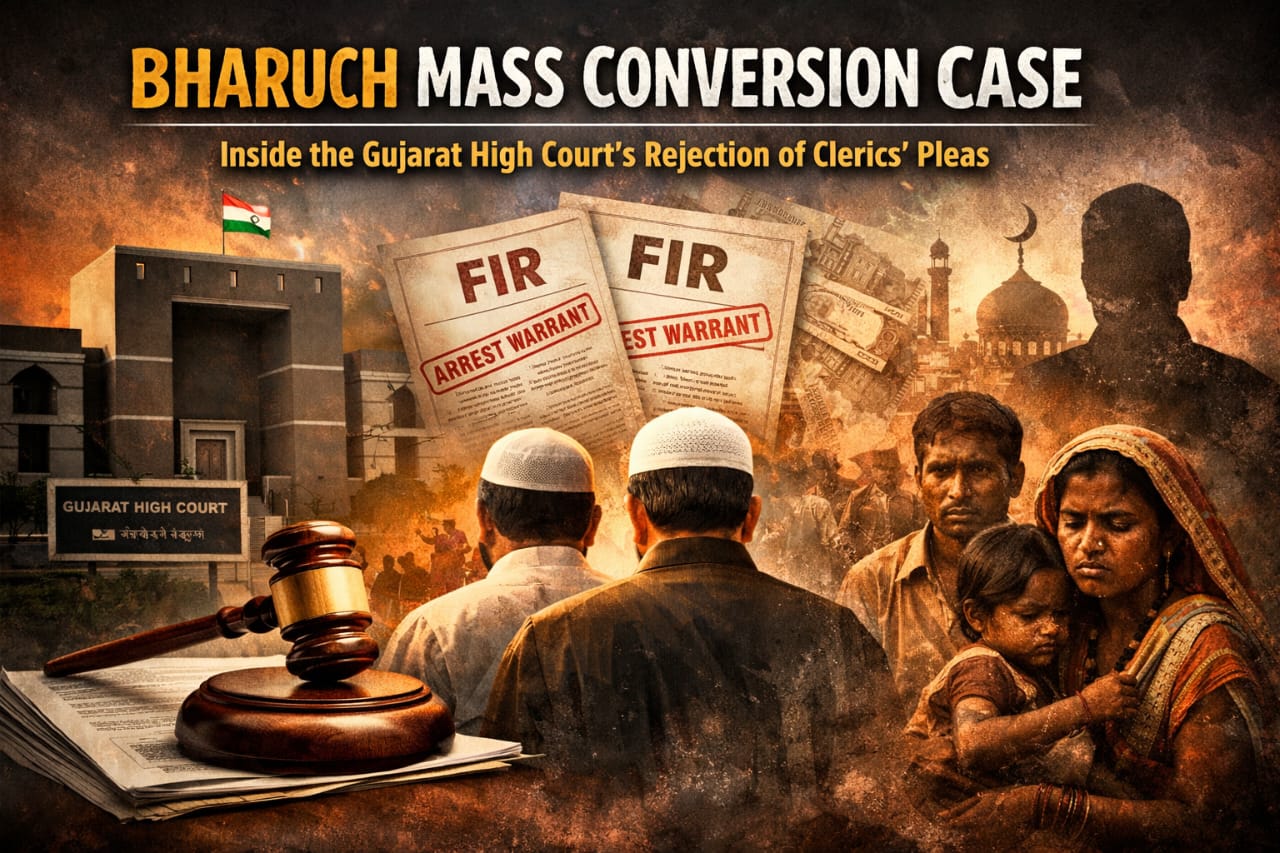
The Gujarat High Court has turned down the petition filed by two clerics requesting discharge in the mass conversion case that arose in the Amod taluka of Bharuch in 2021. This order was issued by a single-judge bench of Justice Geeta Gopi on 30th March. While dismissing the petition, the court remarked that a prima facie analysis of the witness statements and the evidence on record showed indications of conversion-related activities. Therefore, there were no valid grounds to challenge the Trial Court’s ruling regarding the accused.
The incident originates from November 2021, when a First Information Report (FIR) concerning a conversion case was filed at the Amod Police Station. As per the complaint, over 100 people from around 37 Hindu families in Kankariya village of Amod taluka and nearby tribal regions were unlawfully converted to Islam through various enticements. The police have thus far submitted a third supplementary chargesheet against multiple perpetrators in relation to this matter.
Two individuals charged in this case, Sarfaraz also known as Javid Khuji or Javid Mufti Salim Hasan Yusuf Ibrahim Khilji and Ramiz Raja also referred to as Owaish Abdul Gani Abdul Rahim Khilji had earlier submitted discharge petitions to the Trial Court which rejected them. Afterwards, both parties approached the high court. Legal actions have been initiated against the duo under the Gujarat Freedom of Religion Act and the Indian Penal Code.
What arguments were presented in court
Advocate Umarfaruk M. Kharadi, representing the petitioners, argued that the trial court made an error in dismissing the discharge petition, claiming that there was inadequate evidence to establish charges. He contended that the Maulvis had been wrongfully implicated and additionally insisted that these two were named as defendants in a third supplementary chargesheet, well after the investigation had been completed.
The defense counsel added that they are Maulvis by profession, stressing that it is their religious duty to promote and spread their faith. Furthermore, it was argued that the promotion of religion is a fundamental right protected by the Indian Constitution and thus, no criminal proceedings should be initiated against them solely based on their participation in religious activities.
The government exposes the trickery
Public Prosecutor Bhargav Pandya, countering these claims on behalf of the state, emphasised that this case transcended mere religious propagation and represented a meticulously planned conspiracy aimed at facilitating religious conversions by deceiving and alluring impoverished individuals. He informed the court that the defendant, Javid Mufti, has a history of engaging in efforts to convert numerous unsuspecting villagers.
The investigation uncovered that the accused offered cash, new garments and medical supplies to those they converted. Additionally, tribal families were lured to Islam through the promise of material benefits, such as air coolers, water coolers, handcarts and items like mats or sheets intended for prayer.
The primary complainant, Pravinbhai Vasava, stated that in 2018, he and several other families were enticed into changing their religion, and modifications were made to their Aadhaar cards. Moreover, other witnesses have given compelling testimonies to the police concerning the promises of facilities made by the accused, Ramiz Raja, along with the activities related to the conversions.
In reference to incidents that took place in 2019, the Public Prosecutor indicated that the accused would often visit Kankariya village in luxury vehicles. Regular gatherings were conducted at the home of a particular individual in the village, where Namaz was performed and lectures were held under the guise of providing education about Islam. The court was also informed that the police have video recordings of these gatherings which act as evidence in the case.
The Public Prosecutor highlighted that, in accordance with Section 5 of the Gujarat Freedom of Religion Act, 2003, along with Rules 3, 4 and 5 of the 2008 Rules, which require prior legal authorisation for religious conversion, there was a complete lack of compliance in this instance. This failure to follow the legal procedure is, by itself, adequate to classify the activity as illegal and criminal. Thus, a prima facie case has been established against the accused.
What did the high court say
The high court accepted the arguments submitted by the state government and decided not to intervene, at this stage, with the order made by the Trial Court. The court observed that, upon a preliminary assessment of the evidence on record and the statements from witnesses, a case seems to be established. Furthermore, it was noted that the clerics’ meetings were held with the specific intention of facilitating religious conversions. The court stated that the Trial Court had made an appropriate decision and it would not interfere in this matter.
As a result, the petition was dismissed. The high court has also turned down petitions submitted by other accused parties who sought to annul the FIRs filed against them. In October 2025, the court dismissed seven such petitions. During that period, it made an important remark: if an individual who has undergone a religious conversion subsequently encourages or provokes others to convert, they cannot be considered a “victim,” instead, they may also be classified as accused and legal proceedings may be initiated against them.
Background of the matter
This mass conversion aimed at members of the Hindu tribal community in the Amod Taluka of Bharuch was not an isolated event. It was a carefully planned conspiracy that extended from 2006 to 2021. According to police investigations, over 100 individuals from around 37 Hindu tribal families in Kankariya village were converted to Islam through various inducements. Investigations have uncovered that foreign funding, and a locally active group were instrumental in orchestrating this entire scheme, with the main goal being to exploit the vulnerabilities of impoverished tribal communities for the purpose of religious conversions.
The case was brought forth by the complainant, Pravinbhai Vasantbhai Vasava, who had himself yielded to inducements in 2018, converted to Islam, and assumed the name “Salman Patel.” He confessed to the police that the accused had taken advantage of the dire circumstances faced by the local Hindu residents in the area, exploiting their severe poverty. He recounted that, at first, he was directed to live his life according to Sharia law. However, he ultimately came to understand that the entire situation was merely a fraudulent plot motivated by deception and greed.
To enable religious conversions, the accused utilised a method that included communal pressure, inducement and intimidation. Through this approach, destitute tribal individuals were enticed with misleading assurances of cash, food supplies, employment, permanent housing and marriage. They were incessantly indoctrinated with the belief that Hinduism lacks significance and that Islam is the only superior religion. This procedure also encompassed legal deception. Villagers were misled and transported to Surat, where, while confined in vehicles, they were coerced into signing documents to alter their names and religious affiliations on their Aadhaar cards and other government-issued identification proofs.
The FIR filed at the Amod Police Station in November 2021 identifies multiple individuals, both local and foreign nationals, including Shabbir and Samad Bakerywala. Haji Abdullah Fefdawala, who resides in London, has been identified as the primary mastermind. He obtained significant financial support from abroad by exaggerating the figures of religious conversions. The accused perceived this entire operation as a “business,” through which they received funds from overseas for each conversion and these earnings were then used to further attract the tribal population.
After their conversion to a new faith, the children of the tribal community were dispatched to madrasas located in Jambusar and Hazira, where they underwent indoctrination. The Tablighi Jamaat would transport them to religious assemblies in locations such as Malegaon and Mumbai, aiming to distance them from their native culture. The Gujarat Police has classified this situation not just as a local offence, but as a conspiracy of national scale.
Read the original OpIndia Gujarati report here.