Planning attacks on India, seeking annexation of Jammu and Kashmir: US Congress report exposes the nefarious agenda of Pakistan-based terror ecosystem
On 25th March (local time), a report was tabled by the United States Congress, which once again underlined Pakistan’s role as a hub of terrorist activity. The report identified multiple terrorist organisations operating from Pakistan’s soil that continued to target India and sought annexation of Jammu and Kashmir. The report, titled “Terrorist and other Militant Groups in Pakistan”, presented a structured assessment of terror ecosystems functioning within Pakistan and categorised them based on operational focus and ideological orientation. The Congressional Research Service report stated that Pakistan was both a base and a target for numerous non-state militant groups, several of which had been active since the 1980s. It further noted that despite sustained military campaigns and counter-terror operations, these terror outfits continued to function with significant capability. Five categories of terror groups operating from Pakistan The report classified terror organisations linked to Pakistan into five broad categories, that are globally oriented groups, Afghanistan-oriented militants, India and Kashmir-focused organisations, domestically oriented groups, and sectarian outfits targeting Shia communities. The report examined 15 groups, out of which 12 had been designated as Foreign Terrorist Organisations under US law. This classification showed the scale and diversity of terrorist organisations operating from Pakistan. The report also noted that Pakistan itself had suffered significantly from terrorism since 2003, with fatalities peaking in 2009. However, after a brief decline, terrorism-related deaths had risen again and reached 4,001 in 2025, the highest in over a decade. Failure of military offensives to eliminate terror networks One of the key observations made in the report was the limited effectiveness of Pakistan’s military operations against terrorist organisations. It claimed that major offensives, including airstrikes and large-scale intelligence-based operations, had failed to dismantle these networks. The report further noted that hundreds of thousands of such operations had been conducted. However, US and UN-designated terrorist organisations continued to operate from Pakistani territory. This finding raised serious questions about both the intent and the effectiveness of counterterror measures undertaken by Islamabad. Notably, in May 2025, when India destroyed numerous hubs of terrorist organisations in response to the Pahalgam terrorist attack as part of Operation Sindoor, the Pakistani military not only attempted to strike Indian cities but also participated in funeral processions of the terrorists killed in Indian operations. Furthermore, reports suggested that Pakistan was supporting terror outfits to rebuild the destroyed infrastructure in Indian strikes. While the US Congress report did not explicitly detail Pakistan’s role in sponsoring terrorist organisations, what happened in the past year made it clearer than ever that Pakistani authorities were themselves responsible for the growing terrorist problem in the country. India and Kashmir focused terror groups The report placed significant emphasis on terrorist organisations targeting India. Among the most prominent groups named in the report were Lashkar-e-Taiba, Jaish-e-Mohammed, Hizbul Mujahideen, Harakat-ul-Mujahidin, and Harakat-ul Jihad Islami. Lashkar-e-Taiba, led by Hafiz Saeed, was described as a large and well-structured organisation with several thousand terrorists. It was based in Pakistan’s Punjab province and Pakistan-occupied Jammu and Kashmir and had reportedly changed its name to Jamaat-ud-Dawa to evade sanctions. The report recalled its role in the 2008 Mumbai terror attacks, along with several other high-profile incidents. Jaish-e-Mohammed, founded in 2000 by Masood Azhar, was identified as another key group seeking the annexation of Jammu and Kashmir into Pakistan. With approximately 500 armed terrorists, the group operated across India, Afghanistan, and Pakistan. It was also noted for its role in the 2001 attack on the Indian Parliament. Harakat-ul-Mujahidin, which operated from Pakistan-occupied Jammu and Kashmir and urban centres in Pakistan, was linked to the 1999 hijacking of Indian Airlines flight IC 814. This incident ultimately led to the release of Masood Azhar, who later founded Jaish-e-Mohammed. Hizbul Mujahideen was described as one of the oldest militant groups operating in Jammu and Kashmir, with a cadre strength of up to 1,500. The report claimed that its members were primarily “ethnic Kashmiris” seeking either independence or accession to Pakistan. However, Indian security analysts had repeatedly contested such characterisations, noting that a significant number of terrorists neutralised in Jammu and Kashmir operations had origins in mainland Pakistan, particularly from Punjab. Mischaracterisations and factual inconsistencies While the report pres
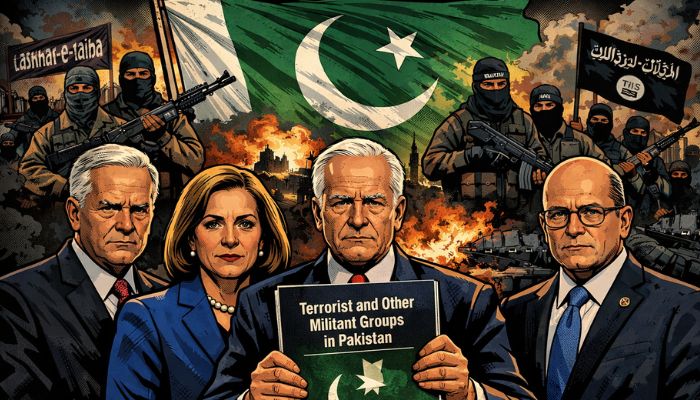
On 25th March (local time), a report was tabled by the United States Congress, which once again underlined Pakistan’s role as a hub of terrorist activity. The report identified multiple terrorist organisations operating from Pakistan’s soil that continued to target India and sought annexation of Jammu and Kashmir. The report, titled “Terrorist and other Militant Groups in Pakistan”, presented a structured assessment of terror ecosystems functioning within Pakistan and categorised them based on operational focus and ideological orientation.
The Congressional Research Service report stated that Pakistan was both a base and a target for numerous non-state militant groups, several of which had been active since the 1980s. It further noted that despite sustained military campaigns and counter-terror operations, these terror outfits continued to function with significant capability.
Five categories of terror groups operating from Pakistan
The report classified terror organisations linked to Pakistan into five broad categories, that are globally oriented groups, Afghanistan-oriented militants, India and Kashmir-focused organisations, domestically oriented groups, and sectarian outfits targeting Shia communities.
The report examined 15 groups, out of which 12 had been designated as Foreign Terrorist Organisations under US law. This classification showed the scale and diversity of terrorist organisations operating from Pakistan. The report also noted that Pakistan itself had suffered significantly from terrorism since 2003, with fatalities peaking in 2009. However, after a brief decline, terrorism-related deaths had risen again and reached 4,001 in 2025, the highest in over a decade.
Failure of military offensives to eliminate terror networks
One of the key observations made in the report was the limited effectiveness of Pakistan’s military operations against terrorist organisations. It claimed that major offensives, including airstrikes and large-scale intelligence-based operations, had failed to dismantle these networks.
The report further noted that hundreds of thousands of such operations had been conducted. However, US and UN-designated terrorist organisations continued to operate from Pakistani territory. This finding raised serious questions about both the intent and the effectiveness of counterterror measures undertaken by Islamabad.
Notably, in May 2025, when India destroyed numerous hubs of terrorist organisations in response to the Pahalgam terrorist attack as part of Operation Sindoor, the Pakistani military not only attempted to strike Indian cities but also participated in funeral processions of the terrorists killed in Indian operations.
Furthermore, reports suggested that Pakistan was supporting terror outfits to rebuild the destroyed infrastructure in Indian strikes. While the US Congress report did not explicitly detail Pakistan’s role in sponsoring terrorist organisations, what happened in the past year made it clearer than ever that Pakistani authorities were themselves responsible for the growing terrorist problem in the country.
India and Kashmir focused terror groups
The report placed significant emphasis on terrorist organisations targeting India. Among the most prominent groups named in the report were Lashkar-e-Taiba, Jaish-e-Mohammed, Hizbul Mujahideen, Harakat-ul-Mujahidin, and Harakat-ul Jihad Islami.
Lashkar-e-Taiba, led by Hafiz Saeed, was described as a large and well-structured organisation with several thousand terrorists. It was based in Pakistan’s Punjab province and Pakistan-occupied Jammu and Kashmir and had reportedly changed its name to Jamaat-ud-Dawa to evade sanctions. The report recalled its role in the 2008 Mumbai terror attacks, along with several other high-profile incidents.
Jaish-e-Mohammed, founded in 2000 by Masood Azhar, was identified as another key group seeking the annexation of Jammu and Kashmir into Pakistan. With approximately 500 armed terrorists, the group operated across India, Afghanistan, and Pakistan. It was also noted for its role in the 2001 attack on the Indian Parliament.
Harakat-ul-Mujahidin, which operated from Pakistan-occupied Jammu and Kashmir and urban centres in Pakistan, was linked to the 1999 hijacking of Indian Airlines flight IC 814. This incident ultimately led to the release of Masood Azhar, who later founded Jaish-e-Mohammed.
Hizbul Mujahideen was described as one of the oldest militant groups operating in Jammu and Kashmir, with a cadre strength of up to 1,500. The report claimed that its members were primarily “ethnic Kashmiris” seeking either independence or accession to Pakistan.
However, Indian security analysts had repeatedly contested such characterisations, noting that a significant number of terrorists neutralised in Jammu and Kashmir operations had origins in mainland Pakistan, particularly from Punjab.
Mischaracterisations and factual inconsistencies
While the report presented a detailed overview, certain descriptions raised questions regarding accuracy. For instance, Jaish-e-Mohammed founder Masood Azhar was described as a “Kashmiri militant leader”, whereas he was widely known to be of Punjabi origin from Pakistan.
Similarly, the depiction of Hizbul Mujahideen cadres as predominantly “ethnic Kashmiris” did not fully align with ground realities observed in counterterror operations in Kashmir. Such inconsistencies highlighted the limitations of external assessments that may rely on outdated or incomplete datasets.
Globally oriented terror groups and regional linkages
The report also examined globally oriented militant organisations operating from Pakistan, including Al Qaeda and its affiliates. Al Qaeda, founded in 1988, continued to maintain linkages with several Pakistan-based groups despite being significantly degraded over the years.
Its regional affiliate, Al Qaeda in the Indian Subcontinent, established in 2014, had been implicated in attacks within Pakistan and attempted operations against military assets.
Another major entity highlighted was the Islamic State Khorasan Province, which operated primarily in Afghanistan but maintained a presence in Pakistan through former members of Tehrik-i-Taliban Pakistan and other militant factions.
Afghanistan oriented networks and safe haven concerns
The report outlined the long-standing presence of Afghanistan-focused militant groups operating from Pakistani territory. The Afghan Taliban, which regained power in Afghanistan in 2021, was noted to have historically operated from cities such as Quetta, Karachi, and Peshawar.
The Haqqani Network, another key group, was described as having operational linkages near the Pakistan-Afghanistan border and was reportedly associated with Pakistan’s intelligence apparatus, a claim denied by Islamabad.
Domestic and sectarian terror ecosystem
The report also highlighted domestically oriented terrorist groups such as Tehrik-i-Taliban Pakistan, which was described as the deadliest militant organisation operating within Pakistan. With an estimated strength of 2,500 to 5,000 fighters, the group sought to overthrow the Pakistani state and impose Sharia law.
Additionally, ethnic separatist groups like the Balochistan Liberation Army and Jaysh al-Adl were identified, along with sectarian outfits such as Lashkar-e-Jhangvi and Sipah-e-Sahaba Pakistan, which had historically targeted Shia communities.
Continued global scrutiny and policy implications
The report noted that Pakistan remained under international scrutiny for its counter-terror record. It noted that the country was designated as a “Country of Particular Concern” under the International Religious Freedom Act in 2018 and had retained this designation annually since.
It also referenced findings from the US State Department’s Country Reports on Terrorism 2023, which stated that while Pakistan had taken some steps to curb terrorist activities, concerns remained regarding radicalisation through certain madrassas that promoted extremist ideologies.
Conclusion
The report tabled by the US Congress reinforced a long-standing global assessment that Pakistan hosted and enabled a wide range of terrorist organisations, many of which directly targeted India and sought territorial changes in Jammu and Kashmir.