Pakistan foreign ministry fumbles, avoids responding to reports of Chinese mining company shutting down in Balochistan
The Balochistan freedom struggle has evolved into a significant crisis for Pakistan as armed rebel factions have exhibited extraordinary organisational strength in the fight against their occupation. The conflict continues to escalate due to enduring grievances related to political marginalisation, resource exploitation and state oppression. Similarly, the locals have also persistently resisted foreign resource extraction and the regular deprivation of the wealth produced in the southwestern region. On the other hand, Islamabad has unsuccessfully tried to suppress the movement through brutal violence and bloodshed, an approach that has taken a heavy toll on both its economy and troops leading to further deterioration of an already volatile affair. Its latest casualty could be the largest Chinese-run copper and gold mine in Pakistan. Saindak Metals Limited (SML) warned that the growing uprising in the unstable area might compel it to shut down its operations. The concerns were conveyed by its managing director in a letter to Pakistan’s energy ministry, reported Financial Times on 15th July. Predictably, the article was first dismissed as “questionable” and then an attempt was made to evade the pertinent inquiry with “assurances” regarding the security of the Chinese people present there. When a journalist asked about it, Ministry of Foreign Affairs spokesperson Tahir Andrabi responded, “We are not obliged to talk about news stories whose facts remain questionable. Pakistan and China have an active dialogue on all aspects of their relation, including the security of Chinese nationals in Pakistan working on various economic projects, including those in Balochistan,” during a press briefing. He asserted that as the host nation, it ensures “impeccable security” for their Chinese guests, including technicians, workers and others participating in these ventures. Weekly Press Briefing by the Spokesperson @TahirAndrabiOn Security of Chinese Nationals Working on Economic Projects in Pakistan. pic.twitter.com/OPR6GGfxMi— Ministry of Foreign Affairs – Pakistan (@ForeignOfficePk) July 16, 2026 What is inside the FT report The FT article on Saindak Metals Limited, published on July 15, quotes the company’s MD Raziq Sanjrani stating, “The prevailing law and order situation in the province has severely affected the transportation of essential project cargo,” in the communication to the minister, per the media house. “If this situation continues unabated, the uninterrupted operation of the Saindak Copper-Gold Project may become unsustainable, and there is a serious likelihood that its operations may be forced to cease within a month owing to the non-availability of essential production materials and logistical support,” he highlighted. The state-controlled Metallurgical Corporation of China leased Saindak in 2001 and it has been run as a joint venture with Pakistan’s state-owned SML. The license was renewed for an additional 15 years in 2022. According to the letter, road travel has become “increasingly hazardous” due to the strikes carried out by Baloch freedom fighters, making it the primary problem for its operations. “The situation in Balochistan is far worse than many in Islamabad realise. Security is especially bad in the area where major projects like (the Barrick Mining-backed) Reko Diq and Saindak are located,” an insider revealed to FT. Islamabad maintains that it can put an end to the armed dispute and provide “foolproof security” for international investors. Unsurprisingly, it has decided to blame India, rather than confronting its own actions and step-motherly treatment towards Balochistan. The latter has strongly rebutted the bogus allegations. The onslaught on foreign assets and staff by Baloch freedom fighters has affected the ties between Pakistan and its closest economic and defence partner, as well as “all-weather friend,” China, after dozens of its citizens have lost their lives in recent years. Senior officials, including President Xi Jinping, have told their Pakistani counterparts that higher security is necessary to secure future funding in light of these precarious circumstances. Pakistan’s economic objectives rooted in the abuse of Balochistan According to official data, the output of the project represented a major portion of Islamabad’s approximately $750 million in copper products last year but nearly all of it has been delivered to Beijing. The latter also played the part biggest bilateral lender to its “Muslim ally.” It has awarded billions of dollars in grants and loans to build electricity and transport infrastructure as part of the Belt and Road Initiative. It is Xi’s global strategy to expand his country’s influence across nations and push expansionist polices. While the Pakistani government continues to profit from the resources extracted from Balochistan, the region’s residents do not often see the benefits of those profits. On 8th July, Pakis
The Balochistan freedom struggle has evolved into a significant crisis for Pakistan as armed rebel factions have exhibited extraordinary organisational strength in the fight against their occupation. The conflict continues to escalate due to enduring grievances related to political marginalisation, resource exploitation and state oppression. Similarly, the locals have also persistently resisted foreign resource extraction and the regular deprivation of the wealth produced in the southwestern region.
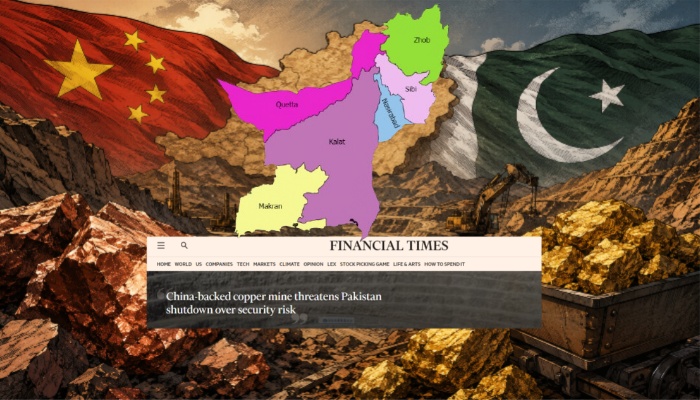
On the other hand, Islamabad has unsuccessfully tried to suppress the movement through brutal violence and bloodshed, an approach that has taken a heavy toll on both its economy and troops leading to further deterioration of an already volatile affair. Its latest casualty could be the largest Chinese-run copper and gold mine in Pakistan. Saindak Metals Limited (SML) warned that the growing uprising in the unstable area might compel it to shut down its operations.
The concerns were conveyed by its managing director in a letter to Pakistan’s energy ministry, reported Financial Times on 15th July. Predictably, the article was first dismissed as “questionable” and then an attempt was made to evade the pertinent inquiry with “assurances” regarding the security of the Chinese people present there.
When a journalist asked about it, Ministry of Foreign Affairs spokesperson Tahir Andrabi responded, “We are not obliged to talk about news stories whose facts remain questionable. Pakistan and China have an active dialogue on all aspects of their relation, including the security of Chinese nationals in Pakistan working on various economic projects, including those in Balochistan,” during a press briefing.
He asserted that as the host nation, it ensures “impeccable security” for their Chinese guests, including technicians, workers and others participating in these ventures.
Weekly Press Briefing by the Spokesperson @TahirAndrabiOn Security of Chinese Nationals Working on Economic Projects in Pakistan. pic.twitter.com/OPR6GGfxMi— Ministry of Foreign Affairs – Pakistan (@ForeignOfficePk) July 16, 2026
What is inside the FT report
The FT article on Saindak Metals Limited, published on July 15, quotes the company’s MD Raziq Sanjrani stating, “The prevailing law and order situation in the province has severely affected the transportation of essential project cargo,” in the communication to the minister, per the media house. “If this situation continues unabated, the uninterrupted operation of the Saindak Copper-Gold Project may become unsustainable, and there is a serious likelihood that its operations may be forced to cease within a month owing to the non-availability of essential production materials and logistical support,” he highlighted.
The state-controlled Metallurgical Corporation of China leased Saindak in 2001 and it has been run as a joint venture with Pakistan’s state-owned SML. The license was renewed for an additional 15 years in 2022.
According to the letter, road travel has become “increasingly hazardous” due to the strikes carried out by Baloch freedom fighters, making it the primary problem for its operations. “The situation in Balochistan is far worse than many in Islamabad realise. Security is especially bad in the area where major projects like (the Barrick Mining-backed) Reko Diq and Saindak are located,” an insider revealed to FT.
Islamabad maintains that it can put an end to the armed dispute and provide “foolproof security” for international investors. Unsurprisingly, it has decided to blame India, rather than confronting its own actions and step-motherly treatment towards Balochistan. The latter has strongly rebutted the bogus allegations.
The onslaught on foreign assets and staff by Baloch freedom fighters has affected the ties between Pakistan and its closest economic and defence partner, as well as “all-weather friend,” China, after dozens of its citizens have lost their lives in recent years. Senior officials, including President Xi Jinping, have told their Pakistani counterparts that higher security is necessary to secure future funding in light of these precarious circumstances.
Pakistan’s economic objectives rooted in the abuse of Balochistan
According to official data, the output of the project represented a major portion of Islamabad’s approximately $750 million in copper products last year but nearly all of it has been delivered to Beijing. The latter also played the part biggest bilateral lender to its “Muslim ally.” It has awarded billions of dollars in grants and loans to build electricity and transport infrastructure as part of the Belt and Road Initiative. It is Xi’s global strategy to expand his country’s influence across nations and push expansionist polices.
While the Pakistani government continues to profit from the resources extracted from Balochistan, the region’s residents do not often see the benefits of those profits. On 8th July, Pakistan’s Director General of the Inter-Services Public Relations (ISPR), Lieutenant General Ahmed Sharif Chaudhry, announced that Baloch fighters have killed 42 persons, including law enforcement and security officials.
More than 20 people were killed in an explosion near a railway track in its capital Quetta in May. The incident happened just after a shuttle train carrying soldiers and officials left the army cantonment for Eid holidays. Baloch fighters earlier hijacked “Jaffar Express” with 400 passengers on board as it was travelling from Quetta to Khyber Pakhtunkhwa’s Peshawar in March. The train was targeted because it serves as a crucial route for the mobility of Pakistani troops.
A few months before, a coordinated attack against the Pakistani forces and military installations spanning the region claimed the lives of over 200 personnel and captured 17 others in January. Meanwhile, the country’s media media alleged that over 100 persons from Islamist and separatist groups have been neutralised since 5th July.
The latest development has dealt a severe setback to Pakistan’s aspirations to transform its western frontier into a site for the extraction of natural resources and a source of vital export income. Barrick Mining had previously delayed the construction of the $9 billion Reko Diq gold and copper mine after it assessed the security condition in the area and the interruption to the supply chain brought on by the tensions in West Asia. Saindak and Reko Diq are about 50 kilometres apart and both have several shared transportation connections.
Notably, another Chinese firm had to cease its operations in the Gwadar North Free Zone in May. A private limited entity named “Hangeng Trade Company,” had built the first large-scale donkey slaughterhouse and processing facility in the country under the China-Pakistan Economic Corridor (CPEC) framework. The move was prompted after the modern export-oriented plant was plagued by bureaucratic obstacles, blocked exports despite complete regulatory compliance and spiking financial losses.
Baloch people’s repeated opposition to appropriation of their resources to outsiders
Speaking to OpIndia, Dr. Allah Nazar Baloch, the present chief of the Balochistan Liberation Front had emphasised the malicious alliance between Islamabad and Beijing in an interview with OpIndia in 2019. He stated that the two wanted to take advantage of the resource-rich region, appropriate its natural wealth and implement an artificial demographic shift by displacing the indigenous population.
“Balochistan has more than 100 minerals. Pakistan has exploited and now is plundering gold, copper, uranium, copper, silver and other resources with the help of China. As the demographic change is concerned, thousands of Baloch are shifted by force along the CPEC route to other places, and initially 0.5 million Chinese are being settled in Gwadar, and three thousand acres of land are legislated and allocated to them. Now we are a double colony as China has officially joined Pakistan to continue the occupation of Balochistan,” he pointed out
He further charged, “China wants to build and raise its empire in Gwadar. At first, China is building a naval base in Jewani near Strait of Hormuz. This colonial act not only effects Baloch but also whole the world will suffer from its subsequent consequences. China is settling more than half a million of people in Gwadar. In the same fashion, Punjabis will bring their five million people here, which is bound to cause a major demographic change in the area.”
He also discussed the Chinese takeover of mining activities in the area, remarking, “China has already seized Saindak’s gold and copper project in Balochistan. Now the whole Balochistan is opened for China to explore oil, gold, and copper, etc.”
Pakistan faced similar backlash in September when Prime Minister Shehbaz Sharif and Field Marshal Asim Munir made a personal presentation of a polished tray containing ‘rare earth minerals’ to United States President Donald Trump in a desperate effort to curry favour with the White House.
Baloch activists denounced the action as a theatrical endeavour to market the stolen treasure right after the pictures were made public. They accused Islamabad of stealing their land, claiming it as its own and trying to mortgage the region’s riches to Washington , much as it had done with Beijing.