Modi govt’s mega shipbuilding push: Guidelines notified for two schemes worth Rs 44,700 crore. Here’s all you need to know
The Modi government has been taking decisions in mission mode to bolster India’s shipbuilding capacity. In a major step towards enhancing domestic shipbuilding capacity and advancing global competitiveness, the Ministry of Ports, Shipping & Waterways has notified the operational guidelines for two major shipbuilding initiatives, the Shipbuilding Financial Assistance Scheme (SBFAS) and the Shipbuilding Development Scheme (SbDS), with a budget of Rs 44,700 Crore. The new framework, published on 27th December 2025, details the procedures for funding, oversight, and implementation. Shipbuilding Financial Assistance Scheme (SBFAS) The SBFAS has a budget of Rs 24,736 crore. Under this scheme, the Central government will offer fiscal assistance ranging from 15% to 25% per vessel, depending on the vessel category. With a corpus of ₹44,700 crore, the Centre has notified comprehensive shipbuilding support schemes to promote indigenous manufacturing to foster a robust maritime ecosystem in India.Union @shipmin_india Minister Shri @sarbanandsonwal said that these will help create a… pic.twitter.com/V9zpl8ExmG— Office of Sarbananda Sonowal (@Officeof_SS) December 29, 2025 In addition, the scheme will offer graded support for small normal, large normal and specialised vessels, with stage-wise disbursement linked to defined milestones and backed by security instruments. The scheme also includes incentives for series orders. The SBFAS also includes setting up a National Shipbuilding Mission (NSM). The NSM will be established to ensure coordinated planning and execution of shipbuilding initiatives. The Ministry of Ports, Shipping and Waterways says that the Shipbreaking Credit Note will be introduced, under which ship owners scrapping vessels at Indian yards will receive a credit equivalent to 40% of the scrap value. This will link ship recycling with new ship construction and support a circular economy approach. The SBFAS is set to support shipbuilding projects worth about Rs 96,000 crore. The scheme will stimulate domestic manufacturing while also generating employment across the maritime value chain. Shipbuilding Development Scheme The Modi government has also launched the Shipbuilding Development Scheme (SbDS) to strengthen long-term capacity and capability creation. The scheme worth Rs 19,989 crore will cover the development of greenfield shipbuilding clusters, expansion and modernisation of existing brownfield shipyards. In addition, the SbDS provides for the establishment of an India Ship Technology Centre under the Indian Maritime University to support research, design, innovation and skills development. Under this initiative, greenfield shipbuilding clusters will receive 100% capital support for common maritime and internal infrastructure through a 50:50 Centre–State special purpose vehicle. In addition, existing shipyards will be eligible for 25% capital assistance for brownfield expansion of critical infrastructure, including dry docks, ship-lifts, fabrication facilities and automation systems. The Ministry of Ports, Shipping and Waterways says that disbursements will be milestone-based and monitored by independent evaluation agencies. Besides, the SbDS also provides for a Credit Risk Coverage Framework. The CRC framework will offer government-backed insurance for pre-shipment, post-shipment and vendor-default risks to improve project bankability and financial resilience. The government estimates that with modern infrastructure and skilled workforce development, India’s commercial shipbuilding capacity will potentially surge to 4.5 million gross tonnage per annum by 2047. Notably, both SBFAS and SbDS will be valid until 31st March 2036, with an in-principle extension up to the year 2047/ Speaking about the two new initiatives, the Union Minister of Ports, Shipping & Waterways (MoPSW), Sarbananda Sonowal, said, “Prime Minister Narendra Modi Ji’s leadership has given India’s shipbuilding sector a decisive policy reset. These guidelines create a stable and transparent framework that will revive domestic shipbuilding, boosting forward and backward linkage, amping ‘Make in India’ initiative, enabling large-scale investment and building world-class capacity, positioning India as a major maritime nation on the path to Viksit Bharat and Aatmanirbhar Bharat. Modi government in action mode to make India ‘Atmanirbhar’ in shipbuilding The newly launched SBFAS and SbDS initiatives are the latest in a string of policy initiatives launched by the Modi government in recent years to revive and bolster domestic shipbuilding under the Make in India initiative and its vision for ‘Atmanirbhar Bharat’. The Central government has launched numerous schemes and entered into agreements with foreign industry leaders to attract investments, strengthen the maritime ecosystem through forward and backward linkages, and build world-class capacity to propel India to the position of a major glo
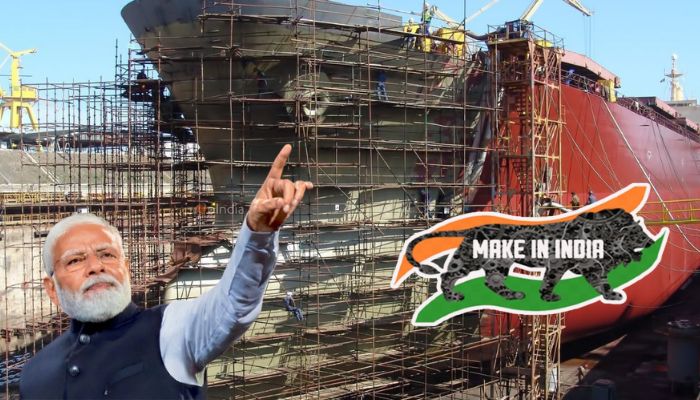

The Modi government has been taking decisions in mission mode to bolster India’s shipbuilding capacity. In a major step towards enhancing domestic shipbuilding capacity and advancing global competitiveness, the Ministry of Ports, Shipping & Waterways has notified the operational guidelines for two major shipbuilding initiatives, the Shipbuilding Financial Assistance Scheme (SBFAS) and the Shipbuilding Development Scheme (SbDS), with a budget of Rs 44,700 Crore.
The new framework, published on 27th December 2025, details the procedures for funding, oversight, and implementation.
Shipbuilding Financial Assistance Scheme (SBFAS)
The SBFAS has a budget of Rs 24,736 crore. Under this scheme, the Central government will offer fiscal assistance ranging from 15% to 25% per vessel, depending on the vessel category.
With a corpus of ₹44,700 crore, the Centre has notified comprehensive shipbuilding support schemes to promote indigenous manufacturing to foster a robust maritime ecosystem in India.
— Office of Sarbananda Sonowal (@Officeof_SS) December 29, 2025
Union @shipmin_india Minister Shri @sarbanandsonwal said that these will help create a… pic.twitter.com/V9zpl8ExmG
In addition, the scheme will offer graded support for small normal, large normal and specialised vessels, with stage-wise disbursement linked to defined milestones and backed by security instruments. The scheme also includes incentives for series orders.
The SBFAS also includes setting up a National Shipbuilding Mission (NSM). The NSM will be established to ensure coordinated planning and execution of shipbuilding initiatives.
The Ministry of Ports, Shipping and Waterways says that the Shipbreaking Credit Note will be introduced, under which ship owners scrapping vessels at Indian yards will receive a credit equivalent to 40% of the scrap value. This will link ship recycling with new ship construction and support a circular economy approach.
The SBFAS is set to support shipbuilding projects worth about Rs 96,000 crore. The scheme will stimulate domestic manufacturing while also generating employment across the maritime value chain.
Shipbuilding Development Scheme
The Modi government has also launched the Shipbuilding Development Scheme (SbDS) to strengthen long-term capacity and capability creation. The scheme worth Rs 19,989 crore will cover the development of greenfield shipbuilding clusters, expansion and modernisation of existing brownfield shipyards. In addition, the SbDS provides for the establishment of an India Ship Technology Centre under the Indian Maritime University to support research, design, innovation and skills development.
Under this initiative, greenfield shipbuilding clusters will receive 100% capital support for common maritime and internal infrastructure through a 50:50 Centre–State special purpose vehicle. In addition, existing shipyards will be eligible for 25% capital assistance for brownfield expansion of critical infrastructure, including dry docks, ship-lifts, fabrication facilities and automation systems. The Ministry of Ports, Shipping and Waterways says that disbursements will be milestone-based and monitored by independent evaluation agencies.
Besides, the SbDS also provides for a Credit Risk Coverage Framework. The CRC framework will offer government-backed insurance for pre-shipment, post-shipment and vendor-default risks to improve project bankability and financial resilience.
The government estimates that with modern infrastructure and skilled workforce development, India’s commercial shipbuilding capacity will potentially surge to 4.5 million gross tonnage per annum by 2047.
Notably, both SBFAS and SbDS will be valid until 31st March 2036, with an in-principle extension up to the year 2047/
Speaking about the two new initiatives, the Union Minister of Ports, Shipping & Waterways (MoPSW), Sarbananda Sonowal, said, “Prime Minister Narendra Modi Ji’s leadership has given India’s shipbuilding sector a decisive policy reset. These guidelines create a stable and transparent framework that will revive domestic shipbuilding, boosting forward and backward linkage, amping ‘Make in India’ initiative, enabling large-scale investment and building world-class capacity, positioning India as a major maritime nation on the path to Viksit Bharat and Aatmanirbhar Bharat.
Modi government in action mode to make India ‘Atmanirbhar’ in shipbuilding
The newly launched SBFAS and SbDS initiatives are the latest in a string of policy initiatives launched by the Modi government in recent years to revive and bolster domestic shipbuilding under the Make in India initiative and its vision for ‘Atmanirbhar Bharat’. The Central government has launched numerous schemes and entered into agreements with foreign industry leaders to attract investments, strengthen the maritime ecosystem through forward and backward linkages, and build world-class capacity to propel India to the position of a major global maritime player.
While India currently ranks 22nd in the global shipbuilding industry, India aims to enter the top 10 global rank by 2030 and become one of the top 5 countries by 2047. This ambition is a part of the Modi government’s broader visions, including the Maritime India Vision 2030 and Amrit Kaal Vision 2047, intended to capture a massive share of the global shipbuilding and ship repair markets.
At present, China, South Korea and Japan are the leaders of the shipbuilding sector globally. However, with the global shipbuilding slots booked in countries like China, South Korea and Japan until 2028, the Indian government eyes an opportunity to emerge as a reliable alternative destination for shipbuilding. India’s strategy is not confined to constructing new ships but also expanding into ship repair and recycling, given that the country already has decent infrastructure.
Notably, the global shipbuilding market was estimated at $207.15 billion in 2023, rising at a 6.5% CAGR to $220.52 billion by 2024. India’s market was valued at $90 million in 2022 and is expected to grow to $8,120 million by 2033, representing a staggering 60% CAGR.

Earlier this year, the Central government proposed a Maritime Development Fund to the tune of Rs 30,000 crore to supplement the Rs 1.5 lakh crore upgrade plan, which includes the development of 6 deep draft ports, and 2 trans-shipment hubs in addition to green and smart ports.
India’s shipbuilding policy reset was seen when the Modi government accorded the coveted ‘infrastructure’ status for large ships. Finance Minister Nirmala Sitharaman announced in her speech for the budget 2025-26 on 1st February that ships above a specified size would be included in the harmonised master list (HML) for infrastructure, making them eligible for financial incentives. This will attract private investment in the shipbuilding industry and enhance fleet modernisation.
The Modi government announced the allocation of a Maritime Development Fund (MDF) with a corpus of Rs 25,000 crore.
In September this year, it was reported that the Central government is considering investing ₹75,000 crore in the three new shipyards that are expected to be built along its east and west coasts.
On 17th December, the Ministry of Ports, Shipping and Waterways announced that it has approved a comprehensive package of Rs. 69,725 crores featuring a four-pillar approach to strengthen domestic capacity, maritime financing, shipyard development, skilling, and reforms. The government estimated that this move could stimulate the creation of over 22 lakh direct and indirect jobs.
In addition to domestic policy reforms and the launching of financial aid initiatives, India is also working towards partnering up with countries like South Korea and Japan to expand shipbuilding capacity and unlock India’s maritime development. Key Japanese and South Korean shipbuilding giants are in talks with Indian companies for joint ventures.
It is estimated that India has an opportunity to the extent of over USD 237 billion (INR 20 lakh crores) by 2047, if the massive demand stemming from the needs of the Indian shipping market is adequately targeted by Indian shipyards.
SBFAS and SbDS could prove to be a game-changer for India’s maritime ambitions
Historically, India’s shipbuilding sector has lagged behind global leaders like China, South Korea, and Japan, due to high costs, policy gaps, and limited infrastructure. However, the Modi government is working to fix these issues even though there is no overnight solution.
By subsidising construction costs and linking recycling to new builds, the Shipbuilding Financial Assistance Scheme (SBFAS) will address cost competitiveness, possibly contributing to increasing India’s share in global shipbuilding over the next decade. In addition, the Rs 96,000 crore initiative would lead to the generation of direct and indirect jobs for locals in coastal regions.
Similarly, the focus of the Shipbuilding Development Scheme (SbDS) on infrastructure upgrades and risk mitigation is a strategically significant move. The government has essentially declared that it will effectively tackle bottlenecks such as financial crunch and outdated facilities, and make Indian yards magnets for private and foreign investments.
With effective execution coupled with transparent milestone tracking and state collaboration, these initiatives could help India significantly reduce reliance on imported ships, which is currently 90%, improve export potential, boost the economy, while also bolster national security via a stronger than ever before maritime supply chain.