Long queues in many cities after rumours of petrol-diesel shortage spread in Gujarat: What was the real reason and how did the situation worsen due to media sensationalism
On 23rd March (Monday), residents in various cities hurriedly left their homes to obtain fuel in response to the circulation of rumours about a petrol and diesel shortage in Gujarat. This resulted in extensive lines at petrol pumps and created a chaotic environment. The conditions worsened, and government intervention became necessary. Deputy Chief Minister Harsh Sanghavi conducted a press conference to emphasise that the state has a sufficient supply of petrol and diesel, assuring that no interruptions are expected and encouraging citizens to remain calm and avoid a frantic rush. The matter escalated to such an extent that the deputy chief minister had to make a public appeal, urging individuals not to share incomplete information on social media and to refrain from spreading or believing in unfounded rumours. Afterwards, Chief Minister Bhupendra Patel and Minister for Energy and Petrochemicals of the state, Rushikesh Patel provided similar clarifications. From the President of the Petrol Pump Owners Association to representatives from various other associations, many stakeholders have clearly indicated that the state has adequate fuel supplies and that the real circumstances do not align with the rumours that are presently being spread. Subsequently, local police forces in different cities intervened to handle the situation. They visited petrol stations, talked to the public and encouraged them to return to their homes. फेडरेशन ऑफ गुजरात पेट्रोलियम डीलर्स एसोसिएशन (FGPDA) के अध्यक्ष, अरविंद ठक्कर ने स्पष्ट किया है कि देशभर में ईंधन की उपलब्धता पूरी तरह सामान्य है और आपूर्ति लगातार स्थिर बनी हुई है। उन्होंने कहा कि किसी भी प्रकार की कमी की कोई स्थिति नहीं है। https://t.co/O2Yz8Cd29c— Bharat Petroleum (@BPCLimited) March 23, 2026 Let us comprehend what truly transpired and the part played by the Gujarati media, which consistently acts irresponsibly in such circumstances. The association and the government have collectively declared that there is no fuel shortage in the state under the existing conditions, and supplies are available. In fact, the challenge did not stem from the supply itself, rather, it was the delays in fuel arriving at certain areas that were due to specific modifications in the fuel supply chain and payment systems, along with certain logistical obstacles. Historically, petrol pump operators received fuel on a credit basis, under usual circumstances. This meant that they would first obtain the fuel and settle the payment by the evening or within a specified timeframe. Nonetheless, acting prudently, oil companies have recently instituted an advance payment system due to the ongoing war in West Asia and the global disruption it has caused in crude oil supplies. It implies that fuel will be delivered after the payment. On 20th March, stock was delivered to all locations precisely as scheduled. This was followed by the weekend, Saturday, in particular, aligning with Eid. As a result, there was a turnout that was slightly above the usual. During this same period, rumours began to intensify, indicating that, following the challenges with LPG, there could be potential shortages of petrol and diesel. Although the situation was not genuinely critical, and the government consistently clarified this, such rumours nonetheless proliferated, causing individuals to begin purchasing petrol in advance. Consequently, this factor contributed to a minor increase in fuel sales over the weekend compared to usual numbers. On the other hand, the oil companies declared that dealers must make advance payments to obtain their stock on Friday evening. As a result, the quantities that had been dispatched earlier under the credit system were held back. On Monday morning, petrol pump operators who had not finalised their advance payments during the weekend were unable to receive any delivery. Hence, fuel did not arrive at some locations. On one hand, there was an overall increase in demand, which led to the swift sale of fuel. The quantity of fuel that pumps are usually sold over a span of one and a half to two days was depleted in just one day. On the other hand, as a result of modifications in the payment system, the supply that should have been received was unavailable due to the “payment-first” policy. As a result, these circumstances caused a short period of disarray at the pumps for a few hours. In an interview with The Times of India, Mehul Patel, who serves as the President of the Gujarat Petroleum Dealers Association, elaborated on this particular issue. He noted that in the past, dealers would obtain fuel initially and settle the payment afterwards, however, the current requirement is for payment to be made in advance. This alteration led to delays in supply, but the situation has since stabilised, alleviating any need for concern. It is noteworthy that although some petrol stations were closed for a few hours on Monday morning, this was not due to a fuel shortage, but ra
On 23rd March (Monday), residents in various cities hurriedly left their homes to obtain fuel in response to the circulation of rumours about a petrol and diesel shortage in Gujarat. This resulted in extensive lines at petrol pumps and created a chaotic environment. The conditions worsened, and government intervention became necessary. Deputy Chief Minister Harsh Sanghavi conducted a press conference to emphasise that the state has a sufficient supply of petrol and diesel, assuring that no interruptions are expected and encouraging citizens to remain calm and avoid a frantic rush.
The matter escalated to such an extent that the deputy chief minister had to make a public appeal, urging individuals not to share incomplete information on social media and to refrain from spreading or believing in unfounded rumours. Afterwards, Chief Minister Bhupendra Patel and Minister for Energy and Petrochemicals of the state, Rushikesh Patel provided similar clarifications.
From the President of the Petrol Pump Owners Association to representatives from various other associations, many stakeholders have clearly indicated that the state has adequate fuel supplies and that the real circumstances do not align with the rumours that are presently being spread. Subsequently, local police forces in different cities intervened to handle the situation. They visited petrol stations, talked to the public and encouraged them to return to their homes.
फेडरेशन ऑफ गुजरात पेट्रोलियम डीलर्स एसोसिएशन (FGPDA) के अध्यक्ष, अरविंद ठक्कर ने स्पष्ट किया है कि देशभर में ईंधन की उपलब्धता पूरी तरह सामान्य है और आपूर्ति लगातार स्थिर बनी हुई है। उन्होंने कहा कि किसी भी प्रकार की कमी की कोई स्थिति नहीं है। https://t.co/O2Yz8Cd29c— Bharat Petroleum (@BPCLimited) March 23, 2026
Let us comprehend what truly transpired and the part played by the Gujarati media, which consistently acts irresponsibly in such circumstances.
The association and the government have collectively declared that there is no fuel shortage in the state under the existing conditions, and supplies are available. In fact, the challenge did not stem from the supply itself, rather, it was the delays in fuel arriving at certain areas that were due to specific modifications in the fuel supply chain and payment systems, along with certain logistical obstacles. Historically, petrol pump operators received fuel on a credit basis, under usual circumstances.
This meant that they would first obtain the fuel and settle the payment by the evening or within a specified timeframe. Nonetheless, acting prudently, oil companies have recently instituted an advance payment system due to the ongoing war in West Asia and the global disruption it has caused in crude oil supplies. It implies that fuel will be delivered after the payment.
On 20th March, stock was delivered to all locations precisely as scheduled. This was followed by the weekend, Saturday, in particular, aligning with Eid. As a result, there was a turnout that was slightly above the usual. During this same period, rumours began to intensify, indicating that, following the challenges with LPG, there could be potential shortages of petrol and diesel.
Although the situation was not genuinely critical, and the government consistently clarified this, such rumours nonetheless proliferated, causing individuals to begin purchasing petrol in advance. Consequently, this factor contributed to a minor increase in fuel sales over the weekend compared to usual numbers.
On the other hand, the oil companies declared that dealers must make advance payments to obtain their stock on Friday evening. As a result, the quantities that had been dispatched earlier under the credit system were held back. On Monday morning, petrol pump operators who had not finalised their advance payments during the weekend were unable to receive any delivery. Hence, fuel did not arrive at some locations.
On one hand, there was an overall increase in demand, which led to the swift sale of fuel. The quantity of fuel that pumps are usually sold over a span of one and a half to two days was depleted in just one day. On the other hand, as a result of modifications in the payment system, the supply that should have been received was unavailable due to the “payment-first” policy. As a result, these circumstances caused a short period of disarray at the pumps for a few hours.
In an interview with The Times of India, Mehul Patel, who serves as the President of the Gujarat Petroleum Dealers Association, elaborated on this particular issue. He noted that in the past, dealers would obtain fuel initially and settle the payment afterwards, however, the current requirement is for payment to be made in advance. This alteration led to delays in supply, but the situation has since stabilised, alleviating any need for concern.
It is noteworthy that although some petrol stations were closed for a few hours on Monday morning, this was not due to a fuel shortage, but rather logistical challenges arising from the new payment system. Supplies were held up for a short period of time. After the supplies arrived, the situation slowly returned to normal.
It is important to note that the residents have been standing in line since yesterday and acquired enough fuel for 2-4 days all in one day. Hence, if there genuinely was a scarcity of petrol and diesel at multiple pumps, then where did all this fuel come from?
How did the media contribute to the spread of rumours
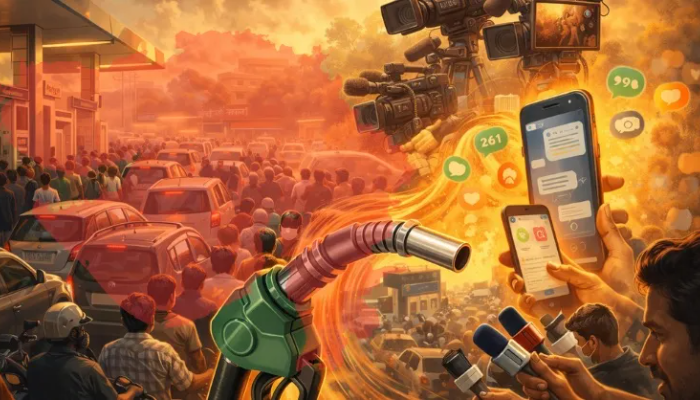
The media’s primary role is to report on current events, however, in situations like these, merely rushing to the scene with cameras to capture and broadcast images is not appropriate. This method poses the danger of exacerbating rumours and spreading incomplete information, which is precisely what occurred recently. Furthermore, it is also vital to uncover the true underlying reasons for these events and the circumstances. Many individuals did not make this effort, while news outlets simply displayed headlines announcing a “petrol shortage” in the state.
The dissemination of this information through social media and other media outlets prompted people to rush to the petrol pumps, leading to the formation of long lines and the eruption of chaos. Subsequently, Instagram accounts became involved, visiting gas stations to capture and share videos, which added to the complexity of the situation.
Listing some other Instagram pages and screenshots of their posts that fueled the rumor about a petrol and diesel shortage.Check the thread below https://t.co/vE0ti8o5Fc— Bhavesh Lodha (@bhav2406) March 24, 2026
The media outlets that first spread incomplete information began to report on the situation only after queues started to form; as a result, rather than improving, the situation deteriorated further. Ironically, when Deputy Chief Minister Harsh Sanghavi conducted a press conference to offer clarification, those same channels and journalists did a complete turnaround and began urging the public not to disseminate rumours.
Obtaining accurate information demands effort and on the other hand, it was easier to create panic among the public by asking questions such as, “How many petrol stations are shut down in which city?” Thus, some of our journalists selected this easier option and did not take into account the nature and scale of the effects that such posts would produce.
Several channels contacted petrol pump operators, however, even after receiving the accurate explanation, they produced headlines that were both misleading and sensational.
''અમને લોડ મળ્યો નથી'', હવે ગુજરાતના પેટ્રોલ પંપો સુધી મિડલ યુદ્ધની અસર! #FuelCrisis #PetrolPump #MiddleEastCrisis #GujaratNews #BreakingNews #PetrolDiesel #EnergyCrisis #IndiaNews #OilSupply #PublicIssue #Reels #Shorts #VTVDigital pic.twitter.com/NvQXWMzHUY— VTV Gujarati News and Beyond (@VtvGujarati) March 23, 2026
During a discussion with VTV, a petrol pump operator thoroughly explained that a new payment system was launched over Friday and Saturday due to certain logistical complications that hindered the arrival of supplies and hence the stock was depleted by Monday. Nevertheless, tankers have now arrived, and sales are anticipated to resume soon. Furthermore, the operator indicated that the stock had, in fact, run out just half an hour ago. Despite this, VTV reported the headline: “Petrol and Diesel Stocks Depleted.”
Zee 24 Kalak also released a report with a headline indicating that petrol and diesel prices were increasing. Staying true to its tendency for sensational headlines, this media outlet stated that “this price increase has taken place in one specific state.” That state is, in fact, Himachal Pradesh, which is presently under the governance of the Congress party. The exclusion of the state’s name from the headline resulted in significant confusion among the public, as clearly demonstrated by the comments section.
Did citizens flock to petrol pumps as a result of PM Modi’s address
During this time, Prime Minister Narendra Modi delivered a speech in the Lok Sabha on 23rd March. He discussed the situation that has developed in India in relation to the West Asian conflict for approximately 25 minutes, elaborating on the government’s initiatives and sharing several crucial details.
In the aftermath, the blame for the narrative spread by the media was directed towards Narendra Modi. It was asserted that people were flocking to petrol pumps in a frenzy solely as a result of his remarks. However, the Prime Minister did not say anything in his address that would instil fear; instead, he reassured the public. Additionally, it is important to note that queues had begun to form even before the speech was delivered.
The immature conduct exhibited by the Gujarati media was also evident during the Corona epidemic, where every circumstance was portrayed with exaggerated and incomplete information, along with sensational headlines. This pattern has reemerged in the recent incident as well.
Some self-styled journalists, defending their peers, claim that the media accurately represented the situation. However, the media’s responsibilities go beyond that. It is crucial to delve into the reasons behind any situation. In today’s social media landscape, anyone can snap a photo by simply pulling out a mobile phone and opening the camera, so why do people seek information from the media? These people will not be able to provide an answer to this question as long as this conduct persists.
Read the report in Gujarat here.