Influencer levelling allegations on Nitin Gadkari gets a defamation notice, but not Caravan magazine: Read how a thin line between caution and assertion played a role
The left-wing section of influencers and commentators has been quick to cry foul after Nitin Gadkari filed a ₹50 crore defamation case against an Ambedkarite influencer, Mukesh Mohan. Social media has since been flooded with claims of “threat to democracy” and “silencing of voices.” But before jumping to any conclusions, it is essential to examine a basic question: what exactly was said in the original report, and how far did the viral video stretch those claims? View this post on Instagram A post shared by All India Adivasi Congress (@incadivasi) What the viral video claimed An Instagram influencer named Mukesh Mohan claimed in his reel that Nitin Gadkari sells cow meat. In his reel, he stated that “Maharashtra police have arrested a truck belonging to the Rembal Agro and Foods company, which was transporting beef (cow meat). The company is owned by BJP leader Nitin Gadkari, as reported by Caravan magazine.” कुछ दिन पहले @thecaravanindia ने नितिन गडकरी पर एक रिपोर्ट छापी। रिपोर्ट नितिन गडकरी और बीफ के कारोबार से संबंधित थी।इस रिपोर्ट के आधार पर मैंने एक वीडियो किया। उस वीडियो के लिए मुझे 50Cr की मानहानि का नोटिस दिया गया और मुझपर नागपुर में एक FIR करवाई गई है।दो दिन हो गए नागपुर…— Mukesh Mohan (@MukeshMohannn) March 26, 2026 The viral video did not merely analyse or question the report’s findings; it went significantly further. It presented the issue as a settled fact, asserting that Union Minister Nitin Gadkari was linked to a company engaged in the sale of “beef,” which Mohan stated was ‘cow meat’. These kinds of claims were made with such certainty that there was little room for nuance or qualification. The distinction between an accusation and a proven fact was effectively erased because the story was told in clear terms rather than as something under investigation. But this is exactly where the problem starts. The strength of a claim does not depend on how strongly it is made, but on whether it is backed up by evidence that can be checked. The video seems to have gone from interpretation to assertion by turning a complicated web of business links and disputed facts into a direct accusation of something that was not proven. What the Caravan report actually says At its core, the issue isn’t whether the report could be discussed, criticised, or even questioned. It’s about how people understood that report and, more importantly, how it was shown to the public. A careful reading of the original report presents a far more layered and cautious picture than what the viral claims suggest. It reveals a consistent pattern of financial connections, overlapping business interests, and operational proximity, while being careful with its conclusions. Crucially, the report stops short of making any direct claim of ownership or operational control by Gadkari himself. In fact, it explicitly notes the absence of any official disclosure establishing such a relationship, even while suggesting that the entities may be closely linked in practice. The report stated that “Despite all this evidence to suggest that Rembal and Cian Agro are far more than just client and customer, there is no official disclosure about the relationship between the two entities.” Basically, the Caravan never claimed that Nitin Gadkari ‘owns’ a beef sale company. The issue of the meat trade, which forms the core of the controversy, is presented with similar caution. The company in question maintains that it deals in buffalo meat, which is legally permitted. At the same time, the report points out inconsistencies in how products are described sometimes as “buffalo meat” and at other times as “beef” thereby highlighting a degree of ambiguity in labelling. Importantly, even in the specific case of the seized truck, the court did not conclusively determine whether the meat was cow or buffalo meat, noting gaps and uncertainties in the documentation provided. Taken together, the report raises questions, inconsistencies, and possible linkages. But it does not arrive at a definitive conclusion that Gadkari owns the company, runs the business, or is directly engaged in any illegal activity. So, the issue is not whether the report raised uncomfortable questions. It did. The issue is whether those questions can be turned into definitive claims without solid proof. The critical point is where inference becomes assertion, and ambiguity becomes certainty. Here, that line was arguably crossed. Where the claim crossed the line: Caravan playing it safe vs the influencer levelling explicit allegations Therefore, the controversy does not arise merely from discussing the report, but it arises from how the report was interpreted and presented. At its core, the original report outlines linkages, overlaps, and inconsistencies, but stops short of drawing definitive conclusions. It operates within the space of investigation, raising questions rather than delivering verdicts. Even where connections appear ext
The left-wing section of influencers and commentators has been quick to cry foul after Nitin Gadkari filed a ₹50 crore defamation case against an Ambedkarite influencer, Mukesh Mohan. Social media has since been flooded with claims of “threat to democracy” and “silencing of voices.” But before jumping to any conclusions, it is essential to examine a basic question: what exactly was said in the original report, and how far did the viral video stretch those claims?
View this post on Instagram A post shared by All India Adivasi Congress (@incadivasi)
What the viral video claimed
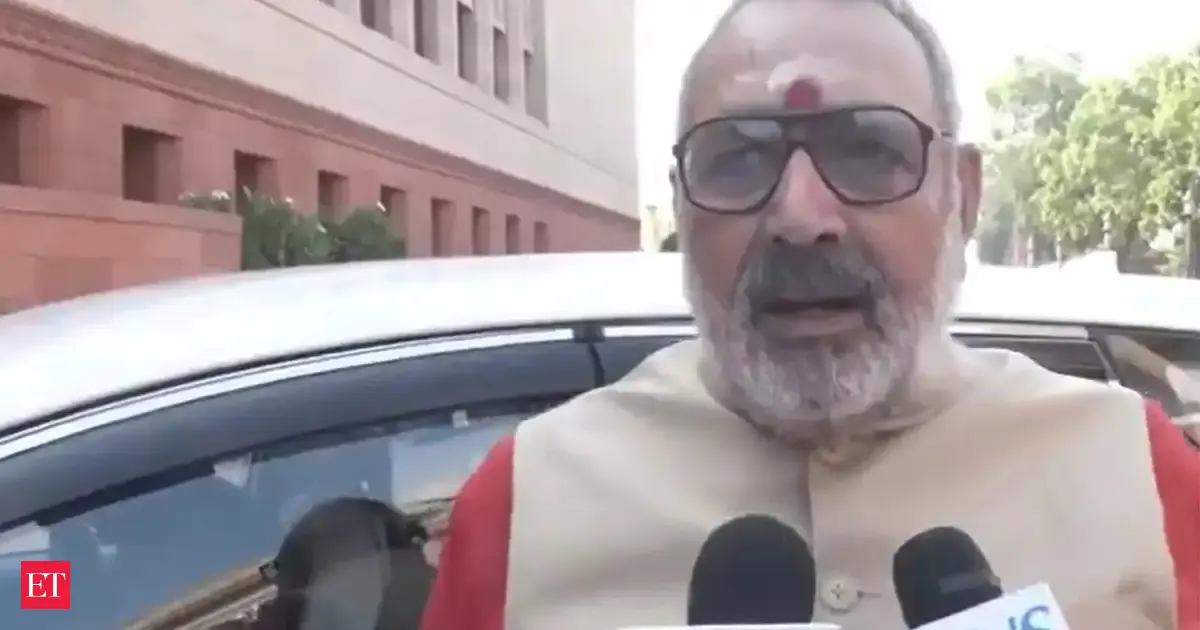
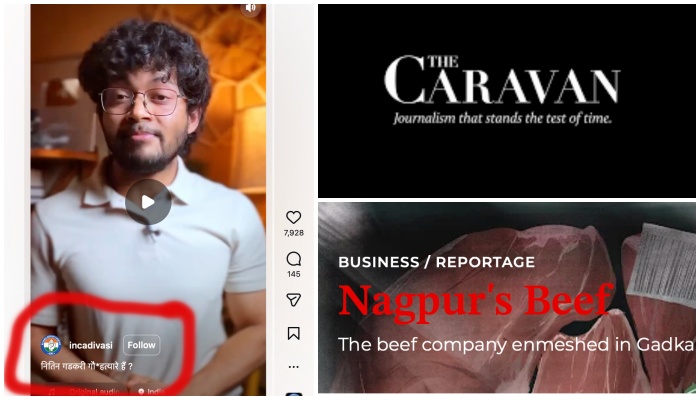
An Instagram influencer named Mukesh Mohan claimed in his reel that Nitin Gadkari sells cow meat. In his reel, he stated that “Maharashtra police have arrested a truck belonging to the Rembal Agro and Foods company, which was transporting beef (cow meat). The company is owned by BJP leader Nitin Gadkari, as reported by Caravan magazine.”
कुछ दिन पहले @thecaravanindia ने नितिन गडकरी पर एक रिपोर्ट छापी। रिपोर्ट नितिन गडकरी और बीफ के कारोबार से संबंधित थी।इस रिपोर्ट के आधार पर मैंने एक वीडियो किया। उस वीडियो के लिए मुझे 50Cr की मानहानि का नोटिस दिया गया और मुझपर नागपुर में एक FIR करवाई गई है।दो दिन हो गए नागपुर…— Mukesh Mohan (@MukeshMohannn) March 26, 2026
The viral video did not merely analyse or question the report’s findings; it went significantly further. It presented the issue as a settled fact, asserting that Union Minister Nitin Gadkari was linked to a company engaged in the sale of “beef,” which Mohan stated was ‘cow meat’. These kinds of claims were made with such certainty that there was little room for nuance or qualification. The distinction between an accusation and a proven fact was effectively erased because the story was told in clear terms rather than as something under investigation. But this is exactly where the problem starts. The strength of a claim does not depend on how strongly it is made, but on whether it is backed up by evidence that can be checked. The video seems to have gone from interpretation to assertion by turning a complicated web of business links and disputed facts into a direct accusation of something that was not proven.
What the Caravan report actually says
At its core, the issue isn’t whether the report could be discussed, criticised, or even questioned. It’s about how people understood that report and, more importantly, how it was shown to the public. A careful reading of the original report presents a far more layered and cautious picture than what the viral claims suggest. It reveals a consistent pattern of financial connections, overlapping business interests, and operational proximity, while being careful with its conclusions. Crucially, the report stops short of making any direct claim of ownership or operational control by Gadkari himself.
In fact, it explicitly notes the absence of any official disclosure establishing such a relationship, even while suggesting that the entities may be closely linked in practice. The report stated that “Despite all this evidence to suggest that Rembal and Cian Agro are far more than just client and customer, there is no official disclosure about the relationship between the two entities.” Basically, the Caravan never claimed that Nitin Gadkari ‘owns’ a beef sale company.
The issue of the meat trade, which forms the core of the controversy, is presented with similar caution. The company in question maintains that it deals in buffalo meat, which is legally permitted. At the same time, the report points out inconsistencies in how products are described sometimes as “buffalo meat” and at other times as “beef” thereby highlighting a degree of ambiguity in labelling.
Importantly, even in the specific case of the seized truck, the court did not conclusively determine whether the meat was cow or buffalo meat, noting gaps and uncertainties in the documentation provided. Taken together, the report raises questions, inconsistencies, and possible linkages. But it does not arrive at a definitive conclusion that Gadkari owns the company, runs the business, or is directly engaged in any illegal activity.
So, the issue is not whether the report raised uncomfortable questions. It did. The issue is whether those questions can be turned into definitive claims without solid proof. The critical point is where inference becomes assertion, and ambiguity becomes certainty. Here, that line was arguably crossed.
Where the claim crossed the line: Caravan playing it safe vs the influencer levelling explicit allegations
Therefore, the controversy does not arise merely from discussing the report, but it arises from how the report was interpreted and presented. At its core, the original report outlines linkages, overlaps, and inconsistencies, but stops short of drawing definitive conclusions. It operates within the space of investigation, raising questions rather than delivering verdicts. Even where connections appear extensive, the report acknowledges the absence of any formally disclosed relationship establishing direct ownership or control by Union Minister Nitin Gadkari.
This caution is deliberate, reflecting the nature of investigative reporting, which often relies on inference and pattern rather than conclusive proof. However, the viral video appears to depart from this framework. Instead of presenting the issue as one involving complex business linkages, it frames it as a matter of direct involvement. Instead of addressing ambiguity, especially in the nature of meat, which the report itself describes as inconsistently labelled between “buffalo meat” and “beef”- the video presents a clear and unqualified conclusion. What the report describes as disputed, ambiguous, and not conclusively established is presented in the video as definitive and settled.
This is not merely a matter of emphasis but a fundamental transformation of meaning. In both law and journalism, there exists a clear distinction between suggesting a possibility and asserting a fact. The former invites scrutiny; the latter demands proof. By collapsing this distinction, the video effectively converts a layered investigative narrative into a categorical allegation. What was originally framed as a network of associations and unanswered questions is presented as a conclusion involving personal culpability. It is precisely at this intersection between inference and assertion that the line arguably was crossed.
Legal perspective: What constitutes defamation
At its core, defamation concerns statements that harm a person’s reputation by presenting unverified or false claims as facts. The key issue is not whether a topic is controversial or politically sensitive, but whether the statement made is supported by credible evidence. In this case, the legal question is straightforward: can an indirect linkage, coupled with ambiguity and lack of conclusive proof, be presented as a direct and definitive claim? When interpretation is framed as fact without substantiation, it risks falling within the ambit of defamation. It is also important to note that the law does not prevent criticism or investigation. What it seeks to regulate is the presentation of unproven allegations as established truth, especially when such claims can damage reputation.
Why the case targets the influencer, not the publication
A key argument being raised online is why legal action has been initiated against the creator rather than the original publisher. This is where the distinction between reporting and reinterpretation becomes crucial. Despite its critical tone, the original report remains carefully worded. It consistently uses language that reflects uncertainty, highlighting linkages, raising questions, and explicitly noting the absence of formal proof. It does not make a direct claim that Nitin Gadkari owns or operates a beef-selling company.
However, the video appears to take that next step. It transforms a layered and cautious narrative into a direct allegation. In doing so, it assumes responsibility for the claim it presents. Therefore, Legal liability does not arise merely from discussing the report. It arises when an individual reframes that information into a definitive assertion without sufficient evidence. In that sense, the issue is not about the size of the platform, but the nature of the statement being made.
Free speech vs responsibility: The Wikimedia–ANI context
The broader debate around this controversy has also invoked concerns about free speech and alleged suppression. However, legal precedent suggests a more nuanced position. In the case involving Asian News International and Wikimedia Foundation, the Supreme Court upheld the principle of “open justice,” affirming that matters of public interest and court proceedings can be discussed and scrutinised by the public.
At the same time, this protection is not absolute. It applies to fair reporting and discussion of facts, not to distorting those facts or presenting unverified claims as established truth. The judgment underscores a balance; while public discourse must remain free, it must also remain responsible.
If we view it through this lens, the present case is not about restricting discussion, but about the manner in which that discussion is conducted. There is a difference between questioning a report and converting its inferences into definitive accusations.
Conclusion
The episode ultimately underscores a significant distinction that frequently becomes obscured in the era of viral content. Investigative reports are not meant to give final answers; they are meant to make people think. While the whole left wing portrays this as a threat to democracy, they support him by adding emotional sentiments. When those questions are turned into categorical claims without any proof, the conversation itself changes.
So, the problem is not between free speech and censorship. It is a matter of interpretation versus accusation. The right to question, criticise, and analyse is still very important. So is the duty to make sure that what is said is true.
If that distinction isn’t made, the line between commentary and defamation becomes not just thin, but also important.