How virtual magnet technology of an Indian startup can reduce the country’s dependence on rare earth magnets and break China’s monopoly on EVs
India is aggressively tackling its rare-earth magnet dependency with two major solutions: homegrown technology and government-backed manufacturing. Now, its electric vehicle (EV) sector might soon have an answer to this glaring supply chain concern. India has greatly accelerated its efforts to shift towards electric mobility, but the industry encounters pressing challenges due to its dependence on rare-earth minerals which are predominantly produced and exported by China. However, a startup based in Bengaluru has stepped in to offer a viable solution to this problem. Vimag Labs has created a groundbreaking software-defined electric motor that replaces the conventional permanent magnets which are critical components and rely on rare earth minerals with copper coils, steel and software-controlled electromagnets. Image via volektra.com Manish Kumar Seth, an automative engineer, who is the CEO launched the company in last September with the goal of reducing the consumption of rare earth materials by the EV sector through the crucial substitution. Dr. Piyush Desai who is also a veteran in this field, is the other co-founder. How Vimag’s “Virtual magnet” works The $5 million enterprise has successfully patented the “Virtual Magnet” technology in a pivotal move aimed at resolving an issue that could greatly benefit India and potentially affect the global market, thereby delivering a massive blow to China’s monopoly on rare earth minerals. It is called “A Robust Rotating Transformer Excited Synchronous Motor and Its Control” which describes its fundamental architecture. The fuel tank and the engine are the two most prominent parts of any vehicle with an internal combustion engine. These are swapped out for a battery and a motor in a modern EV. The motor and its control inverter are the actual point of interaction. It directly impacts efficiency, torque, acceleration and the maximum range an automobile can attain from its battery. A Permanent Magnet Synchronous Motor (PMSM), which employs fixed rare-earth magnets integrated in the rotor to generate torque, powers nearly all EVs on the road. However, Vimag’s Virtual Magnet Synchronous Motor (VMSM) completely removes the need for these magnets as it creates and regulates the rotor’s magnetic field in real time with power electronics and proprietary control algorithms all while maintaining a brushless, slip-ring free design. The motor wirelessly transfers power inside the motor assembly rather than via brushes or slip rings. Its programming constantly modulates copper coils, resulting in highly tuned electromagnets that mimic the actions of permanent magnets. According to the corporation, this strategy can boost vehicle economy while lowering battery demand. Software controls the motor’s characteristics and performance updates can be transmitted over the air. On the other hand, the properties of permanent magnets diminish over time owing to heat and ageing. The firm declared that the platform meets or exceeds permanent-magnet performance without utilising them. Additionally, the motor offers a little longer driving range than conventional PMSMs due to the real-time adjustment of the magnetic field and saving automakers money on costly battery cells. Seth mentioned, “This patent is the outcome of over 87,600 engineering hours.” Vimag currently has 5 granted patents as 10 more patents along with 15 trademarks are pending. Accel, Chakra Growth Fund and Thinkuvate have invested in the startup. It has reported to be conducting pilots with two-wheeler and passenger vehicle makers and also inked a manufacturing memorandum of understanding with Jendamark to enable expansion with a focus on industrial systems ranging from 200 kW (Kilowatt) to 600 kW along with robotics, defence as well as cooling applications. “We actually have physical products undergoing testing and getting ready for deployment. We invented what we call the Virtual Magnet. Using proprietary technology, wireless power transfer and sophisticated software algorithms, we generate electric fields inside the motor that behave like a permanent magnet. This allows us to build motors using only copper and steel, completely eliminating the need for rare-earth materials,” Seth conveyed while talking to NDTV. He further mentioned, “Many alternative technologies rely on physical brushes, slip rings or bulky wireless systems. Our architecture is fully integrated into the motor itself, making it compact and robust.” “Our internal tests and customer trials are actually showing that our motors perform better than traditional permanent magnet motors,” he highlighted, remarking that these will not strain the wallets of the buyers but will be “competitively priced with permanent magnet motors.” The inception of the revolutionary idea The Covid-19 pandemic had left the world in a vulnerable state with the global economy near-total shutdown and Seth was also confronted with a c
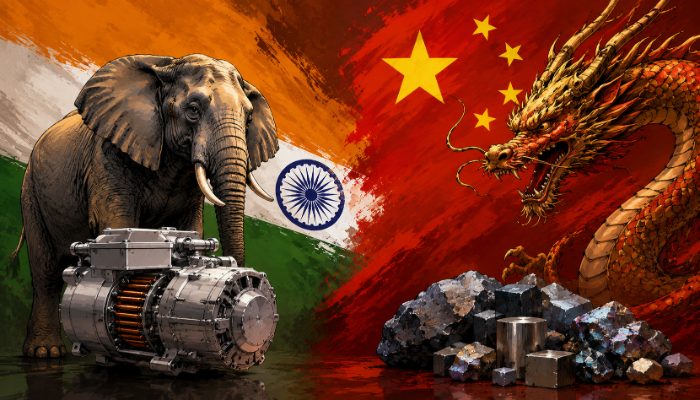
India is aggressively tackling its rare-earth magnet dependency with two major solutions: homegrown technology and government-backed manufacturing. Now, its electric vehicle (EV) sector might soon have an answer to this glaring supply chain concern. India has greatly accelerated its efforts to shift towards electric mobility, but the industry encounters pressing challenges due to its dependence on rare-earth minerals which are predominantly produced and exported by China.
However, a startup based in Bengaluru has stepped in to offer a viable solution to this problem. Vimag Labs has created a groundbreaking software-defined electric motor that replaces the conventional permanent magnets which are critical components and rely on rare earth minerals with copper coils, steel and software-controlled electromagnets.
Image via volektra.com
Manish Kumar Seth, an automative engineer, who is the CEO launched the company in last September with the goal of reducing the consumption of rare earth materials by the EV sector through the crucial substitution. Dr. Piyush Desai who is also a veteran in this field, is the other co-founder.
How Vimag’s “Virtual magnet” works
The $5 million enterprise has successfully patented the “Virtual Magnet” technology in a pivotal move aimed at resolving an issue that could greatly benefit India and potentially affect the global market, thereby delivering a massive blow to China’s monopoly on rare earth minerals. It is called “A Robust Rotating Transformer Excited Synchronous Motor and Its Control” which describes its fundamental architecture.
The fuel tank and the engine are the two most prominent parts of any vehicle with an internal combustion engine. These are swapped out for a battery and a motor in a modern EV. The motor and its control inverter are the actual point of interaction. It directly impacts efficiency, torque, acceleration and the maximum range an automobile can attain from its battery.
A Permanent Magnet Synchronous Motor (PMSM), which employs fixed rare-earth magnets integrated in the rotor to generate torque, powers nearly all EVs on the road. However, Vimag’s Virtual Magnet Synchronous Motor (VMSM) completely removes the need for these magnets as it creates and regulates the rotor’s magnetic field in real time with power electronics and proprietary control algorithms all while maintaining a brushless, slip-ring free design.
The motor wirelessly transfers power inside the motor assembly rather than via brushes or slip rings. Its programming constantly modulates copper coils, resulting in highly tuned electromagnets that mimic the actions of permanent magnets. According to the corporation, this strategy can boost vehicle economy while lowering battery demand.
Software controls the motor’s characteristics and performance updates can be transmitted over the air. On the other hand, the properties of permanent magnets diminish over time owing to heat and ageing. The firm declared that the platform meets or exceeds permanent-magnet performance without utilising them.
Additionally, the motor offers a little longer driving range than conventional PMSMs due to the real-time adjustment of the magnetic field and saving automakers money on costly battery cells. Seth mentioned, “This patent is the outcome of over 87,600 engineering hours.” Vimag currently has 5 granted patents as 10 more patents along with 15 trademarks are pending. Accel, Chakra Growth Fund and Thinkuvate have invested in the startup.
It has reported to be conducting pilots with two-wheeler and passenger vehicle makers and also inked a manufacturing memorandum of understanding with Jendamark to enable expansion with a focus on industrial systems ranging from 200 kW (Kilowatt) to 600 kW along with robotics, defence as well as cooling applications.
“We actually have physical products undergoing testing and getting ready for deployment. We invented what we call the Virtual Magnet. Using proprietary technology, wireless power transfer and sophisticated software algorithms, we generate electric fields inside the motor that behave like a permanent magnet. This allows us to build motors using only copper and steel, completely eliminating the need for rare-earth materials,” Seth conveyed while talking to NDTV.
He further mentioned, “Many alternative technologies rely on physical brushes, slip rings or bulky wireless systems. Our architecture is fully integrated into the motor itself, making it compact and robust.”
“Our internal tests and customer trials are actually showing that our motors perform better than traditional permanent magnet motors,” he highlighted, remarking that these will not strain the wallets of the buyers but will be “competitively priced with permanent magnet motors.”
The inception of the revolutionary idea
The Covid-19 pandemic had left the world in a vulnerable state with the global economy near-total shutdown and Seth was also confronted with a considerable professional crisis. A shipment of magnets, which were essential for the prototype motors his company was constructing got stuck in a Shanghai port that was under lockdown in 2020. It remained there for three agonising months.
Hence, Seth made the decision to handle things himself. “I had gone through that pain. At that point in time, I decided that we need to do something about it. And that’s how the idea of the total magnet-free, rare-earth-free motor started,” he disclosed in a conversation with India Today.
AC (Alternating Current) induction motors or switched reluctance motors can be used but they are heavy and ineffective solutions. Ferrite magnets also lead to lower performance. Seth underscored, “You cannot substitute gold with aluminum. You have to give something as worth of gold. Other magnet-free tech makes motors big. You cannot generate as much torque or power, and then you consume more batteries, so your range goes down. Global automotive and aerospace industries are not going to compromise on performance.”
“We remove permanent magnets, replace them with copper coils, and then through software, we generate magnetic fields inside the motor. The trick is how to convert the copper inside the motor into magnets, and that we do through software and electronics,” he expressed.
Seth pointed out, “If you’re driving a traditional EV, and the physical magnets get demagnetised due to heat or age, you are stuck. You cannot do anything. But if it’s software-defined, you can actively tune the magnetic field on the fly. You can keep improving the performance of the motor through over-the-air (OTA) software developments without ever changing the physical hardware.”
China’s chokehold on rare earth magnets
The International Energy Agency (IEA) informed that China controls about 90% of the world’s rare earth minerals and 94% of the magnets (specifically, Neodymium-Iron-Boron, or NdFeB magnets) used in powerful electric motors, giving it a complete dominance on the supply chain.
According to its report, the country produced 94% of the sintered permanent magnets used in EV motors and approximately 91% of the world’s rare-earth refining and separation. Its’s leverage comes from processing rather than from the ground because it only owns around one-third of the globe’s reserves.
These tiny yet potent parts are indispensable for modern life and are used in everything from cellphones, medical scanners and defence gear to wind turbines and electric vehicles. Beijing supplies 80-90% of New Delhi’s magnets and related materials. However, it has consistently misused this position as a tool in diplomatic confrontations, tightening export restrictions which made India, United States and other nations susceptible to supply shocks.
It placed similar limits on seven heavy rare-earth metals and associated magnets in April 2025. Afterwards, American and European automakers were compelled to reduce output while licenses were being processed. China slapped a “0.1%” de minimis rule that targeted any foreign-made product that contained its rare earth content in October that year. The imposition was later suspended but not entirely obliterated to ensure the East Asian country retained control.
Beijing’s export quotas are a key factor in the extreme volatility of their rates. In the past, prices have fluctuated between 30 and 80 per cent in just a few months and even touched 1 million Chinese Renminbi (RMB) a tonne before dropping. Thus, China has enjoyed a disproportionate amount of influence over international downstream industries.
The availability of rare earths for commercial EVs, drones and robotics is also swiftly reducing owing to the explosive growth of artificial intelligence, which demands enormous amounts of these elements for data center infrastructure and defence hardware.
Furthermore, leaching, a procedure that involves dissolving raw ore in large amounts of acid to separate the heavy metals is necessary to refine rare earth elements. Thorium, a radioactive waste product that needs long-term and specialised containment is an essential outcome of this operation. This is the primary reason why the majority of nations outsource the production of magnets to China rather than deal with radioactive waste on their own soil. However, these unstable times have pushed them to sought resource sovereignty.
Indian technology to the rescue
India possesses enormous subsurface reserves of rare earth minerals, but it is quite expensive, tedious and difficult to refine them into forms that are usable and China has a long history of success in this field. However, Vimag’s motor is completely dependent on common power electronics, steel and standard copper, all of which can be produced wholly in India.
“As the electronics industry moves further, and as India invests heavily into chips through the India Semiconductor Mission, the cost of our motors is going to continuously go down. We are electronics-dependent rather than rare-earth-dependent. Supply of rare earths is going to decrease globally, but the supply of semiconductors is only going to increase,” Seth noted.
His firm is now concentrating on ecosystems for electric two-and three-wheelers. According to him, there is ongoing testing with one of the top five manufacturers of electric two-wheelers and comprehensive talks with another firm that holds the top two spots. They even partnered with an “iconic, premium Indian heritage brand that recently made its foray into EVs.”
Likewise, Vimag has teamed up with a powertrain supplier that has a staggering 40% market share in the commercial three-wheeler sector and is collaborating with one of the top two passenger vehicle producers in India to co-develop a next-generation EV platform. It is even collaborating with a European Tier 1 automotive supplier to include their magnet-free motor into high-end European and US electric cars.
Seth outlined, “The products are actually in the real world right now. People can buy them, but because we are limited by supply, we are ramping up carefully. We expect to ship between 1,000 and 10,000 motors from our factory by the end of this year.”
The platform provides OEMs (Original Equipment Manufacturers) with two benefits: reduced motor costs and protection from the supply-chain hazards associated with rare-earth magnets. It also endorses Modi government’s “Make in India” and “Atmanirbhar Bharat” objectives by facilitating domestic production.
Seth shared that the project “strengthens every dimension of our commercial roadmap-OEM partnerships, licensing, manufacturing scale-up, and future growth. Our long-term vision is to build scalable, software-driven, magnet-free motor systems for global electrification. This innovation strengthens India’s deep-tech base across electric mobility, power electronics, robotics, defence and clean-energy systems.”
India’s efforts to combat China’s supremacy in the rare-earths market
India intends to roughly triple the size of its rare earth magnet production incentive program of ₹7,280 crore as it wants to build up indigenous capacity in a market centred around China. The proposal was approved in November. It intends to generate 6,000 tonnes of permanent magnets annually within seven years and will provide capital and sales-linked incentives to certain entities. The mission is to satisfy surging domestic demand, which authorities predict will double over the next five years.
Dedicated corridors for the mining, processing, research and production of Rare Earth Permanent Magnets (REPMs) in Odisha, Kerala, Andhra Pradesh and Tamil Nadu were announced during the Union Budget 2026–2027. India is making a concerted effort to increase its raw material mining and processing operations.
It established the National Critical Mineral Mission (NCMM) in January 2025 for a 7-year period and committed to ensuring robust supply chains and stocks for the assignment. The ambition is far more than a traditional mining venture and outlines a long-term plan to improve India’s technological self-reliance, economic development and energy security.
India is also going to invest in the production of steel, nickel and rare earth permanent magnets in Indonesia to strengthen the supply channel. The announcement was made during Prime Minister Narendra Modi’s latest visit to the country.
Reliance, Vedanta and Adani have expressed interest in building facilities to process the substantial reserves of valuable rare-earth minerals found in Andhra Pradesh, reported Reuters. The three are among almost ten companies that have indicated interest in commencing these operations in the state which hopes to draw ₹500 billion in rare earth and titanium investments over the next ten years. Meanwhile, New Delhi is scaling up measures to foster local rare earth mining, processing and magnet manufacturing capabilities.
An organised campaign is clearly in motion to break China’s grip on rare earths, with both the Modi government and companies aligning their efforts. Vimag has also on the verge of a a monumental leap in this regard which could trigger an unprecedented change in the EV sector and provide an extraordinary boost to Indian technology and manufacturing prowess.