How India remains at the forefront of vaccine development, the latest being the jab for dengue prevention
On 20th July (Monday), the Drug Controller General of India (DCGI) has allowed market authorisation to Takeda Biopharmaceuticals India Private Limited for a dengue prevention vaccination “QDENGA” in a significant breakthrough in the fight against the fatal disease. According to the company, pre-vaccination screening including blood-test is not necessary for this live-attenuated tetravalent vaccine which means that it protects against all four dengue virus serotypes (DENV 1, 2, 3 and 4) and can be administered irrespective of prior dengue exposure in contrast to certain other dengue vaccines like Dengvaxia. Takeda, a Japanese pharmaceutical entity teamed up with Hyderabad-based Biological E vaccine manufacturer in 2024 to increase QDENGA production in line with “Make in India” mission. Furthermore, the former has set a target of producing 100 million doses yearly for the world by the end of the decade. The goal would be aided by this partnership which intends to build a manufacturing capacity of 50 million doses annually. The vaccine can be provided to individuals between the ages of 4 and 60. More than 40 countries such as the European Union, the United Kingdom, Brazil, Indonesia and Argentina have already given a nod to the vaccine and India has followed suit as dengue turns out to be among its worst seasonal public health risks. Mahender Nayak, Head of Intercontinental Markets at Takeda expressed, “Since its launch in 2022, QDENGA has been approved in 43 countries, with more than 32 million doses distributed globally. This approval marks an important step forward in strengthening dengue prevention in India.” It is intended to boost immunity against all four dengue virus serotypes, minimising the likelihood of severe illness that can lead to hospitalisation and symptomatic dengue. The vaccination is given in two doses of 0.5 milliliter spaced three months apart by subcutaneous injection. World Health Organisation (WHO) has advised its usage in regions with a high dengue transmission prevalence as part of a global dengue control plan alongside incorporation in public immunisation programs in high-transmission areas without needing pre-vaccination verification. How useful is QDENGA The firm mentioned that long-term data gathered over a seven-year period demonstrated that the vaccination remains effective in providing protection against hospitalisation and dengue infection triggered by all four dengue virus serotypes. The results of Takeda’s worldwide clinical research program, which comprised 19 Phase I, II, and III clinical trials with over 28,000 individuals in both dengue-endemic and non-endemic countries, served as the foundation for the acceptance. The Phase III DEN-302 clinical trial in India, which examined the vaccine’s safety and immunological response in individuals aged 4 to 60 in India, provided further support for the conclusion. Over 20,000 children and adolescents from 8 dengue-endemic nations engaged in the crucial TIDES Phase III trial, which generated positive long-term outcomes. The review consisted of 4.5 years of monitoring which illustrated that the vaccine showcased 84.1% protection against hospitalisation due to dengue, 90.4% efficacy against dengue-related hospitalisation after 18 months and overall, about 61% protection against dengue with virological confirmation. Furthermore, efficency varied by dengue serotype but both persons with and without prior dengue infection had sustained protection against severe dengue. The WHO’s recommendation and other worldwide regulatory licenses were influenced by these findings. Nayak conveyed, “Dengue is a growing public health challenge, and India needs sustained, evidence-based prevention.” Empirical substantiation and ongoing pharmacovigilance to improve knowledge of the vaccine’s safety and efficacy further advance these clinical aims. The significance for India The permission comes as India continues to record one of the largest dengue cases in the world and the four virus serotypes circulate at the same time in various places within its borders. The tally has risen dramatically as a result of population expansion, urbanisation, shifting mosquito habitats and climate change. The reports have surged more than 11-fold over the past 20 years with India accounting for about one-third of worldwide dengue epidemic. Hospitals continue to be under tremendous strain from seasonal outbreaks, especially during the monsoon and post-monsoon seasons. Control of mosquitoes, removing breeding grounds, personal safety precautions, early diagnosis and supportive care were prescribed to counter the menace. However, the vaccine has added another crucial layer to tackle the issue. Goh Choo Beng, Medical Affairs Head for Takeda’s Southeast Asia and India Cluster pointed out, “Its approval represents an important step in strengthening India’s comprehensive approach to dengue prevention, alongside vector control
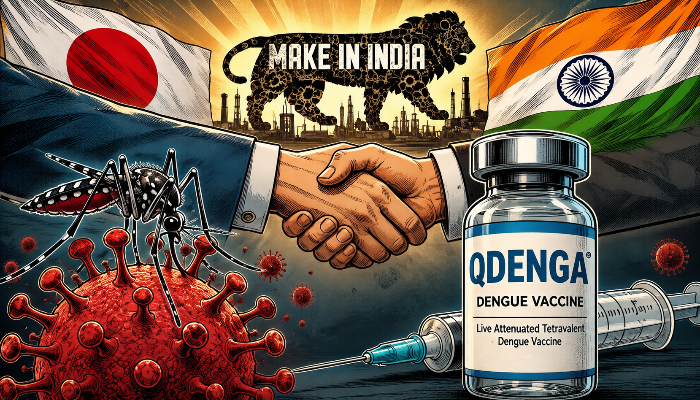
On 20th July (Monday), the Drug Controller General of India (DCGI) has allowed market authorisation to Takeda Biopharmaceuticals India Private Limited for a dengue prevention vaccination “QDENGA” in a significant breakthrough in the fight against the fatal disease.
According to the company, pre-vaccination screening including blood-test is not necessary for this live-attenuated tetravalent vaccine which means that it protects against all four dengue virus serotypes (DENV 1, 2, 3 and 4) and can be administered irrespective of prior dengue exposure in contrast to certain other dengue vaccines like Dengvaxia.
Takeda, a Japanese pharmaceutical entity teamed up with Hyderabad-based Biological E vaccine manufacturer in 2024 to increase QDENGA production in line with “Make in India” mission. Furthermore, the former has set a target of producing 100 million doses yearly for the world by the end of the decade. The goal would be aided by this partnership which intends to build a manufacturing capacity of 50 million doses annually.
The vaccine can be provided to individuals between the ages of 4 and 60. More than 40 countries such as the European Union, the United Kingdom, Brazil, Indonesia and Argentina have already given a nod to the vaccine and India has followed suit as dengue turns out to be among its worst seasonal public health risks.
Mahender Nayak, Head of Intercontinental Markets at Takeda expressed, “Since its launch in 2022, QDENGA has been approved in 43 countries, with more than 32 million doses distributed globally. This approval marks an important step forward in strengthening dengue prevention in India.”
It is intended to boost immunity against all four dengue virus serotypes, minimising the likelihood of severe illness that can lead to hospitalisation and symptomatic dengue. The vaccination is given in two doses of 0.5 milliliter spaced three months apart by subcutaneous injection.
World Health Organisation (WHO) has advised its usage in regions with a high dengue transmission prevalence as part of a global dengue control plan alongside incorporation in public immunisation programs in high-transmission areas without needing pre-vaccination verification.
How useful is QDENGA
The firm mentioned that long-term data gathered over a seven-year period demonstrated that the vaccination remains effective in providing protection against hospitalisation and dengue infection triggered by all four dengue virus serotypes.
The results of Takeda’s worldwide clinical research program, which comprised 19 Phase I, II, and III clinical trials with over 28,000 individuals in both dengue-endemic and non-endemic countries, served as the foundation for the acceptance. The Phase III DEN-302 clinical trial in India, which examined the vaccine’s safety and immunological response in individuals aged 4 to 60 in India, provided further support for the conclusion.
Over 20,000 children and adolescents from 8 dengue-endemic nations engaged in the crucial TIDES Phase III trial, which generated positive long-term outcomes. The review consisted of 4.5 years of monitoring which illustrated that the vaccine showcased 84.1% protection against hospitalisation due to dengue, 90.4% efficacy against dengue-related hospitalisation after 18 months and overall, about 61% protection against dengue with virological confirmation.
Furthermore, efficency varied by dengue serotype but both persons with and without prior dengue infection had sustained protection against severe dengue. The WHO’s recommendation and other worldwide regulatory licenses were influenced by these findings. Nayak conveyed, “Dengue is a growing public health challenge, and India needs sustained, evidence-based prevention.”
Empirical substantiation and ongoing pharmacovigilance to improve knowledge of the vaccine’s safety and efficacy further advance these clinical aims.
The significance for India
The permission comes as India continues to record one of the largest dengue cases in the world and the four virus serotypes circulate at the same time in various places within its borders. The tally has risen dramatically as a result of population expansion, urbanisation, shifting mosquito habitats and climate change.
The reports have surged more than 11-fold over the past 20 years with India accounting for about one-third of worldwide dengue epidemic. Hospitals continue to be under tremendous strain from seasonal outbreaks, especially during the monsoon and post-monsoon seasons. Control of mosquitoes, removing breeding grounds, personal safety precautions, early diagnosis and supportive care were prescribed to counter the menace. However, the vaccine has added another crucial layer to tackle the issue.
Goh Choo Beng, Medical Affairs Head for Takeda’s Southeast Asia and India Cluster pointed out, “Its approval represents an important step in strengthening India’s comprehensive approach to dengue prevention, alongside vector control, surveillance, community awareness and other public health measures.”
QDENGA has been prequalified by the WHO, indicating that it satisfies international standards for efficacy, safety and quality as well as validates the vaccine for purchase by global entities like the Pan American Health Organisation (PAHO) and United Nations International Children’s Emergency Fund (UNICEF).
Local production might boost supply and cut off dependence on imports. The cost of the vaccine will also vary subject to whether it is first solely available on the commercial market or if it is subsequently introduced to government immunisation schemes.
The way forward
The prevention of mosquito bites and the management of mosquito reproduction cannot be replaced by vaccination. WHO highlighted that it should be implemented as part of an integrated approach that consists of control of mosquitoes, awareness of the community, early diagnosis, obtaining healthcare and monitoring.
However, Dengue cannot be totally eradicated by extremely effective vaccinations because 4 distinct virus serotypes are simultaneously transmitted, infection is continuously spread by mosquito populations which are flourishing due to urbanisation and climate change. According to experts, vaccinations should assist with current public health initiatives rather than take their place.
During seasonal outbreaks, QDENGA could lessen hospital admissions, acute medical conditions and the load on healthcare systems if it is extensively implemented. Moreover, India is presently positioned as a key manufacturing location for the world’s supply of dengue vaccines owing to the agreement between the two sides which could also prove advantageous for the country.
India at the forefront of vaccine development
India’s capability for vaccine research and development is accelerating as it continues to be an essential part in the creation of critical new vaccines. The nation is one of the world’s leading producers of vaccines and its stature in this field was recently evident during the Covid-19 pandemic.
India had built its first domestic vaccine “Covaxin” which was created by pharmaceutical firm Bharat Biotech and government-funded Indian Council of Medical Research (ICMR) and the National Institute of Virology (NIV) at the time.
On the other hand, Pune’s Serum Institute of India (SII) made Covishield, a variant of the AstraZeneca-Oxford COVID-19 vaccine along with Covovax XBB.1.5 and Covovax (developed by Novavax). The vaccines were also exported to other countries as part of New Delhi’s “Vaccine Maitri”(Friendship) campaign and flew at least more than 298 million vaccines to about 100 countries worldwide.
SII also developed and produces “Cervavac” which is an indigenous Human Papillomavirus (HPV) vaccine that protects against its 4 HPV types (6, 11, 16, 18). India’s Department of Biotechnology, the Biotechnology Industry Research Assistance Council and the Bill & Melinda Gates Foundation were also involved in the project. The vaccine is used to prevent genital warts and cervical cancer. It was recognised by the drug controller general of India in January 2023.
India has also developed vaccines for polio, rabies, Hepatitis B, Swine flu, Meningitis, Cholera, Japanese Encephalitis and Rotavirus Gastroenteritis, among others.
“India accounts for 60 per cent of global vaccine production making it the largest vaccine producer in the world. India is also one of the biggest suppliers of low-cost vaccines in the world and is the largest provider of generic medicines globally, occupying a 20% share in global supply by volume,” an estimate suggested in 2023.