Hassan Suhrawardy was no ‘academic’: He was a Muslim League Jihadi, whose nephew was the ‘Butcher of Bengal’ – why Gopal Mukherjee deserves his name etched in history
West Bengal Chief Minister Suvendu Adhikari announced on Sunday, 21 June, that Kolkata’s Suhrawardy Avenue would be renamed Gopal Mukherjee Road, a move he described as a historic correction of a long-standing historical wrong. The decision came a day after the Kolkata Municipal Corporation formally renamed the prominent road, which had for decades carried the name of the Suhrawardy family. Welcoming the move, Adhikari, in a post on social media, wrote, “For decades, a major artery of our city bore the name of someone who wilfully misused state power as a weapon, orchestrating the massacre of innocent citizens for sheer political gain.” I commend the historic decision taken by the Kolkata Municipal Corporation, yesterday, on the solemn occasion of Paschimbanga Divas, which would be instrumental in rectifying a historical wrong.Suhrawardy Avenue will now be renamed as Gopal Mukherjee Road.For decades, a major… pic.twitter.com/eUmZj1msE9— Suvendu Adhikari (@SuvenduWB) June 21, 2026 The road has now been named after Gopal Chandra Mukherjee, popularly known as Gopal ‘Patha’, an influential figure linked to the events that followed the Great Calcutta Killings of 1946. The decision has immediately sparked a political controversy. Leaders from the Congress, Youth Congress, Left parties and several secular commentators have accused the BJP government of confusing history. They argue that the avenue was named after Lieutenant Colonel Hassan Suhrawardy, an academic and former Vice-Chancellor of Calcutta University, and not after his nephew, Huseyn Shaheed Suhrawardy, the former Premier of Bengal, who remains a deeply controversial figure because of his role during Direct Action Day in 1946. Left and Youth Congress defend Hassan Suhrawardy The Youth Congress, Trinamool Congress (TMC), and various leftists began accusing the BJP government of confusing history, arguing that the administration had targeted the wrong member of the Suhrawardy family. Opposition leaders and secular academicians are trying to defend Hassan Suhrawardy by portraying him as a mere “academic” and an innocent intellectual whose only mistake was that he happened to be the uncle of the infamous Huseyn Shaheed Suhrawardy. Kolkata's Suhrawardy Avenue is renamed Gopal Mukherjee Road by the KMC. Critics call out the BJP govt for conflating academic Sir Hassan Suhrawardy (1933) with controversial Huseyn Suhrawardy, arguing the move erases genuine educational history. pic.twitter.com/y8f1s9lMCc— WB Youth Congress (@IYCWestBengal) June 21, 2026 However, the reality is not as simple as the leftists are portraying on social media. In reality, Hassan Suhrawardy was not merely an academic but was also associated with the Muslim League, and the larger political legacy of the Suhrawardy family cannot be separated from the events that shaped Bengal during the Partition era. Who was Huseyn Shaheed Suhrawardy: The Butcher of Bengal Huseyn Shaheed Suhrawardy was a senior Muslim League leader who served as the Premier of Bengal in the years leading up to Partition. He later moved to Pakistan and eventually became the Prime Minister of Pakistan. His name remains closely associated with the communal violence that erupted in Calcutta on 16 August 1946, a day remembered as the Great Calcutta Killings. The violence followed Muslim League leader Muhammad Ali Jinnah’s call for “Direct Action Day” after disagreements with the Congress over the future of British India. The day witnessed one of the worst outbreaks of communal violence in pre-Independence India. Huseyn Shaheed Suhrawardy had instructed all Islamic clerics to deliver sermons telling Jumma Namazis to do everything possible for the creation of Pakistan. It was a clear dog whistle to start attacking the Hindu community. At the same time, he assured violent Muslims that they would enjoy legal immunity and that the police would not intervene. This further emboldened armed mobs to unleash mayhem in Hindu neighbourhoods. Suhrawardy effectively restrained the law enforcement authorities, allowing the Muslim goons to carry out their attacks without fear of reprisal. As the day progressed, the situation deteriorated rapidly. Muslim mobs armed with iron rods, swords, and other weapons began targeting Hindu homes and businesses across the city of Kolkata. Areas such as College Street and Barabazar became battlegrounds for Muslims to carry out mass killings, rapes, and arson. The riots lasted several days and are estimated to have claimed around 5,000 lives. Tens of thousands were injured, while over one lakh people were rendered homeless. The violence later spread to other parts of the subcontinent and contributed to the atmosphere that ultimately led to Partition. Huseyn Shaheed Suhrawardy had played a central role in enabling the violence that engulfed Calcutta in August 1946. Unmasking the uncle: The so-called “Secular intellectual” While leftists and secu
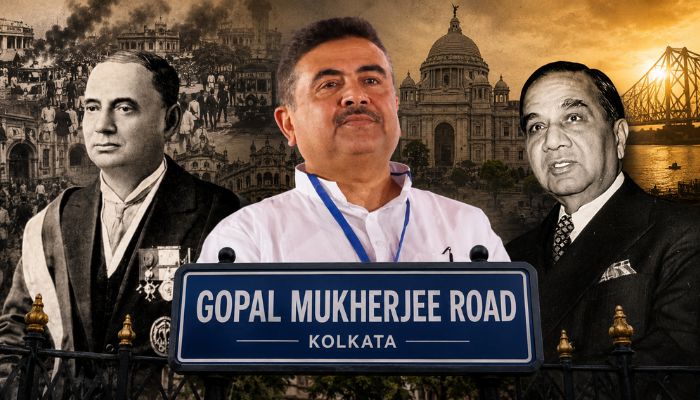
West Bengal Chief Minister Suvendu Adhikari announced on Sunday, 21 June, that Kolkata’s Suhrawardy Avenue would be renamed Gopal Mukherjee Road, a move he described as a historic correction of a long-standing historical wrong. The decision came a day after the Kolkata Municipal Corporation formally renamed the prominent road, which had for decades carried the name of the Suhrawardy family.
Welcoming the move, Adhikari, in a post on social media, wrote, “For decades, a major artery of our city bore the name of someone who wilfully misused state power as a weapon, orchestrating the massacre of innocent citizens for sheer political gain.”
I commend the historic decision taken by the Kolkata Municipal Corporation, yesterday, on the solemn occasion of Paschimbanga Divas, which would be instrumental in rectifying a historical wrong.Suhrawardy Avenue will now be renamed as Gopal Mukherjee Road.For decades, a major… pic.twitter.com/eUmZj1msE9— Suvendu Adhikari (@SuvenduWB) June 21, 2026
The road has now been named after Gopal Chandra Mukherjee, popularly known as Gopal ‘Patha’, an influential figure linked to the events that followed the Great Calcutta Killings of 1946.
The decision has immediately sparked a political controversy. Leaders from the Congress, Youth Congress, Left parties and several secular commentators have accused the BJP government of confusing history. They argue that the avenue was named after Lieutenant Colonel Hassan Suhrawardy, an academic and former Vice-Chancellor of Calcutta University, and not after his nephew, Huseyn Shaheed Suhrawardy, the former Premier of Bengal, who remains a deeply controversial figure because of his role during Direct Action Day in 1946.
Left and Youth Congress defend Hassan Suhrawardy
The Youth Congress, Trinamool Congress (TMC), and various leftists began accusing the BJP government of confusing history, arguing that the administration had targeted the wrong member of the Suhrawardy family. Opposition leaders and secular academicians are trying to defend Hassan Suhrawardy by portraying him as a mere “academic” and an innocent intellectual whose only mistake was that he happened to be the uncle of the infamous Huseyn Shaheed Suhrawardy.
Kolkata's Suhrawardy Avenue is renamed Gopal Mukherjee Road by the KMC. Critics call out the BJP govt for conflating academic Sir Hassan Suhrawardy (1933) with controversial Huseyn Suhrawardy, arguing the move erases genuine educational history. pic.twitter.com/y8f1s9lMCc— WB Youth Congress (@IYCWestBengal) June 21, 2026
However, the reality is not as simple as the leftists are portraying on social media. In reality, Hassan Suhrawardy was not merely an academic but was also associated with the Muslim League, and the larger political legacy of the Suhrawardy family cannot be separated from the events that shaped Bengal during the Partition era.
Who was Huseyn Shaheed Suhrawardy: The Butcher of Bengal
Huseyn Shaheed Suhrawardy was a senior Muslim League leader who served as the Premier of Bengal in the years leading up to Partition. He later moved to Pakistan and eventually became the Prime Minister of Pakistan.
His name remains closely associated with the communal violence that erupted in Calcutta on 16 August 1946, a day remembered as the Great Calcutta Killings.
The violence followed Muslim League leader Muhammad Ali Jinnah’s call for “Direct Action Day” after disagreements with the Congress over the future of British India. The day witnessed one of the worst outbreaks of communal violence in pre-Independence India.
Huseyn Shaheed Suhrawardy had instructed all Islamic clerics to deliver sermons telling Jumma Namazis to do everything possible for the creation of Pakistan. It was a clear dog whistle to start attacking the Hindu community.
At the same time, he assured violent Muslims that they would enjoy legal immunity and that the police would not intervene. This further emboldened armed mobs to unleash mayhem in Hindu neighbourhoods.
Suhrawardy effectively restrained the law enforcement authorities, allowing the Muslim goons to carry out their attacks without fear of reprisal. As the day progressed, the situation deteriorated rapidly.
Muslim mobs armed with iron rods, swords, and other weapons began targeting Hindu homes and businesses across the city of Kolkata. Areas such as College Street and Barabazar became battlegrounds for Muslims to carry out mass killings, rapes, and arson.
The riots lasted several days and are estimated to have claimed around 5,000 lives. Tens of thousands were injured, while over one lakh people were rendered homeless. The violence later spread to other parts of the subcontinent and contributed to the atmosphere that ultimately led to Partition.
Huseyn Shaheed Suhrawardy had played a central role in enabling the violence that engulfed Calcutta in August 1946.
Unmasking the uncle: The so-called “Secular intellectual”
While leftists and secularists have started their ritual mourning, crying that the road was named after the “secular intellectual” uncle Hassan and not the “butcher” nephew Huseyn, the historical reality of the family’s political allegiance tells a deeper story.
BJP is gloating over changing the name of a lane on Kolkata which was named after Hassan Suhrawardy Hassan Suhrawardy was a prominent physician and the Vice-Chancellor of the University of Calcutta between 1930 and 1934They mistook it for being named after Huseyn Shaheed… pic.twitter.com/9mZ7lx47Ev— Supriya Shrinate (@SupriyaShrinate) June 22, 2026
Lieutenant Colonel Hassan Suhrawardy was far from a neutral academic detached from Muslim League politics. Though his public image is carefully curated as a sophisticated surgeon, Vice-Chancellor of Calcutta University, and an art critic, he was later an active, deeply embedded member of the Muslim League. In 1932, he was bestowed a knighthood by the British Empire for saving the life of Sir Stanley Jackson, the British Governor of Bengal.
Lieutenant Colonel Hassan Suhrawardy (1884-1946) was a surgeon and vice-chancellor of Calcutta University. In 1932, he was bestowed knighthood for saving the life of Stanley Jackson from Bina Das. Selected by Muslim League to be a member of the Legislative Assembly, he renounced… pic.twitter.com/7vKF4ZFZO1— Anuj Dhar (@anujdhar) June 21, 2026
On 6th February 1932, during the Convocation Ceremony of the University of Calcutta, 21-year-old revolutionary Bina Das had fired shots at the Governor. Hassan Suhrawardy, who was present on the stage as the Vice-Chancellor, immediately leapt forward, grabbed Bina Das’s hand, and restrained her, thereby saving Jackson’s life and securing his title of “Sir.”
Yet, when the Muslim League intensified its communal separatist movement and called upon its members to reject British titles, Hassan Suhrawardy completely fell in line with his party’s directives. Selected by the Muslim League to be a member of the Legislative Assembly, he formally renounced his knighthood at the ultimate call of his party, proving where his foundational loyalties lay. His daughter later went on to become a prominent politician and diplomat in Pakistan, cementing the family’s absolute alignment with the Partition architects.
A history of appeasement: The Nehru-Suhrawardy correspondence
The defensive posture adopted by the Youth Congress and modern leftists is part of a long-standing pattern of political appeasement toward the infamous Suhrawardy family. Historical archives reveal that this protection dates back to the highest echelons of post-Independence governance.
The Selected Works of Jawaharlal Nehru contain a fascinating episode that sheds light on Prime Minister Nehru’s priorities in the volatile years immediately following Independence, showing how he personally intervened to bail out the “Butcher of Bengal” from massive financial liabilities before Suhrawardy abandoned India for Pakistan.
Documents reveal that in December 1948, Nehru intervened regarding a major income-tax dispute involving Suhrawardy.
At the time, Suhrawardy had complained that he had been assessed nearly ₹50 lakh in taxes for the years 1945-46 and 1946-47. He alleged that tax authorities were acting unfairly and harassing him.
On 12th December 1948, Nehru wrote an official letter to Finance Minister John Matthai regarding an enormous income-tax assessment issued against Huseyn Shaheed Suhrawardy. The former Premier of Bengal had personally complained to Nehru that the Income Tax Department was “harassing” him by assessing him for nearly ₹50 lakh in unpaid taxes for the financial years of 1945–46 and 1946–47.
Rather than leaving the tax evasion case entirely to the legal tax authorities, Nehru chose to intervene. He forwarded Suhrawardy’s grievances to Matthai and explicitly cautioned that any “high-handed” action could have serious political repercussions.
In the letter, Nehru wrote to Finance Minister John Matthai expressing concern about the matter. In the letter, Nehru stated: “There are certain public consequences of what might be done to Suhrawardy. Every such action has certain reactions both in India and Pakistan.”
Nehru further argued that the matter should be handled carefully and without any appearance of vindictiveness. He requested that the issue be examined thoroughly and suggested that execution proceedings against Suhrawardy’s assets be halted while legal remedies were being pursued.
In the same letter, Nehru acknowledged that “Suhrawardy’s record in Bengal as Premier was thoroughly bad,” but also noted that Suhrawardy had later worked with Mahatma Gandhi and had made efforts toward communal harmony.
An excerpt from Nehru’s letter to the then Finance Minister
On the very same day, Nehru wrote another letter to West Bengal Chief Minister Dr B.C. Roy, describing the multi-lakh tax assessment against the riot architect as “extraordinary” and asking for confidential information. Suhrawardy was no ordinary citizen; he was a man directly responsible for the slaughter of thousands of Bengalis.
Yet, Nehru’s primary concern remained the broader political fallout and the reaction of Muslim leaders, rather than fiscal justice. Backed by this prime ministerial shielding, Suhrawardy smoothly disposed of his commercial interests in India, completely avoided the ₹50 lakh liability, moved to Pakistan, and eventually became the Prime Minister of Pakistan.
Who is Gopal Chandra Mukherji, and why has his name been chosen
The renaming of the avenue to Gopal Mukherjee Road finally brings historical recognition to the man who saved Kolkata from total liquidation.
Gopal Chandra Mukherjee, popularly known as Gopal Patha, emerged as a prominent figure during the communal violence of August 1946. He earned the nickname “Patha” because he ran a mutton business. Before the riots, he had organised a group known as the Bharat Jatiya Bahini, which was involved in social and relief activities.
Patha became a key organiser of Hindu self-defence efforts after the violence broke out in Calcutta. Supporters portray him as a man who stepped forward when large sections of the Hindu population felt abandoned and vulnerable. Gopal Patha (Patha means ‘lamb’. He was called so because he ran a mutton shop) had already founded the Bharat Jatiya Bahini, an organisation of young men to help fellow citizens during a natural calamity.
On the 17th, Gopal Patha turned from a philanthropist to a warrior, ready to defend his people. Throughout the night, Gopal Patha, along with his young men from the Bharat Jayati Bahini, worked on a plan on how they could defend Hindus from the Muslim barbarians.
The Marwaris offered finances, and others spent the night making weapons for them. Muslim League chief minister of Bengal, Huseyn Shaheed Suhrawardy and the Muslim League goons had decided on the 17th that they were going to take two more days to complete the annihilation of Hindus.
But they had not taken into consideration their greatest roadblock – Gopal Patha. From the 18th to the 20th, Gopal Patha and his men put up a brave fight, paying the Muslim League goons back in equal measure, if not more.
Historian Sandip Bandopadhyay wrote, “They faced resistance everywhere. Hindu youths counter-attacked with such ferocity that the Muslim League men had to flee. Many were killed. Emboldened by their success in taking on and defeating their Islamist attackers, Hindu youths took the fight to Muslim-majority areas and started killing Islamist men. They did not, however, touch Muslim women and children or the aged and the infirm”.
Having expected a one-sided slaughter, the Muslim League leaders began fleeing with their tails between their legs. It was only on the 21st of August, once the Muslim League realised its forces were being systematically defeated by Gopal Patha’s armed resistance, that the British Viceroy’s military rule finally stepped in to enforce order.
By replacing the Suhrawardy name with Gopal Mukherjee Road on Paschimbanga Divas, Kolkata has rejected a legacy of communal partition and state-sponsored violence, choosing instead to honour the local defender who stepped into the vacuum of law and order to save the city’s population from annihilation.