From Punjab jails to California drug routes: How Jaggu Bhagwanpuria’s gang became a global crime syndicate
On 14th July, local time, the US Federal Bureau of Investigation placed Indian national Nitish Kaushal alias Lala on its wanted list for his alleged role in the Jaggu Bhagwanpuria organised crime group. On its website, the FBI has described Kaushal as a key member of the organisation who allegedly committed kidnappings, assaults and other violent crimes. The agency has warned that he should be considered armed and dangerous. Nitish Kaushal is #wanted by the #FBI for his alleged involvement in a transnational criminal organization engaged in, among other things, acts involving murder, kidnapping, drug trafficking, extortion, weapons trafficking, money laundering, and human smuggling. This… pic.twitter.com/xuEXpJIx6u— FBI Most Wanted (@FBIMostWanted) July 14, 2026 Notably, an arrest warrant was issued against Kaushal on 25th June 2026 by the US District Court for the Central District of California. He has been charged with conspiracy under the Racketeer Influenced and Corrupt Organizations Act, commonly known as the RICO Act. The action against Kaushal came after the unsealing of a wider US indictment against Jaggu Bhagwanpuria and 16 other accused. According to prosecutors, Bhagwanpuria established a criminal enterprise in Punjab that later expanded into the United States, Canada, the United Kingdom, Europe, Australia and New Zealand. The prosecution claims that Bhagwanpuria’s organisation is not merely a Punjab gang with a few contacts abroad, but a transnational syndicate with over 1,000 alleged members and associates worldwide. Over 100 of them are said to be operating in the US alone. At the centre of this network is Jagdeep Singh alias Jaggu Bhagwanpuria, a jailed Punjab gangster who has reportedly continued his criminal activities, including drug trafficking, extortion and other crimes, even while behind bars. What is the RICO Act? The Racketeer Influenced and Corrupt Organizations (RICO) Act is a US federal law used to prosecute organised criminal enterprises. It allows prosecutors to connect offences such as murder, kidnapping, extortion, drug trafficking and illegal weapons dealing as activities carried out through one organisation. Leaders, coordinators and operatives can therefore be charged for allegedly participating in the wider enterprise instead of every offence being treated as an isolated crime. Who is Jaggu Bhagwanpuria? The real name of 38-year-old Jaggu Bhagwanpuria is Jagdeep Singh. He was born in Bhagwanpur village in Gurdaspur district, Punjab, hence the alias Bhagwanpuria. Before becoming one of Punjab’s most notorious gangsters, Bhagwanpuria was reportedly a kabaddi player. His first major encounter with the law came in 2012, when he was booked by the Punjab Police in a case involving the alleged recovery of 28 grams of heroin from Mattewal village in Amritsar district. However, he was later acquitted in that case, but by the time his name was cleared, the damage had already been done. According to investigators, it marked the beginning of his entry into organised crime. Since 2012, he has reportedly been booked in around 128 criminal cases, including murder, extortion, narcotics trafficking, illegal weapons and offences under the Arms Act. Around a dozen cases against him have reportedly been registered under the Narcotic Drugs and Psychotropic Substances Act. Bhagwanpuria spent most of the past decade behind bars in different prisons in Punjab, including jails in Patiala, Goindwal Sahib and Bathinda. However, his incarceration did not end his alleged criminal activities. According to the Narcotics Control Bureau, his network continued to facilitate the smuggling of heroin, opium, psychotropic substances and illegal weapons. He has also been accused of repeatedly using mobile phones inside high-security prisons to direct criminal operations. In March 2025, he was detained by the NCB under the Prevention of Illicit Traffic in Narcotic Drugs and Psychotropic Substances Act and shifted from Bathinda Central Jail to Silchar Central Jail in Assam. The aim behind shifting him to Assam was to remove him from the local ecosystem that allegedly allowed him to communicate with associates, oversee drug consignments and retain influence over criminal groups operating in Punjab. In a statement, the NCB stated that Bhagwanpuria had established links with international operatives in Canada, the US and Pakistan. His relocation to Assam was considered necessary to disrupt the network that had allegedly continued functioning despite his imprisonment. From a Lawrence Bishnoi associate to an independent gang leader Notably, Bhagwanpuria was once an associate of another notorious gangster, Lawrence Bishnoi. Their names have appeared together in several criminal investigations, including the murder of controversial Punjabi singer Sidhu Moose Wala in May 2022. According to the available information, Bhagwanpuria eventually became Bishnoi’s rival and fo
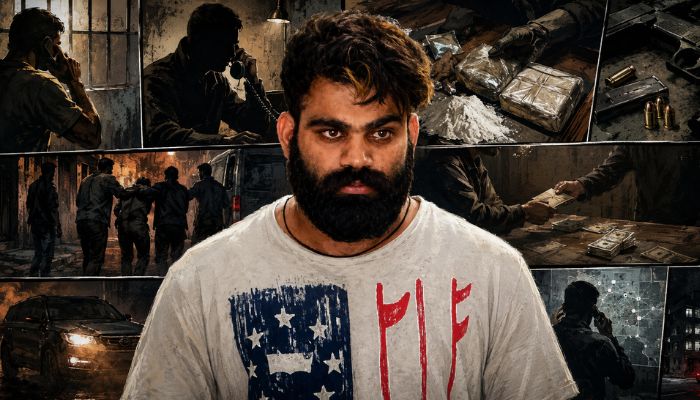
On 14th July, local time, the US Federal Bureau of Investigation placed Indian national Nitish Kaushal alias Lala on its wanted list for his alleged role in the Jaggu Bhagwanpuria organised crime group. On its website, the FBI has described Kaushal as a key member of the organisation who allegedly committed kidnappings, assaults and other violent crimes. The agency has warned that he should be considered armed and dangerous.
Nitish Kaushal is #wanted by the #FBI for his alleged involvement in a transnational criminal organization engaged in, among other things, acts involving murder, kidnapping, drug trafficking, extortion, weapons trafficking, money laundering, and human smuggling. This… pic.twitter.com/xuEXpJIx6u— FBI Most Wanted (@FBIMostWanted) July 14, 2026
Notably, an arrest warrant was issued against Kaushal on 25th June 2026 by the US District Court for the Central District of California. He has been charged with conspiracy under the Racketeer Influenced and Corrupt Organizations Act, commonly known as the RICO Act.
The action against Kaushal came after the unsealing of a wider US indictment against Jaggu Bhagwanpuria and 16 other accused. According to prosecutors, Bhagwanpuria established a criminal enterprise in Punjab that later expanded into the United States, Canada, the United Kingdom, Europe, Australia and New Zealand.
The prosecution claims that Bhagwanpuria’s organisation is not merely a Punjab gang with a few contacts abroad, but a transnational syndicate with over 1,000 alleged members and associates worldwide. Over 100 of them are said to be operating in the US alone.
At the centre of this network is Jagdeep Singh alias Jaggu Bhagwanpuria, a jailed Punjab gangster who has reportedly continued his criminal activities, including drug trafficking, extortion and other crimes, even while behind bars.
What is the RICO Act?
The Racketeer Influenced and Corrupt Organizations (RICO) Act is a US federal law used to prosecute organised criminal enterprises. It allows prosecutors to connect offences such as murder, kidnapping, extortion, drug trafficking and illegal weapons dealing as activities carried out through one organisation. Leaders, coordinators and operatives can therefore be charged for allegedly participating in the wider enterprise instead of every offence being treated as an isolated crime.
Who is Jaggu Bhagwanpuria?
The real name of 38-year-old Jaggu Bhagwanpuria is Jagdeep Singh. He was born in Bhagwanpur village in Gurdaspur district, Punjab, hence the alias Bhagwanpuria. Before becoming one of Punjab’s most notorious gangsters, Bhagwanpuria was reportedly a kabaddi player. His first major encounter with the law came in 2012, when he was booked by the Punjab Police in a case involving the alleged recovery of 28 grams of heroin from Mattewal village in Amritsar district.
However, he was later acquitted in that case, but by the time his name was cleared, the damage had already been done. According to investigators, it marked the beginning of his entry into organised crime. Since 2012, he has reportedly been booked in around 128 criminal cases, including murder, extortion, narcotics trafficking, illegal weapons and offences under the Arms Act. Around a dozen cases against him have reportedly been registered under the Narcotic Drugs and Psychotropic Substances Act.
Bhagwanpuria spent most of the past decade behind bars in different prisons in Punjab, including jails in Patiala, Goindwal Sahib and Bathinda. However, his incarceration did not end his alleged criminal activities.
According to the Narcotics Control Bureau, his network continued to facilitate the smuggling of heroin, opium, psychotropic substances and illegal weapons. He has also been accused of repeatedly using mobile phones inside high-security prisons to direct criminal operations.
In March 2025, he was detained by the NCB under the Prevention of Illicit Traffic in Narcotic Drugs and Psychotropic Substances Act and shifted from Bathinda Central Jail to Silchar Central Jail in Assam. The aim behind shifting him to Assam was to remove him from the local ecosystem that allegedly allowed him to communicate with associates, oversee drug consignments and retain influence over criminal groups operating in Punjab.
In a statement, the NCB stated that Bhagwanpuria had established links with international operatives in Canada, the US and Pakistan. His relocation to Assam was considered necessary to disrupt the network that had allegedly continued functioning despite his imprisonment.
From a Lawrence Bishnoi associate to an independent gang leader
Notably, Bhagwanpuria was once an associate of another notorious gangster, Lawrence Bishnoi. Their names have appeared together in several criminal investigations, including the murder of controversial Punjabi singer Sidhu Moose Wala in May 2022.
According to the available information, Bhagwanpuria eventually became Bishnoi’s rival and founded his own criminal enterprise in Punjab. The split reportedly became visible after a violent clash inside Goindwal Sahib Central Jail in February 2023. Bhagwanpuria gang members Mandeep Singh alias Tufan and Manmohan Singh alias Mohna were killed in the violence.
Goldy Brar, a close associate of Bishnoi, later claimed responsibility through a social media post. The fallout was not simply a personal dispute between jailed gangsters. It represented a fight over extortion networks, shooters, narcotics routes and overseas contacts.
Bhagwanpuria subsequently emerged as the head of an organisation capable of operating independently and competing for control over criminal networks in Punjab and abroad.
What is the Bhagwanpuria organised crime group?
According to US investigators, Bhagwanpuria’s organisation has its headquarters in India but operates through members and associates spread across several countries. Prosecutors believe that Bhagwanpuria’s organisation has over 1,000 members and associates. Its presence extends across India, the US, Canada, Britain, Europe, Australia and New Zealand. The indictment claims that more than 100 people linked to the group are present in the United States.
According to investigators, his gang does not appear to function as a single group whose members operate together from one location. It reportedly works through a chain of local handlers, overseas coordinators, drug transporters, weapons suppliers, extortionists and violent operatives.
While Bhagwanpuria has remained at the top of the network, trusted members of the organisation have been handling operations from different locations worldwide.
In Punjab, the gang allegedly recruited young men, arranged weapons, managed fugitives and maintained contact with local criminal networks. In the United States, particularly California, associates allegedly handled drug transportation, firearms, extortion and violence. Canada was both a major market for narcotics and an important centre for overseas associates and buyers.
The gang’s international presence allowed it to operate across borders while continuing to exploit social and family links connecting the Punjabi diaspora with India.
How Bhagwanpuria allegedly controlled operations from jail
According to US investigators, Bhagwanpuria personally remained involved in international drug trafficking even while behind bars. Indian authorities have long maintained that gangsters use mobile phones smuggled inside prisons to communicate with associates.
The documentation accessed by OpIndia stated that he gave an FBI confidential informant the phone number of a drug coordinator who was supposed to facilitate the movement of a 20 kg cocaine consignment. The drugs were allegedly meant to be transported from Los Angeles to Vancouver in Canada.
Bhagwanpuria also allegedly supplied the serial number of a currency note. The number was to be used to authenticate the person receiving or collecting the consignment. Such authentication methods are commonly used in illegal transactions where the parties may never have met. A person carrying a currency note with the matching serial number can prove that he was authorised by the organiser of the deal. The consignment was intercepted by US authorities in February 2026.
Prosecutors have claimed that Bhagwanpuria quickly realised that something had gone wrong. In a Punjabi message allegedly sent from jail, he said that the entire load had been caught. He then reportedly accused the informant of compromising the shipment because a tracking device had been placed inside the cocaine bricks.
The exchange is central to the US case because it allegedly shows that Bhagwanpuria had real-time knowledge of the transaction. He was not merely a jailed figure whose name was being used by associates abroad. Prosecutors claim that he was personally providing contacts, authenticating deliveries and monitoring what happened to a cocaine consignment moving between the United States and Canada.
The alleged operation connected three different points of the organisation. The leader was imprisoned in India. The cocaine was located in California. The shipment was intended for Vancouver.
How the Bhagwanpuria gang recruited youngsters in Punjab
Bhagwanpuria did not expand his gang in Punjab by relying only on experienced criminals. A Punjab Police investigation indicated that social media played an important role in identifying and recruiting new members. Using social media to recruit “soldiers” appears to be a modus operandi used by criminals and terrorists worldwide. Even Islamic terrorist organisations such as ISIS and Lashkar-e-Taiba have used social media platforms to lure youths into joining them.
In 2023, police officials stated that three members of an international module linked to his gang were recruited via Instagram. According to the material on record in the US case, the gang targeted disgruntled and economically vulnerable youths, including minors.
Quick money, recognition and membership in a powerful criminal group are enough to lure youngsters into joining the gang. With time, the gang itself became part of the attraction. Social media pages glorifying gangsters helped present criminal life as a path to money, influence and status. Photographs of weapons, threats against rivals and responsibility claims after shootings helped create an image of power.
The gang allegedly offered another incentive to recruits who proved their loyalty: the possibility of moving abroad, which is one of the most prominent aspirations among the youth of Punjab. Those who performed local work in Punjab could eventually be connected with associates in Canada, the United States or Britain. Once overseas, they could become part of the organisation’s drug, weapons or extortion operations.
This created an alleged recruitment pipeline that began on mobile phones in Punjab and ended in organised crime networks abroad. A young recruit could first be asked to conduct surveillance, carry a weapon, threaten a local businessman or assist another gang member. Successful operatives could then be introduced to overseas coordinators. The migration route therefore became an operational route for the gang.
How Punjab’s migration networks aided international expansion
Countries such as Canada, the United States, Britain, Australia and New Zealand have large Punjabi communities that have settled there over several decades. The same community and family networks that help migrants establish themselves abroad can also be exploited by criminal organisations.
Someone moving from Punjab to California or British Columbia already understands the language, local community structure and social relationships within the diaspora. Such associates may also know which families own transport businesses, restaurants, liquor stores, real estate companies or other commercial establishments.
The US indictment suggests that the Bhagwanpuria organisation followed Punjab’s migration routes and developed operational nodes wherever significant Punjabi communities had settled. Overseas members could provide vehicles, temporary accommodation, storage sites and access to transport networks. They could collect money, identify potential victims and connect the organisation with local narcotics buyers.
They could also use their knowledge of families in Punjab to pressure victims living abroad. This gave the gang an advantage that an ordinary foreign criminal organisation would not possess. Its members understood both sides of the relationship. They knew where a businessman lived in California or Canada. They could also know where his parents or siblings lived in Punjab.
California as the gang’s American base
During the investigation by US authorities, California emerged as a major centre for the Bhagwanpuria gang. The state has a large Punjabi and Indian-origin population. It also has major transport corridors connecting Southern California with other parts of the United States, Mexico and Canada.
According to prosecutors, the Bhagwanpuria gang developed drug transportation sub-networks in Los Angeles and the Inland Empire. The Inland Empire includes major warehousing, logistics and transport centres in Southern California. Its location and extensive road network make it a significant hub for commercial freight.
Criminal organisations can exploit the same infrastructure to conceal narcotics among legitimate goods and move them through long-distance trucking routes. The Bhagwanpuria indictment includes allegations of cocaine and heroin distribution, firearms dealing, extortion and violent crimes in the United States.
Nitish Kaushal’s alleged role fits into this wider network. The FBI has accused Kaushal of carrying out violent acts on behalf of the gang, including kidnappings and assaults. His case makes it clear that the Bhagwanpuria gang allegedly required more than drug transporters and financial handlers in the US. It also needed operatives who could enforce its demands.
Violence or the threat of violence could be used against debtors, rivals, witnesses or extortion victims. Kaushal’s name appearing on the wanted list shows that US authorities consider operatives of the Bhagwanpuria gang a direct threat inside the country rather than foreign criminals communicating with people abroad.
Drug routes from Southern California to Canada
According to reports, drug trafficking was allegedly one of the principal sources of income for the Bhagwanpuria gang. According to the US case, the gang collected, stored and transported bulk quantities of cocaine and heroin from Southern California. The narcotics were then moved towards the eastern US or transported north into Canada.
One such alleged transaction involved Garinder Deo, a Vancouver resident known by the aliases Doctor, Rocket and Ritz Carlton. While he has not been charged as a member or associate of the Bhagwanpuria gang, he reportedly helped enrich the group by purchasing bulk quantities of cocaine and heroin.
Furthermore, members and associates of the gang were reportedly involved in arranging the transportation of these drugs from Southern California. In June 2025, authorities intercepted an attempted shipment containing around 99.2 kg of cocaine and one kg of heroin.
The scale of the shipment shows that the operation went far beyond street-level drug dealing. Moving around 100 kg of cocaine requires suppliers, storage facilities, transport coordinators, drivers, receivers and people capable of moving or laundering the money. It also requires trust between actors operating in different jurisdictions.
The alleged 20-kilogram cocaine transaction overseen by Bhagwanpuria and the intercepted 99.2-kilogram shipment together indicate how California and Canada were connected through the organisation’s drug network.
Southern California served as an alleged supply and logistical centre. Canada offered buyers and a destination market. Bhagwanpuria and his associates in India allegedly remained involved in coordination.
How drug transportation networks were allegedly used
According to the US indictment, the Bhagwanpuria gang funded its activities through drug trafficking and used drug transportation sub-networks operating in Los Angeles and the Inland Empire.
The indictment does not provide detailed information about how these sub-networks transported the drugs. However, it alleges that members and associates of the Bhagwanpuria enterprise assisted in moving bulk quantities of cocaine and heroin from Southern California.
One such attempted shipment in June 2025 involved approximately 99.2 kg of cocaine and one kg of heroin. Law enforcement authorities intercepted the consignment before it could be delivered.
How extortion in America reached families in Punjab
The gang’s alleged extortion system is one of the clearest examples of how its Indian and North American operations were connected. US prosecutors say the organisation preyed on members of the Indian diaspora who continued to have relatives, property or business connections in Punjab.
A businessman living in California or another US state could be threatened directly. If he refused to pay, his parents, siblings or other relatives in India could allegedly be targeted. Gang members could threaten violence against the victim’s children in America while associates in Punjab placed pressure on the extended family.
One defendant, Gurdev Singh, allegedly tried to extort a family living in the American Midwest while he was himself being held in US Immigration and Customs Enforcement custody. Prosecutors allege that he threatened to put bullets in the family’s children.
The fact that an accused person allegedly continued making threats while in immigration custody reflects the same operating method attributed to Bhagwanpuria in India. Imprisonment or detention did not necessarily end communication with the network.
The person making the demand did not always need to be physically present near the victim. A phone call, encrypted message or social media threat could be enough if the gang had already established a reputation for violence.
Alleged use of corrupt police contacts in Punjab
US prosecutors have made serious allegations about the Bhagwanpuria organisation’s links with corrupt law enforcement officers and government officials in India. According to the indictment, the gang used corrupt contacts to strengthen extortion schemes and target people believed to be rivals or police informants.
The organisation allegedly supplied false information to police officers about crimes. This information could then be used to initiate baseless criminal proceedings against targeted individuals. The possibility of arrest or prolonged involvement in a serious criminal case could become a tool for extortion.
One alleged incident involved Gurlal Singh, a 22-year-old resident of Stockton, California, who prosecutors identify as a Bhagwanpuria syndicate member. In April 2026, Singh allegedly threatened a victim and provided the victim’s name to a corrupt law enforcement officer in Punjab.
This allegedly resulted in the victim, his father and his sister being falsely accused of a murder committed in India in January 2026. The corrupt police officer then allegedly extorted the victim and his father in connection with the pending murder case.
If proved, the incident would show how an overseas gang operative could allegedly weaponise the Indian criminal justice system against a family. The threat was no longer limited to an anonymous phone call from another country. The target’s relatives could face a murder accusation, police action and pressure to pay money. These claims remain allegations made by US prosecutors and will have to be established in court.
Why diaspora victims often remain silent
Extortion victims within diaspora communities may be reluctant to approach the police. A victim living in California may believe that American law enforcement can protect him. He may not have the same confidence about the safety of his relatives in a village or town in Punjab.
Reporting the threat could place parents, siblings or business partners at risk. Victims may also fear that police action against one overseas operative will not dismantle the wider network. The person sending the message may be in Canada. The organiser may be in an Indian prison. The shooter may be in Punjab. The money collector may be in California. This geographical spread creates uncertainty about where the next threat will come from.
The FBI’s Sacramento office had publicly encouraged members of the Punjabi community to report extortion attempts amid growing concerns about organised gangs targeting the diaspora. Silence benefits the gang. Each successful extortion strengthens its reputation and convinces the next victim that resistance could be dangerous.
How violence became a business tool
Violence allegedly served a wider purpose within the Bhagwanpuria organisation. A shooting, kidnapping or assault could punish one individual. Publicising that act could frighten hundreds of others.
Social media posts claiming responsibility for murders or attacks ensured that the gang’s name remained associated with violence. This reputation could then be used during extortion demands. The gang did not need to attack every person who refused to pay. It only needed victims to believe that the threat was credible. The alleged use of young recruits, overseas enforcers and illegal firearms helped sustain this system.
According to US prosecutors, the organisation was involved in murder-for-hire, kidnapping, extortion, weapons trafficking and other violent offences. The indictment also charges members with conspiracy to engage in firearms dealing without a licence and possession of a machine gun. These allegations indicate that firearms were not only commodities sold for profit. They were also essential tools for enforcing the gang’s authority.
The gang war that reached Bhagwanpuria’s family
The violence surrounding the Bhagwanpuria organisation eventually reached the gangster’s own family. In June 2025, Bhagwanpuria’s mother, Harjit Kaur, and Karanvir Singh were shot by motorcycle-borne assailants near their residence in Batala.
Karanvir died on the spot. Harjit Kaur later succumbed to her injuries. A social media post attributed to people linked to the Bambiha gang claimed responsibility for the attack. The post alleged that Karanvir handled Bhagwanpuria’s operations, including fugitives, weapons and money.
The people behind the post claimed that Karanvir was the intended target and that the attack was retaliation for the killing of one of their associates. Police had not verified the authenticity of the online claim in the material available at the time.
The attack nevertheless demonstrated how Punjab’s gang rivalries had moved beyond attacks on known gang members. Families and people accused of providing logistical support had also become targets. A jailed gang leader requires people outside prison to manage money, locate fugitives, arrange weapons and communicate instructions. Removing such a handler can disrupt operations even if the leader remains alive.
How the Bhagwanpuria gang allegedly made money
The US indictment identifies several alleged revenue streams for the organisation. Drug trafficking appears to have been one of the most important. Bulk cocaine and heroin shipments could generate significant profits. The money could then be used to purchase firearms, pay transporters, support fugitives and finance violent operations.
Extortion was another major source of income. Business owners and families could be ordered to make payments under the threat of shootings, kidnappings or attacks on relatives. The gang was also allegedly involved in illegal firearms dealing.
Weapons could be sold to other criminals or retained for use by the organisation’s own members. Murder-for-hire and violent enforcement further expanded the organisation’s activities. A gang with access to shooters could carry out attacks for its own purposes or provide violence as a service to others.
Together, these crimes created a self-sustaining structure. Drug trafficking generated money. Money purchased weapons and loyalty. Violence created fear. Fear made extortion more effective. Extortion money then funded further recruitment and trafficking.
Operation Hard Ball and the international crackdown
The indictment against the Bhagwanpuria organisation was unsealed as part of Operation Hard Ball, a coordinated investigation involving authorities in the United States, Canada and Europe. The operation resulted in charges against 37 people linked to three separate India-origin criminal organisations.
Twenty-four of the accused were arrested across the United States, Canada and Europe. Authorities also seized approximately 1,000 kilograms of cocaine, one kilogram of heroin, firearms and cash. The Bhagwanpuria case, however, is distinct from the other indictments unsealed under the operation.
Its central allegation is that a Punjab-based gang founded by an imprisoned Indian gangster established a network of members and operations across several continents. The organisation allegedly combined drug trafficking and firearms dealing with a form of extortion specifically designed to exploit the vulnerabilities of the Indian diaspora.
Victims in America and Canada could be threatened through relatives in Punjab. Associates abroad could use contacts in India. A jailed leader could remain involved in drug transactions taking place thousands of kilometres away.
From a Punjab gang to a transnational organisation
The Bhagwanpuria gang’s alleged expansion was not the result of one dramatic move into the United States or Canada. It appears to have grown gradually through recruitment, migration, prison communications and criminal partnerships. The organisation began with its leadership and enforcement network in Punjab. Social media provided access to young recruits. Overseas migration placed trusted associates in countries with large Punjabi communities.
California offered narcotics supply routes, warehouses, transport networks and potential extortion targets. Canada provided another major diaspora base and a lucrative market for drugs transported from the United States. Contraband phones and encrypted applications allowed Bhagwanpuria to remain connected with these different nodes while imprisoned. The result, according to US prosecutors, was a criminal organisation headquartered in India but capable of arranging drugs, weapons, threats and violence across national borders.
Nitish Kaushal’s appearance on the FBI’s wanted list is only the latest development in the case. The larger story is how an organisation allegedly controlled from Indian prisons built an operating chain that extended from Punjab’s gang recruitment networks to cocaine routes in Southern California and extortion targets in Canada and the United States.
The charges contained in the US indictment are allegations. All accused are presumed innocent unless proven guilty beyond a reasonable doubt in a court of law.