From AIMIM to CJP: US-based Osman Faizan Ali behind posters at CJP protests. Read how he is provoking youth to spark street unrest
As Delhi’s Jantar Mantar became the centre of fresh protests over the contentious NEET issue on June 20, 2026, OpIndia uncovered the visible footprint of a US-based social media ‘activist’ whose influence extended far beyond the digital world and onto the streets of the national capital. The protest, organised by the Cockroach Janta Party (CJP), was projected as a spontaneous youth-led movement against Union Education Minister Dharmendra Pradhan and the government over alleged NEET-related grievances. However, what emerged from ground reporting was evidence suggesting that the agitation was being actively fuelled and amplified by those who had no skin in the game, provoking people from thousands of miles away. One such individual was Osman Faizan Ali, a self-styled activist based in the United States, who has been using social media platforms to provoke, mobilise and emotionally charge young Indians into confrontation with authorities. Across Jantar Mantar, protesters were seen carrying professionally designed placards featuring social media commentator Dhruv Rathee, activist Abhijit Dipke and actor Rakhi Sawant. Yet a closer examination revealed a curious common feature. Printed prominently on many of these posters was the photograph of a bearded man identified as “Indian Osman Faizan Ali — From USA.” Who is Osman Ali, the man sitting in the US and provoking Indian youth toward unrest?A protester reached Jantar Mantar carrying posters of Dhruv Rathee and Osman Faizan Ali.Is the internet being weaponized to turn India's youth into a disruptive mob? @ashu_nauty reports from… pic.twitter.com/RBejg8WnpN— OpIndia.com (@OpIndia_com) June 20, 2026 The discovery immediately raised questions. Why was the image of an overseas activist appearing on posters at a protest supposedly driven by students and local activists? More importantly, how many of those carrying the placards even knew who he was? When OpIndia spoke to several protesters at the venue, the answers were revealing. Many admitted they had no idea who Osman Faizan Ali was. One young protester openly stated that the poster had been handed to him by organisers and that he was unaware of the identity of the person whose photograph appeared on it. Similar responses from other demonstrators suggested that while they were being used to amplify Ali’s messaging, many were not even familiar with the individual behind it. This disconnect points to a broader strategy. Rather than building a movement organically, Ali appears to be attempting to hijack it, manufacturing outrage and directing public anger through carefully designed propaganda distributed to impressionable participants on the ground. A closer look at his social media activity reveals a pattern of deliberate provocation. Operating primarily through the Instagram account @bbm_india_, Ali has spent weeks pushing highly charged content related to the CJP protests. His videos are not limited to expressing support for demonstrators. Instead, they repeatedly seek to create a sense of impending confrontation, portraying the movement as a battle between angry youth and the Indian state. His content relies heavily on emotionally loaded rhetoric, aggressive messaging and repeated attempts to convince young followers that they are part of a historic uprising. The objective appears clear: transform frustration over a public issue into a mass mobilisation driven by anger and confrontation. One of the clearest examples came on June 1, 2026, when Ali uploaded a video directly addressing the Delhi Police. Rather than appealing for peaceful protest, the video carried an unmistakably threatening tone. He warned the police to deploy massive numbers of personnel before allowing CJP activists and Abhijit Dipke supporters to gather at Jantar Mantar. He repeatedly spoke about an unstoppable “tsunami” of people that would overwhelm any attempt by authorities to control the situation. View this post on Instagram A post shared by OSMAN FAIZAN ALI (@bbm_india_) The language was significant. Instead of encouraging lawful democratic participation, Ali sought to create an atmosphere of confrontation. The message being conveyed to supporters was that they were part of a force powerful enough to challenge the state. Such rhetoric is a common tactic employed by agitators seeking to emotionally charge crowds and push supporters towards increasingly aggressive behaviour. The fact that these messages were being delivered from the safety of a foreign country makes the situation even more troubling. While young Indians are encouraged to take to the streets, face police action and potentially risk legal consequences, the individual issuing these calls remains comfortably insulated from the fallout. Ali’s efforts did not end there. He has been posting provocative content aimed at mobilising ‘Cockroaches’ ever since CJP started gaining online traction. Earlier yesterday, he uploade
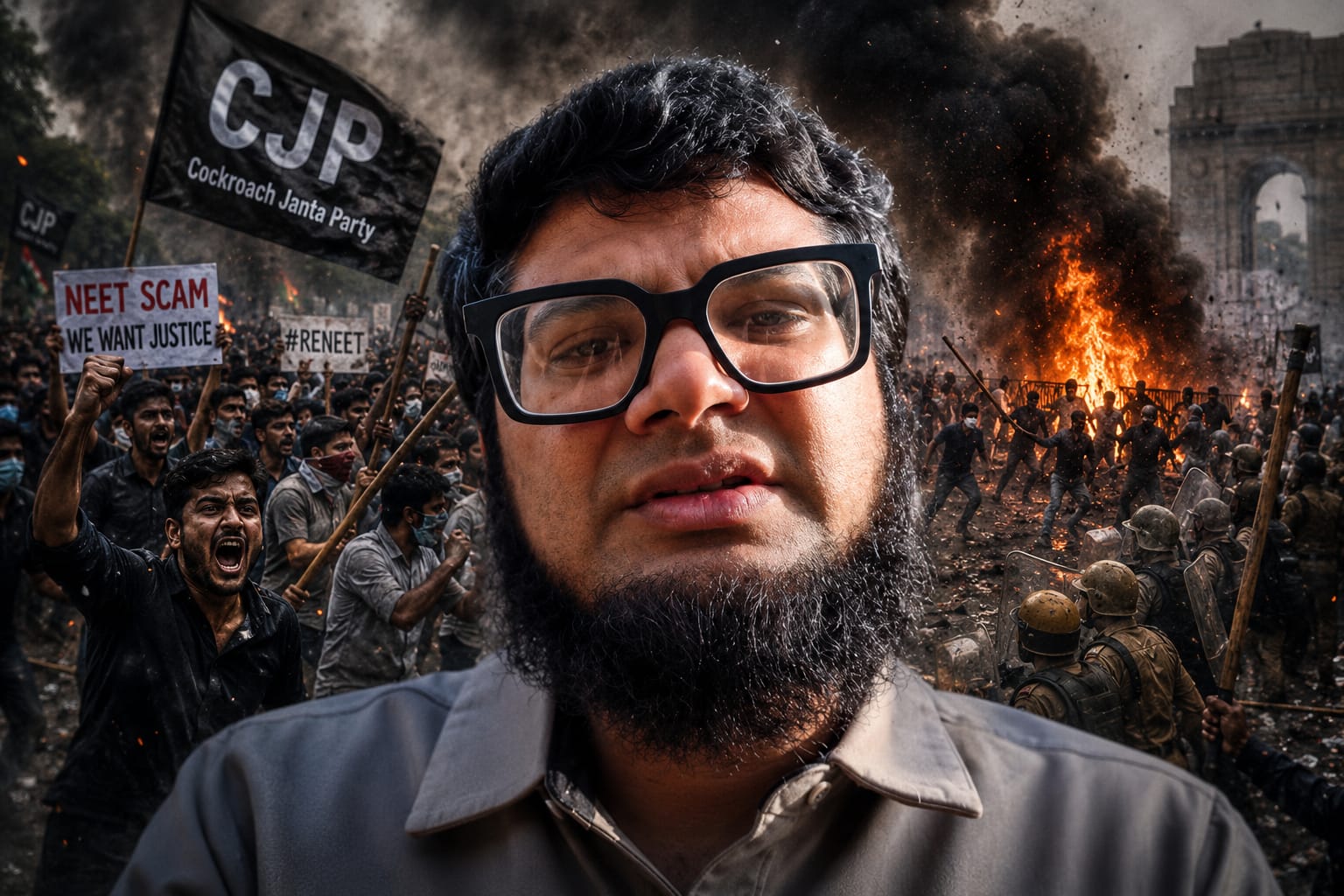
As Delhi’s Jantar Mantar became the centre of fresh protests over the contentious NEET issue on June 20, 2026, OpIndia uncovered the visible footprint of a US-based social media ‘activist’ whose influence extended far beyond the digital world and onto the streets of the national capital.
The protest, organised by the Cockroach Janta Party (CJP), was projected as a spontaneous youth-led movement against Union Education Minister Dharmendra Pradhan and the government over alleged NEET-related grievances. However, what emerged from ground reporting was evidence suggesting that the agitation was being actively fuelled and amplified by those who had no skin in the game, provoking people from thousands of miles away. One such individual was Osman Faizan Ali, a self-styled activist based in the United States, who has been using social media platforms to provoke, mobilise and emotionally charge young Indians into confrontation with authorities.
Across Jantar Mantar, protesters were seen carrying professionally designed placards featuring social media commentator Dhruv Rathee, activist Abhijit Dipke and actor Rakhi Sawant. Yet a closer examination revealed a curious common feature. Printed prominently on many of these posters was the photograph of a bearded man identified as “Indian Osman Faizan Ali — From USA.”
Who is Osman Ali, the man sitting in the US and provoking Indian youth toward unrest?A protester reached Jantar Mantar carrying posters of Dhruv Rathee and Osman Faizan Ali.Is the internet being weaponized to turn India's youth into a disruptive mob? @ashu_nauty reports from… pic.twitter.com/RBejg8WnpN— OpIndia.com (@OpIndia_com) June 20, 2026
The discovery immediately raised questions. Why was the image of an overseas activist appearing on posters at a protest supposedly driven by students and local activists? More importantly, how many of those carrying the placards even knew who he was?
When OpIndia spoke to several protesters at the venue, the answers were revealing. Many admitted they had no idea who Osman Faizan Ali was. One young protester openly stated that the poster had been handed to him by organisers and that he was unaware of the identity of the person whose photograph appeared on it. Similar responses from other demonstrators suggested that while they were being used to amplify Ali’s messaging, many were not even familiar with the individual behind it.
This disconnect points to a broader strategy. Rather than building a movement organically, Ali appears to be attempting to hijack it, manufacturing outrage and directing public anger through carefully designed propaganda distributed to impressionable participants on the ground.
A closer look at his social media activity reveals a pattern of deliberate provocation. Operating primarily through the Instagram account @bbm_india_, Ali has spent weeks pushing highly charged content related to the CJP protests. His videos are not limited to expressing support for demonstrators. Instead, they repeatedly seek to create a sense of impending confrontation, portraying the movement as a battle between angry youth and the Indian state.
His content relies heavily on emotionally loaded rhetoric, aggressive messaging and repeated attempts to convince young followers that they are part of a historic uprising. The objective appears clear: transform frustration over a public issue into a mass mobilisation driven by anger and confrontation.
One of the clearest examples came on June 1, 2026, when Ali uploaded a video directly addressing the Delhi Police. Rather than appealing for peaceful protest, the video carried an unmistakably threatening tone. He warned the police to deploy massive numbers of personnel before allowing CJP activists and Abhijit Dipke supporters to gather at Jantar Mantar. He repeatedly spoke about an unstoppable “tsunami” of people that would overwhelm any attempt by authorities to control the situation.
View this post on Instagram A post shared by OSMAN FAIZAN ALI (@bbm_india_)
The language was significant. Instead of encouraging lawful democratic participation, Ali sought to create an atmosphere of confrontation. The message being conveyed to supporters was that they were part of a force powerful enough to challenge the state. Such rhetoric is a common tactic employed by agitators seeking to emotionally charge crowds and push supporters towards increasingly aggressive behaviour.
The fact that these messages were being delivered from the safety of a foreign country makes the situation even more troubling. While young Indians are encouraged to take to the streets, face police action and potentially risk legal consequences, the individual issuing these calls remains comfortably insulated from the fallout.
Ali’s efforts did not end there. He has been posting provocative content aimed at mobilising ‘Cockroaches’ ever since CJP started gaining online traction.
Earlier yesterday, he uploaded another video attempting to shape events on the ground. This time, he publicly appealed to the Delhi Police and security agencies to permit the demonstrations. However, the appeal came with an underlying threat. The video repeatedly suggested that stopping the protesters could lead to unrest and instability.
View this post on Instagram A post shared by OSMAN FAIZAN ALI (@bbm_india_)
This form of messaging allows Ali to maintain plausible deniability while continuing to inflame passions. He does not explicitly call for violence, yet repeatedly frames confrontation as the likely outcome if authorities intervene. The practical effect is to heighten tensions, deepen mistrust of law enforcement and encourage supporters to view any administrative action as oppression. And to do all this from thousands of miles away, in the United States, is all too convenient for someone who positions himself as a crusader ‘fighting to save democracy in India.’
A review of Ali’s broader online activity suggests that this is not an isolated episode but part of a long-standing pattern. His social media presence consistently revolves around mobilising outrage, amplifying opposition narratives and encouraging followers to see political disagreements through the lens of conflict and resistance.
His YouTube channel, “Button Ballot Movement by Osman Faizan Ali,” provides further insight into his political objectives. While largely inactive today, archived content demonstrates that he has long sought to influence Indian politics despite operating from abroad.
One audio recording uploaded on May 13, 2024, featured an explicit appeal to voters in Hyderabad and Secunderabad. In the recording, Ali urged listeners to vote strategically for AIMIM and Congress candidates with the stated objective of defeating the BJP. The message was not framed around supporting particular policies or programmes but around defeating a political opponent through coordinated voting behaviour.
The recording demonstrates that Ali’s activism extends far beyond student issues or social causes. Rather, it reveals a pattern of attempting to influence political discourse and electoral outcomes in India while operating from abroad. His present-day support for the Cockroach Janta Party does not appear to stem from any long-standing ideological commitment to the movement. Instead, it seems to reflect an opportunistic effort to latch onto a viral internet phenomenon that has recently gained traction among sections of the youth. His political positioning has shifted with changing circumstances.
As recently as 2024, Ali was openly urging voters in Hyderabad and Secunderabad to support AIMIM and Congress candidates with the stated objective of defeating the BJP. His current embrace of the Cockroach Janta Party, therefore, appears less like an ideological commitment and more like political opportunism. Rather than being rooted in any consistent set of principles, his activism seems to follow whichever movement offers the greatest potential for mobilisation and visibility. Until 2024, Ali was actively rallying support behind AIMIM and Congress in their efforts to electorally challenge the BJP. Today, he has repositioned himself as a cheerleader for the CJP-led agitation, suggesting that his primary objective is not advancing a particular ideology but inserting himself into causes that act against the BJP and PM Modi.
The events at Jantar Mantar demonstrate how social media has transformed the nature of political mobilisation. In the past, protest movements were largely directed by individuals physically present on the ground and accountable for their actions. Today, however, activists sitting thousands of kilometres away can shape narratives, design propaganda, distribute campaign material, and influence the behaviour of large crowds with the click of a button.
What makes the current case particularly concerning is the apparent vulnerability of the young people being targeted. Many of the protesters carrying Ali’s posters did not even know who he was. Yet they were unknowingly helping promote his image and messaging in the heart of the national capital.
This raises serious questions. How many young participants are consuming such content without recognising the motives behind it? How many are being encouraged to view confrontation with institutions as a desirable outcome? And how many understand that those encouraging them to take risks are often individuals who bear none of the consequences themselves?
The Jantar Mantar protest offers a glimpse into a new model of political agitation in which overseas influencers attempt to weaponise local grievances to advance broader political objectives. By feeding young audiences a steady stream of inflammatory content, portraying institutions as enemies and framing protests as showdowns with the state, individuals like Osman Faizan Ali seek to transform public dissatisfaction into organised unrest.
While protesters on the ground face the possibility of detention, legal proceedings or violence if situations spiral out of control, those directing the outrage from abroad remain beyond the immediate reach of Indian law enforcement. The result is an unequal dynamic in which the risks are borne by impressionable youth while the rewards of political visibility accrue to digital agitators operating safely overseas.
The prominence of Osman Faizan Ali’s image at the Jantar Mantar protest is therefore more than a curious detail. It is evidence of how a foreign-based armchair ‘activist’ has attempted to insert himself into a domestic agitation, cultivate anger among young Indians and use digital platforms to push them towards confrontation. The incident serves as a reminder that in the age of social media, political unrest is no longer shaped only by those present on the streets. Increasingly, it is being influenced by individuals who may be thousands of kilometres away but are actively working to provoke, mobilise and radicalise audiences through the power of the internet.