Exclusive on Tahir Hussain’s conviction: Tahir Hussain claimed his PCR calls proved his innocence. Here’s why the court didn’t buy his propaganda
On the 26th of February 2020, a lifeless, battered body was recovered from the Chand Bagh drain. The body bore testimony to the brutality inflicted upon it by a large mob – stab wounds, lacerations, potential acid to the face and broken bones. That body, with injuries on the head, face, chest, back and waist, was of 26-year-old Ankit Sharma – an IB officer who had been mercilessly murdered by a mob of Muslims led by Tahir Hussain during the anti-Hindu Delhi riots. 6 years after India witnessed that brutality, on the 13th of July 2026, Tahir Hussain and 5 others were convicted for the murder of Ankit Sharma under sections 188, 153A, 147, 148, 149, 365 and 302 of the IPC. This case was registered on February 26, 2020, on the complaint given by Ravinder Kumar, the father of the deceased Ankit Sharma. In the complaint, Kumar revealed that incidents of stone pelting, brick batting, arson, firing and sabotage had taken place during the anti-CAA protests at Chand Bagh Pulia, Main Karawal Nagar Road. He had also revealed that AAP leader Tahir Hussain’s office was located in that area, and he had a lot of goons in his office. The Muslim mob had pelted stones, petrol bombs and shots were fired from the rooftop of the office of Tahir Hussain, and he had created an atmosphere of fear among the public. On 25 February, Ankit Sharma didn’t return home. Ravinder Kumar filed a missing person report the next day. Then he came to know that a man was thrown into the Khajuri Khas Nala from the Masjid of Chand Bagh Pulia after he was killed. Following this information, the body of Ankit Sharma was recovered from Khajuri Khas Nala. His clothes were missing, except for the underwear. What the court said about Tahir Hussain’s animus towards Hindus In the judgement convicting Tahir Hussain, the court said the following: “The prosecution has proved its case beyond all reasonable doubts against accused Tahir Hussain for commission of offences punishable u/s 188 IPC, u/s 153A r/w section 149 IPC, section 147 r/w section 149 IPC, section 148 r/w section 149 IPC, section 365 r/w section 149 IPC and section 302 r/w section 149 IPC”. Some of the operative parts of the judgment reinforce what OpIndia has been reporting for 6 long years, proving that what happened in 2020 was indeed anti-Hindu violence. Excerpt of Tahir Hussain jugement The court declared that the prosecution had proven beyond a reasonable doubt that Tahir Hussain was indeed a part of the mob at Chand Bagh, with animus against Hindus. The court further said that Tahir Hussain and other Muslims “had assembled at Chand Bagh Pulia with a common object to commit rioting, loot, arson and to cause damage to the property and person of the members of the Hindu community; and that the members of this assembly knew that it was likely that in prosecution of the objects of this assembly, death could result and someone could be killed”. The court further said that there was no doubt that the Muslim mob, which was armed and committing unspeakable violence, had dragged Ankit Sharma, abducted him, committed brutal violence against him and then murdered him. The court found Tahir Hussain was a part of the mob and therefore, liable for the murder committed. The “PCR calls” defence by Tahir Hussain – propaganda spread by The Wire, AltNews and others Apart from noting the animus of the mob and of Tahir Hussain against Hindus, there was another interesting aspect of the judgement which has been the subject of several op-eds by those who spent years trying to whitewash the role of Tahir Hussain and others in the Delhi anti-Hindu riots. Right after the body of Ankit Sharma was recovered from the Chand Bagh drain and revelations about Tahir Hussain’s involvement started trickling in, the entire Left-liberal ecosystem was busy trying to find an out. To that end, the ecosystem, in a coordinated manner, started peddling a fabricated video. In the video, Tahir Hussain was seen pleading, claiming that he was the real victim of the violence. To substantiate the claim of victimhood, Tahir Hussain claimed that he had made several calls to the PCR (Police Control Room) seeking help, because the rioters were trying to harm him. The video was shared “exclusively” by The Wire, the publication that Arfa Khanum Sherwani calls her home. EXCLUSIVE | “I am innocent and a victim of communal violence myself. I have full faith in the justice system of my country. I want to surrender before the court.”Suspended AAP councillor and an accused in recent violence in delhi, Tahir Hussain. pic.twitter.com/RoxZhGyXq3— The Wire (@thewire_in) March 5, 2020 This video was then peddled by many others within the ecosystem, and based on this video, the role of Tahir was sought to be whitewashed. A glimpse of those who defended Tahir Hussain The narrative that Tahir Hussain was merely an innocent victim was also furthered by those like Rajdeep Sardesai, who furthered a video
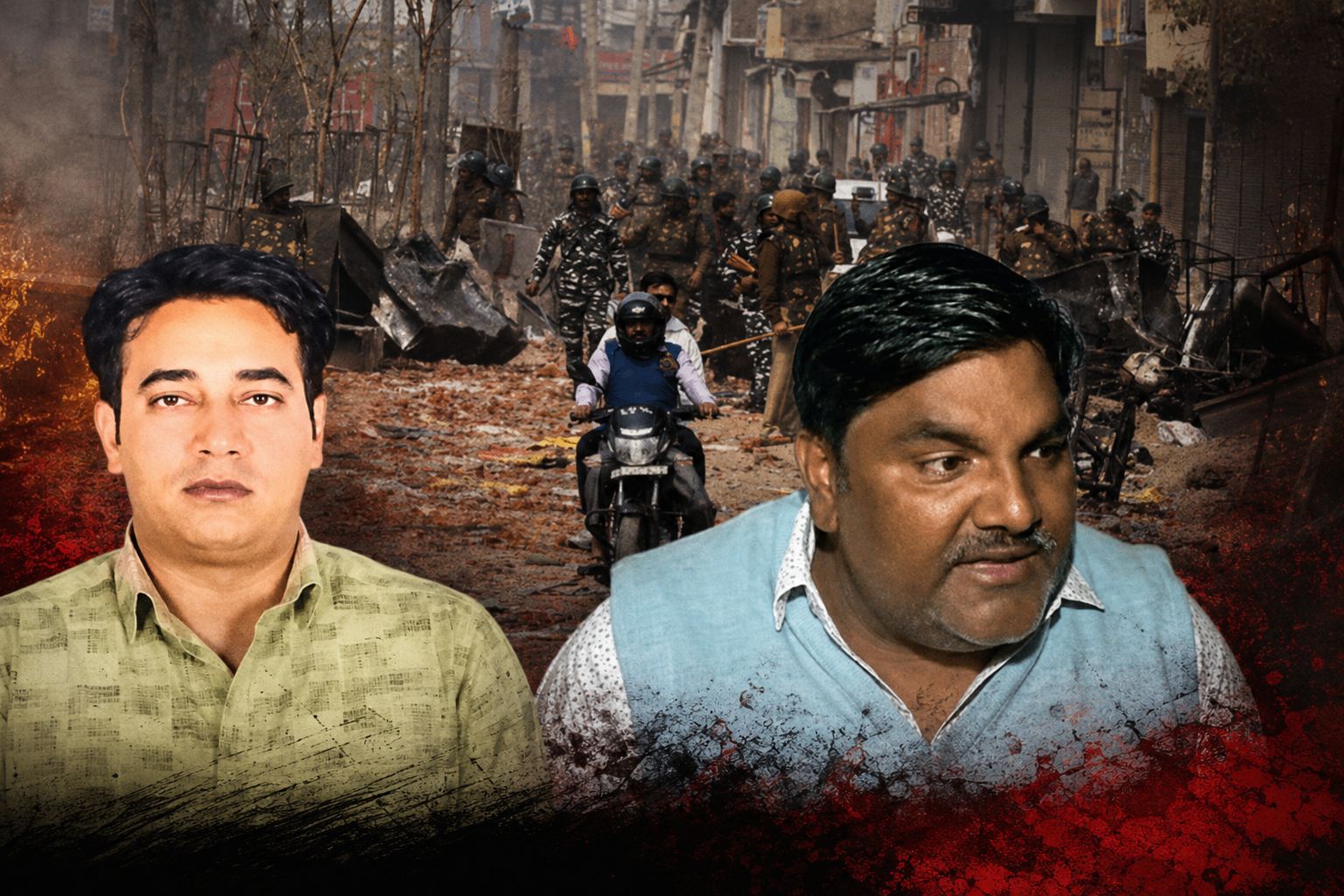
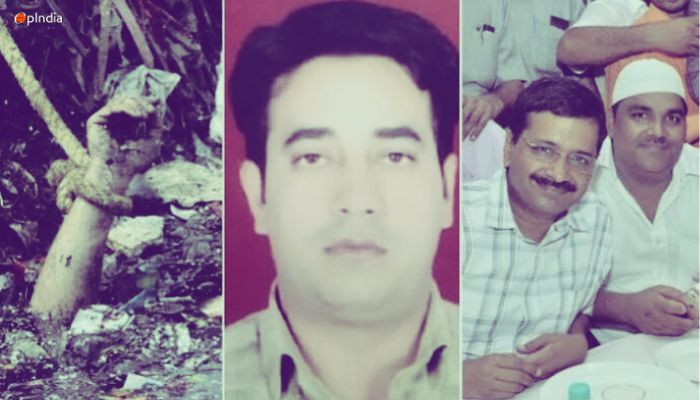
On the 26th of February 2020, a lifeless, battered body was recovered from the Chand Bagh drain. The body bore testimony to the brutality inflicted upon it by a large mob – stab wounds, lacerations, potential acid to the face and broken bones. That body, with injuries on the head, face, chest, back and waist, was of 26-year-old Ankit Sharma – an IB officer who had been mercilessly murdered by a mob of Muslims led by Tahir Hussain during the anti-Hindu Delhi riots. 6 years after India witnessed that brutality, on the 13th of July 2026, Tahir Hussain and 5 others were convicted for the murder of Ankit Sharma under sections 188, 153A, 147, 148, 149, 365 and 302 of the IPC.
This case was registered on February 26, 2020, on the complaint given by Ravinder Kumar, the father of the deceased Ankit Sharma. In the complaint, Kumar revealed that incidents of stone pelting, brick batting, arson, firing and sabotage had taken place during the anti-CAA protests at Chand Bagh Pulia, Main Karawal Nagar Road. He had also revealed that AAP leader Tahir Hussain’s office was located in that area, and he had a lot of goons in his office.
The Muslim mob had pelted stones, petrol bombs and shots were fired from the rooftop of the office of Tahir Hussain, and he had created an atmosphere of fear among the public. On 25 February, Ankit Sharma didn’t return home. Ravinder Kumar filed a missing person report the next day. Then he came to know that a man was thrown into the Khajuri Khas Nala from the Masjid of Chand Bagh Pulia after he was killed. Following this information, the body of Ankit Sharma was recovered from Khajuri Khas Nala. His clothes were missing, except for the underwear.
What the court said about Tahir Hussain’s animus towards Hindus
In the judgement convicting Tahir Hussain, the court said the following: “The prosecution has proved its case beyond all reasonable doubts against accused Tahir Hussain for commission of offences punishable u/s 188 IPC, u/s 153A r/w section 149 IPC, section 147 r/w section 149 IPC, section 148 r/w section 149 IPC, section 365 r/w section 149 IPC and section 302 r/w section 149 IPC”.
Some of the operative parts of the judgment reinforce what OpIndia has been reporting for 6 long years, proving that what happened in 2020 was indeed anti-Hindu violence.
Excerpt of Tahir Hussain jugement
The court declared that the prosecution had proven beyond a reasonable doubt that Tahir Hussain was indeed a part of the mob at Chand Bagh, with animus against Hindus. The court further said that Tahir Hussain and other Muslims “had assembled at Chand Bagh Pulia with a common object to commit rioting, loot, arson and to cause damage to the property and person of the members of the Hindu community; and that the members of this assembly knew that it was likely that in prosecution of the objects of this assembly, death could result and someone could be killed”.
The court further said that there was no doubt that the Muslim mob, which was armed and committing unspeakable violence, had dragged Ankit Sharma, abducted him, committed brutal violence against him and then murdered him. The court found Tahir Hussain was a part of the mob and therefore, liable for the murder committed.
The “PCR calls” defence by Tahir Hussain – propaganda spread by The Wire, AltNews and others
Apart from noting the animus of the mob and of Tahir Hussain against Hindus, there was another interesting aspect of the judgement which has been the subject of several op-eds by those who spent years trying to whitewash the role of Tahir Hussain and others in the Delhi anti-Hindu riots.
Right after the body of Ankit Sharma was recovered from the Chand Bagh drain and revelations about Tahir Hussain’s involvement started trickling in, the entire Left-liberal ecosystem was busy trying to find an out. To that end, the ecosystem, in a coordinated manner, started peddling a fabricated video. In the video, Tahir Hussain was seen pleading, claiming that he was the real victim of the violence. To substantiate the claim of victimhood, Tahir Hussain claimed that he had made several calls to the PCR (Police Control Room) seeking help, because the rioters were trying to harm him.
The video was shared “exclusively” by The Wire, the publication that Arfa Khanum Sherwani calls her home.
EXCLUSIVE | “I am innocent and a victim of communal violence myself. I have full faith in the justice system of my country. I want to surrender before the court.”Suspended AAP councillor and an accused in recent violence in delhi, Tahir Hussain. pic.twitter.com/RoxZhGyXq3— The Wire (@thewire_in) March 5, 2020
This video was then peddled by many others within the ecosystem, and based on this video, the role of Tahir was sought to be whitewashed.
A glimpse of those who defended Tahir Hussain
The narrative that Tahir Hussain was merely an innocent victim was also furthered by those like Rajdeep Sardesai, who furthered a video where Tahir Hussain and his cohorts were trying to keep the door to his building closed. Rajdeep claimed that Tahir and his mob were trying to keep the presumably Hindu mob out.
So Tahir Hussain tells @IndiaToday he wasn’t in house when his terrace was used to target people with petrol bombs: claims a mob was trying to enter his house and he escaped with police help! Shows us a video of a mob allegedly trying to force its way into house. pic.twitter.com/VjqdKGngXz— Rajdeep Sardesai (@sardesairajdeep) February 27, 2020
As evident from Rajdeep Sardesai’s tweet, it was Tahir Hussain who had directly seeded this narrative to the media – to MSM like India Today and digital platforms like The Wire and AltNews.
None of these publications bothered to verify facts and chose to look away from the mountain of videographic evidence against Tahir Hussain. 6 years on, the court has finally addressed this narrative and, despite Tahir Hussain’s legal gymnastics, thrown it out of the window.
How the court caught on to the legal gymnastics by Tahir Hussain and discarded the “PCR call” narrative
In the judgment, the court has addressed this specific argument by Tahir Hussain that he was actually the victim of the violence and not the perpetrator, by citing the number of times he called the PCR for help.
The court notes that the chargesheet itself notes that Tahir Hussain had called the PCR several times. The judgment notes, “It is even reflected from the chargesheet that on 25/02/2020 from 3:55 PM to 4:31 PM, Tahir Hussain had made around six calls to the PCR. Before that, on 24/02/2020 around 3:53 PM, Tahir Hussain made a call to the PCR stating, ‘caller ke ghar ki chhat par log chadh gaye hain aur pathrav kar rahe hain.’ The same information was again given by him to the PCR at 5:57 PM. It is also contended that the prosecution has relied upon the CDR of the mobile phone belonging to Tahir Hussain. This record shows that on 25/02/2020 from 2:36 PM to 5:30 PM Tahir Hussain was continuously making calls to KP Singh of Delhi Police, several leaders of Aam Aadmi Party, correspondents of Indian Express, Nigam Parshad of Karawal Nagar and other persons”.
So if the chargesheet by the police and the court acknowledge that Tahir Hussain had indeed called the PCR, why was this argument discarded by the court?
The lies in the following paragraph of the judgment.
The court notes that the names of those whom Tahir Hussain tried to contact were all mentioned in the CDR; however, none of them was called to the stand by the Defence for examination. None of the people called by Tahir Hussain was examined in court.
The court, therefore, asks a pertinent question. Were these calls by Tahir Hussain made in earnest to seek help? Or were these calls made to set up an alibi for the future, given that news of rioters on Tahir Hussain’s rooftop had already started circulating?
The court ruled that, in the absence of the defence examining any of them, or even calling them to the stand as witnesses, it is not in a position to presume that the PCR calls were made in earnest.
Further, the court also makes a shocking revelation. Tahir Hussain himself did not take the stand to explain his PCR calls. It was noted that the intent of those calls could have been explained by Tahir Hussain on record had he taken the stand, but he chose not to and in the absence of such testimony, there cannot be a presumption that the calls were indeed made by Tahir to seek help and not as a ruse.
Excerpt of Tahir Hussain jugement
What was revealed in Tahir Hussain’s own disclosure statement about the PCR calls and his role
In the Disclosure Statement signed by Tahir Hussain, the AAP councillor confesses that during the nationwide protests against the Citizenship Amendment Act, he got the information that there were going to be some rallies in support of CAA as well. After receiving this information, he met with others and hatched a conspiracy to “teach them a lesson”.
Further, Tahir Hussain confesses in the Disclosure Statement that per this conspiracy that he had hatched, he chose his own house as a launchpad for the riots since it was a high-rise in the area. Tahir Hussain says that he also chose his own house as a launchpad because, in his house, construction was already being done and hence, him collecting stones and bricks for the riots would not raise suspicion.
He confesses that he and his co-conspirators had started collecting stones, bricks and other ammunition well in advance so that they could teach those who were in support of the CAA a lesson when the time was right. To that end, 2-3 days before the riots broke out, he had also got his licensed pistol released from the police station. While gearing up for the riots and collecting ammunition to teach Hindus a lesson, Tahir Hussain says that he had instructed his supporters to be “ready for anything and in every manner” and also ensure that all the CCTV cameras, private and government installed, in the area, were broken so the evidence of the riots could not be captured. It is to be kept in mind that all of this was done well before the anti-Hindu riots broke out in Delhi.
Tahir Hussain admits that he, along with his brother Shah Alam, Arshad, Abid, Shahid, Irshad and several others, were present at his residence. His office space is also in the same building from where the riots were launched. Tahir Hussain then discloses that on the 24th afternoon, his mobs started chanting ‘Allah Hu Akbar’ and ‘Maaro Maaro Kaafiro Ko Maaro’.
Tahir then says that on his instruction, his supporters reached the terrace of his house and started specifically targeting Hindus and their properties by hurling stones, shooting and throwing petrol bombs. Hussain had told his supporters that since his building is a high-rise in the area, they will not be hurt or put in harm’s way by any retaliation by the Hindus either. He further said that his brother, Shah Alam, Gulfam and others were also firing a pistol at Hindus.
Then comes the most clinching part that has been used by several Left portals like The Wire in an attempt to shield Tahir Hussain. NDTV and The Wire, along with several other foot-soldiers, were at the forefront of defending Tahir Hussain. Both portals had claimed that there are serious questions regarding the charges against Tahir Hussain since he himself had made several calls to the PCR and thus, was a victim of violence himself. The Wire had aired an “exclusive” interview with Hussain where he had claimed that he is a victim and is being targeted because he is a Muslim. Further, NDTV, accessing his calls to the PCR, had confidently claimed that these calls put a question mark on the charges against Hussain.
While the entire cabal peddled the lies by Tahir Hussain to exonerate him of the murder of IB staffer Ankit Sharma and the riots that he had unleashed, Tahir Hussain in his statement has revealed the reason behind his calls to the PCR.
He says in his signed Disclosure Statement that, according to his plan, he had made several calls to PCR and the Police officers from his own mobile phone to protect himself from taking the blame for the riots that he had engineered and to give himself an alibi. He says he knew that no matter how large the police force was, they would not be able to cross the Pulia because thousands of Muslims had congregated there. Moreover, the Muslim mob was pelting the police force with stones and bricks to ensure that they were chased away. He also said that the mob was burning Hindu homes on both sides of the bridge.
When Tahir Hussain had admitted in his disclosure statement that his PCR calls were a sham, why did he not take the stand?
It is evident from the court judgment that Tahir Hussain only mentioned the PCR calls to claim his innocence; however, he did not examine those whom he had called and did not take the stand to testify. The court rightly noted that there was no evidence to assume that the calls were made in earnest.
Now, why did Tahir Hussain refuse to take the stand to testify? It’s simple. Had he taken the stand, the prosecution would have questioned him about his disclosure statement and all the other evidence, which clearly points towards the PCR calls made by him simply being a ruse to later claim he was the victim and not the perpetrator. To avoid cross-examination, Tahir simply did not take the stand and hoped that the judge would buy into his legal gymnastics even in the absence of his direct court testimony or the testimony of those he supposedly spoke to.
The judge rightly saw through the shenanigans and refused to take the PCR calls at face value, tossing that defence argument out of the window.
While Tahir Hussain has been convicted, one has to keep in mind that the current conviction is by a lower court. The appeal process promises to be long and arduous, with Tahir Hussain likely set to approach the High Court and then, likely, the Supreme Court to challenge the conviction. It is also pertinent to note that Tahir Hussain is one of the conspirators, accused of orchestrating the Delhi anti-Hindu riots. The conspiracy chargesheet 59/2020 names him as one of the accused along with Sharjeel Imam, Umar Khalid and others. That proceeding is still ongoing.